
AI's Power Gap Is Four Years Wide
How the nuclear deals announced to solve AI's electricity problem arrive years after the data centres that need them switch on.

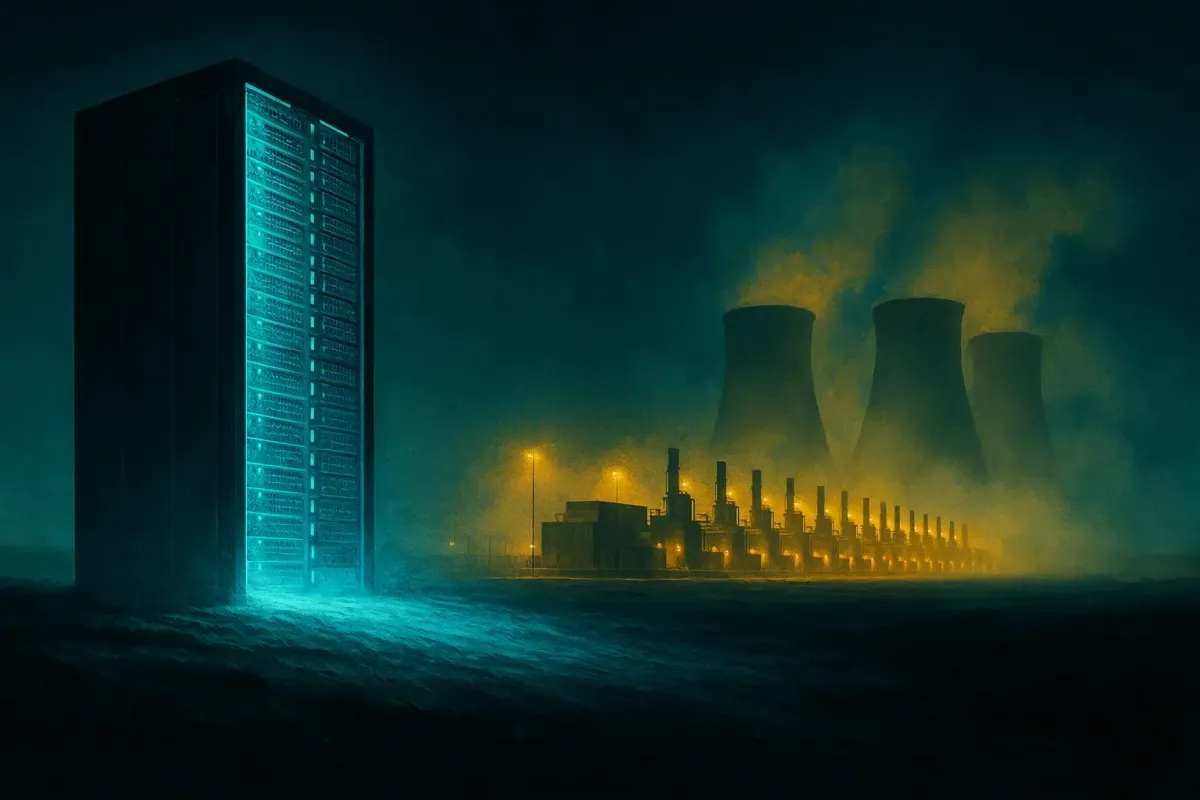
The nuclear deals are real. The arithmetic that makes them a solution to AI's power problem is not.
Here is the argument in one line: AI needs electricity in 2027, and almost every nuclear commitment announced to solve that problem delivers electricity in 2031 or later. The gap between those two dates is roughly four years, it will be filled with natural gas and grid congestion, and nobody announcing a reactor partnership is being especially clear about that.
This is an opinion piece. The numbers underneath it are not opinions.
What the demand curve actually says
The International Energy Agency's assessment is the least excitable one available, which is why it is worth starting there. Global data centre electricity demand is set to more than double by 2030 to around 945 terawatt-hours — more than Japan currently consumes in total. Demand from AI-optimized facilities specifically is projected to more than quadruple.
The composition shift matters more than the total. AI has accounted for something like 5 to 15 percent of data centre power in recent years. The IEA's projection puts it at 35 to 50 percent by 2030. Data centres are not just getting bigger; they are becoming a fundamentally different kind of electrical load — denser, less flexible, and concentrated in a handful of places.
In the United States, data centres are on course to account for almost half the growth in total electricity demand between now and 2030. Half. Of all growth. In an economy that also intends to electrify transport and heating in the same window.
Why nuclear became the answer
The appeal is easy to understand. A hyperscaler needs firm, carbon-free power that runs at high capacity factor and does not care about weather. That description fits nuclear and almost nothing else at the required scale. Solar plus storage is cheaper per megawatt-hour but needs land and hours of battery to serve a load that never dips.
So the deals came. Meta announced agreements with Vistra, TerraPower, Oklo and Constellation for up to 6.6 gigawatts of nuclear capacity in January — one of the largest corporate nuclear commitments in American history. Microsoft has committed to restarting Three Mile Island. Amazon contracted with Talen. Google signed with Kairos for small modular reactors. Across the sector, the big platforms have now put their names to more than ten gigawatts of possible new US nuclear capacity in about a year.
Every one of those announcements is genuine. Several involve real money moving now. None of them produce a meaningful electron before the end of this decade, and the small modular reactor projects — the ones doing the most rhetorical work in these announcements — are first-of-a-kind builds in a country that has not delivered a nuclear project on schedule in living memory.
The word doing the heaviest lifting in most of these press releases is "up to."
The four-year gap
Strip out the announcements and look at the schedule. The training and inference capacity being financed right now is being built now. It energises in 2027 and 2028. The restarts, if they go well, arrive around 2028. The new builds and SMR fleets arrive in the 2030s.
Something has to serve the load in between, and it is not going to be a reactor.
In practice it is three things. Natural gas turbines, which are being ordered at a pace that has pushed delivery lead times out for years. Existing grid capacity, which means data centres competing with everyone else for interconnection queue positions that already run five years deep in the worst regions. And behind-the-meter generation — the reason Crusoe built a $30 billion business out of stranded gas rather than waiting for a utility.
That third category is where the honest version of this industry's energy strategy currently lives. Not reactors. Turbines, fuel cells, and whatever can be sited fast on land the company already controls.
What I think is actually happening
The nuclear announcements are doing three jobs at once, and only one of them is about electricity.
The first is a hedge with a genuinely long horizon. If AI demand compounds the way these companies believe, they will need firm power in the 2030s and the queue for it forms now. That is rational and the deals should be read as real.
The second is regulatory positioning. A company that has publicly committed billions to carbon-free firm generation is a much more sympathetic applicant when it asks a state regulator for an interconnection or a gas plant permit. The reactor announcement buys goodwill that gets spent on the turbine.
The third is narrative management. "We are financing America's nuclear renaissance" is a materially better sentence than "our data centres will run on gas until 2031." Both can be true. Only one gets the press release.
I do not think this is cynical, exactly. I think it is what happens when an industry with quarterly capital cycles collides with an industry that measures projects in decades, and the shorter cycle writes the communications.
What would change my mind
Three things would make me wrong, and each is worth watching.
If a small modular reactor project delivers on cost and schedule — genuinely, not with a redefined baseline — the entire timeline compresses and the deals stop being hedges and start being infrastructure. That is a real possibility and the case for it is not stupid.
If efficiency improvements bend the demand curve harder than the IEA expects, the gap shrinks on its own. Inference cost per token has fallen steeply and repeatedly; the assumption that demand growth swamps efficiency gains is an assumption, not a law. Carbon Brief's work on putting data centre energy use in context is a useful corrective to the more breathless projections.
And if the AI capital cycle slows, the demand simply does not materialise, and the nuclear deals become expensive options on a future that arrived smaller than forecast. Given how much of the buildout is financed against backlog rather than revenue, that is not a remote scenario.
Longer term, the thing that resolves this is not on the current schedule at all. Fusion is the answer to the 2040s question, not the 2028 one.
The zoom-out
The useful discipline here is to separate the announcement from the delivery date, then ask what serves the load in between. Applied to AI's power problem, that question has an unglamorous answer that no company wants in a headline.
Firm, clean, cheap power at scale in four years does not exist as a product you can buy. What exists is gas that can be sited quickly, grid capacity someone else is also queuing for, and a set of nuclear commitments that will matter enormously in 2033 and not at all in 2028.
Watch what gets built, not what gets announced. The announcement is a decade out. The turbines are on order now.
Frequently Asked Questions
How much electricity will AI data centres use by 2030?
The International Energy Agency projects global data centre electricity demand will more than double by 2030 to roughly 945 terawatt-hours, exceeding Japan's current total consumption. AI-optimized facilities are expected to more than quadruple their demand, rising from 5–15 percent of data centre power today to 35–50 percent by 2030.
Can nuclear power supply AI data centres?
Eventually, yes — but not on the timeline AI capacity is being built. Restarts of existing plants may deliver around 2028, while new builds and small modular reactors are 2030s projects. Big tech has committed to more than ten gigawatts of potential US nuclear capacity, most of which energises after the current buildout needs it.
What will actually power AI data centres before 2030?
Primarily natural gas turbines, existing grid capacity, and behind-the-meter generation sited on land operators already control. Gas turbine order books have lengthened considerably, and interconnection queues in constrained regions run several years deep, which is pushing operators toward self-supply rather than utility service.
Which companies have signed nuclear deals for data centres?
Meta announced agreements with Vistra, TerraPower, Oklo and Constellation for up to 6.6 gigawatts. Microsoft committed to restarting Three Mile Island, Amazon contracted with Talen Energy, and Google signed with Kairos Power for small modular reactors. Collectively these exceed ten gigawatts of potential capacity.
Editor's note — sources: IEA, Energy and AI; American Public Power Association on the IEA findings; Meta Newsroom; Bulletin of the Atomic Scientists; Carbon Brief. This piece is analysis and argument; the projections cited belong to their sources, and the interpretation is ours.