
Castelion's $13 Billion Assembly Line
How a SpaceX-style bet on mass-producing hypersonic weapons pulled a $1 billion round from Wall Street and Silicon Valley at once.

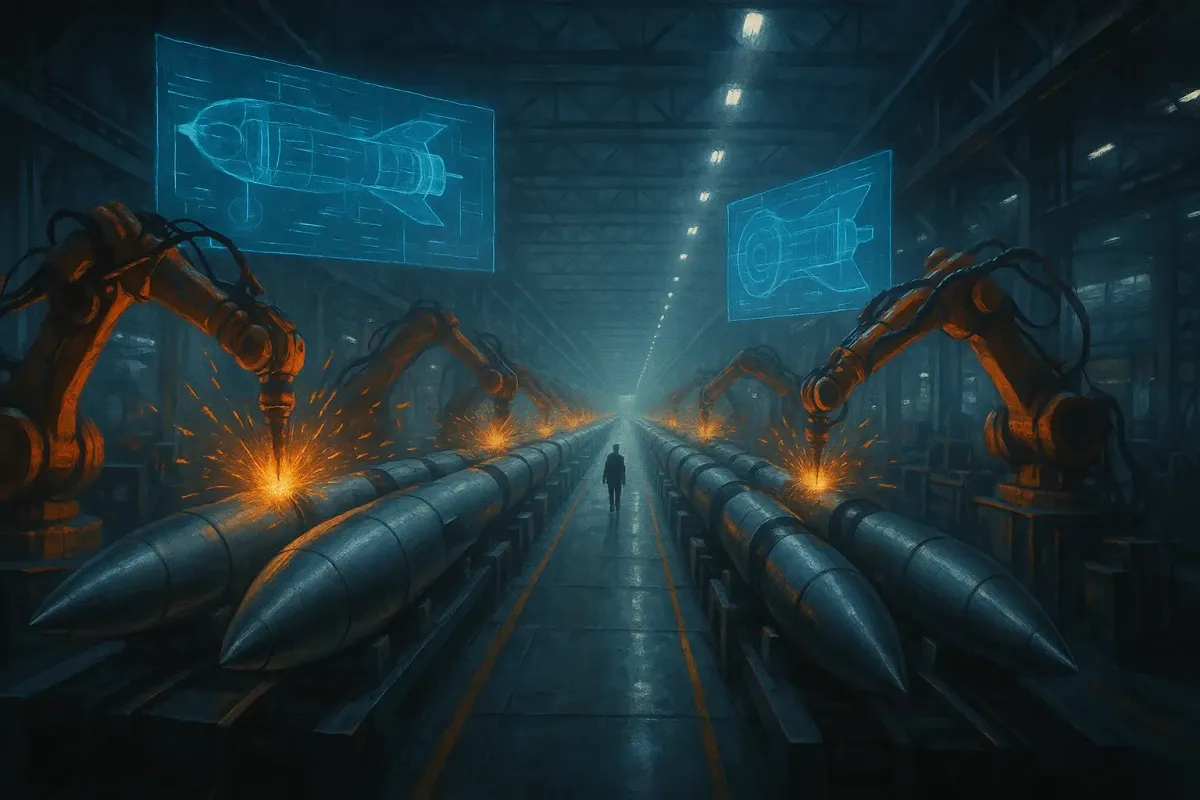
Defense used to be a business of a few enormous programs. Castelion is betting it becomes a business of factories — and investors just paid up for that idea.
The traditional defense contractor builds like a cathedral: slowly, expensively, one bespoke masterpiece at a time. Castelion, founded in 2022 by former SpaceX executives, wants to build like SpaceX — cheaper units, faster iteration, and a factory that treats a hypersonic missile less like a monument and more like a product coming off a line. On that promise, the company just raised $1 billion.
The Series C, announced August 19, values Castelion at $13 billion — a striking price for a company only three years old whose central weapon is still ramping into production. The structure tells you as much as the number: $800 million in equity plus a $250 million committed revolving credit facility, a mix that funds both the build-out and the working capital a real manufacturer needs. And the investor list reads like a truce between two worlds that rarely share a cap table.
Wall Street and the Valley on the same line
The round was co-led by Andreessen Horowitz, Carlyle, and JPMorgan Chase — a venture firm, a private-equity giant, and a bank, together — with Lightspeed Venture Partners, Lavrock Ventures, Altimeter, General Catalyst, Interlagos, and new investor T. Rowe Price also taking part, according to the company. That composition is the story beneath the story. Venture capital chases asymmetric upside; private equity and banks want durable cash flows and hard assets. When both show up for the same defense startup, it signals that they see two different things they like — explosive growth and a balance sheet backed by government demand.
The funds are aimed at scaling production of Blackbeard, Castelion's hypersonic strike missile, at its manufacturing complex in Sandoval County, New Mexico, while accelerating work on a longer-range precision weapon and defensive systems. The through-line from Castelion's earlier $350 million Series B is consistent: the pitch has always been low cost and high speed, the two variables legacy primes struggle most to move.
Why "mass-produce" is the whole thesis
Hypersonic weapons are hard for a reason. They fly at more than five times the speed of sound, endure brutal heat and stress, and demand exotic materials and controls. The instinct, therefore, is to build few and build carefully. Castelion's contrarian claim is that the way to win is to build many — to drive cost down through volume and iteration the way SpaceX drove down the price of reaching orbit, rather than treating each unit as an irreplaceable jewel.
This is where the AI-and-software story hides inside a hardware headline. The manufacturing philosophy Castelion inherited from SpaceX is software-defined and data-driven: rapid design cycles, heavy simulation, automation on the factory floor, and learning compounded across every unit produced. Modern autonomous and precision weapons are as much software and sensing as they are propulsion. A company that can iterate in software and manufacture at volume is running a different loop than a prime that ships a handful of hand-built systems a year. The bet investors are making is on that loop — that speed of iteration, applied to defense, produces the same kind of cost curve it produced in rockets.
There is a hard demand backdrop making the wager rational. Governments are rebuilding weapons stockpiles, hypersonics have become a headline priority, and the perception that traditional primes are too slow and too expensive has opened the door to challengers. Castelion is selling itself as the answer to a procurement system frustrated with cathedral economics.
The stakeholders
For the defense primes, Castelion is a warning shot. The incumbents' moat has long been scale, security clearances, and decades of program relationships. But if a three-year-old can attract $1 billion to out-manufacture them on cost and speed, the moat looks more like a habit. The primes are not going to be displaced quickly — defense procurement moves at the pace of institutions — but the premium the market just placed on "builds fast and cheap" is a repudiation of "builds slow and gold-plated."
For investors, the appeal is a rare combination in venture: a startup with a genuinely large, government-backed addressable market and tangible assets to underwrite. That is why a bank and a PE firm were comfortable next to venture money. The risk is equally real — defense revenue depends on program wins, budgets, and politics, and a $13 billion valuation prices in years of flawless execution on a weapon still scaling into volume.
For the government buyer, more competition on hypersonics is, in principle, good news: lower unit costs and faster delivery. The catch is dependence on an unproven manufacturer for a strategic capability. Betting national security on a startup's ability to hit a production curve is its own kind of risk, however attractive the price.
The lesson for builders
Castelion's raise is the clearest sign yet that the "manufacture it like software, at scale" playbook has jumped the fence from consumer hardware and rockets into the most guarded corner of industry. The lesson is not about missiles. It is that in sectors long defined by bespoke, low-volume, high-cost production, the disruptive move is to reframe the product as something you can build repeatedly and improve continuously — and to let software, simulation, and automation compound the advantage.
Capital is now willing to underwrite that reframing even in defense, even at eye-watering valuations, even before the factory has proven it can hit the number. When investors pay a premium for a company's assembly line rather than its prototype, they are betting on the process, not the product. Castelion's task now is to prove the line runs as fast as the pitch deck promised.
Frequently Asked Questions
How much did Castelion raise and at what valuation?
Castelion raised a $1 billion Series C at a $13 billion valuation, announced August 19, 2026. The round comprised $800 million in equity and a $250 million committed revolving credit facility, according to TechCrunch and SpaceNews.
Who invested in Castelion's Series C?
The round was co-led by Andreessen Horowitz, Carlyle, and JPMorgan Chase, with participation from Lightspeed Venture Partners, Lavrock Ventures, Altimeter, General Catalyst, Interlagos, and new investor T. Rowe Price, according to the company's announcement.
What does Castelion make?
Castelion, founded in 2022 by former SpaceX executives, develops low-cost hypersonic weapons. Its funding will scale production of Blackbeard, a hypersonic strike missile, at its manufacturing complex in Sandoval County, New Mexico, and accelerate work on a longer-range precision weapon and defensive systems.
Why is Castelion's manufacturing approach significant?
Castelion applies a SpaceX-style, software-defined manufacturing model — rapid iteration, simulation, and volume production — to weapons that are traditionally built in small, expensive batches. Investors are betting that this approach can drive down unit costs and delivery times in a defense market frustrated with slow, costly incumbents.
Editor's note — sources: TechCrunch (valuation, date); SpaceNews (round structure); Castelion via PR Newswire (investors, Blackbeard, facility); TechCrunch, 2025 (prior Series B). All figures attributed to these sources; no quotes exceed 15 words.