
Riot Platforms' $9.1 Billion AI Pivot
How a bitcoin miner's $9.1 billion lease to Anthropic reveals that the scarcest resource in AI isn't chips or talent — it's grid-connected power.

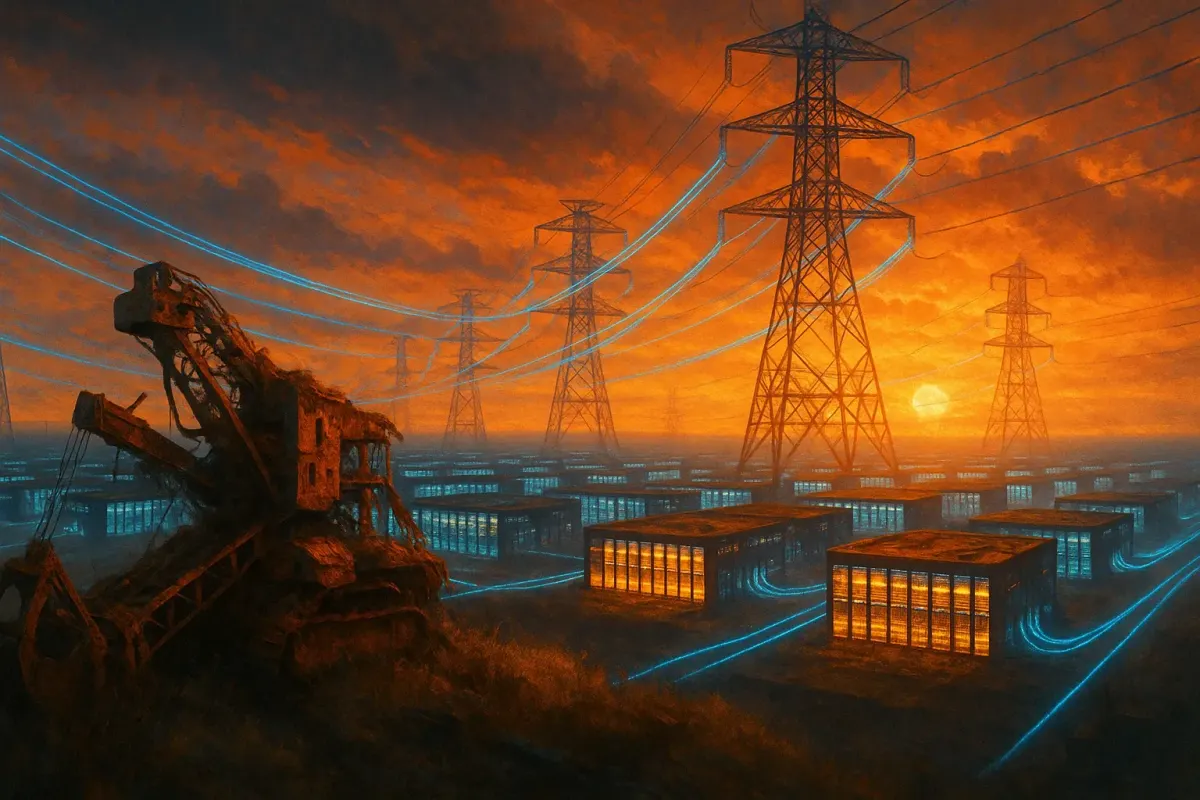
How a bitcoin miner's $9.1 billion lease to Anthropic reveals that the scarcest resource in AI isn't chips or talent — it's grid-connected power.
Riot Platforms spent years turning cheap electricity into bitcoin. This week it signed a 20-year deal to turn the same electricity into AI — and the market rewarded the pivot with a 17% jump.
On August 11, Riot Platforms disclosed a 20-year agreement to lease 191 megawatts of capacity at its Rockdale, Texas campus, a deal CNBC valued at $9.1 billion. Riot did not name the tenant. Bloomberg, citing people familiar with the matter, reported it was Anthropic. Whoever the customer, the structure of the deal is the story: a company built to mine cryptocurrency has become, functionally, an AI infrastructure landlord — and its stock soared roughly 17% on the news, according to 24/7 Wall St., dragging peer miners up with it.
The reason a lease made a miner's shares jump is the same reason this deal matters beyond Riot: in the physical economy of AI, the binding constraint is no longer silicon. It's power you can actually plug into.
What the Riot–Anthropic deal contains
The terms are specific. The lease covers 191 MW at Rockdale over an initial 20 years, with two five-year extension options that would push the total potential contract value to $16.5 billion if both are exercised, per DataCenterDynamics. The capacity comes online in stages: about 96 MW is expected to go live in December 2027, with full deployment slated for June 2028.
Set that against Riot's recent trajectory. In just over six months, the company has signed leases totaling 241 MW — roughly $9.8 billion of long-term, contracted revenue — across two of the AI ecosystem's most consequential customers, Yahoo Finance noted in its coverage. The other tenant is chipmaker AMD, under an earlier agreement worth up to about $1 billion in potential revenue.
Read the numbers together and the transformation is unmistakable. A firm whose income once rose and fell with the price of bitcoin has swapped a volatile commodity for two decades of contracted cash flow from an AI lab desperate for capacity.
Why power became the bottleneck
For most of the AI buildout, the public narrative fixated on GPUs. Who could get Nvidia's latest chips, and how many. But a chip does nothing without a place to run it, and running tens of thousands of high-density accelerators requires an enormous, uninterrupted supply of electricity delivered to a specific patch of ground with the right grid interconnection, cooling, and permits.
That combination — power, land, and an interconnection agreement with a utility — takes years to assemble and cannot be conjured with capital alone. This is what bitcoin miners happen to already own. They spent the last decade acquiring cheap-power sites, negotiating grid connections, and building the electrical infrastructure to run hardware around the clock. Those assets, built for one purpose, turned out to be exactly what AI labs now need and cannot quickly build themselves.
So the miners are converting. Riot's deal gives Anthropic access to scarce, grid-connected power on a timeline it could not match by breaking ground on its own. For Anthropic, the lease is a hedge against the single input most likely to cap its growth. Locking in 191 MW two decades out is a statement that the company expects its compute appetite to keep climbing — and that securing the electricity to feed it is worth a 20-year commitment.
The stakeholders
For Riot, the pivot rewrites the business. Bitcoin mining is a margin machine when prices are high and a liability when they aren't; its cash flows swing with a market Riot doesn't control. A 20-year power lease to a creditworthy AI tenant replaces that volatility with something bankers love: predictable, contracted, long-duration revenue. That is why the stock jumped — investors are repricing Riot from a leveraged bet on crypto to an infrastructure company with an annuity. The risk is execution and concentration: Riot must deliver hundreds of megawatts on schedule, and it is now heavily exposed to the fortunes of a small number of large AI customers.
For Anthropic, the lease is a supply-chain move, not a real-estate one. The company is racing to secure the physical capacity to train and serve ever-larger models, and power is the input most likely to constrain it. Committing to 191 MW for 20 years signals conviction about long-run demand — and a willingness to trade flexibility for certainty of supply. The bet loses only if AI compute demand or Anthropic's own trajectory falls dramatically short of what a two-decade lease implies.
For the AI industry, the deal is a marker of how far the constraint has migrated down the stack. The competition is no longer just for chips and researchers; it's for megawatts and the sites that can host them. Whoever controls grid-connected power controls a chokepoint on AI's growth, and that control is now a strategic asset that trades at a premium.
For the crypto-mining sector, Riot is a template. Peers like the ones that rallied alongside it are sitting on the same latent asset — power infrastructure that can be repurposed for AI — and the market is signaling it will pay more for contracted AI revenue than for bitcoin exposure. Expect more miners to follow the money out of hashing and into hosting.
What to take from it
The first lesson is that scarcity in AI keeps moving, and the winners are whoever owns the current bottleneck. It was data, then chips, and now increasingly power and the land and grid access to use it. The strategic question for any AI-adjacent business is which constraint will bind next — and whether you own an asset that sits astride it.
The second is that unglamorous, physical assets can be worth more than they look when a new demand curve arrives. Riot's value wasn't in bitcoin; it was in the electrical infrastructure underneath the mining. The AI boom didn't just create demand for algorithms — it created demand for the industrial base that powers them. In a gold rush, sometimes the most valuable thing you own is the river.
The zoom-out
It's tempting to read AI as a purely digital phenomenon — models, tokens, benchmarks. The Riot–Anthropic deal is a reminder that it runs on a stubbornly physical foundation of electricity, land, transformers, and cooling, all of which take years and permits to build. Capital is abundant; grid-connected power is not.
That mismatch is reshaping who holds leverage. The companies that quietly assembled power and interconnection over the last decade now find themselves holding the scarcest input in the most capital-hungry technology race of the era. For builders and investors, the signal is clear: follow the constraint, not the hype. The next durable AI franchise may not be a lab or a chipmaker at all — it may be whoever owns the electricity.
Frequently Asked Questions
What did Riot Platforms and Anthropic agree to?
On August 11, 2026, Riot Platforms disclosed a 20-year lease for 191 megawatts of capacity at its Rockdale, Texas campus, reported at $9.1 billion. Riot did not publicly name the tenant, but Bloomberg reported it was Anthropic. With two five-year extension options, the total potential value reaches $16.5 billion.
Why is a bitcoin miner leasing capacity to an AI company?
Bitcoin miners spent years acquiring cheap-power sites and grid interconnections to run hardware around the clock. Those assets are exactly what AI companies need and can't quickly build. By leasing capacity to an AI tenant, Riot swaps volatile crypto-linked income for long-term, contracted revenue.
When does the capacity come online?
According to reports, about 96 MW is expected to go live in December 2027, with full deployment of the 191 MW slated for June 2028. The initial lease term runs 20 years, with two optional five-year extensions.
Why did Riot's stock rise on the news?
Riot's shares jumped roughly 17% because the deal transforms its financial profile from a volatile bet on bitcoin prices into a company with predictable, long-duration contracted revenue from a major AI customer — a profile investors value more highly. Peer miners with similar power assets rose alongside it.
Editor's note — sources: CNBC; DataCenterDynamics; Yahoo Finance; 24/7 Wall St..