
Top 7 API Testing Tools for Developers in 2026
Postman, Insomnia, Bruno, Hoppscotch, SmartBear ReadyAPI, Apidog and Karate - the seven best API testing tools in 2026, ranked by breadth, licensing and real pricing, with honest pros and cons for each.


The best API testing tools in 2026 are Postman for all-in-one teams, SmartBear ReadyAPI for enterprise functional, security and load testing, and lightweight open-source clients — Insomnia, Hoppscotch and Bruno — for developers who want local-first workflows without a forced login. Apidog bundles API design, testing, mocking and docs for less than Postman, and Karate is the strongest code-first framework for API, contract and load testing in CI. Below we rank seven API testing tools by maturity, adoption, breadth and fit, with real pricing, licenses and honest trade-offs for each.
TL;DR
- Postman is still the broadest platform — design, mock, monitor, load — but its free plan is now one user and teams pay $19/user/mo (annual). Repeated pricing changes keep pushing people to alternatives.
- Three serious open-source clients now cover most REST/GraphQL work: Insomnia (Apache-2.0), Hoppscotch (MIT, ~80k GitHub stars) and Bruno (MIT, Git-native, fully offline). None forces a cloud account.
- SmartBear ReadyAPI is the deepest enterprise suite — functional, security and load testing plus service virtualization — but pricing is quote-only.
- Best value goes to Apidog (design + test + mock + docs in one, priced below Postman); for CI-native testing in code, pick Karate.
How we picked these
We ranked on the things that decide whether a tool survives in a real workflow, not on brand familiarity.
- Breadth across the API lifecycle: design, client, mocking, monitoring, functional, load and security testing.
- Protocol coverage: REST and GraphQL are table stakes; gRPC, WebSocket, SOAP and SSE separate the serious tools.
- Deployment and licensing: open source vs proprietary, offline vs cloud-only, self-hostable vs SaaS.
- Real, published pricing — stated where the vendor publishes it, flagged as quote-only where it doesn't.
- CI/CD fit (a usable CLI) and current maintenance.
We did not rank alphabetically, and we take no payment for placement. All pricing and feature claims are as of November 2026.
Quick comparison
| Tool | Best for | Deployment | Pricing (Nov 2026) |
|---|---|---|---|
| Postman | End-to-end API platform for teams | Proprietary, cloud-first SaaS | Free (1 user); Team $19/user/mo |
| SmartBear ReadyAPI | Enterprise functional + security + load | Proprietary desktop/server | Quote-only |
| Insomnia | Open-source client, Kong environments | Apache-2.0 desktop app | Free; Pro $12/user/mo |
| Hoppscotch | Lightweight, browser-based, self-host | MIT, SaaS + self-hosted | Free; Enterprise on request |
| Bruno | Git-native, offline, privacy-first | MIT desktop app | Free; paid Golden/Enterprise |
| Apidog | Affordable all-in-one alternative | Proprietary freemium SaaS | Freemium, per-seat |
| Karate | Code-first API + contract + load in CI | MIT framework (JVM) | Free; commercial tooling on request |
1. Postman
Postman is the most complete API platform and the default for collaborative teams. It covers the full lifecycle: API design against OpenAPI, a request client, mock servers, monitors, functional and data-driven tests, Flows, and load testing. Protocol support is the widest here — HTTP/REST, SOAP, GraphQL, gRPC, WebSocket and MQTT — with tests scripted in JavaScript through the pm.* sandbox and run in CI via the Postman CLI or Newman. In 2025 Postman added an AI Agent Builder and MCP server tooling, pushing further into agent workflows.
The catch is cost and weight. The free plan is now a single user, and repeated pricing tightening since 2024 is exactly why many teams started shopping for alternatives.
Best for: Teams that want one end-to-end API platform.
Pros: - Broadest feature set of any tool here, from design to load testing. - Largest ecosystem, integrations and template library. - Strong collaboration and governance (workspaces, RBAC, API catalog).
Cons: - Cloud-first and account-centric; telemetry and login are hard to avoid. - Free plan capped at one user, and pricing has crept up repeatedly. - Can feel heavy for simple REST testing.
2. SmartBear ReadyAPI / SoapUI
SmartBear ReadyAPI is the deepest dedicated testing suite on this list. It splits into functional testing (REST, SOAP, Kafka, JDBC, JMS), security testing (SQL injection, fuzzing, XSS scans), performance and load testing, and service virtualization for mocking dependencies. SoapUI, the free open-source predecessor, is still the go-to for SOAP and legacy services. Tests are scripted in Groovy, and the suite has mature CI/CD and data-driven testing.
This is enterprise tooling, with the trade-offs that implies: the UI is dated, it is Windows-centric, and SmartBear does not publish ReadyAPI prices — you contact sales. SmartBear is owned by Francisco Partners with investment from Vista Equity Partners.
Best for: Enterprises that need SOAP, security and load testing in one suite.
Pros: - Most complete testing depth — functional, security, load and virtualization together. - Best-in-class for SOAP and regulated, legacy-heavy environments. - Mature CI/CD and data-driven testing.
Cons: - Pricing is quote-only; third-party figures circulate but are not vendor-published. - Heavyweight, dated UX, Windows-centric. - Overkill for solo developers and modern REST-only shops.
3. Insomnia
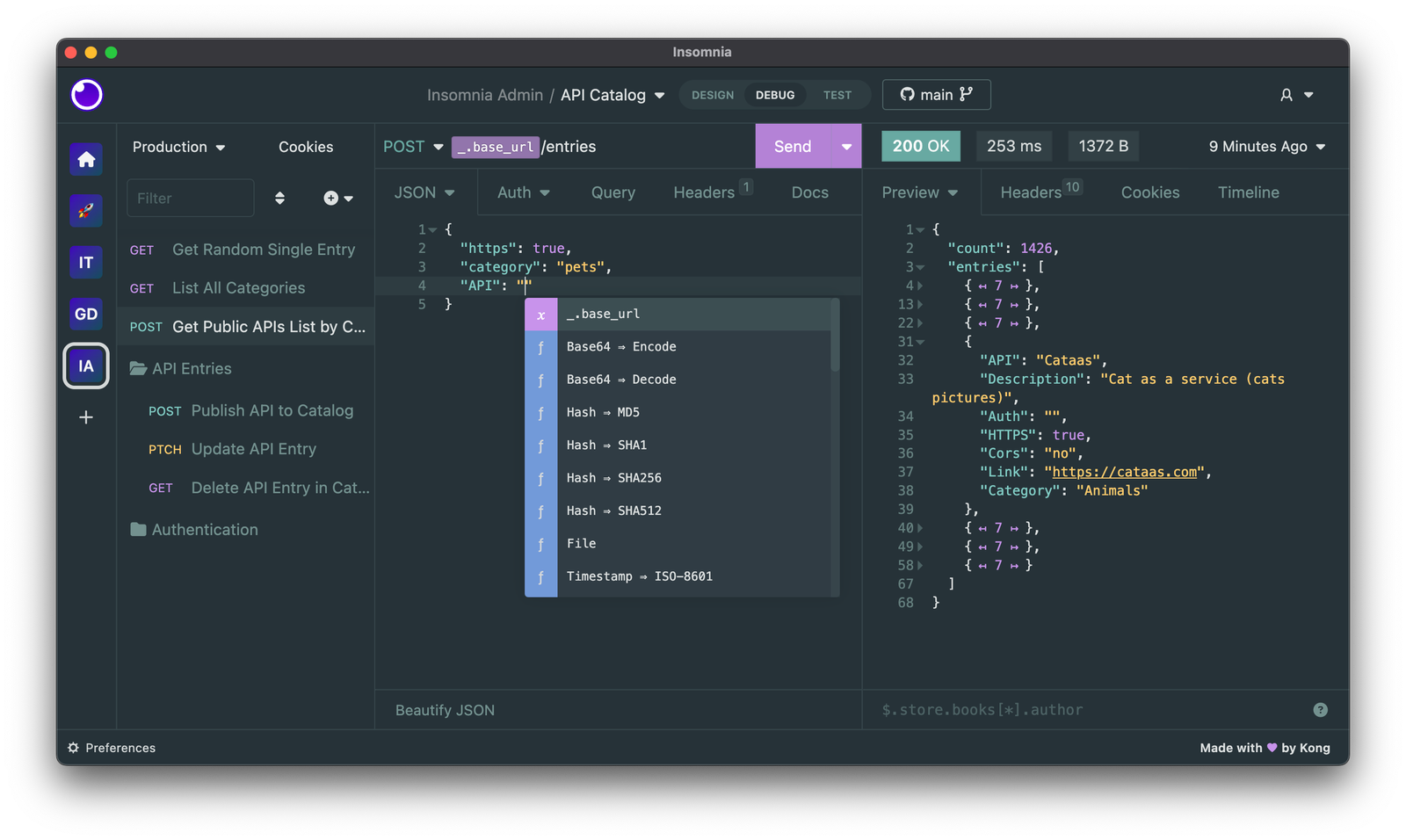
Insomnia is the leading open-source API client and the natural pick inside Kong environments. It is licensed Apache-2.0, runs as a desktop app on Mac, Windows and Linux, and handles REST, GraphQL, gRPC, WebSockets and SSE. It includes OpenAPI design, test suites and the Inso CLI for CI, with Git-sync and local-only projects for teams that want to keep data off the cloud.
Insomnia lost trust in 2023 when version 8.0 forced a cloud login and some users reported losing local data. Kong, which has owned Insomnia since 2019, reversed course: local-only projects returned in 8.3, and later releases removed forced login and added a local vault. The reputation hit lingers, but the product recovered.
Best for: Developers who want an open-source client, especially with Kong.
Pros: - Genuinely open source under Apache-2.0. - Lighter and cleaner than Postman, with broad protocol coverage. - Git-sync and local-only projects for privacy-conscious teams.
Cons: - The 2023 forced-login episode still colors trust for some users. - Kong steers users toward its paid cloud tier. - Smaller ecosystem than Postman.
4. Hoppscotch
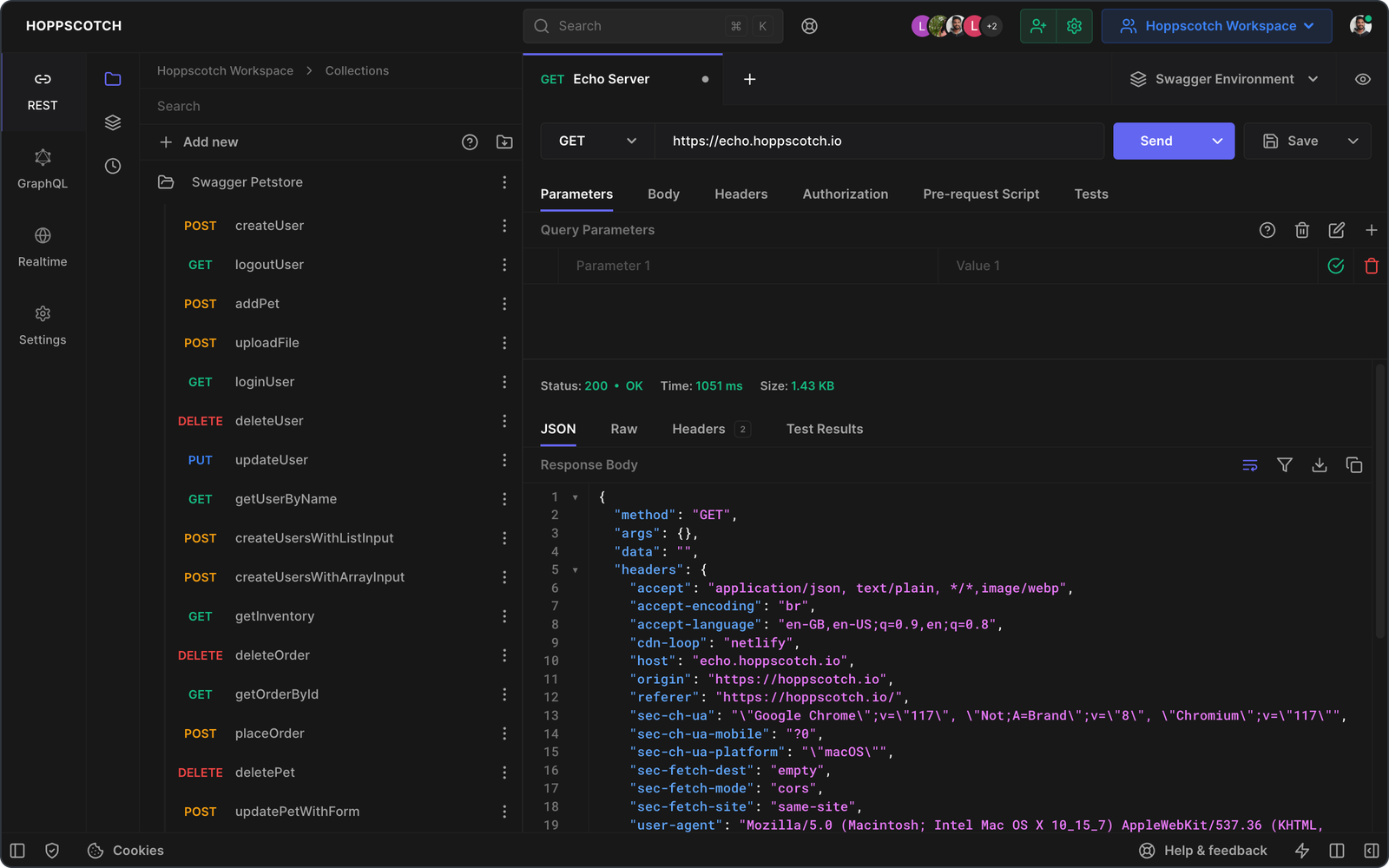
Hoppscotch is a fast, lightweight, open-source API client that runs in the browser as well as on the desktop. It is MIT-licensed with roughly 80,000 GitHub stars, and it is strong on realtime protocols: HTTP/REST, GraphQL, WebSocket, SSE, Socket.IO and MQTT. Notably, it does not support gRPC. The backend is self-hostable through a free Community Edition, with a paid Enterprise Edition for teams that self-host at scale.
For developers who just want to fire requests quickly without installing a heavy client, Hoppscotch is hard to beat. It trades away some depth — mocking and test-automation features are thinner than Postman or ReadyAPI.
Best for: Fast, free, browser-based testing and self-hosters.
Pros: - Extremely lightweight and fast; works in the browser. - MIT-licensed and self-hostable. - Strong realtime protocol support (WebSocket, SSE, MQTT, Socket.IO).
Cons: - No gRPC support. - Thinner mocking and test-automation depth than the heavyweights. - Enterprise Edition pricing is quote-only.
5. Bruno
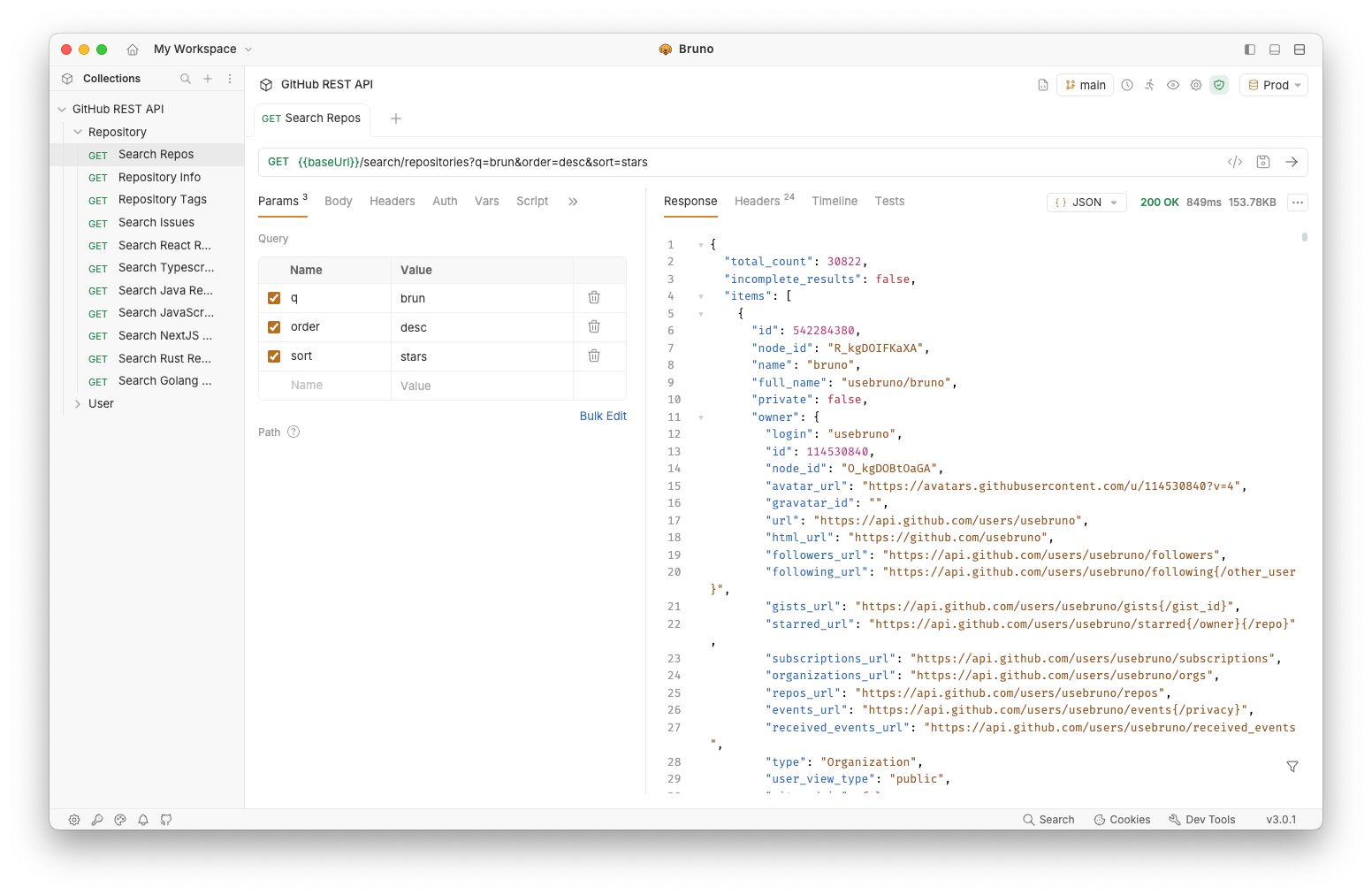
Bruno is the fastest-rising Postman alternative, built on a simple idea: store API collections as plain-text .bru files in a local folder you can version with Git. It is MIT-licensed, fully offline, and needs no account — a direct answer to the forced-login complaints that hit Postman and Insomnia. A CLI and Docker images handle CI, and it covers REST, GraphQL and OpenAPI, with JavaScript scripting.
Being younger shows. gRPC, load testing, monitoring and mocking are weaker or still emerging, and some collaboration features sit behind a paid Golden Edition (a one-time purchase) or Bruno Enterprise. For teams that review API changes in pull requests, the plain-text model is a real advantage.
Best for: Developers who want Git-versioned, offline API collections.
Pros: - Truly offline and plain-text, so collections review cleanly in Git. - MIT-licensed with no telemetry or login pressure. - Lightweight and growing fast.
Cons: - Narrower protocol and feature set than Postman (weaker gRPC, load, mocking). - Smaller ecosystem and integrations. - Some collaboration features require a paid edition.
6. Apidog
Apidog is an all-in-one platform that folds API design, debugging, automated testing, a mock server and documentation generation into a single tool, positioned explicitly as a cheaper Postman alternative. It supports REST, SOAP, GraphQL, WebSocket, gRPC and SSE, with no-code and scriptable tests and a CLI for CI. An on-premises Enterprise option (Docker/Kubernetes, air-gapped) is available for teams with data-residency requirements.
Apidog publishes per-seat pricing that sits below Postman, with a free tier for small teams. Two caveats: it is closed-source, and the core team is based in China, which draws data-residency scrutiny from some enterprises. Treat its self-published comparison benchmarks with the usual skepticism.
Best for: Teams wanting an affordable design-plus-test-plus-docs alternative.
Pros: - Design, testing, mocking and docs integrated in one tool. - Published per-seat pricing below Postman, with a free tier. - On-premises, air-gapped option for regulated teams.
Cons: - Closed-source; China-based team raises data-residency questions for some. - Smaller ecosystem and community than Postman. - Self-published benchmarks should be read with caution.
7. Karate
Karate is the strongest code-first choice: an open-source, MIT-licensed framework that combines API testing, mocks, contract testing and performance testing (via Gatling) behind a readable Gherkin-style DSL, with no Java coding required despite running on the JVM. It is CI-native, supports parallel execution, and handles REST, SOAP and GraphQL. Karate Labs, which maintains the open-source project, also sells commercial IDE and cloud tooling.
Karate is a framework, not a GUI client, so there is no point-and-click window for ad-hoc exploration — you write tests. For developers and SDETs who want API, contract and load testing to live in the same repo as their code, that is the point.
Best for: Developers and SDETs who want code-first API, contract and load testing.
Pros: - Purpose-built for API testing — functional, contract, mocks and load in one. - MIT-licensed, CI-native, no cloud lock-in. - Readable DSL with built-in parallelism.
Cons: - JVM dependency and a smaller ecosystem than Postman. - No GUI client for ad-hoc requests. - Smaller community and commercial-support footprint.
How to choose
Match the tool to how your team works, not to a leaderboard.
- Solo developer or small team: Start with an open-source client — Hoppscotch for speed in the browser, Bruno if you want Git-versioned collections offline, Insomnia if you live in the Kong ecosystem. All are free and avoid forced logins.
- Collaborative API-first team: Postman still wins on breadth and collaboration if you can absorb the per-seat cost; Apidog is the value alternative when design, docs and mocking matter and budget is tight.
- Enterprise with SOAP, security or load requirements: SmartBear ReadyAPI is the deepest suite, with SoapUI for free SOAP work. Budget for quote-only pricing.
- CI-first, test-as-code shop: Karate keeps API, contract and load tests in your repository and your pipeline.
If privacy and data residency drive the decision, the open-source, offline tools — Bruno, Hoppscotch and Insomnia's local-only mode — are the safest defaults.
Frequently Asked Questions
What are API testing tools?
API testing tools send requests to an application's API and check the responses, letting you verify that endpoints return the right data, status codes and performance under load. They range from GUI clients like Postman and Insomnia to code-first frameworks like Karate, and often add mocking, documentation and CI integration on top of raw request testing.
What is the best tool for API testing?
There is no single best tool; it depends on your team. Postman is the most capable all-rounder for collaborative teams, SmartBear ReadyAPI is deepest for enterprise functional, security and load testing, and Hoppscotch, Bruno and Insomnia are the best free, open-source clients for individual developers who want a lightweight, local-first workflow.
What is the best open-source API testing tool?
For a GUI client, Hoppscotch (MIT, ~80k GitHub stars), Bruno (MIT, Git-native and offline) and Insomnia (Apache-2.0) are the leading open-source options. For code-first testing in CI, Karate (MIT) is the strongest open-source framework, covering functional, contract and load testing. SoapUI remains the open-source standard for SOAP.
Is Postman free?
Postman has a free plan, but as of November 2026 it is limited to a single user. Paid plans start at $9/month for the Solo tier and $19/user/month for Team (billed annually), with custom Enterprise pricing. The free-plan tightening since 2024 is a common reason teams evaluate Bruno, Hoppscotch and Apidog.
What's the difference between API testing and load testing?
API testing verifies that an API behaves correctly — right data, status codes and error handling. Load testing measures how it performs under concurrent traffic, checking latency and failure rates at scale. Several tools here do both: Postman, ReadyAPI and Karate (via Gatling) include performance testing alongside functional checks, while lightweight clients focus on correctness.