
Cloudflare's Browser for Machines
How Kitesurf, an agent-first browser built in Rust, resets the unit economics of letting AI read the web.

A browser that is slower per page and up to seven times cheaper to run is a bad deal for humans and an obvious one for agents.
Every AI agent that browses the web today is driving a car built for someone else. Chromium was designed for a human being with eyes, a mouse, and patience — it paints pixels, runs animations, honors fonts, and holds an entire rendering pipeline in memory so a person can look at it. An agent scraping a product page needs almost none of that. It needs the text, the structure, and occasionally a screenshot. Everything else is overhead billed by the gigabyte.
Cloudflare's answer is to stop paying for it. On August 6 the company introduced Kitesurf, a stateless browser written from scratch in Rust, compiled to WebAssembly, and running inside the same V8 isolates that power Cloudflare Workers. It is free during beta. And according to Cloudflare's own numbers, it uses three to seven times less CPU and memory than Chromium on the tasks agents actually perform — screenshots and HTML extraction.
That ratio is the whole story. Not the Rust, not the WebAssembly, not the clever reuse of Firefox's CSS engine. The ratio.
What Cloudflare actually shipped
Kitesurf is an agent-first browser — a rendering engine with no interface, no tabs, no extensions, no profile, and no memory of the last session. It lives on Browser Run, Cloudflare's browser automation product, and it does not replace the existing Chromium option. It sits beside it as a second engine you can select per request.
The switch is deliberately trivial. Existing Puppeteer, Playwright, and Model Context Protocol clients keep working; you append browser=kitesurf to any Browser Run CDP or Quick Action endpoint and the request routes to the new engine instead. There is a public playground for anyone who wants to poke at it without writing code. Cloudflare built the thing out of parts rather than from nothing: as the engineering post explains, it combines a modular rendering engine derived from Blitz, Firefox's Stylo CSS parser, and Boa, a Rust ECMAScript engine, with rendering split across separate Workers that talk over Cloudflare's built-in RPC system.
The tradeoff is honest and Cloudflare does not hide it. Kitesurf is slower per page than Chromium. Cloudflare published medians from five Browser Run quick-action runs across a 14-URL corpus, and the shape of the result is unambiguous:
| Metric | Kitesurf | Chromium (warm pool) | Kitesurf, relative |
|---|---|---|---|
| CPU: screenshot | 380 ms | 1,173 ms | 3.1× less CPU |
| CPU: HTML extraction | 229 ms | 877 ms | 3.8× less CPU |
| Memory: screenshot | 57.8 MiB | 271.0 MiB | 4.7× less memory |
| Memory: HTML extraction | 39.4 MiB | 273.7 MiB | 7.0× less memory |
| Wall time: screenshot | 1,148 ms | 637 ms | 1.8× slower |
| Wall time: HTML extraction | 820 ms | 472 ms | 1.7× slower |
Chromium wins the stopwatch, and Cloudflare explains why plainly: a just-in-time compiler that has already seen a page beats a cold software renderer, with most of the remaining gap in rasterization and image encoding. Kitesurf wins on the two lines that show up on an invoice. TechCrunch's account of the launch framed the same tradeoff: cheaper per session, lighter on RAM, individual pages back later.
For a human, that trade is terrible. Nobody wants a browser that takes twice as long to load a page. For a fleet of agents doing ten thousand concurrent lookups, it is close to free money.
Why the economics flipped
Headless Chromium at scale is one of the quieter cost centers in agentic infrastructure, and it belongs to the same category of expense as the shift in AI spending from training to inference — costs that scale with usage rather than with ambition. Every session spins up a process with a full DOM, a layout engine, a JavaScript runtime, a compositor, and a graphics stack. Memory footprints run to hundreds of megabytes per instance. Providers who rent browser sessions price accordingly, and companies building web-browsing agents discover the bill somewhere between the prototype and the production rollout.
Cloudflare's insight is that the isolate model it already uses for Workers — thousands of lightweight execution contexts inside a single process, rather than one process per tenant — applies just as well to browsing, provided you are willing to throw away the parts of a browser that exist for human comfort. There is no compositor because nobody is watching. There is no extension API because no one is installing an ad blocker. The engine renders enough to produce a faithful DOM and, when asked, an image.
This is a familiar pattern in infrastructure, and it usually wins. You take a general-purpose tool that was optimized for a workload that no longer dominates, strip it to the subset the new workload needs, and accept a worse result on the old axis in exchange for a dramatically better one on the new. It is how purpose-built inference silicon has eaten into general-purpose GPUs, and how columnar stores displaced row stores for analytics. The question is never whether the specialized thing is better in the abstract. It is whether the new workload is now large enough to justify its own hardware — or in this case, its own browser.
Cloudflare is betting that agent traffic has crossed that line.
Who this lands on
For companies building browsing agents, the calculus changes at the margin, not the center. If your agent does a handful of careful, latency-sensitive page loads — a live booking flow, a checkout, anything where a user is waiting — Chromium's speed advantage still matters and Kitesurf's slower wall-clock hurts. If your agent does bulk work — monitoring, extraction, crawling, research, comparison — the memory ratio dominates and the latency penalty is invisible. Most agent workloads today are the second kind. That is not permanent.
For Browser Run's competitors, this is a pricing problem disguised as a technical announcement. Browserbase, Steel, and the rest of the hosted-browser market largely sell managed Chromium. If Cloudflare can serve a comparable job at a fraction of the compute, the floor on what browser sessions can cost drops — and it drops for a company that already owns the network the traffic runs over. Cloudflare has run this play before, attaching a commodity primitive to its edge and pricing it aggressively enough that standalone vendors have to justify a premium. Free-during-beta is not a promotion. It is a range-finding exercise.
For website operators, the implication is uncomfortable and mostly unspoken. Making agent browsing three to seven times cheaper makes agent browsing more common. Cloudflare sits on both sides of this: it sells the bot-management products publishers use to keep automated traffic out, and it is now selling a cheaper way to generate that traffic. The company has spent the past two years building toward brokering that relationship rather than picking a side — its pay-per-crawl work and its interest in agent payment rails both point at metered access rather than blocking, which is the same direction Google has been edging toward with publishers. Whether publishers read that as mediation or as a landlord renting to both tenants will depend on what the rates look like when the beta ends.
For Cloudflare itself, Kitesurf is strategically cheap and optionally enormous. It reuses the Workers runtime the company has spent a decade hardening. It gives developers a reason to route agent traffic through Cloudflare rather than around it. And if agent browsing becomes as routine as API calls, owning the engine that renders the page is a genuinely good place to be standing.
What it does not solve
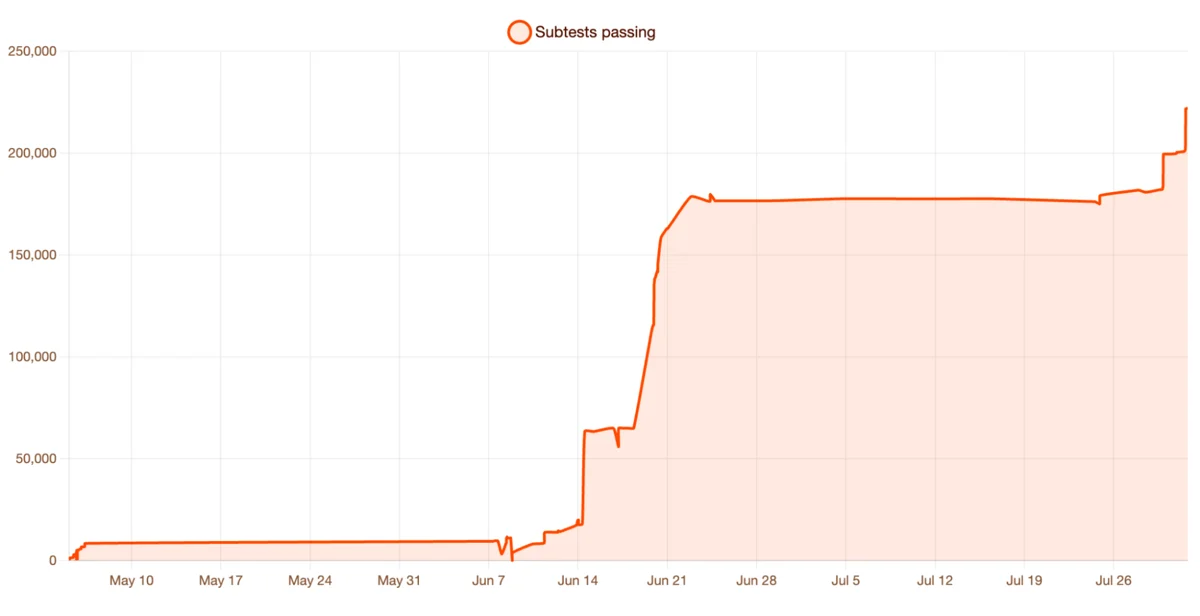
A browser engine built from parts is a browser engine with gaps. Cloudflare says Kitesurf passes around 215,000 web platform tests and is adding hundreds every week — a real number, and also a reminder that web compatibility is measured in hundreds of thousands of tests for a reason. The company notes that the areas agents lean on hardest (CSS, DOM, HTML, selection, SVG, XHR) already have good coverage. Sites that depend on exotic JavaScript or aggressive anti-automation will find the seams faster than a static article page will.
Cloudflare also concedes an inelegance in the design: JavaScript eval is handled by running Boa, a Rust ECMAScript engine, on top of the Workers runtime. Running a runtime inside a runtime is not optimal, as the company says outright, and the plan is to drop it once Workers supports eval natively.
The bet is that this does not matter much for the median agent task, and that the gaps close over time the way they always do. That is probably right. But "probably right, eventually" is exactly the kind of claim that looks different when your agent silently returns a blank page on the one site your business depends on. Teams adopting this should measure per-site, not in aggregate.
There is also a quieter question about what a browser is when nobody looks at it. A human browser is a security boundary as much as a renderer — the sandbox exists because the person on the other side can be tricked. An agent browser inherits every one of those threats and adds a new one: the content it loads can contain instructions aimed at the model reading it. Kitesurf's statelessness helps here, since there is no session to hijack and nothing persists between requests. It does not address prompt injection, which is a model problem, not a rendering one — and which has produced its own category of startups selling containment.
The zoom-out
The interesting thing about Kitesurf is not that Cloudflare built a browser. It is what building it assumes.
For thirty years, the browser was the most contested piece of software on earth because it was where humans met the internet. Every fight — Netscape and Internet Explorer, WebKit and Blink, the standards wars, the extension ecosystems, the default-search deals worth tens of billions — was a fight over human attention routed through a rendering engine. The engine mattered because the eyeballs did.
Kitesurf assumes a web where a large and growing share of requests have no eyeballs behind them at all. In that web, the browser stops being a product and becomes a subroutine: something you call, that returns structured text, that you never see. You do not choose it. Your agent does, and it chooses on cost and reliability, the way it would choose a database driver.
That is a smaller, less glamorous role than the browser has occupied since 1994. It is also, plausibly, a much larger business.
If a growing share of your traffic has no eyes behind it, the question is no longer which browser your users prefer. It is which browser your agents can afford.
Frequently Asked Questions
What is Cloudflare Kitesurf?
Kitesurf is a stateless, agent-first browser that Cloudflare launched on August 6, 2026. It is written in Rust, compiled to WebAssembly, and runs inside V8 isolates on Cloudflare Workers rather than as a separate process. It is available free during beta through Cloudflare's Browser Run product and is designed for AI agents rather than human users.
How much more efficient is Kitesurf than Chromium?
Cloudflare reports that Kitesurf uses three to seven times less CPU and memory than Chromium for common agentic tasks such as taking screenshots and extracting HTML. The tradeoff is speed: individual page loads take roughly 1.7 to 1.8 times longer in wall-clock time, making it better suited to high-volume work than to latency-sensitive tasks.
Do I need to rewrite my code to use Kitesurf?
No. Existing Puppeteer, Playwright, and Model Context Protocol clients continue to work unchanged. To switch engines, you append the browser=kitesurf parameter to any Browser Run CDP or Quick Action endpoint. Cloudflare also offers a public playground for testing Kitesurf without writing any code at all.
Why build a browser specifically for AI agents?
Traditional browsers spend most of their resources on things agents never use — compositing, animation, extensions, and persistent session state. Stripping those out cuts the cost per session dramatically. As agent traffic grows into a significant share of web requests, the economics of running thousands of concurrent sessions start to justify a purpose-built engine.
Editor's note — sources:
- Cloudflare Developer Changelog — https://developers.cloudflare.com/changelog/post/2026-08-06-kitesurf/
- Cloudflare Blog, "Introducing Kitesurf" — https://blog.cloudflare.com/kitesurf/
- Cloudflare Browser Run documentation — https://developers.cloudflare.com/browser-run/
- TechCrunch — https://techcrunch.com/2026/08/07/cloudflare-launches-kitesurf-a-browser-built-for-ai-agents/