
Las Vegas Becomes the Robotaxi Stress Test
How Nevada regulators authorized up to 7,000 robotaxis in a single county - and turned Clark County into the first market where supply stops being the excuse.

How Nevada regulators authorized up to 7,000 robotaxis in a single county — and turned Clark County into the first market where supply stops being the excuse.
Every robotaxi launch so far has been demand-constrained by design: too few vehicles, invite-only access, a waitlist standing in for a business model. Las Vegas is where that ends.
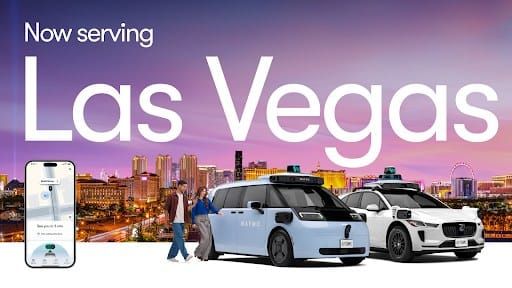
Waymo opened its Las Vegas service to public riders on Monday, starting with dozens of its new Ojai minivans covering the Strip south of Highway 589 and running into Boulder Junction. Access is invite-only for now — request a code, wait, hope — which is the same playbook Waymo has run in fourteen other cities and typically opens fully within a month or two.
On its own that is a routine expansion, the fifteenth market for a company that now runs more than 4,000 robotaxis across more than a dozen cities. What makes Clark County different is what the regulators did in August.
The number that matters is 7,000
The Nevada Transportation Authority has authorized Waymo to operate up to 1,000 autonomous vehicles over the next year. Tesla is cleared for up to 5,000. Uber is cleared for up to 1,000, which it plans to run through partnerships with Hyundai's Motional and with Zoox. Together that is permission for roughly 7,000 robotaxis in one metropolitan area within twelve months. Zoox is already running a commercial service there.
Nobody expects those ceilings to be reached. Waymo's entire national fleet is around 4,000 vehicles. Tesla's own Cybercab chief engineer, Eric Early, told state regulators in August that the company would be "extremely happy and satisfied if we could get ourselves up to 2,500," perhaps slightly more, within the year. Permits are ceilings, not forecasts.
But even a fraction of 7,000 changes the nature of the experiment. Las Vegas has an unusual demand profile: a dense, walkable tourist corridor, extreme ride concentration around a few destinations, heavy late-night demand, and a visitor population with no car and no loyalty to any particular app. It is close to a laboratory-grade environment for testing what people will actually pay for an autonomous ride when there are enough of them to hail.
Every prior robotaxi market has been supply-constrained. Waiting lists are wonderful for narrative and useless for economics, because a service that cannot meet demand never has to discover its price. Clark County is the first place where that constraint plausibly lifts.
What we are about to learn
Whether the price premium survives contact with abundance. Riders have paid a premium for novelty and for the absence of a driver. Novelty depreciates. When three operators are competing for the same airport-to-Strip run, the question stops being whether someone will take an autonomous ride and becomes what they will pay for one relative to a human driver who is also right there.
Whether utilization holds at scale. Robotaxi unit economics are dominated by vehicle utilization — rides per vehicle per day against a large fixed cost per vehicle. Adding vehicles faster than demand grows does to robotaxis exactly what it does to any capital-intensive fleet business. The ceiling on profitability is not technical.
Whether the operating model differentiates. Waymo owns and runs its fleet. Uber is aggregating other people's vehicles through Motional and Zoox. Tesla is betting on manufacturing cost. Those are three genuinely different theories of the business, and Las Vegas is the first city where all three run against the same riders at the same time. We laid out the competing approaches in Top 7 Robotaxi Companies in 2026.
Whether the city pushes back. Curb space, congestion on the Strip, and the local taxi and rideshare workforce are all finite. A regulator that grants generous ceilings in August can revisit them, and the political economy of thousands of driverless vehicles in a union-heavy service town has not been tested. Uber's own labor-cost restructuring, which we read as an org-chart argument, is the same pressure showing up on a different balance sheet.
The safety asymmetry nobody has priced
Concentration cuts both ways. A dense deployment generates enormous volumes of comparable operational data, which accelerates learning for everyone running vehicles there.
It also concentrates risk. A single serious incident in a market this visible, involving any of the three operators, becomes a Las Vegas story rather than a company story. Regulators respond to categories, not brands. Waymo has spent years building a safety record precisely so it would not be judged alongside less mature programs, and a shared market undermines that separation — which is exactly why federal scrutiny of how competitors certify their vehicles matters to everyone, as we covered in NHTSA Is Auditing How Tesla Certified the Cybercab.
Waymo's own recent pace compounds the exposure. Denver, San Diego and Tampa opened to invited riders earlier this month, and San Antonio launched and then paused. Fifteen markets is a lot of simultaneous operational surface for a company whose core asset is the assumption that it does not make mistakes.
The honest read
Las Vegas is not a milestone because Waymo arrived. It is a milestone because the scarcity ends.
For four years the robotaxi conversation has been about capability — can the vehicle handle the intersection, the rain, the construction zone. That question is substantially settled in the geographies where these companies operate. The unsettled question is commercial, and it could not be asked while every service had a waiting list.
A business that cannot serve its demand never has to find out what its product is worth.
Sometime in the next year, in one dense American county, three operators will have enough vehicles on the road to answer that. The result will not be a technology verdict. It will be a price, a utilization rate, and a margin — and those three numbers will determine whether robotaxis are a transportation industry or an extremely well-funded demonstration.
Frequently Asked Questions
Is Waymo operating in Las Vegas now?
Yes. Waymo began opening its robotaxi service to public riders in Las Vegas on September 14, 2026, starting with dozens of Ojai minivans. Access is initially invite-only, covering the Strip south of Highway 589 and extending into Boulder Junction, with the service area expected to expand.
How many robotaxis will operate in Las Vegas?
The Nevada Transportation Authority authorized up to 1,000 vehicles for Waymo, up to 5,000 for Tesla, and up to 1,000 for Uber through partnerships with Motional and Zoox — roughly 7,000 in total across Clark County over twelve months. Those are permit ceilings, and none of the operators is expected to reach them.
Which robotaxi companies operate in Las Vegas?
Zoox already runs a commercial robotaxi service in Las Vegas. Waymo launched public service in September 2026. Tesla and Uber, working with Motional and Zoox, have received Nevada approval and plan commercial services, making Clark County the first US market where several major operators compete directly.
Why does Las Vegas matter for robotaxi economics?
Previous robotaxi markets were supply-constrained, with waiting lists masking the question of what riders will pay. Las Vegas combines dense tourist demand with permission for thousands of vehicles, making it the first place where pricing, vehicle utilization and margins can be observed rather than projected.
Editor's note — sources: Waymo's own Las Vegas announcement and TechCrunch's reporting on the launch, the August Nevada Transportation Authority approvals, and Waymo's Denver, San Diego and Tampa expansion. Eric Early's remark is as reported by TechCrunch from an August regulatory meeting. Fleet figures are as reported. The assessment of unit economics and market saturation is Edgewisely's own analysis.