
Devin vs Claude Code: Which to Use in 2026?
Claude Code runs in your terminal; Devin runs on its own cloud VM. Both start at $20/month. We compared current pricing, the one benchmark both vendors publish, parallelism and enterprise governance - with dated primary sources throughout.

TL;DR
- Claude Code runs in your terminal on your own machine, defaults to Claude Opus 5.5, and starts at $20/month (Pro). Devin runs as a hosted agent in its own cloud VM and also starts at $20/month (Pro), but teams pay an $80/month minimum plus $40/month per full seat.
- On Terminal-Bench 4.0 — the one agentic benchmark both vendors publish — Opus 5.5 scores 66.4% (Anthropic, 22 September 2026) versus 27.3% for Cognition's SWE-2 (Cognition, 10 September 2026). Devin also runs Claude models, so treat that as a model result, not a product verdict.
- Neither company reports SWE-bench Verified anymore. Any 2026 comparison quoting SWE-bench Verified scores for these tools is using retired numbers.
- Devin's $500/month team plan and per-ACU self-serve pricing were retired in April 2026. Most pages ranking for this query still quote them.
Devin vs Claude Code is a choice between two execution models. Claude Code is a terminal-resident agent that works inside your local repo. Devin is a hosted agent that works in its own cloud VM with a full desktop, shell and browser. Both start at $20/month. Choose Claude Code for hands-on work you steer and review as it happens. Choose Devin for clearly scoped tasks you delegate and collect later.
One note on sourcing before the detail: most pages currently ranking for this query are published by companies that sell a competing or adjacent coding agent. Everything below comes from Cognition's and Anthropic's own pricing pages, docs, model cards and engineering posts, with dates attached.
Devin vs Claude Code: what actually differs
The architectural split is where the two products genuinely diverge, and it drives everything else.
Claude Code is a local process. It installs to your machine and runs against the repo you are already in, using your git credentials and your environment. It reads a CLAUDE.md in your project root at the start of every session, and also picks up AGENTS.md if your repo already has one for other agents.
It is not terminal-only anymore. The same engine now runs across the terminal CLI, VS Code, JetBrains, a desktop app, the web, and mobile. You can start a task locally and push it to the cloud with claude --cloud, or pull a cloud session back down with claude --teleport.
Devin is a hosted agent with its own machine. Each cloud session gets a full desktop environment. Per Cognition's own guidance, Devin can spin up your app locally, click through the UI, take screenshots and QA its own changes before opening a PR.
That VM is the real differentiator. Claude Code inherits your dev environment; Devin builds and owns one.
Devin also spans more surfaces than most comparisons acknowledge: Devin Cloud (the hosted agent), Devin Desktop (the IDE, renamed from Windsurf on 2 June 2026), Devin CLI (terminal, with /handoff to the cloud), Devin Review (PR review with Auto-Fix), Ask Devin and DeepWiki. Integrations cover Slack, Microsoft Teams, Linear, Jira, GitHub, GitLab and Bitbucket.
The model question matters less than you'd think. Devin is multi-model. Its Pro plan advertises frontier models from OpenAI, Claude, Gemini and xAI alongside Cognition's own SWE-2. Claude Code runs Claude. So "Devin AI vs Claude Code" is a comparison of harnesses and workflows, not of models — you can run Claude inside Devin.
If you're weighing terminal agents specifically, our Claude Code vs GitHub Copilot comparison covers the IDE-assistant end of the spectrum, and Aider vs Claude Code covers the open-source alternative.
What does Devin cost in 2026?
Devin now has two entirely separate pricing models, and the older one is gone.
Self-serve plans, per Cognition's pricing page:
- Free — $0, light quota, limited model availability
- Pro — $20/month, single user, includes Devin Cloud access
- Max — $200/month, single user, significantly higher quotas with no daily cap
- Teams — $80/month minimum plus $40/month per full dev seat, up to 200 users
- Enterprise — custom
The Teams structure is the part people get wrong. Every Teams account pays at least $80/month. You can hit that with two full seats at $40 each, or one full seat plus $40 of credits, or $80 of credits alone. Flex seats are free but draw entirely from the team's shared credit pool and don't include Devin Desktop.
Enterprise is billed in Agent Compute Units (ACUs) at whatever rate the order form sets. Cognition does not publish that rate. An ACU reflects the work Devin actually performs — planning, context gathering, execution, browser and code actions, plus VM time.
Two mechanics worth knowing: Devin does not consume usage while sleeping, and sleeps automatically after 30 minutes of inactivity. Windows sessions consume roughly 9% more than equivalent Linux sessions.
What changed: Cognition retired the legacy Core and Team plans in April 2026. Legacy Core users were migrated to Free. On-demand credits carry the same dollar value as the old ACUs. If a comparison page quotes you $500/month or $2.25 per ACU, it is describing a product that no longer exists.
What does Claude Code cost?
Claude Code is included in every paid Claude plan rather than sold separately. From Anthropic's pricing page:
- Free — no Claude Code access
- Pro — $17/month billed annually ($200 up front), or $20 monthly
- Max — $100/month (5x Pro usage) or $200/month (20x)
- Team — $20/seat/month annually ($25 monthly) for Standard; $100/seat/month annually ($125 monthly) for Premium. 2 to 150 users
- Enterprise — $20/seat/month billed annually, plus usage at API rates
There is no separate Claude Code add-on. The catch is that Claude Code draws from the same usage pool as your Claude chats, on a rolling five-hour window with weekly caps on top. Hit the limit and you can enable usage credits to continue at standard API rates.
Pay-as-you-go through the API is the alternative: Opus 5.5 at $4/$20 per million input/output tokens, Sonnet 5.5 at $2/$10, Haiku 4.5 at $1/$5.
Devin vs Claude Code pricing, side by side
| Devin | Claude Code | |
|---|---|---|
| Entry paid tier | $20/mo (Pro) | $20/mo, or $17/mo annual (Pro) |
| Top individual tier | $200/mo (Max) | $200/mo (Max 20x) |
| Team entry | $80/mo min + $40/full seat | $20/seat/mo annual |
| Team seat cap | 200 users | 150 users |
| Enterprise | ACUs, rate not disclosed | $20/seat/mo + API-rate usage |
| Free tier includes agent | Yes, limited quota | No |
| Overage model | Prepaid on-demand credits | Usage credits at API rates |
| Concurrent sessions | Up to 10 (Pro/Max), unlimited (Team/Enterprise) | Not capped by plan |
| Execution | Hosted cloud VM | Your machine, plus cloud sessions |
| Models | Multi-vendor plus SWE-2 | Claude, defaults to Opus 5.5 |
For a genuinely small team, Claude Code is cheaper at the door: three developers cost $60/month on Team annual versus $120/month on Devin Teams. Devin's pricing assumes the agent is doing enough work to justify a seat.
What do the benchmarks actually say?
Start with what is no longer true. Neither vendor reports SWE-bench Verified for current models. It appears nowhere in the Opus 5.5 system card and nowhere in Cognition's SWE-2 announcement. The field moved on.
That leaves Terminal-Bench 4.0 as the only clean head-to-head, because both companies publish it:
| Benchmark | Claude Opus 5.5 | Cognition SWE-2 |
|---|---|---|
| Terminal-Bench 4.0 | 66.4% | 27.3% |
| FrontierCode 1.1 Main | 54.4% (max effort) | 50.0% |
| DeepSWE 1.1 | 74.2% | 73.0% |
Sources and dates: Opus 5.5 figures from Anthropic's announcement and system card, published 22 September 2026. SWE-2 figures from Cognition's SWE-2 post, published 10 September 2026.
Four caveats, because the numbers are softer than they look.
The Terminal-Bench comparison cross-validates. Both vendors independently report Fable 5.1 at 55.8%, GPT-6 Astra at 57.9% and GPT-5.6 Sol at 37.3% — identical figures from separate runs. That agreement is what makes the 66.4% vs 27.3% gap credible rather than a scaffold artifact.
FrontierCode is Cognition's own benchmark, published by Cognition in June 2026. Opus 5.5 still edges SWE-2 on it.
DeepSWE is not a real head-to-head. Anthropic reports 74.2% with no comparison models, so there is no shared anchor confirming both ran the same harness. Treat 74.2 vs 73.0 as two self-reported figures, not a measured result.
SWE-2 isn't trying to win on raw capability. Cognition positions it on the cost-performance frontier — within one point of Fable 5.1 while being 64% cheaper, in its own words. Its own table shows GPT-6 Astra beating it on two of four benchmarks.
The most telling detail sits in Cognition's methodology appendix. When Cognition benchmarks Anthropic models, it runs them in Claude Code — naming the competing harness as the reference implementation for Claude. Both companies, in other words, agree on which tool you use to get the most out of a Claude model.
Which handles parallel work better?
This is the strongest argument for Devin, and it's the one comparison pages usually skip.
Devin parallelises by spawning sessions. Each gets its own VM, so there is no shared working directory to collide over. Cognition explicitly recommends splitting big projects across sessions and running them simultaneously, either through managed Devins or the Devin API for programmatic orchestration. Pro and Max cap you at 10 concurrent sessions; Team and Enterprise are uncapped.
Claude Code parallelises inside one session. Subagents run different parts of a task with separate context, coordinated by a lead agent. Background agents run several full sessions you monitor from one screen. For custom orchestration there is the Agent SDK.
The practical difference: Devin's isolation is free and automatic because every session is a different machine. With Claude Code you manage git worktrees or accept that parallel agents share a checkout. If your workflow is "fan out twenty independent tickets overnight," Devin's model fits better.
Claude Code counters with scheduling and CI depth — Routines run in the cloud on a schedule, plus GitHub Actions, GitLab CI/CD and automatic PR review. For a comparison of the lighter-weight open-source agents in this space, see Kilo Code vs Cline.
Which one can your security team approve?
Both have real enterprise stories, and they are shaped differently.
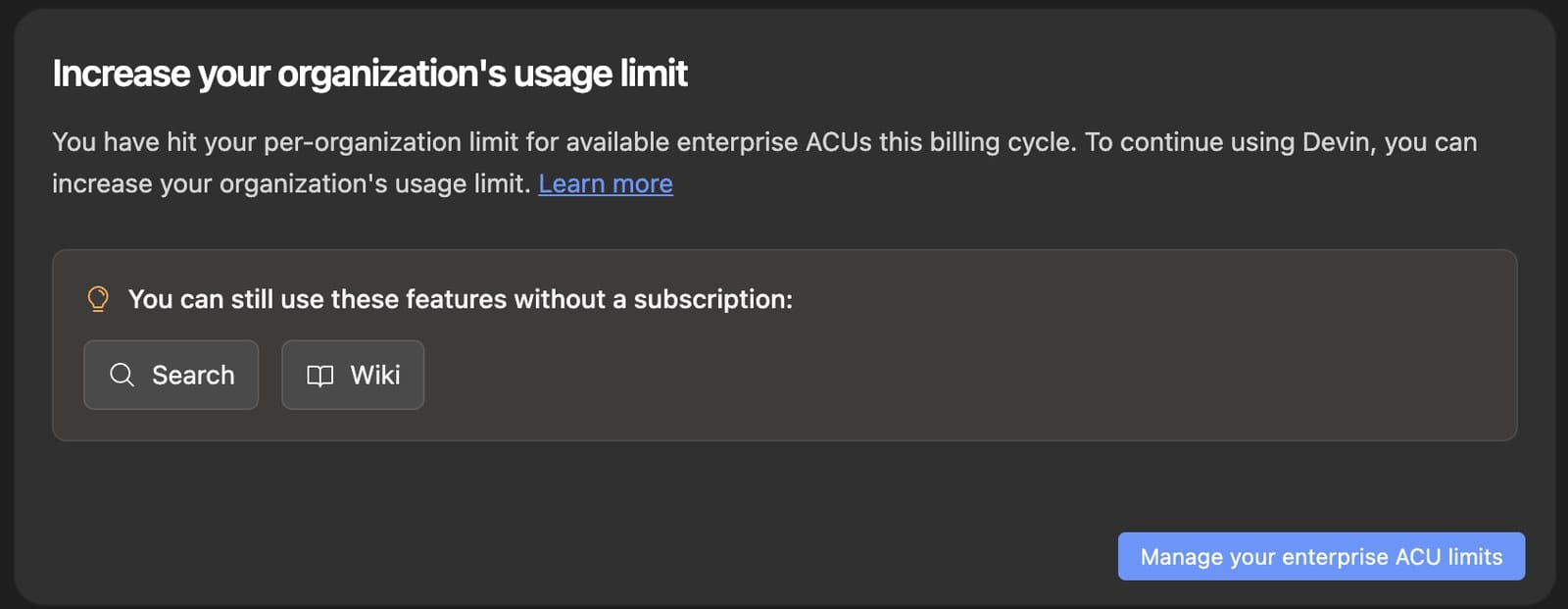
Devin offers VPC deployment, SAML/OIDC SSO, teamspace isolation, centralized admin controls, and per-organization and per-user ACU limits that hard-block work at the cap. Cognition reached FedRAMP High In-Process in July 2026.
Claude Code leans on configuration control. Managed and server-managed settings let admins pin an allowlist of permitted models, force a specific login method, and require that logins belong to your organization. Enterprise adds SCIM, audit logs, a compliance API, role-based access and custom data retention. Inference can route through Amazon Bedrock, Google Cloud's Agent Platform, Microsoft Foundry, or a self-hosted gateway — so the model calls never need to touch Anthropic's endpoint.
The split is clean. Devin gives you better spend governance. Claude Code gives you better deployment and data-path control.
Worth noting on vendor stability: Cognition raised over $2B at a $48B valuation in September 2026 and says it crossed $1B in annualised revenue run rate. Neither company is a procurement risk. We covered Cognition's $48B valuation separately.
What this means for you
If you're a solo developer: Claude Code. It is cheaper in practice at $17/month annual, the default Opus 5.5 is the stronger coding model, and local execution means no environment setup. Devin's free tier is worth a look since Claude Code has none, but Pro-for-Pro the local agent wins.
If you run a small team (2–10): Claude Code on Team, at $20/seat/month annual. Devin's $80 minimum plus $40 per seat is roughly double for the same headcount, and you don't yet have the ticket volume to exploit parallel sessions.
If you run a platform team with a large backlog: Devin, or both. The case for Devin is structural — hosted VMs make fanning out dozens of independent, well-specified tasks trivial, and Devin Review with Auto-Fix closes the loop without a human in it. Many teams run Claude Code for interactive work and Devin for the delegated queue.
If you're in a regulated environment: Claude Code, if your constraint is where inference runs. Bedrock, Vertex or a self-hosted gateway keeps the data path inside infrastructure you control. Devin if your constraint is a VPC deployment with hard per-user spend caps.
If unpredictable bills are the blocker: Claude Code. Flat seat pricing with a shared usage pool is easier to forecast than consumption billing, and Devin's own docs concede that usage varies with task complexity, prompt quality, codebase size and session length.
The honest verdict: for most teams, Claude Code is the better default in 2026 — stronger model, lower entry cost, no environment lift. Devin earns its premium specifically when you have more well-scoped work than engineers to supervise it, and you want that work done on machines that aren't yours.
Frequently Asked Questions
Is Devin better than Claude Code?
Not on measured capability. On Terminal-Bench 4.0, the only benchmark both vendors publish, Claude Opus 5.5 scores 66.4% against SWE-2's 27.3%. Devin is better at a different thing: running many isolated sessions in parallel on its own cloud VMs. Devin also runs Claude models, so the two aren't mutually exclusive.
How much does Devin cost?
Devin Pro is $20/month for one user and Max is $200/month. Teams costs a minimum of $80/month plus $40/month per full developer seat, up to 200 users. Enterprise is billed in Agent Compute Units at an undisclosed contract rate. The old $500/month team plan was retired in April 2026.
Can Claude Code work autonomously like Devin?
Yes, through several paths. Background agents run full unattended sessions, Routines execute on a cloud schedule, and GitHub Actions or GitLab CI/CD trigger it on repo events. The difference is the sandbox: Devin provisions a fresh VM per session, while Claude Code runs in an environment you supply.
Which is better for large codebases?
Both handle them, differently. Claude Code gets a 1M-token context window on Opus 5.5 plus persistent CLAUDE.md instructions and auto memory across sessions. Devin brings DeepWiki and Ask Devin's code search for scoping before it writes anything. For monorepos, Devin's advantage is splitting work across parallel isolated sessions.
Is Devin worth it in 2026?
It depends on supervision capacity, not price. At $20/month for Pro it costs the same as Claude Code Pro and the free tier lets you test it. The $80 Teams minimum is only justified when you have more clearly scoped, verifiable tickets than engineers available to review them interactively.
Editor's note — sources: All prices verified 30 September 2026 against Cognition's and Anthropic's own pricing pages. Devin's Teams seat mechanics, the $80 monthly minimum and the April 2026 retirement of the legacy Core and Team ACU plans are documented at docs.devin.ai/admin/billing/self-serve, and what an ACU measures at docs.devin.ai/admin/billing/usage. Benchmark figures are vendor-published and dated: Claude Opus 5.5 from Anthropic's 22 September 2026 announcement and system card, Cognition SWE-2 from its 10 September 2026 post. Neither vendor publishes SWE-bench Verified for current models, so no SWE-bench figure appears here. Cognition's enterprise ACU rate is set per order form and is not published; no figure is quoted. The Windsurf-to-Devin-Desktop rename is dated 2 June 2026 per Cognition's own documentation.