
Kling vs Sora: Which AI Video Generator Wins in 2026?
Kling vs Sora in 2026: Kling 3.0 wins because OpenAI discontinued Sora's app and API. Compare price, 4K, 15-second length and audio, fully sourced.

In the Kling vs Sora matchup as of November 2026, Kling wins by default: Kuaishou's Kling 3.0 is a live, globally available video generator, while OpenAI discontinued Sora — both the consumer app and the Sora 2 API — during 2026. If you need to make AI video today, Kling is the only one of the two you can actually use.
That is the uncomfortable headline most "kling vs sora which is better" comparisons still miss. They pit Kling 3.0 against Sora 2 as if both were on the shelf. One of them is not.
TL;DR
- Verdict: Kling wins because it is still running. OpenAI announced on March 24, 2026 it would shut down Sora, and its Sora 2 and Sora 2 Pro models plus the Videos API were retired on September 24, 2026 with "no one-to-one replacement."
- Price basis (Kling, consumer, Nov 2026): paid plans run $6.99 to $127.99/month; 4K video costs about 30 credits per second.
- Price basis (Sora, historical, retired): the Sora 2 API was $0.10/second; Sora 2 Pro ran $0.30 to $0.70/second by resolution — but you can no longer buy it.
- Max clip / resolution: Kling 3.0 generates up to 15 seconds at up to 4K. Sora generated up to ~1080p before shutdown.
- Audio: Both shipped native, synchronized audio. Only Kling's still works.
Kling vs Sora at a glance
The table compares each product's latest flagship. Sora's cells reflect its final state before OpenAI pulled it; every one is dated.
| Dimension | Kling (Kling 3.0) | Sora (Sora 2 / 2 Pro) |
|---|---|---|
| Latest version + date | Kling 3.0, launched Feb 5, 2026 | Sora 2 / 2 Pro, retired Sep 24, 2026 |
| Available now (Nov 2026)? | Yes, globally | No — app and API shut down |
| Max clip length | 15 seconds (3–15s flexible) | ~minute-class historically; not disclosed for Sora 2 |
| Max resolution | 4K video mode (Kling-listed); 1080p arena-tested | Up to 1080p (API, pre-shutdown) |
| Native synchronized audio | Yes (Kling 3.0 Omni) | Yes (while it existed) |
| Price basis + figure | Consumer $6.99–$127.99/mo; 4K ≈ 30 credits/sec | API was $0.10–$0.70/sec; now unavailable |
| Standout strength | Current, cheap, 4K, multi-shot control | Was strong on physics + audio realism |
| Availability / region | Global | Discontinued |
| Commercial use | Permitted on paid plans (confirm current terms) | Moot — service retired |
Kling vs Sora: which is better?
Kling. Not because Sora 2 was a weak model — it was a strong one — but because you cannot generate a single frame with Sora anymore, and you can with Kling right now.
OpenAI said on March 24, 2026 that it was discontinuing Sora. TechCrunch reported the farewell message to users: "What you made with Sora mattered, and we know this news is disappointing." A company spokesperson told VentureBeat the plain version: "We've decided to discontinue Sora in the consumer app and API."
The developer side is the part that matters for anyone building on video. OpenAI's own deprecations page lists the Videos API, sora-2, sora-2-pro and their snapshots as shut down on September 24, 2026, with the recommended replacement listed as "no one-to-one replacement." OpenAI said the Sora research team would refocus on world-simulation and robotics work.
So the real question is not "which model is better on a benchmark." It is "which one can you ship with." Only Kling clears that bar.
How much do Kling and Sora cost?
Kling sells consumer subscriptions with monthly credits; Sora's pricing is now historical. Compare them on different bases, because that is the only honest way.
Kling's paid tiers, per its official pricing guide (as of Nov 2026), are: Standard $6.99/mo (660 credits), Pro $25.99/mo (3,000 credits), Premier $64.99/mo (8,000 credits) and Ultra $127.99/mo (26,000 credits). Those are first-subscription prices; Kling's guide lists higher renewal rates (roughly $8.80 to $160/mo). Kling lists a native 4K video mode at 30 credits per second, so a five-second 4K clip is about 150 credits — a handful of dollars depending on your tier. Independent arena testing (below) scores the 1080p Pro configuration.
Sora's prices are a tombstone, not a quote. Before the September 2026 shutdown, OpenAI's Sora 2 Pro model card listed $0.30/second at 720p, $0.50/second at 1024×1792, and $0.70/second at 1080p, with the cheaper Sora 2 at $0.10/second. On paper that undercut a lot of rivals. In practice the price is irrelevant now, because the product is gone.
Bottom line: on a like-for-like "can I pay for it in November 2026" basis, Kling costs money and Sora costs nothing because it sells nothing.
Which makes more realistic video?
On independent, blind-preference testing, Kling 3.0 is a solid mid-pack model — and Sora is simply absent, because retired models drop off the boards.
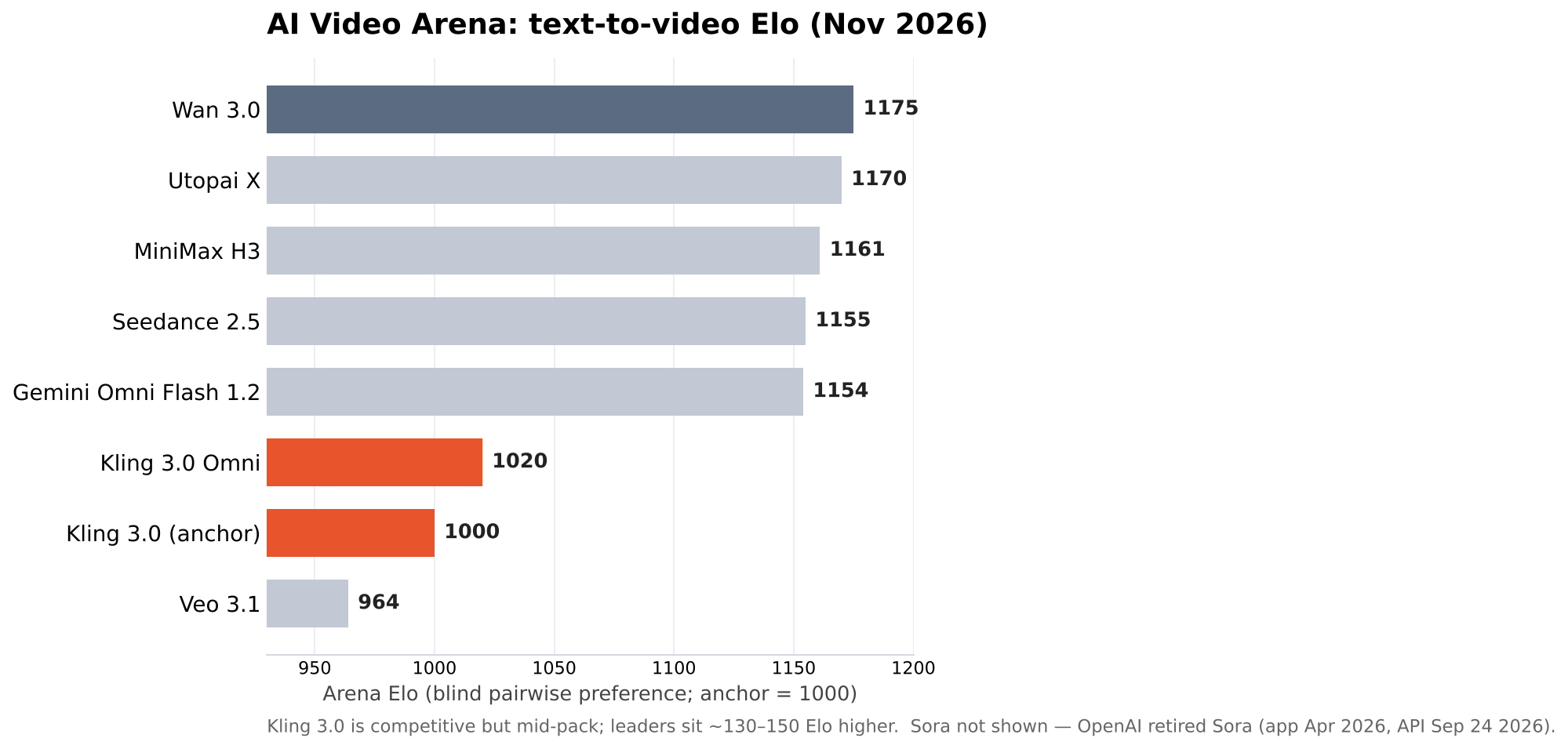
The Artificial Analysis Video Arena scores models with blind pairwise votes, anchored at an Elo of 1000. On its text-to-video board (v2.1, newest entries dated Nov 2026), Kling 3.0 Omni (1080p Pro) scores 1020 and Kling 3.0 (1080p Pro) is the 1000 anchor. For reference, the current leader tier sits around 1150–1175 (for example Dreamina Seedance 2.5 at 1155), and Google's Veo 3.1 scores 964. The image-to-video board tells a similar story: Kling 3.0 Omni at 1002, Seedance 2.5 on top at 1161.
Read that carefully. Kling is competitive, not dominant — it trails the Seedance and MiniMax tier on crowd preference but beats Veo 3.1 on both boards. And there is no Sora row to compare against, which is itself the finding: you cannot benchmark a product you cannot run.
One caveat on the arenas. Blind-preference Elo captures which clip a human prefers in a quick side-by-side — it rewards polish, motion smoothness and prompt-match. It does not measure render time, cost, controllability, or how a model behaves on your specific prompts. Treat it as a signal, not a verdict.
What's the max length and resolution?
Kling 3.0 generates clips of up to 15 seconds (flexible from 3 to 15) at up to 4K, per Kling's materials. Sora, before shutdown, topped out around 1080p on its API.
Kling's launch announcement (Kling AI, Feb 5, 2026) emphasizes multi-shot and storyboard control: in Kling 3.0 Omni you can set duration, shot size, perspective, narrative content and camera movement for each shot. That shot-level control is the real length story — you build a sequence, not just a single take.
Sora's historical strength was different: its original research preview claimed videos "up to a minute long," and Sora 2 was known for physically plausible motion. None of that is purchasable today, so it is context, not a current spec.
Does Kling or Sora have audio?
Both shipped native synchronized audio — the feature that made 2026's video models feel finished rather than silent. Only Kling's audio is still usable.
Kling 3.0's native audio, per Kuaishou's launch, covers dialogue, ambience, sound effects and lip movement, across multiple languages and accents (English, Chinese, Japanese, Korean and Spanish, with American, British and Indian accents noted). Multi-character scenes can have each character speak a different language. That is a meaningful step past a model that only renders a voice-over track.
Sora 2's synchronized audio was one of its signature upgrades over the original Sora, and part of what drove the Sora app's viral moment. But like everything else about Sora, it went away with the September 2026 shutdown.
Kling vs Sora: which should you use?
Use Kling — it is the only live option, and it is a genuinely capable one. The more useful question is which Kling tier, and whether Kling is right versus the models that now outrank it.
- Social and marketing clips, product video, ads: Kling 3.0 on the Pro or Premier tier. The multi-shot storyboard, 4K output and native audio cover the vast majority of short-form commercial work.
- Cheapest entry: Standard at $6.99/mo to test the workflow before you commit credits.
- Heavy production: Ultra at $127.99/mo for the 26,000-credit allotment and early access to new models.
- If you specifically wanted Sora: you need a new plan entirely. Treat the shutdown as permanent for now.
Our take
The genuinely newsworthy fact in "Kling vs Sora" is not that Kling edged ahead on a benchmark. It is that one of the two contenders left the field. OpenAI launched the standalone Sora app in September 2025, rode it to the top of the App Store, and then killed it roughly six months later — announcing the wind-down on March 24, 2026 and retiring the models and Videos API on September 24, 2026. Axios reported the scope bluntly: the iOS app, the API, and the sora.com experience, all going away. The stated reason was focus — OpenAI reallocating compute and research toward world-simulation, robotics and enterprise priorities. The reported collateral damage included a canceled ~$1 billion Disney deal.
That reframes the whole category decision. For most of 2025, the smart take was "Sora for cinematic realism, Kling for value and access." Half of that take is now obsolete. If you built a product, a content pipeline, or a client workflow on the Sora API, you got a hard lesson in platform risk: a frontier lab can retire a flagship with a six-month notice and no successor. "Best model on the arena" and "model you can still call next quarter" are different questions, and 2026 made the second one the important one.
Here is where I think Kling actually wins, and where it does not. Kling wins on durability and economics. Kuaishou is running Kling as a real business, not a research demo — the company told SCMP it hit roughly a $240 million annualized revenue run rate, more than double a prior figure. A product with paying revenue and 60 million-plus creators (Kling's own claim at the 3.0 launch) is less likely to vanish than a lab's side project. Kling also wins on practical specs most creators care about: 4K, 15-second multi-shot sequences, native multilingual audio, and consumer pricing that starts under $7.
Kling does not win the raw-quality crown, and you should not let the Sora shutdown fool you into thinking it did. On the Artificial Analysis boards, Kling 3.0 sits around the 1000–1020 anchor zone while the current leaders — Seedance 2.5, MiniMax H3, Wan 3.0 — sit 130–150 Elo higher. That is a real gap in blind human preference. If your only criterion is "most realistic clip, cost be damned," Kling is a reasonable pick but not the top of the board. The honest framing is: Kling is the best-supported, best-priced option among the two this article names, and a strong-but-not-leading option in the wider field.
A word on what the arenas miss, because it cuts in Kling's favor. Elo from blind side-by-sides rewards the prettiest five-second clip. It does not score shot-to-shot consistency across a 15-second sequence, lip-sync accuracy in a named language, the time to render, or whether the model respects a storyboard. Those are exactly the dimensions that decide real commercial work, and they are exactly where Kling has invested with Omni's multi-shot controls. So Kling's "mid-pack" Elo likely understates its usefulness for actual production, the same way a camera's lab resolution chart understates how it shoots a wedding.
My verdict, segmented. Best for ad, product and social video where you need 4K, audio and shot control on a budget: Kling 3.0, Pro or Premier tier. Best for squeezing the absolute highest blind-preference realism out of a single short clip: look past both names in this headline to the current arena leaders. Avoid planning anything around Sora until OpenAI ships a genuine successor — as of November 2026 there is no Sora you can use, and OpenAI has promised no replacement. If the word "Sora" is in your roadmap, replace it.
One honest uncertainty: OpenAI's Sora research team was redirected, not disbanded, toward world-simulation work. A future OpenAI video model is plausible. But "plausible future model" is not something you can ship on, and this comparison is about what exists now.
Comparing the rest of the generative-media stack? See our Suno vs Udio AI music breakdown, the Veo vs Sora video comparison, and the Nano Banana vs Seedream image head-to-head.
Frequently Asked Questions
Is Kling better than Sora?
In November 2026, yes — because Sora no longer exists as a usable product. OpenAI discontinued the Sora app and retired the Sora 2 and Sora 2 Pro models and Videos API during 2026. On pure blind-preference quality before that, the two traded blows; today Kling 3.0 is the only one you can run.
Is Kling cheaper than Sora?
Kling's paid consumer plans run $6.99 to $127.99 per month, with 4K video at about 30 credits per second. Sora's API was once cheaper per clip at $0.10 to $0.70 per second, but OpenAI retired it on September 24, 2026, so its price is now irrelevant. Kling is the only purchasable option.
Does Kling have audio like Sora?
Yes. Kling 3.0 Omni generates native synchronized audio — dialogue, ambience, sound effects and lip movement — across multiple languages and accents including English, Chinese, Japanese, Korean and Spanish. Sora 2 also had synchronized audio, which was a signature feature, but it went offline with the rest of Sora in 2026.
What's the max video length for Kling vs Sora?
Kling 3.0 generates clips of up to 15 seconds, flexibly from 3 to 15 seconds, with multi-shot sequencing inside that window. Sora's original preview claimed up to about a minute, but OpenAI never published a confirmed max duration for the retired Sora 2 API, and the product is no longer available to test.
Can you use Kling and Sora videos commercially?
Kling permits commercial use on its paid plans, though you should confirm the current terms for your specific plan and access route before client work. Sora's commercial question is moot: OpenAI shut down the app and API in 2026, so there is no Sora output to license going forward.
Editor's note — sources: Sora's discontinuation is confirmed by OpenAI's own API deprecations page (sora-2, sora-2-pro and the Videos API shut down September 24, 2026) and TechCrunch and VentureBeat coverage of the March 24, 2026 announcement; historical Sora pricing is from OpenAI's Sora 2 Pro model card. Kling 3.0 specs and launch date come from Kling AI's launch announcement and its pricing guide. Quality rankings are from the Artificial Analysis Video Arena (as of November 2026); revenue is per SCMP. All benchmark and price figures carry their source and date in-line; the "Our take" section is Edgewisely analysis.