
Etched's $21 Billion Bet Against Nvidia
How Etched's $700 million raise at a $21 billion valuation — double its price a month earlier — turns a bet that inference will dwarf training into the most serious startup challenge Nvidia has faced at the chip level.

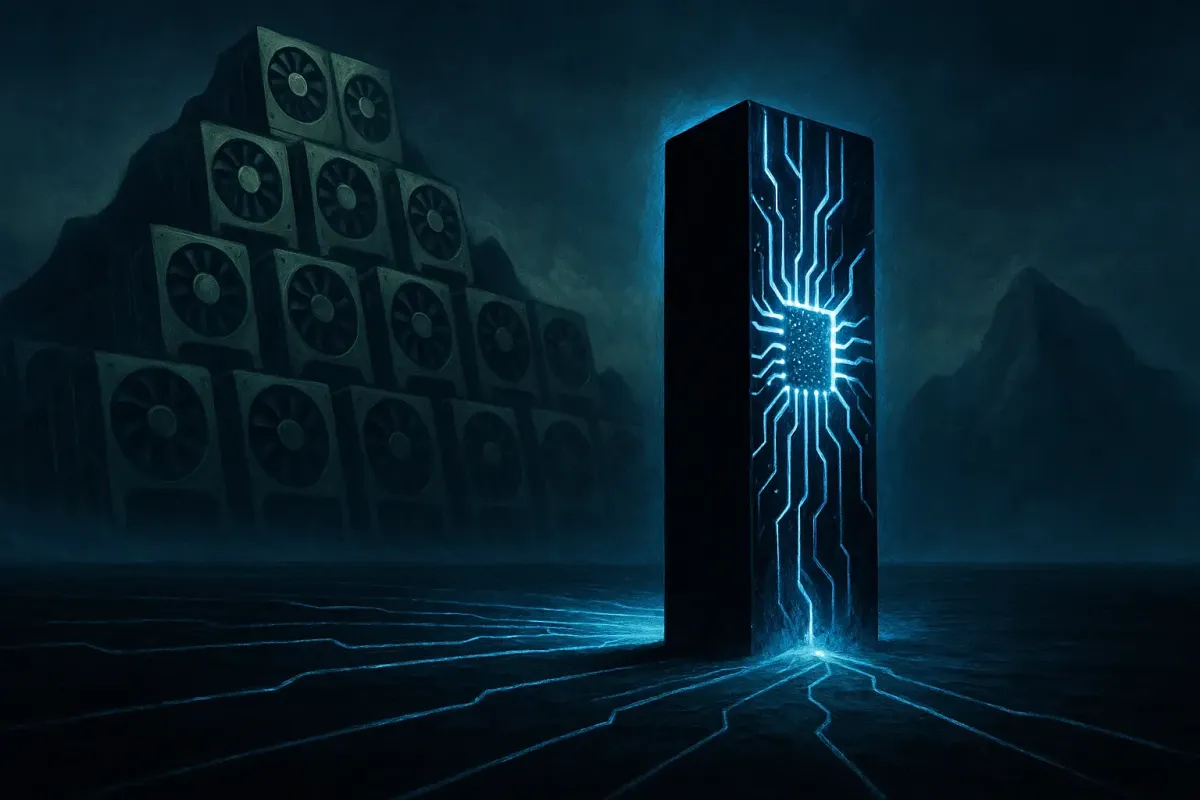
A chip company that makes hardware for only one job just doubled its value in under a month.
Most semiconductor startups die in the gap between a promising design and a shipped product. Etched, founded by three Harvard dropouts, has crossed that gap — and the market is repricing it in real time. On August 18, the company raised another $700 million at a $21 billion valuation, in a round led by the quantitative trading firm Jane Street. That valuation is roughly double the $10.3 billion Etched carried in a round reported just weeks earlier, as TechCrunch noted — a doubling in under a month.
The Etched AI chip thesis is narrow to the point of being a dare: build silicon that does nothing but run AI inference, and it will beat a general-purpose GPU on speed and cost for that one job. For years, that kind of bet against Nvidia was considered close to unfinanceable. Etched's raise, its shipped hardware, and its first paying customer suggest the AI buildout has grown large enough to reopen a market everyone had written off.
What Etched's AI chip actually does, and why timing matters
Etched makes server racks packed with processors designed for a single purpose: inference. It helps to slow down what that word means, because the whole bet rides on it. Training is the expensive, one-time work of building a model on enormous clusters of chips. Inference is what happens every time afterward — each time a model answers a prompt, generates an image, or runs an agent. Training is a construction project; inference is the electricity bill that never stops. As AI shifts from a research phase into mass production use, inference is where the compute — and the cost — increasingly lives.
Nvidia's GPUs are extraordinary precisely because they are flexible: they can train, they can infer, they can handle workloads no one has invented yet. Etched's argument is that flexibility has a price. A chip built only to run today's dominant model architectures can strip out everything it doesn't need and pour all its silicon into doing one thing faster and cheaper per response. If inference is going to be the largest category of AI compute, the reasoning goes, then a specialist optimized for it can win a slice of a very large market even against the best generalist in the world.
The traction is what separates Etched from the graveyard of chip startups. According to the company and reporting from TechCrunch, Etched has raised nearly $2 billion in total, booked more than $1 billion in orders, and begun shipping. Jane Street — famous for demanding extreme low latency — is its first paying customer, with a rack running production workloads in its own data center. When a firm that lives and dies by microseconds puts your chip into production, that is a harder endorsement to fake than any benchmark.
Why a chip startup beating Nvidia was supposed to be impossible
To appreciate the raise, you have to understand the barriers. Software startups can iterate weekly and scale on someone else's cloud. Chip startups face a brutal physical world: fabrication schedules measured in years, packaging and memory constraints, supply-chain competition for the same manufacturing capacity Nvidia and Apple are buying, and enormous upfront capital just to get first silicon back. On top of that sits Nvidia's real moat — CUDA, the software ecosystem that a generation of AI engineers already knows. Beating Nvidia has never been only about making a faster chip; it has been about making one people can actually build on.
That is why the specialization is the strategy. Etched is not trying to be a better general-purpose accelerator — a fight that has broken far larger companies. It is trying to be the best possible answer to one question: how do you run inference at the lowest cost per response? By narrowing the target, a startup can concentrate its limited capital and talent where a focused bet has a chance, rather than spreading thin against an incumbent that does everything. Etched is also recruiting engineers directly from Nvidia and other established chipmakers, a sign that the talent side of the moat is more porous than it looks when the upside is a $21 billion valuation.
Stakeholder analysis: who this reshapes
For Nvidia, Etched is not an existential threat — but it is a signal. The company's dominance rests partly on the belief that general-purpose GPUs are the right tool for every stage of AI. A credible, well-funded specialist winning production inference workloads chips at that assumption. Nvidia can absorb one competitor; what it cannot easily reverse is the idea, now backed by real orders, that the inference market is big and distinct enough to support purpose-built rivals.
For hyperscalers and AI labs, more inference silicon is close to pure upside. Every cloud provider already knows that running models at scale is where the operating cost concentrates, which is why Google built TPUs, Amazon built Trainium and Inferentia, and others are designing in-house chips. A merchant supplier like Etched gives companies without full chip-design organizations another lever to cut cost per token. In a business where inference volume is exploding, even small efficiency gains compound into enormous savings.
For investors, the doubling in a month is the story and the warning. It reflects genuine conviction that inference is the durable center of AI demand — but a valuation that moves that fast is pricing in a future that still has to be delivered against fabrication timelines, competition, and the risk that model architectures shift beneath a chip designed for today's. Specialization is powerful and brittle at once: a bet optimized for the current architecture is exposed if the architecture changes.
For the broader chip market, Etched is one data point in a larger fragmentation. Custom silicon — from hyperscaler ASICs to design-service partners — is spreading precisely because inference at scale rewards optimization. The competitive question is widening from "who makes the best AI GPU?" to "who can deliver the most efficient compute for a specific workload?" Etched is a bet that the answer, for inference, will not always be Nvidia.
The takeaway for builders
Two lessons sit under the $21 billion number. The first is that in a market dominated by a generalist, the opening for a challenger is almost never to be a slightly better generalist. It is to pick the one workload that matters most and be undeniably the best at it. Etched did not try to out-Nvidia Nvidia; it tried to make the flexibility of a GPU look like wasted silicon for the specific job of inference.
The second is that traction beats narrative, especially in hardware. Investors did not double Etched's valuation on a vision deck. They did it after the company shipped, booked over a billion dollars in orders, and put a rack into production at a customer that tolerates no latency. In a field crowded with AI promises, delivered silicon in a paying customer's data center is the rarest and most convincing asset there is.
The AI economy has spent two years obsessed with who trains the biggest model. Etched is a bet that the more durable question is who runs those models most cheaply, billions of times a day, forever. Training built the model. Inference is the business — and Etched is wagering $21 billion that the business needs a different chip.
Frequently Asked Questions
What is Etched and what did it announce?
Etched is a semiconductor startup, founded by three Harvard dropouts, that designs chips built specifically for AI inference. On August 18, 2026, it announced a $700 million raise at a $21 billion valuation, led by Jane Street, and said it had completed its first customer hardware delivery to Jane Street.
Why did Etched's valuation double in a month?
Its valuation rose from about $10.3 billion in a round reported weeks earlier to $21 billion, reflecting investor conviction that AI inference — the compute used every time a model responds — will become the largest category of AI demand, and that a specialized chip can beat general-purpose GPUs on cost and speed for that workload.
How is Etched challenging Nvidia?
Rather than building a flexible chip that competes with Nvidia across all workloads, Etched focuses only on inference, optimizing its silicon for that single job. It has booked more than $1 billion in orders, begun shipping, and is recruiting engineers from Nvidia and other chipmakers.
What are the risks to Etched's bet?
Chip startups face long fabrication timelines, capital intensity, and supply-chain constraints. A chip optimized for today's dominant model architectures is also exposed if those architectures change, and Nvidia's CUDA software ecosystem remains a formidable competitive moat.
Editor's note — sources: Etched press release (GlobeNewswire); TechCrunch; SiliconANGLE; Proactive Investors.