
RTX PRO 6000 vs H100: Specs, Bandwidth, Real Cost
Four NVIDIA cards get called "RTX 6000," and three page-one results compare the wrong one. Verified specs for the RTX PRO 6000 Blackwell against every H100 variant — plus our own bandwidth-per-dollar calculation on published cloud rates.

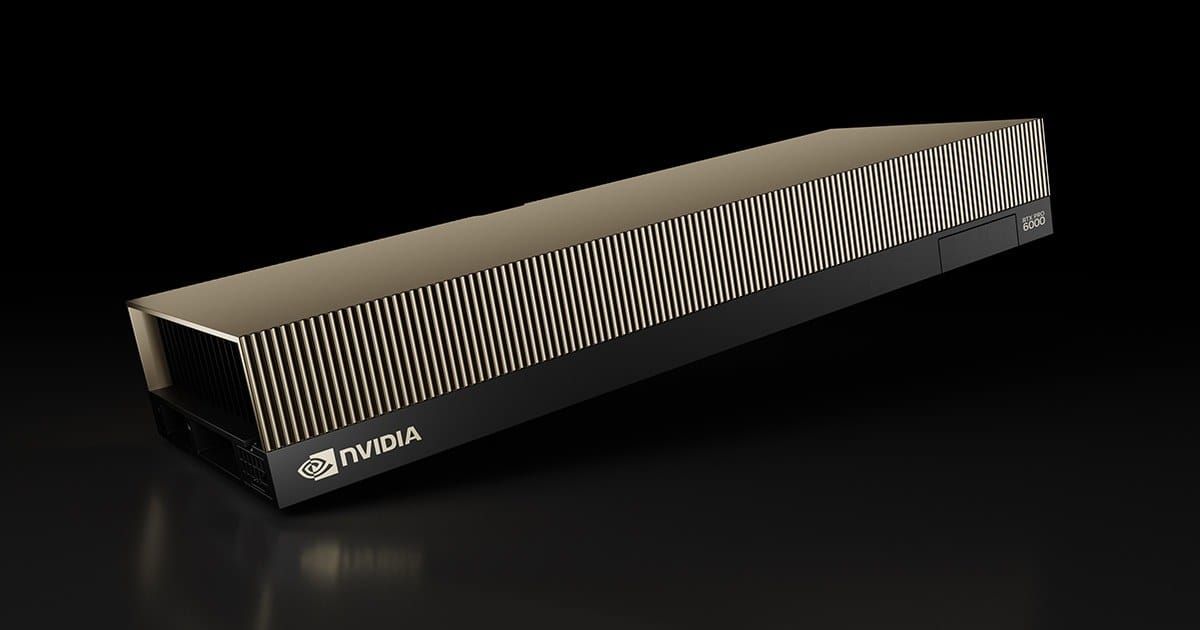
TL;DR
- Four different NVIDIA cards get called "RTX 6000." The one people mean in 2026 is the RTX PRO 6000 Blackwell (96 GB GDDR7, 2025). Several page-one results compare the RTX A6000 (2020) or RTX 6000 Ada (2022) instead — cards with half the memory.
- Bandwidth is the whole story for LLM decode. H100 SXM: 3,350 GB/s. H100 NVL: 3,938 GB/s. RTX PRO 6000 Server Edition: 1,597 GB/s. Workstation Edition: 1,792 GB/s.
- The RTX PRO 6000 Blackwell has no NVLink. NVIDIA's own product brief lists it as "Not supported." That settles every multi-GPU training question.
- Edgewisely's calculation: on Runpod's published Secure Cloud rates (read 5 Oct 2026), the RTX PRO 6000 gives you 56% more VRAM per dollar-hour than an H100 NVL — but the H100 NVL gives you 62% more memory bandwidth per dollar-hour.
The H100 is the faster card for LLM inference. The RTX PRO 6000 Blackwell is the cheaper way to fit a big model on a single GPU. H100 SXM moves 3,350 GB/s against the RTX PRO 6000 Server Edition's 1,597 GB/s — more than twice the bandwidth. The Blackwell card wins on capacity: 96 GB versus 80 GB.
Which RTX 6000 are you actually comparing?
Check this before anything else. NVIDIA has shipped four distinct cards that people shorten to "RTX 6000," and they are not close to equivalent.
| Card | Launched | Memory |
|---|---|---|
| RTX A6000 | 2020 (Ampere) | 48 GB GDDR6 |
| RTX 6000 Ada Generation | 2022 (Ada Lovelace) | 48 GB GDDR6 |
| RTX PRO 6000 Blackwell Workstation | 2025 | 96 GB GDDR7 |
| RTX PRO 6000 Blackwell Server Edition | 2025 | 96 GB GDDR7 |
This matters because the search results are a mess. Of the ten pages currently ranking for this query, three compare the wrong card entirely — Runpod's comparison page pits the RTX A6000 against the H100 NVL, and both the Bizon benchmark page and the top NVIDIA developer-forum thread are about the RTX 6000 Ada.
Three more are forums. Four of the rest are companies that rent you the hardware being compared.
So if you landed on a page claiming the "RTX 6000" has 48 GB, you were reading about a card from 2020 or 2022.
Note the split inside the Blackwell generation too. The Workstation Edition runs at 1,792 GB/s; the passive Server Edition runs at 1,597 GB/s — about 11% slower. No ranking page makes that distinction.
Which H100 are you comparing?
Same problem on the other side. Three H100 variants with materially different bandwidth and power.
- H100 SXM — 80 GB HBM3, 3,350 GB/s, up to 700 W, NVLink at 900 GB/s
- H100 PCIe — 80 GB HBM2e, 2,000 GB/s, 350 W, NVLink bridge at 600 GB/s
- H100 NVL — 94 GB HBM3, 3,938 GB/s, 400 W, NVLink bridge at 600 GB/s
The H100 PCIe is the weakest of the three on bandwidth and the one most likely to lose a benchmark against Blackwell. The H100 NVL is the strongest. Pages that say "the H100" without specifying are not telling you enough to decide.
Full spec comparison
| RTX PRO 6000 Server Ed. | RTX PRO 6000 Workstation | H100 SXM | H100 PCIe | H100 NVL | |
|---|---|---|---|---|---|
| Architecture | Blackwell | Blackwell | Hopper | Hopper | Hopper |
| Memory | 96 GB GDDR7 ECC | 96 GB GDDR7 ECC | 80 GB HBM3 | 80 GB HBM2e | 94 GB HBM3 |
| Bandwidth | 1,597 GB/s | 1,792 GB/s | 3,350 GB/s | 2,000 GB/s | 3,938 GB/s |
| Bus width | 512-bit | 512-bit | — | 5,120-bit | 6,016-bit |
| FP4 Tensor | 4 PFLOPS | 4,000 AI TOPS | Not supported | Not supported | Not supported |
| FP8 Tensor | 2 PFLOPS | — | 3,958 TFLOPS | — | 3,341 TFLOPS |
| BF16 Tensor | 1 PFLOP | — | 1,979 TFLOPS | — | 1,671 TFLOPS |
| NVLink | Not supported | Not supported | 900 GB/s | 600 GB/s | 600 GB/s |
| MIG | Up to 4 | Up to 4 | Up to 7 | Up to 7 | Up to 7 |
| Max TDP | 600 W | 600 W | 700 W | 350 W | 400 W |
| Form factor | FHFL dual-slot, passive | Dual-slot, active | SXM | FHFL dual-slot, passive | FHFL dual-slot, passive |
NVIDIA marks the H100 tensor figures "with sparsity," and marks the RTX PRO 6000's 4,000 AI TOPS as "effective FP4 TOPS with sparsity." Treat every tensor row as a sparsity-inclusive peak number, not a dense one. NVIDIA does not publish a dense tensor table for the RTX PRO 6000, so we have not derived one.
Why the H100 is still faster for LLM inference
Token generation is memory-bandwidth-bound, not compute-bound. Every decode step reads the entire model's weights out of VRAM. Bandwidth sets your ceiling on tokens per second.
Do the arithmetic. A 70B model quantised to 8-bit occupies roughly 70 GB. Reading 70 GB once per token gives a theoretical ceiling of:
- H100 NVL at 3,938 GB/s → near 56 tokens/sec
- H100 SXM at 3,350 GB/s → near 48 tokens/sec
- H100 PCIe at 2,000 GB/s → near 29 tokens/sec
- RTX PRO 6000 Server Ed. at 1,597 GB/s → near 23 tokens/sec
Real throughput lands well below these ceilings, and batching changes the picture substantially. This is a modelling illustration, not a benchmark. But the ranking holds: the H100 NVL has 2.5x the decode headroom of the RTX PRO 6000 Server Edition. GDDR7 is fast for GDDR. It is not HBM3.
The flip side is what the Blackwell card is genuinely good at. 96 GB on one card fits models that need two H100 SXMs. If you were going to shard across two GPUs, one RTX PRO 6000 avoids the interconnect penalty entirely — and avoids needing an interconnect at all. The same capacity-versus-bandwidth trade shows up in our A100 vs H100 breakdown and again in L40S vs A100.
Does the RTX PRO 6000 Blackwell support NVLink?
No. NVIDIA's own Server Edition product brief lists "NVIDIA NVLink — Not supported" in its product specifications table. The card's only host interface is PCIe Gen5 x16.
This is the single most decisive fact in the comparison, and almost nothing on the SERP states it from the primary source.
What it means in practice:
- Multi-GPU training is off the table at any serious scale. Tensor-parallel training needs high-bandwidth GPU-to-GPU links. PCIe Gen5 x16 gives you 128 GB/s. H100 SXM gives you 900 GB/s over NVLink — about 7x more.
- Multi-GPU inference is viable but constrained. Pipeline parallelism over PCIe works. Tensor parallelism across cards will bottleneck.
- Single-GPU workloads are unaffected. If your model fits in 96 GB, NVLink is irrelevant to you.
If you are scaling past one node, the comparison you actually want is H200 vs B200, not this one.
What FP4 buys you on Blackwell
The RTX PRO 6000's fifth-generation Tensor Cores support FP4, rated at 4 PFLOPS. Hopper does not support FP4 at all — the H100 stops at FP8.
For inference, FP4 roughly halves the memory footprint of weights versus FP8. That partly offsets the bandwidth deficit: fewer bytes read per token means more tokens per second from the same 1,597 GB/s. It also means a 96 GB card can hold a model that would need far more in FP8.
The catch is maturity. FP4 inference quality depends on the quantisation method and the serving stack, and support varies across vLLM, TensorRT-LLM and llama.cpp. If you are weighing local serving runtimes, our Ollama vs llama.cpp comparison covers where that support currently sits.
NVIDIA publishes no head-to-head RTX PRO 6000 vs H100 benchmark. Neither product page compares them. Treat any single-number speed claim you find as that vendor's own test, not a manufacturer figure.
The cost model: bandwidth per dollar vs VRAM per dollar
This is Edgewisely's own calculation. Inputs are NVIDIA's published bandwidth figures and Runpod's published Secure Cloud on-demand rates, both read 5 October 2026. Runpod is used because it stocks and prices all four cards on one rate card, so the comparison is like-for-like.
| GPU | Secure Cloud rate/hr | Bandwidth | GB/s per $1/hr | VRAM GB per $1/hr |
|---|---|---|---|---|
| RTX PRO 6000 | $2.09 | 1,597 GB/s | 764 | 45.9 |
| H100 NVL | $3.19 | 3,938 GB/s | 1,234 | 29.5 |
| H100 SXM | $3.49 | 3,350 GB/s | 960 | 22.9 |
| H100 PCIe | $2.89 | 2,000 GB/s | 692 | 27.7 |
The headline finding: the cheaper card is the more expensive way to generate tokens. The H100 NVL delivers 62% more memory bandwidth per dollar-hour than the RTX PRO 6000. The H100 SXM delivers 26% more.
Invert the metric and Blackwell wins decisively. The RTX PRO 6000 gives you 56% more VRAM per dollar-hour than an H100 NVL, and exactly 2x that of an H100 SXM.
The ranking is not an artefact of the pricing tier. We re-ran the same arithmetic on Runpod's cheaper Community Cloud rates ($1.69, $2.59, $2.69 and $1.99 respectively, read the same day) and the result holds: the H100 NVL still leads on bandwidth per dollar by 61%, and the RTX PRO 6000 still leads on VRAM per dollar by 57%. The one row that moves is the H100 PCIe, which edges ahead of the RTX PRO 6000 on bandwidth per dollar at Community rates while trailing it at Secure rates.
So: rent the RTX PRO 6000 to hold a model. Rent the H100 to move bytes through one.
On the purchase side, the value case has eroded sharply. The card launched at $8,565 for single units in April 2025. Tom's Hardware reported NVIDIA's US Marketplace price at $13,250 in June 2026 and $16,000 by August 2026 — a near-90% increase in seventeen months.
At the launch price, the Workstation Edition delivered about 209 GB/s of bandwidth per $1,000 spent. At $16,000, that figure is 112 GB/s per $1,000 — a 46% collapse in bandwidth per dollar, with no change to the silicon.
Most of the ranking pages for this query were written in 2025, when the card cost half what it does now. Their value verdicts have not been re-run. H100 street pricing is not published at list, so we have not computed a purchase-side comparison for it — anyone showing you one is estimating.
What this means for you
If you're running local inference on one GPU: take the RTX PRO 6000 Blackwell. 96 GB on a single card, no interconnect to configure, FP4 support. Accept that tokens arrive more slowly than on an H100.
If you're training anything multi-GPU: take the H100 SXM. No NVLink on the Blackwell card is disqualifying, and 900 GB/s versus 128 GB/s over PCIe is not a gap you engineer around.
If you're renting by the hour and optimising for throughput: take the H100 NVL. It is the best bandwidth per dollar on the rate card by a wide margin, and it has 94 GB.
If you're renting and optimising for model size: take the RTX PRO 6000 at $2.09/hr on Secure Cloud. Nothing else gives you 96 GB that cheaply.
If you're buying today: think hard. At roughly $16,000 the card costs about twice its launch price while delivering the same 1,792 GB/s. Price in a rental period before committing capital.
Frequently Asked Questions
Is the RTX PRO 6000 better than the H100?
Neither card is better outright. The RTX PRO 6000 Blackwell has more memory — 96 GB versus 80 GB — and supports FP4. The H100 has far more bandwidth: 3,350 GB/s on SXM against 1,597 GB/s. Choose capacity for large single-GPU models, bandwidth for throughput.
How does the RTX PRO 6000 compare to the H100 for inference?
The H100 generates tokens faster. LLM decode is memory-bandwidth-bound, and an H100 NVL at 3,938 GB/s has roughly 2.5x the bandwidth of an RTX PRO 6000 Server Edition at 1,597 GB/s. The Blackwell card compensates with 96 GB of capacity and FP4 support, which cuts bytes read per token.
Does the RTX PRO 6000 Blackwell support NVLink?
No. NVIDIA's Server Edition product brief explicitly lists NVLink as "Not supported." The card connects only over PCIe Gen5 x16, giving 128 GB/s host bandwidth. By contrast, H100 SXM offers 900 GB/s of NVLink, and H100 PCIe and NVL support 600 GB/s bridges.
What is the difference between RTX PRO 6000 Workstation and Server Edition?
Bandwidth, cooling and power. The Workstation Edition runs 1,792 GB/s with active double-flow-through cooling at a fixed 600 W. The Server Edition runs 1,597 GB/s, is passively cooled for rack airflow, and is configurable between 450 W and 600 W. Both carry 96 GB GDDR7 with ECC.
Can you train large models on an RTX PRO 6000?
You can fine-tune on a single card — 96 GB handles LoRA and QLoRA on large models comfortably. Full multi-GPU pretraining is impractical: with no NVLink, tensor-parallel training is limited to PCIe Gen5's 128 GB/s versus 900 GB/s on H100 SXM.
Editor's note — sources: RTX PRO 6000 Blackwell Server Edition specifications, including the "NVLink — Not supported" line, are from NVIDIA's Server Edition product page and product brief SP-12355-001_v02. H100 SXM and NVL figures are from NVIDIA's H100 product page; H100 PCIe figures from NVIDIA's PCIe product brief (nvidia.com/content/dam/en-zz/Solutions/gtcs22/data-center/h100/PB-11133-001_v01.pdf). Where NVIDIA's PCIe brief's prose and its own specification table disagree on NVLink bandwidth, we used the table's 600 GB/s. Hourly rates are Runpod's published rate card, read 5 October 2026. Purchase-price history is from Tom's Hardware. All bandwidth-per-dollar and VRAM-per-dollar figures, the decode-ceiling illustration and the purchase-side bandwidth-per-$1,000 calculation are Edgewisely's own arithmetic on those published inputs. Memory capacities for the RTX A6000 and RTX 6000 Ada are NVIDIA-published; we have omitted bandwidth figures for those two legacy cards because NVIDIA's current product pages render those spec tables dynamically and we could not read them at source.