
Fireworks AI Hits a $17.5 Billion Valuation
How a bet on 'owning your own intelligence' turned Fireworks into a $17.5 billion inference company in ten months.

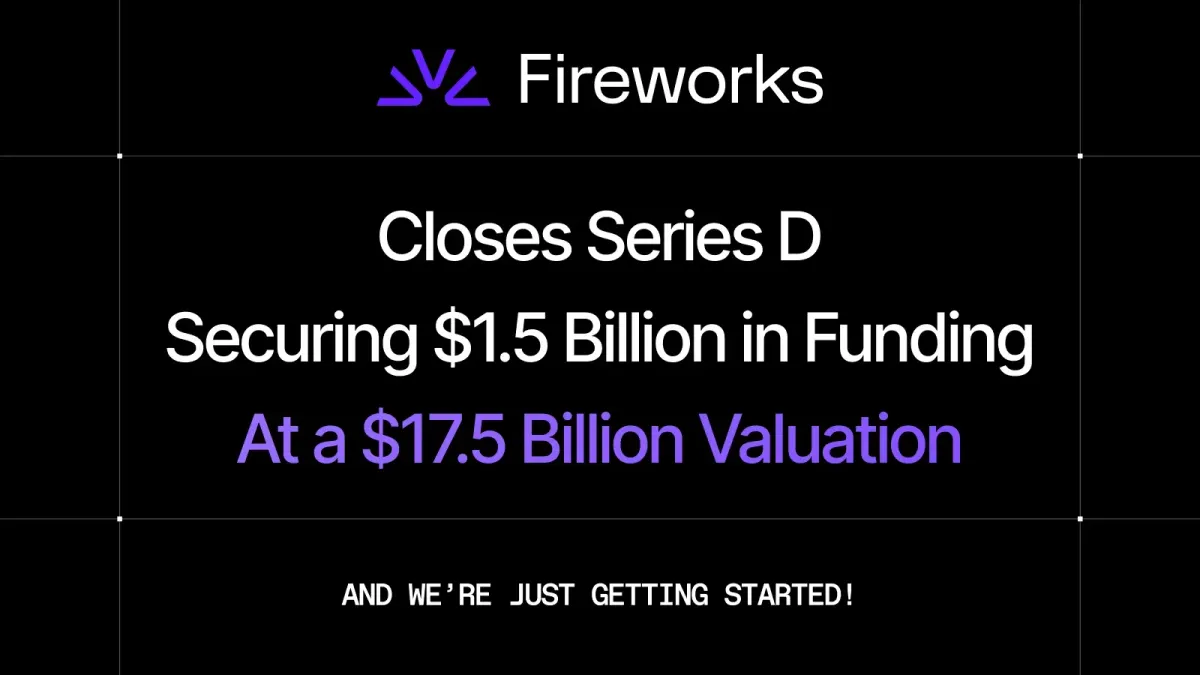
Fireworks AI just raised $1.5 billion at a valuation seven times higher than it had ten months ago, on the argument that companies would rather own a customized model than rent someone else's frontier one.
Fireworks AI announced a $1.505 billion Series D on July 15, 2026, at a $17.5 billion valuation, according to the company's own funding announcement. The round was led by Atreides Management, Index Ventures, and TCV, with Nvidia, Lightspeed Venture Partners, Bessemer Venture Partners, Menlo Ventures, Insight Partners, Ontario Teachers' Pension Plan, and Lone Pine Capital also participating. Ten months earlier, Fireworks had raised $250 million at a $4 billion valuation, a roughly 4.4x jump in valuation in under a year, according to reporting from Quartz via Yahoo Finance.
What the money is chasing
Fireworks is an AI inference infrastructure company: it takes general-purpose open models, helps enterprises fine-tune them on proprietary data, and serves the resulting custom models at scale. The company says it now processes more than 40 trillion tokens a day, up from 15 trillion a year earlier, and has crossed $1 billion in annualized revenue, up fivefold year over year. More than 95% of that token volume, per the company, comes from models that have been specialized for a specific customer's data and workload rather than general-purpose queries.
Fireworks CEO and co-founder Lin Qiao framed the pitch bluntly in comments to CNBC, reported by Quartz: "Our cost compared with the equivalent-quality closed model is five to 10 times cheaper." That is the entire thesis in one sentence. As open-weight models close the capability gap with closed frontier labs, the economic argument for fine-tuning and self-hosting a smaller, specialized model instead of paying per-token for a general one gets sharper, especially for high-volume, repetitive workloads like coding assistants, customer support, and search.
Atreides Management's Gavin Baker, whose firm co-led the round, put a more measured version of the same idea on the record: "We believe both frontier and open models will increasingly be used together." That is notably not a bet against the frontier labs. It is a bet that the market segments into two tiers, general intelligence rented from OpenAI, Anthropic, or Google, and specialized intelligence owned and run by the company that needs it, and that Fireworks captures the second tier at scale.
Who is actually using it
The company's customer list, confirmed in its funding announcement and corroborated in the Quartz report, includes Uber, Shopify, Doximity, Elastic, GitLab, and MongoDB, alongside AI-native customers Cursor and Harvey. Fireworks also struck a partnership with Microsoft in March, giving Azure customers access to models running on Fireworks' inference stack, which the company says draws compute from more than 20 supplier partners. That diversified supply chain, rather than dependence on a single cloud, is part of what let the company scale token throughput nearly 3x in a year without a single point of infrastructure failure.
The round also lands amid a broader pattern of Nvidia writing checks into the compute layer around AI rather than just selling chips into it, a strategy Edgewisely examined in the context of Nvidia's stake in Poolside, and the broader shift toward specialized GPU cloud providers competing for inference workloads.
Stakeholder read
Enterprises weighing build-versus-rent decisions now have a well-capitalized vendor explicitly selling the "own your intelligence" pitch, with reference customers across fintech, legal, and developer tools. The five-to-ten-times cost claim, if it holds under real production load, is the kind of number that reopens budget conversations enterprises had already closed around frontier-model subscriptions, part of a broader shift in how enterprise AI pricing actually works.
OpenAI, Anthropic, and Google face a structurally different kind of competition than they do from each other. Fireworks is not trying to out-benchmark GPT or Gemini; it is trying to make the underlying model choice matter less by commoditizing the layer that fine-tunes and serves whatever open model is cheapest and good enough for a given job.
Nvidia, an investor in this round as in Fireworks' prior one, has a direct interest in more inference workloads existing anywhere, on any chip, regardless of which foundation model wins. Backing infrastructure companies like Fireworks is a hedge against any single model vendor consolidating too much of the demand for compute.
Rival inference platforms Together AI and Baseten, both of which have also raised large rounds this year, are now competing for the same thesis with less capital. Fireworks' round size gives it a war chest to out-hire and out-partner in a market where enterprise sales relationships and cloud partnerships, not raw model quality, increasingly decide who wins a given customer.
Takeaways
- A $4 billion-to-$17.5 billion valuation jump in ten months reflects investor conviction that "specialized intelligence" is a distinct, defensible category from frontier model access, not a discount version of it.
- The claimed 5-10x cost advantage over closed models is the number to watch in coming quarters, since it is the entire commercial argument and has not yet been independently benchmarked at scale.
- Fireworks' bet requires open models to keep closing the quality gap with frontier ones; a sudden capability leap by a closed lab would undercut the thesis quickly.
- The Microsoft partnership signals that even hyperscalers see value in third-party inference layers rather than insisting all traffic run through their own model stacks.
The bigger picture
Every AI funding cycle produces a company that claims to have found the arbitrage between "frontier" and "affordable." What makes Fireworks notable is less the size of the round than the specificity of the customers backing the thesis with real production traffic, not pilot budgets. If specialized, self-owned intelligence really does end up running the unglamorous majority of enterprise AI workloads, the most valuable company in the stack might not be the one with the smartest model. It might be the one that made someone else's model cheap enough to actually use.
Frequently Asked Questions
How much did Fireworks AI raise and at what valuation?
Fireworks AI raised a $1.505 billion Series D round on July 15, 2026, at a $17.5 billion valuation, led by Atreides Management, Index Ventures, and TCV, with participation from Nvidia and other investors.
What does Fireworks AI actually do?
Fireworks provides AI inference infrastructure that helps companies fine-tune general-purpose open models on their own proprietary data and serve the resulting specialized models in production, often at lower cost than using closed frontier models directly.
How fast is Fireworks growing?
The company says it has surpassed $1 billion in annualized revenue, up fivefold year over year, while daily token volume processed on its platform grew from roughly 15 trillion to more than 40 trillion over the same period.
Who are Fireworks AI's customers and competitors?
Disclosed customers include Uber, Shopify, Doximity, Elastic, GitLab, MongoDB, Cursor, and Harvey. Its main competitors in the AI inference infrastructure market are Together AI and Baseten.
Editor's note — sources: Fireworks AI, "Announcing our Series D and $1B ARR," fireworks.ai/blog, July 15, 2026; Cris Tolomia, "Fireworks AI raises $1.5 billion Series D at $17.5 billion valuation," Quartz via Yahoo Finance, July 16, 2026 (citing Reuters and CNBC reporting).