
Top 7 MLOps Platforms and Tools in 2026
The 7 best MLOps platforms and tools in 2026, compared on capability, deployment and real pricing: Databricks, Amazon SageMaker, Google Vertex AI, Azure ML, Weights & Biases, DataRobot and ClearML.


Top 7 MLOps Platforms and Tools in 2026
TL;DR
- The strongest all-round MLOps platforms in 2026 are Databricks (built on the Apache 2.0 MLflow standard), Amazon SageMaker, Google Vertex AI, and Azure Machine Learning — the four with end-to-end coverage from experiment tracking to governed serving.
- For focused experiment tracking, Weights & Biases leads — now owned by CoreWeave after the acquisition completed May 5, 2025.
- Want self-hosted control with no vendor lock-in? ClearML is the open-source pick (Apache 2.0 core). For AutoML in regulated industries, DataRobot — but its pricing is quote-only.
- The whole category shifted toward agents in the last year: MLflow 3.0 added GenAI tracing, SageMaker became SageMaker Unified Studio (GA March 2025), and Vertex AI is being repositioned as an agent platform.
MLOps platforms manage the machine-learning lifecycle — tracking experiments, versioning models and data, running training pipelines, deploying models, and monitoring them in production. In 2026 the leaders are the three hyperscaler suites (SageMaker, Vertex AI, Azure ML), the Databricks lakehouse built around the open-source MLflow standard, the specialist tracker Weights & Biases, the AutoML platform DataRobot, and the open-source ClearML. This guide ranks all seven on real capability, deployment options, and published pricing.
How we picked these
We ranked on five criteria, not on vendor marketing:
- Breadth of lifecycle coverage — experiment tracking, pipelines, model registry, serving, and monitoring in one place.
- Deployment flexibility — SaaS, self-hosted, or open source, and how locked-in you are.
- Pricing transparency — whether you can see a number before a sales call.
- Adoption — only where the vendor publishes named customers or usage figures.
- Current status — GA, actively developed, and not quietly deprecated.
We make no claim about sponsorship or paid placement. Pricing and feature claims are stated as of October 2026 and link to primary sources.
Quick comparison
| Platform | Best for | Deployment | Pricing model |
|---|---|---|---|
| Databricks | Lakehouse + MLflow standard | SaaS (multi-cloud) + OSS core | Consumption (DBU) |
| Amazon SageMaker | AWS-native teams | SaaS (AWS only) | Per-second compute |
| Google Vertex AI | GCP + GenAI builders | SaaS (GCP only) | Usage-based |
| Azure ML | Microsoft-stack enterprises | SaaS (Azure only) | Compute/storage only |
| Weights & Biases | Experiment tracking | SaaS + self-hosted | Free tier + paid; Enterprise quote |
| DataRobot | AutoML, regulated industries | SaaS + self-managed | Pricing on request |
| ClearML | Self-hosted, no lock-in | OSS self-host + SaaS | Freemium |
1. Databricks
Databricks is the data-and-AI lakehouse whose open-source MLflow project became the default experiment-tracking and model-registry standard across the industry. MLflow 3.0, released in 2025, added native GenAI tracing and evaluation, and Unity Catalog provides one governance layer spanning data, models, and GenAI assets. Mosaic AI handles agent and LLM serving. The platform runs on AWS, Azure, and GCP.
The distinctive point: MLflow's core is Apache 2.0 and stewarded under the Linux Foundation, so you can self-host tracking and the registry independent of Databricks, then adopt the managed platform when you need governance and serving at scale.
Best for: Teams that want the MLflow standard plus a full governed platform.
Pros
- MLflow core is Apache 2.0 and genuinely self-hostable, independent of the paid platform.
- Unity Catalog gives a single governance layer across data, ML, and GenAI.
- MLflow 3.0 unifies classic experiment tracking and LLM tracing in one tool.
Cons
- DBU consumption pricing is opaque and hard to forecast.
- The newest GenAI evaluation features ship Databricks-managed-first before reaching OSS.
- Steep learning curve across the full lakehouse stack.
2. Amazon SageMaker
Amazon SageMaker is AWS's managed ML platform: training, hyperparameter tuning, Pipelines, a model registry, real-time and batch inference, plus Clarify for bias and explainability and Model Monitor for drift. As of March 13, 2025 it is wrapped in SageMaker Unified Studio, a single IDE that merges data, analytics, ML, and Bedrock agent building, backed by SageMaker Catalog and a lakehouse.
Billing is per-second on the underlying instances, which avoids idle-cluster cost but spreads charges across many line items — training, storage, inference, and Studio compute — so total cost is hard to predict.
Best for: Enterprises already standardized on AWS.
Pros
- Deep native AWS security and data integration (IAM, VPC, KMS).
- Built-in governance tooling: Clarify for bias, Model Monitor for drift.
- Per-second billing avoids paying for idle clusters.
Cons
- AWS-only — no multi-cloud or self-hosted option.
- Many separate billable line items make total cost hard to forecast.
- Migrating from classic Studio to Unified Studio adds transitional complexity.
3. Google Vertex AI
Google Vertex AI unifies classic ML and GenAI: a Model Garden of 200+ models including Gemini, managed training, a Feature Store, Kubeflow-based Pipelines, a model registry, and serving endpoints. In the last year Google has been repositioning it — the product is now surfaced as the Gemini Enterprise Agent Platform (formerly Vertex AI), with agent-building tools headlining the pitch.
That rebrand is worth flagging for buyers: the classic MLOps capabilities are intact and GA, but the positioning increasingly centers on agents rather than traditional model training.
Best for: GCP teams building on Gemini and GenAI alongside classic ML.
Pros
- Native Gemini plus a large third-party Model Garden in one console.
- Usage-based pricing with no separate platform fee.
- ML pipelines and agent tooling live in the same product.
Cons
- The rebrand blurs the "MLOps platform" vs "agent platform" line for evaluators.
- Enterprise-scale training and serving require contacting sales rather than self-serve pricing.
- GCP-only, with no self-hosted option.
4. Azure Machine Learning
Azure Machine Learning is Microsoft's managed ML workspace: a visual designer, AutoML, pipelines, a model registry, managed endpoints, and a responsible-AI dashboard. It is converging with Azure AI Foundry and Prompt Flow for agent and GenAI workflows. Microsoft states there is no extra charge for the ML service itself — you pay only for the compute and storage you consume.
That consumption model means there is no flat tier pricing to read off the page; you have to model the specific compute SKUs you will run.
Best for: Enterprises standardized on the Microsoft and Azure stack.
Pros
- No platform fee beyond the compute and storage you use.
- Integrates with Azure's enterprise identity and compliance stack (Entra ID, private networking).
- Responsible-AI and fairness dashboards are built in.
Cons
- Azure-only, with no self-hosted option.
- True cost requires modeling compute SKUs, since no flat pricing is published.
- Overlapping branding with Azure AI Foundry creates product-boundary confusion.
5. Weights & Biases
Weights & Biases is the specialist leader in experiment tracking, model and dataset versioning, hyperparameter sweeps, and collaborative reports. Its client library is open source, and it offers both SaaS and self-hosted or dedicated deployments. The company publishes strong adoption numbers: more than 1 million AI practitioners at 1,400+ companies, including OpenAI, Meta, and NVIDIA, and over 1 billion tracked runs.
The ownership changed in 2025. CoreWeave (Nasdaq: CRWV) acquired W&B, with the deal completed May 5, 2025. The product continues under its own name inside "CoreWeave Forge," and the FAQ states self-hosted and dedicated deployments are unchanged, though SaaS sign-in now routes through CoreWeave.
Best for: ML research and engineering teams that want best-in-class tracking.
Pros
- Vendor-published scale: 1M+ practitioners, 1,400+ companies, 1B+ runs.
- Remains cloud-agnostic post-acquisition — not locked to CoreWeave compute.
- Self-hosted and dedicated deployment still offered unchanged.
Cons
- The core product now depends on CoreWeave's roadmap and ownership.
- The pricing page has been merged into CoreWeave's site, adding navigation friction.
- The Enterprise tier is quote-only, with no published number.
6. DataRobot
DataRobot is an enterprise AutoML and MLOps platform: automated feature engineering, a model-comparison leaderboard, deployment, and drift and bias monitoring. It has added an "Agentic AI Platform" layer and, through its February 2025 acquisition of Agnostiq, folded in the open-source Covalent distributed-compute engine (Apache 2.0). It offers both SaaS and self-managed or on-prem deployment.
The catch is commercial transparency: DataRobot publishes no list pricing. Everything is a custom quote, which makes it hard to budget before engaging sales.
Best for: Regulated enterprises (finance, insurance, healthcare) wanting AutoML plus governance.
Pros
- Strong automated model comparison and bias/drift monitoring for regulated use.
- Offers self-managed and on-prem deployment, not SaaS-only.
- The Covalent compute engine is genuinely open source (Apache 2.0).
Cons
- No published pricing anywhere — fully custom-quote, hard to budget.
- Heavy sales-led positioning versus self-serve competitors.
- Steep learning curve across the full AutoML and governance stack.
7. ClearML
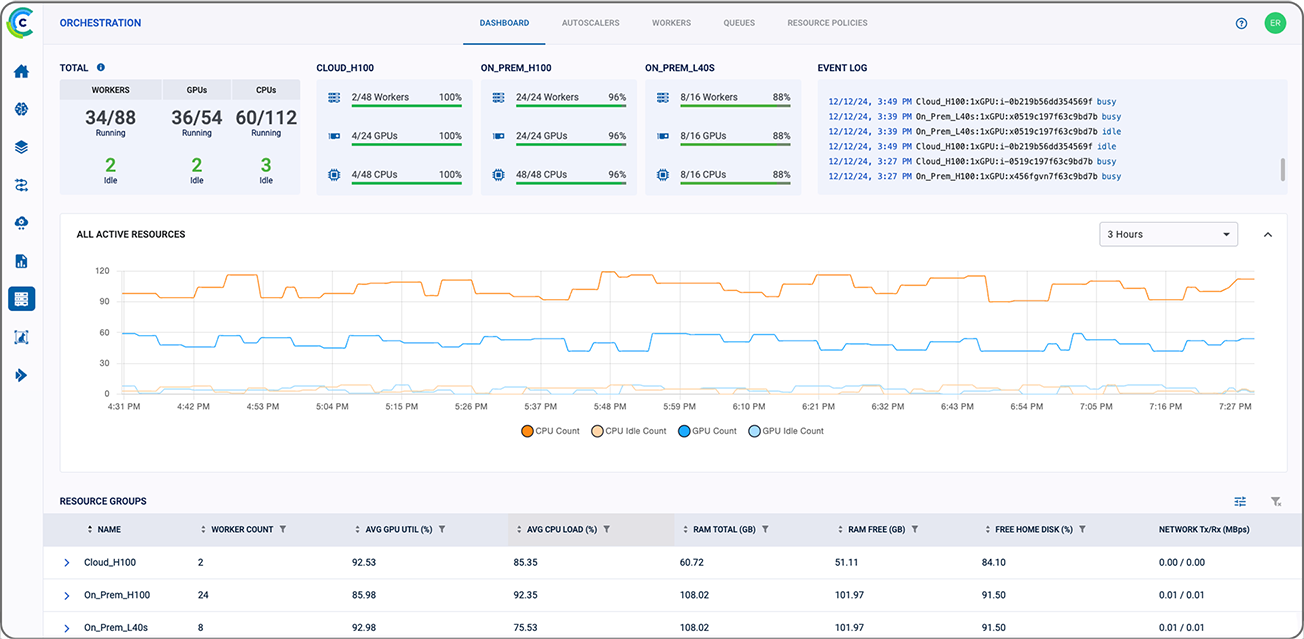
ClearML is the open-source-first MLOps option: experiment tracking, orchestration and pipelines, GPU cluster and queue management, a model repository, and a newer GenAI App Engine for LLM app serving. The core is Apache 2.0 and fully self-hostable, with hosted SaaS tiers on top. The company (formerly Allegro AI) reports 2,100+ organizations and 300,000+ users, naming Ulta Beauty, Bumble, Mobileye, NVIDIA, AMD, and IBM.
Its built-in GPU cluster and queue orchestration — with visual job management — is a genuine differentiator for teams running their own hardware rather than renting managed clusters.
Best for: Teams wanting self-hosted MLOps with no vendor lock-in.
Pros
- Fully self-hostable core under Apache 2.0 — no lock-in required.
- Built-in GPU cluster and queue orchestration with a visual dashboard.
- Free Community tier with real production features, not a crippled trial.
Cons
- Self-hosting means operating your own infrastructure at scale.
- Scale and Enterprise tiers gate advanced governance and support behind custom quotes.
- Smaller ecosystem and brand recognition than Databricks, AWS, or Google.
How to choose
- You want the industry-standard tooling and a full platform: Databricks. MLflow is the safe default for tracking, and you can start open-source.
- You are already on one cloud: use that cloud's native suite — SageMaker on AWS, Vertex AI on GCP, Azure ML on Azure. Integration and billing will be simplest.
- You mainly need experiment tracking and collaboration: Weights & Biases, with the caveat that it now sits inside CoreWeave.
- You want self-hosted control and no lock-in: ClearML, if you can operate the infrastructure.
- You are in a regulated industry and want AutoML: DataRobot — but get the quote early.
If you also run large models in production, pair your platform with a dedicated model serving framework and, for LLM work, an LLM observability tool. Teams fine-tuning their own models should also review the leading LLM fine-tuning platforms, and anyone standardizing training data should look at ML feature stores.
Frequently Asked Questions
What is MLOps?
MLOps (machine learning operations) is the set of practices and tools for taking machine-learning models from experiment to production reliably. It covers experiment tracking, data and model versioning, training pipelines, deployment, and production monitoring for drift and performance — the ML equivalent of DevOps for software.
How does MLOps differ from DevOps?
DevOps ships and operates software; MLOps does the same for models, plus the parts software lacks. Models depend on data and retraining, degrade through drift, and need experiment tracking, data versioning, and continuous monitoring of prediction quality. MLOps extends DevOps practices with these ML-specific concerns.
What is the difference between MLOps and LLMOps?
MLOps covers the full machine-learning lifecycle for any model type. LLMOps is the subset focused on large language models — prompt management, retrieval, token-cost control, tracing, and output evaluation. In 2026 the lines are blurring: MLflow, SageMaker, and Vertex AI now all ship GenAI and agent tooling alongside classic MLOps.
Which MLOps platform is best for a small team?
For a small team, start with open-source MLflow (via Databricks or self-hosted) or ClearML's free Community tier — both give real tracking and registry features at no cost. If you are already on one cloud, that cloud's native suite avoids extra integration. Weights & Biases offers a free tier for experiment tracking.
Are there free and open-source MLOps tools?
Yes. MLflow (Apache 2.0) is the most widely used open-source MLOps tool and self-hostable. ClearML's core is Apache 2.0 with a free Community tier. DataRobot's Covalent compute engine is Apache 2.0. Weights & Biases offers a free tier, and its client library is open source.
Editor's note — sources: Databricks MLflow and pricing (databricks.com), AWS SageMaker product and pricing pages plus the SageMaker Unified Studio GA announcement (aws.amazon.com), Google Vertex AI (cloud.google.com), Azure Machine Learning product page (azure.microsoft.com), Weights & Biases and the CoreWeave acquisition FAQ (coreweave.com), DataRobot product pages and the Agnostiq acquisition (datarobot.com), and ClearML product and pricing pages (clear.ml). Pricing and feature claims verified October 2026 and subject to change.