
Top 7 AI Data Annotation and Labeling Platforms in 2026


Every large language model and computer vision system still depends on humans labeling data somewhere upstream — the question in 2026 is which vendor does it accurately, at scale, and without becoming a liability.
Data annotation and labeling platforms turn raw text, images, video, and sensor data into the structured, human-verified examples that machine learning models train and evaluate against. As frontier labs shift budget from pretraining toward reinforcement learning and evaluation, the annotation category has split: some vendors chase high-skill RLHF and agentic-eval work for AI labs, others focus on volume labeling for computer vision and autonomous systems, and a few serve regulated industries like healthcare where annotator credentials matter as much as throughput. This roundup compares seven platforms that data science and ML engineering teams evaluate most often in 2026, ranked on verifiable evidence of scale, specialization, and platform maturity — not marketing claims.
How we picked these
We looked for platforms with a documented product (not just a labeling workforce), verifiable funding or revenue signals, and a clear customer base beyond a single anchor client. We prioritized vendors with a distinct specialization — RLHF and eval work, multimodal and physical-AI data, healthcare-grade annotation, or breadth of managed workforce — over platforms that only compete on price. Ranking reflects our own assessment of platform maturity, verifiable traction, and specialization depth as of September 2026. We did not accept payment or in-kind consideration from any company in this article, and no vendor reviewed this list before publication.
Quick comparison
| Company | Best for | Deployment | Pricing model |
|---|---|---|---|
| Scale AI | Enterprises needing a full data + GenAI platform | Managed cloud platform | Custom enterprise contracts |
| Labelbox | Frontier labs building RL environments and evals | Cloud platform, self-serve and enterprise | Usage-based and custom enterprise plans |
| Encord | Multimodal and physical-AI / robotics data | Cloud and on-prem/VPC options | Custom enterprise contracts |
| Surge AI | Large frontier-lab RLHF programs | Managed service, not self-serve | Custom, sales-led only |
| iMerit | Healthcare and regulated-industry annotation | Managed workforce + platform | Custom enterprise contracts |
| Appen | Global-scale, multilingual data collection | Managed workforce platform | Custom enterprise contracts |
| SuperAnnotate | Mid-market teams building an internal labeling pipeline | Cloud platform, self-serve and enterprise | Tiered plans plus custom enterprise |
1. Scale AI
Best for: enterprises that want one platform spanning data labeling, evaluation, and GenAI application building.
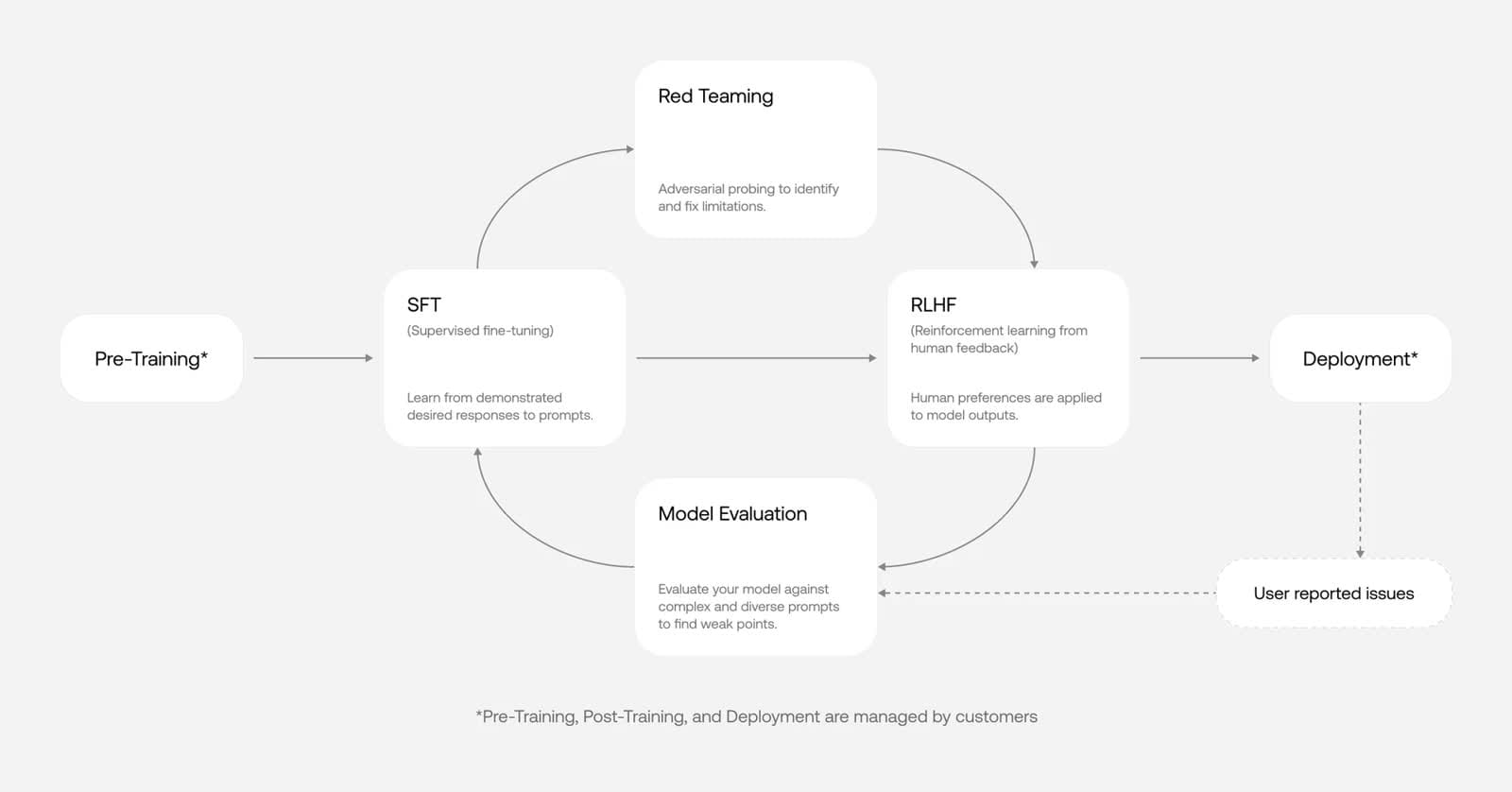
Scale AI, founded in 2016 by Alexandr Wang and Lucy Guo, built its business on the Data Engine — a labeling and data-curation platform originally built for autonomous-vehicle perception data that has since expanded into a broader GenAI Platform covering RLHF, model evaluation, and enterprise AI deployment. In June 2025, Meta acquired a 49% non-voting stake in Scale for roughly $14.3 billion, valuing the company at more than $29 billion; as part of the deal, co-founder Alexandr Wang moved to Meta to lead its new Superintelligence Labs as Chief AI Officer. Francis deSouza has since become Scale's chief executive. The company remains one of the largest and most broadly resourced players in the category, but the size and structure of the Meta stake has raised questions among some prospective customers about data-sharing and competitive-neutrality concerns when they are themselves competing with Meta's AI products.
Pros:
- Broadest product surface in the category, spanning raw data labeling through GenAI evaluation and deployment tooling
- Deep experience in autonomous-vehicle and computer-vision annotation dating back nearly a decade
- Heavily capitalized following the Meta transaction, reducing near-term funding risk
- Serves both frontier AI labs and large non-AI enterprises
Cons:
- Meta's 49% stake and Wang's move into a senior Meta AI role have prompted some AI-lab customers to reassess data-confidentiality exposure
- Enterprise-only sales motion with no published self-serve pricing
- Platform breadth can mean less specialization than narrower competitors in any single modality
2. Labelbox
Best for: AI labs and enterprises building reinforcement-learning environments and model evaluations rather than static labeling.
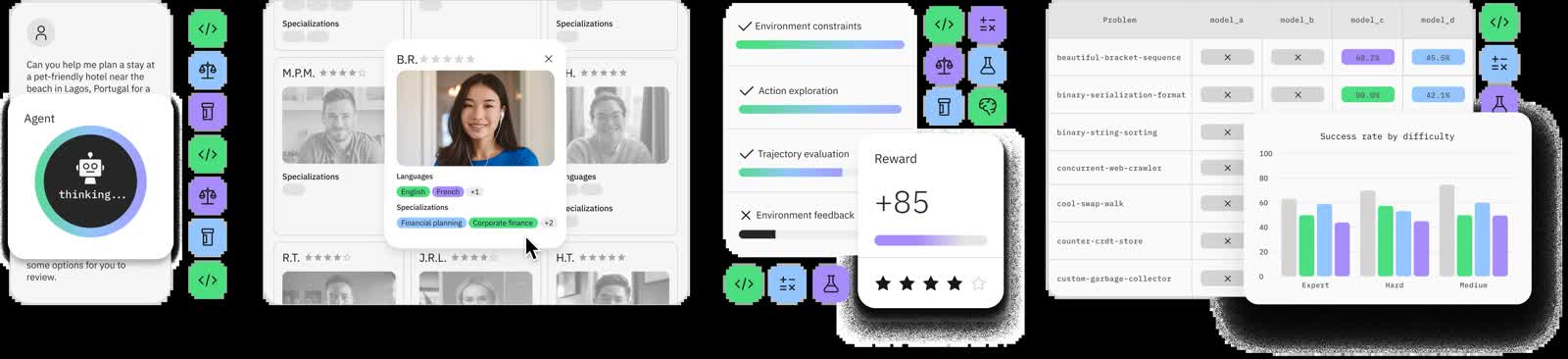
Labelbox, led by co-founder and CEO Manu Sharma, has repositioned itself away from traditional bounding-box annotation toward building RL environments, agentic-task evaluation, and human-feedback pipelines for frontier model training. The company has raised a total of $189 million in venture funding and says it works with the majority of leading AI labs building foundation models, a claim it makes about its own customer base rather than one independently verified by Edgewisely. Labelbox's platform still supports conventional image, video, and text labeling for enterprises that need it, but its go-to-market emphasis in 2026 is squarely on the RLHF and evaluation workloads that frontier labs now spend heavily on.
Pros:
- Strong specialization in RL environments and agentic evaluation, a fast-growing segment of AI lab spending
- Established relationships across multiple frontier AI labs, per company statements
- Supports both self-serve and enterprise engagement models
- $189 million in total funding provides runway for continued platform investment
Cons:
- Customer-count and "majority of AI labs" claims come from Labelbox itself and are not independently audited
- Pivot toward RLHF/eval work means less public documentation for teams that only need conventional bounding-box or segmentation labeling
- Enterprise pricing for high-touch RLHF programs is not published
3. Encord
Best for: teams working with multimodal data, video, and physical-AI or robotics training sets.

Encord raised a $60 million Series C led by Wellington Management in February 2026, bringing its total funding to $110 million. The company has built out annotation tooling specifically for multimodal data — video, medical imaging, and increasingly physical-AI and robotics datasets — alongside more conventional image and text labeling. Encord positions itself around data quality and curation tooling (finding mislabeled or low-value training examples) in addition to the labeling interface itself, and offers both cloud and private-deployment options for customers with strict data-residency requirements.
Pros:
- Recent, well-documented Series C funding ($60M, Feb 2026) signals investor confidence and near-term stability
- Differentiated focus on physical-AI and robotics data, a category with growing demand
- Data quality and curation tooling beyond raw labeling
- On-prem/VPC deployment options for data-sensitive customers
Cons:
- Smaller total funding base ($110M) than Scale AI or Labelbox, which may limit resourcing for very large enterprise programs
- Physical-AI/robotics focus is newer than its core computer-vision business, with a shorter public track record in that specific niche
- Enterprise pricing is not published and requires a sales conversation
4. Surge AI
Best for: frontier labs that need large-scale, high-skill RLHF work from a single vendor and can work through a sales-led, non-self-serve process.

Surge AI, founded in 2020 by CEO Edwin Chen (formerly of Twitter, Google, and Dropbox), has become one of the largest players in RLHF and data-labeling services for AI labs without ever raising outside venture funding — the company has remained self-funded since inception. Reporting from Forbes, TIME, and other outlets puts Surge's 2024 revenue at roughly $1.2 billion, with customers reported to include Google and Anthropic. Unlike most of the platforms in this list, Surge does not operate a public self-serve product, published pricing, or extensive marketing site; its business is built around direct, sales-led engagements with large AI labs, which makes it harder for smaller teams to evaluate or engage the company independently.
Pros:
- Reported 2024 revenue of roughly $1.2 billion suggests substantial scale and customer trust among frontier labs
- Fully self-funded since 2020, meaning no outside investor pressure on strategy or exit timeline
- Deep specialization in high-skill RLHF and expert-annotator work
Cons:
- No public pricing, self-serve signup, or detailed product documentation, making it difficult for smaller teams to evaluate the platform without a direct sales engagement
- Revenue and customer figures come primarily from press reporting rather than audited company disclosures
- Limited visibility into which specific frontier labs remain active customers at any given time
5. iMerit
Best for: healthcare, life sciences, and other regulated industries that need annotators with domain credentials.
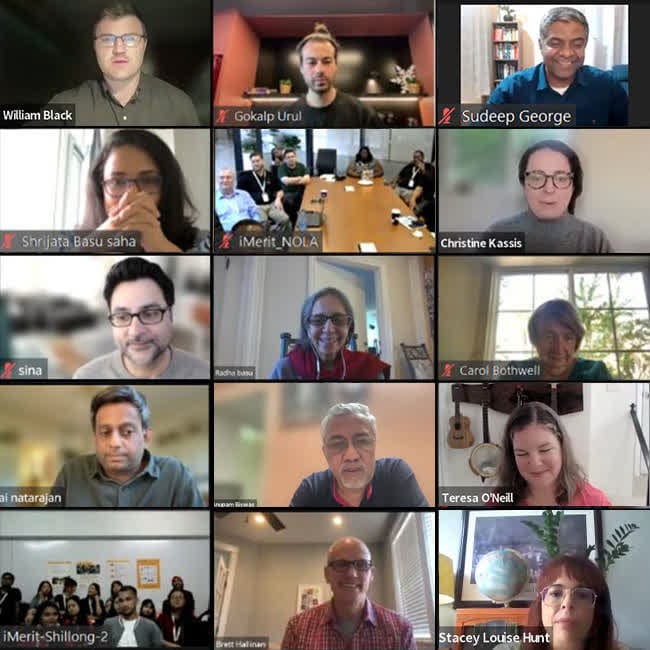
iMerit was founded in 2012 by Radha Basu and has built a workforce of more than 10,000 annotators, with particular depth in healthcare imaging, geospatial data, and other domains where subject-matter expertise affects label quality. In August 2026, business-process outsourcing firm EXL completed its acquisition of iMerit in a deal valued at up to $310 million, with Basu joining EXL as an executive vice president to continue leading the iMerit business. The acquisition gives iMerit access to EXL's larger enterprise sales infrastructure and existing customer relationships in regulated industries, though it also means the business is no longer an independent company charting its own roadmap.
Pros:
- Strong specialization in healthcare and other regulated-industry annotation, where credentialed annotators matter
- Large managed workforce (10,000+) supports high-volume programs
- Now backed by EXL's larger enterprise sales and delivery infrastructure post-acquisition
Cons:
- As a newly acquired business unit rather than an independent company, iMerit's product roadmap and pricing may shift under EXL's ownership
- Less public-facing self-serve tooling than platform-first competitors like Labelbox or SuperAnnotate
- Deal value of "up to $310 million" suggests an earnout structure, meaning the final price is contingent on performance milestones
6. Appen
Best for: teams that need broad multilingual, global-scale data collection and want the transparency of a publicly listed vendor.

Appen is one of the longest-running companies in this category, with roughly three decades of experience in data collection, annotation, and linguistic services. It is listed on the Australian Securities Exchange (ASX: APX), which means its financials are subject to standard public-company disclosure requirements — a level of transparency most competitors in this list do not offer. Appen's core strength remains breadth: global crowd-sourced workforce coverage across languages and locales for search relevance, speech, and computer-vision labeling programs at enterprises that need multilingual data at scale.
Pros:
- Nearly 30 years of operating history in data collection and annotation
- Public-company status (ASX: APX) provides financial transparency competitors don't offer
- Broad multilingual and global-locale workforce coverage
Cons:
- As a public company, Appen's results and strategy are subject to quarter-to-quarter market scrutiny in a way privately held competitors avoid
- Less differentiated toward newer high-growth workloads like RLHF and agentic evaluation compared with Labelbox or Surge AI
- Enterprise pricing is not published
7. SuperAnnotate
Best for: mid-market teams building an internal computer-vision or multimodal labeling pipeline who want a self-serve platform before committing to a large enterprise contract.
SuperAnnotate raised a $36 million Series B led by Socium Ventures, with participation from NVIDIA, Databricks Ventures, Play Time Ventures, and Glynn Capital. The platform focuses on annotation tooling for computer vision and multimodal data, with an emphasis on letting internal teams manage their own labeling workflows rather than outsourcing entirely to a managed workforce. Its investor list, notably including NVIDIA and Databricks Ventures, signals strategic interest from infrastructure players in the surrounding AI stack.
Pros:
- $36 million Series B with strategic investors (NVIDIA, Databricks Ventures) signals infrastructure-level validation
- Built for teams that want to run labeling internally rather than fully outsource it
- Supports both self-serve and enterprise engagement
Cons:
- Smaller disclosed funding total than Scale AI, Labelbox, or Encord, which may limit resourcing for the largest enterprise programs
- Less specialization in frontier-lab RLHF/eval workloads than Labelbox or Surge AI
- Third-party aggregators report inconsistent total-funding figures for the company beyond the disclosed $36M round, so we've limited our funding claim to the figure SuperAnnotate itself has published
How to choose
If you're a frontier AI lab building RLHF pipelines or agentic evaluations, Labelbox and Surge AI are the most specialized options, with Surge better suited to teams comfortable with a sales-led, non-self-serve engagement and higher volumes. If your data is multimodal, video-heavy, or physical-AI/robotics-oriented, Encord's recent funding and quality-tooling focus make it worth a serious look. Enterprises that want one platform spanning labeling through GenAI evaluation and deployment, and that aren't concerned about Meta's stake in the company, should evaluate Scale AI first. Healthcare and other regulated-industry teams should start with iMerit given its credentialed-annotator workforce, while teams needing broad multilingual coverage and public-company transparency should look at Appen. Mid-market teams that want to run labeling in-house rather than fully outsourcing it, and want a self-serve option before signing an enterprise contract, are best served by SuperAnnotate.
Frequently Asked Questions
What's the difference between a data labeling platform and a managed labeling workforce?
A platform (like Labelbox or SuperAnnotate) gives you tooling to manage annotators yourself, whether that's your own team or contracted labelers. A managed workforce (like Surge AI or iMerit) handles the labeling work directly with its own annotators. Several vendors in this list, including Scale AI and Encord, offer both models depending on the engagement.
Why has RLHF and evaluation work become a bigger part of this market?
As frontier labs shift spend from pretraining toward post-training alignment and evaluation, they need annotators who can judge model outputs, build RL environments, and design agentic-task evaluations, not just draw bounding boxes. Labelbox and Surge AI have both built their current business emphasis around this shift, which reflects where AI lab budgets moved through 2025 and 2026.
Does Meta's stake in Scale AI create a conflict of interest for other AI labs?
It's a legitimate question several prospective Scale customers have raised publicly, since Meta holds a 49% non-voting stake and former Scale CEO Alexandr Wang now leads Meta's AI efforts. Scale has stated Meta's stake is non-voting and doesn't grant operational control, but companies competing directly with Meta's AI products should factor this into their own vendor risk assessment.
Is Surge AI a good option for a smaller company just starting to build training data pipelines?
Probably not as a first stop. Surge operates a sales-led model without published self-serve pricing, and its scale and specialization are built around large frontier-lab RLHF programs. Smaller teams are generally better served starting with a self-serve platform like SuperAnnotate or Labelbox.
How current is the funding and pricing information in this article?
All funding, acquisition, and revenue figures cited here are current as of September 2026 and sourced from company announcements or reputable press coverage as noted in the Editor's note below. Pricing for most vendors in this category is negotiated per enterprise contract and not published, so treat any pricing-model description as directional rather than a quote.
Editor's note — sources: Company product and pricing pages for Scale AI, Labelbox, Encord, Surge AI (surgehq.ai), iMerit, Appen, and SuperAnnotate; reporting from CNBC, TechCrunch, and Forbes on the Meta–Scale AI transaction (June 2025) and Scale AI leadership changes; reporting from TIME, Inc., and the Center for Data Innovation on Surge AI's founding, funding status, and 2024 revenue; the EXL–iMerit acquisition press release (August 2026); Encord's own funding announcement for its February 2026 Series C; SuperAnnotate's Series B funding announcement.