
Top 7 API Security Platforms in 2026
For platform and AppSec teams choosing a vendor in 2026: the seven API security platforms that matter, what each actually does underneath the AI repositioning, and where each one falls down.


For platform, AppSec and infrastructure teams choosing a vendor in 2026. Two of the category's best-known names no longer exist independently, and almost every remaining vendor has bolted AI-agent security onto the pitch. Here is what each product actually does underneath the repositioning.
API security is the layer most enterprises discovered they needed only after an incident. The problem is structural: APIs expose business logic directly, so the dangerous attacks — pulling another tenant's records through a valid, authenticated request — look like normal traffic to a firewall. The seven platforms below take genuinely different approaches to that problem, from behavioural traffic analysis (Salt Security, Akamai, Cequence, Wallarm) to contract-driven enforcement (42Crunch) to proving exploitability by attacking your own APIs (APIsec, Escape). Consolidation has thinned the field considerably, so start by checking who still exists.
How we picked these
Still independent, or clearly still a product. This category consolidated hard. Noname Security was acquired by Akamai in June 2024 for roughly $450 million and no longer sells under its own name — it is now the foundation of Akamai API Security. Traceable AI merged into Harness. Wib was absorbed by F5. If you are working from a 2024 shortlist, a third of it is out of date.
Coverage of a real part of the lifecycle. Discovery, posture, testing and runtime protection are four different jobs. We picked vendors that do at least one of them distinctly well and were honest about which ones they skip.
Verifiable evidence. Named customers, published funding, or disclosed scale, each traceable to a company's own site or press release. Claims we could not check from a primary source are not in this article.
Honest about the AI pivot. Nearly every vendor here has repositioned around agentic AI and MCP security during 2026. Some of that is real capability; some is messaging. We note where the pivot has moved the product's centre of gravity, because it affects what you are actually buying. Pricing and feature claims are as of September 2026.
Quick comparison
| Company | Best for | Deployment | Pricing model |
|---|---|---|---|
| Salt Security | Large estates needing behavioural detection without touching traffic paths | Agentless SaaS | On request |
| Akamai API Security | Enterprises wanting API security inside an existing security platform | SaaS, multicloud, hybrid, on-prem | On request |
| Cequence Security | Teams that need discovery and blocking in one product | SaaS, on-prem, hybrid | On request |
| Wallarm | Teams that want detection and inline blocking together with WAAP | Hybrid: SaaS control plane, inline nodes | On request |
| 42Crunch | Organizations standardized on OpenAPI that want shift-left enforcement | IDE, CI/CD, embedded runtime firewall | Enterprise quote |
| APIsec | Teams that want proven exploits rather than findings lists | SaaS, on-prem available | Published, from $690/month |
| Escape | Engineering teams testing REST and GraphQL for business-logic flaws | SaaS | On request |
1. Salt Security
Salt Security is the longest-running pure-play vendor in the category and still the reference point most buyers compare against. Its core approach is agentless: rather than sitting inline, it ingests API traffic from infrastructure you already run — cloud load balancers, gateways, WAFs — and builds behavioural baselines over time. That matters for the attacks that defeat signature matching, where an attacker spends days quietly enumerating object IDs through entirely valid requests.

The platform is now sold as a set of modules: Salt Surface for external exposure, Salt Connect for cloud API discovery, Salt Collect for live traffic analysis, Salt Protect for blocking logic-based attacks, and Salt Code, which pushes policy into AI coding agents. Integrations include CrowdStrike, Kong, AWS, Azure Sentinel and GCP. Customer logos published on Salt's own site include Hyundai, SoFi, Flutterwave, Luxottica, Kingston Technology, Armis and Coralogix. The company has raised a $140 million Series D, per its own announcement, making it among the best-capitalised independents here.
Best for: Large API estates where deploying anything inline is politically or operationally impossible.
Pros - Agentless deployment means no proxy in the request path and no latency added to production traffic. - Behavioural baselining is designed for the low-and-slow reconnaissance that rule-based tooling misses. - Deep integration set, including a CrowdStrike partnership correlating API and endpoint telemetry. - Named customer logos across banking, automotive and fintech, published by the company itself.
Cons - Agentless coverage depends on being able to tap existing traffic sources; unusual architectures can leave blind spots. - Detection-first by design, so blocking depends on integration with enforcement points you already own. - No public pricing at any tier. - Marketing has shifted heavily toward "agentic security", which makes it harder to evaluate the core API product on its own terms.
2. Akamai API Security
Akamai entered this market by acquisition, buying Noname Security in June 2024 for approximately $450 million and rebuilding the product line around it. The result covers the full lifecycle: discovery and inventory across an estate, posture and risk assessment, and runtime attack detection. Importantly for buyers, it is vendor-neutral — the API security module works across multicloud, hybrid and on-premises environments rather than requiring traffic to route through Akamai's own edge network.
It sits alongside App & API Protector, Firewall for AI and Bot Manager in Akamai's application security portfolio, which is both the argument for it and the argument against it. Akamai is publicly traded (NASDAQ: AKAM), so vendor longevity is not a question.
Best for: Enterprises already buying Akamai security who want API coverage consolidated under one contract.
Pros - Inherits Noname's discovery and posture-management technology, which was well regarded as a standalone product. - Deployment is genuinely vendor-neutral across multicloud, hybrid and on-prem, not restricted to Akamai-delivered traffic. - Backed by a public company with an established enterprise support organization. - Natural consolidation path for teams already running Akamai's WAAP and bot products.
Cons - No longer purchasable as a focused, independent API security product — it is a line inside a large portfolio. - Roadmap priorities compete with the rest of Akamai's security business rather than being set by API security alone. - Buyers searching for Noname Security will find a brand that no longer exists, which has caused real confusion during the transition. - No public pricing.
3. Cequence Security
Cequence Security sells what it calls Unified API Protection, and the word that matters is unified: discovery, inventory, risk classification and runtime mitigation happen in one product, without handing off to a separate enforcement tool. For teams that have been burned by a detection product that could only file a ticket, that architecture is the pitch.
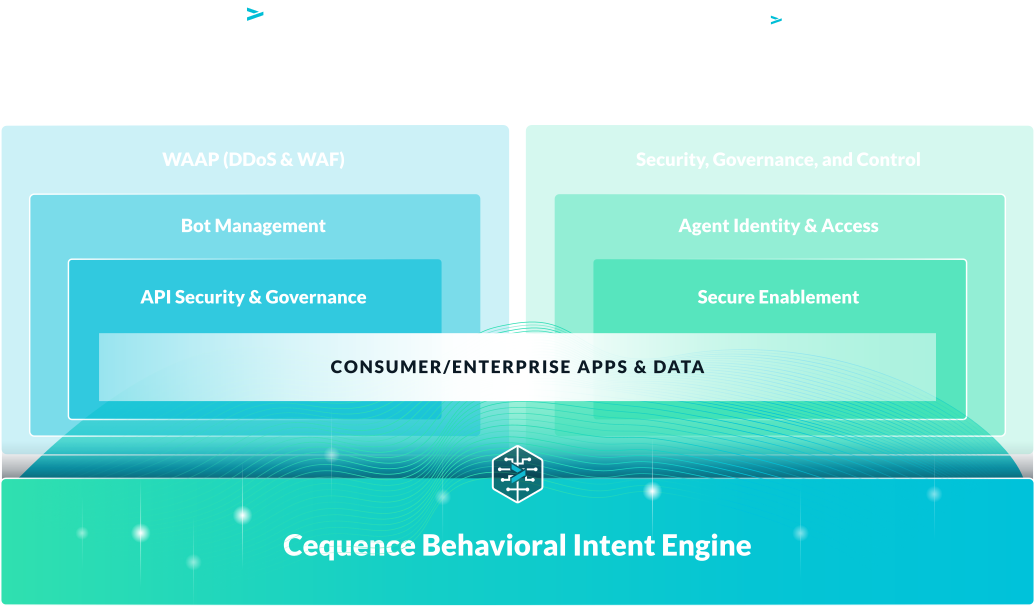
Its published scale is substantial. In its Series C announcement the company stated it protects two billion API transactions per day across more than 85 brands, including several Fortune 500 companies. That round — $60 million led by Menlo Ventures, with ICON Ventures, Telstra Ventures, HarbourVest, Shasta Ventures, Dell Technologies Capital and T-Mobile Ventures — brought total investment to $100 million. The platform now also spans bot management, WAAP, Agentic AI Governance and an AI Gateway.
Best for: Teams that want discovery and enforcement from one vendor, especially where bot abuse and account takeover are part of the threat model.
Pros - Detection and mitigation in the same product, so blocking does not depend on signalling a second tool. - Two billion API transactions per day is one of the largest disclosed processing volumes in the category. - Deploys as SaaS, on-prem or hybrid, which few competitors match. - Strategic investors from telecom and infrastructure suggest real carrier-scale deployments.
Cons - The confirmed funding disclosure dates to December 2021; we found no verified round since. - Aggregate customer claims only — no named enterprise logos in the primary funding source. - Product scope has widened considerably into AI gateway and agentic governance, so buyers should confirm exactly which modules they need and pay for. - No public pricing.
4. Wallarm
Wallarm combines API security with WAAP — web application and API protection — in a single platform covering discovery, posture management and runtime protection against OWASP API Top 10 attacks, bot abuse and API-layer denial of service. The deployment model is hybrid: a SaaS-managed control plane with enforcement nodes deployed inline in your own cloud or datacentre, which is what allows it to block rather than merely alert.
That inline position is the defining trade-off. It buys real-time enforcement at the cost of more integration work than agentless competitors require, and it puts Wallarm in the request path.
Best for: Teams that want one product covering both classic web application attacks and API-specific threats, with blocking on by default.
Pros - Inline enforcement means detection and blocking are the same deployment, not two projects. - Covers web application and API threats together, reducing tool count for smaller security teams. - Addresses bot abuse and API-layer DDoS alongside business-logic attacks. - Self-managed enforcement nodes keep traffic inspection inside a customer's own infrastructure.
Cons - Inline sensors require more integration and change management than an agentless rollout. - Being in the request path introduces an availability dependency that agentless tools avoid. - No public pricing. - Product documentation and imagery are comparatively thin publicly; we could not verify named customer references from a primary source.
5. 42Crunch
42Crunch takes the most structurally different approach on this list. Instead of learning what an API does by watching traffic, it starts from the OpenAPI contract and treats that as the source of truth. API Audit runs more than 300 static checks against the specification the moment it is written — mass assignment, weak authentication schemes, data leakage, missing resource controls — inside the developer's IDE. API Scan then tests the running implementation against the same contract. At runtime, a micro-firewall enforces the contract as a positive-security allowlist: anything undeclared is rejected, at sub-millisecond overhead.
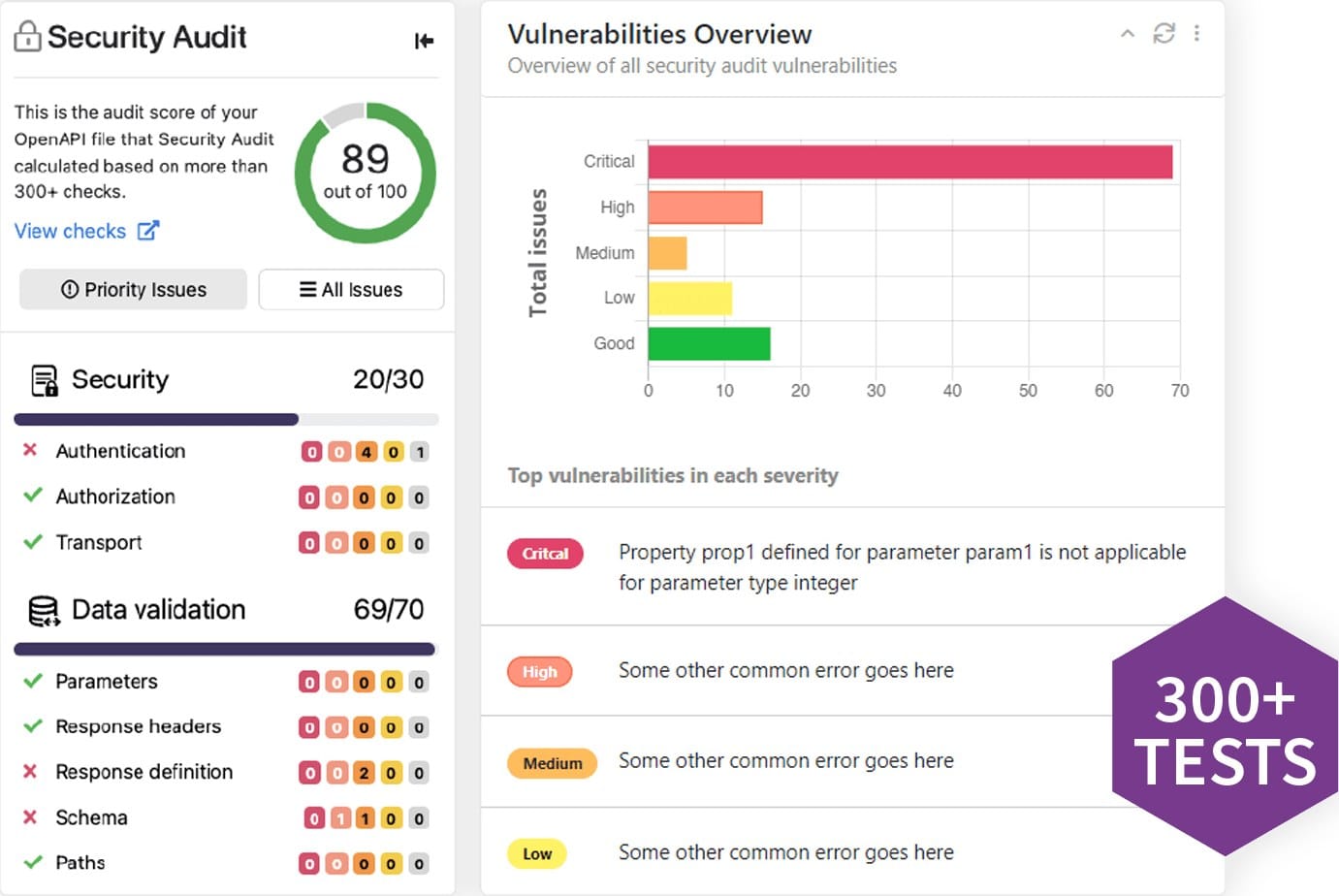
The company has been doing this since 2017 and states that 2.4 million developers use its tooling, with customer logos including Allianz, Ford, Verizon, BT, Travelers, Lenovo, Bridgestone and Checkout.com. During 2026 it extended the same contract-driven model to MCP servers, and that AI governance work now leads its marketing.
Best for: Engineering organizations with mature OpenAPI discipline that want security enforced in CI/CD rather than discovered in production.
Pros - Positive-security enforcement derived from the contract blocks undeclared paths and parameters without signature updates. - Catches vulnerabilities at design time, before implementation exists, which is materially cheaper than fixing them in production. - Security Quality Gates fail a build the way a broken test does, giving security a real enforcement point in the pipeline. - Named enterprise customers across insurance, automotive and telecom, published on its own site.
Cons - Value depends on OpenAPI coverage. APIs without maintained contracts get substantially less benefit. - Weaker on broad behavioural threat-hunting across an existing estate than the traffic-analysis vendors above. - The 2026 repositioning toward MCP and AI governance now dominates the site, and API security has become the secondary story. - Platform pricing is enterprise-scoped and quote-only; only individual developers using the AI coding plugins get a self-serve option.
6. APIsec
APIsec answers a different question from everyone above: not what is exposed, but what an attacker can actually reach. The platform discovers applications and their APIs, builds a model of how each one works — endpoints, authentication flows, role and permission matrices, object ownership — then generates and executes attacks against that model. What comes back is a validated exploit with the request sequence, the data reached, and a replay, rather than a list of possible findings.
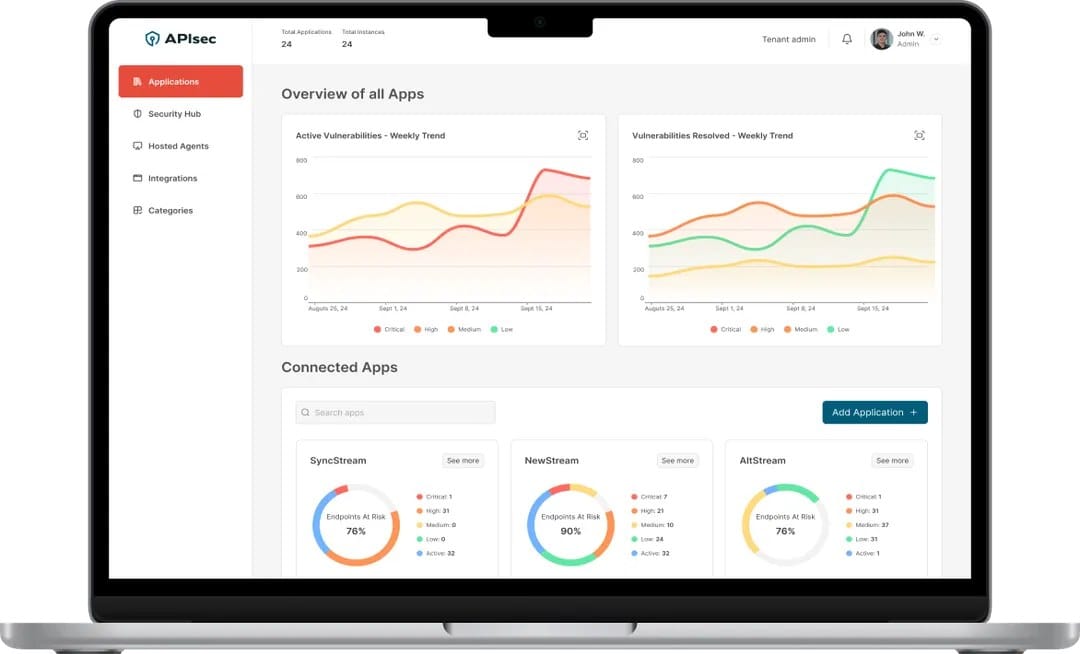
The company makes a specific engineering claim worth noting: it uses models to reason about the application and generate attacks, but not to decide whether an attack succeeded. Execution is the arbiter, which is what makes results reproducible. APIsec states it is used by 75% of the Fortune 100 and 10,000+ organizations, with customer logos including Nike, FedEx, Johnson & Johnson, Bank of America, Tesla and Coca-Cola. It also runs APIsec University, which it says has over 150,000 practitioners.
Best for: Security teams tired of triaging scanner output who need proof of exploitability to get engineering to act.
Pros - Publishes real pricing: a free tier, Standard at $690 per month per 100 endpoints, Pro at $2,750 per month per 100 endpoints, and custom bug-bounty engagements. That transparency is rare here. - Deterministic, replayable results — the same application tested twice returns the same verdict. - Tests business-logic flaws including BOLA and broken role enforcement, not just injection payloads. - Free self-serve signup with no credit card, so teams can evaluate without a sales cycle.
Cons - Testing, not runtime protection. It tells you what is exploitable; something else has to block it. - Per-endpoint pricing scales awkwardly for very large API estates — a thousand endpoints on Pro is a substantial annual line item. - Private API testing requires deploying a hosted agent, and on-prem is custom-priced. - Like several vendors here, messaging has expanded toward agentic and AI application security, broadening the product story.
7. Escape
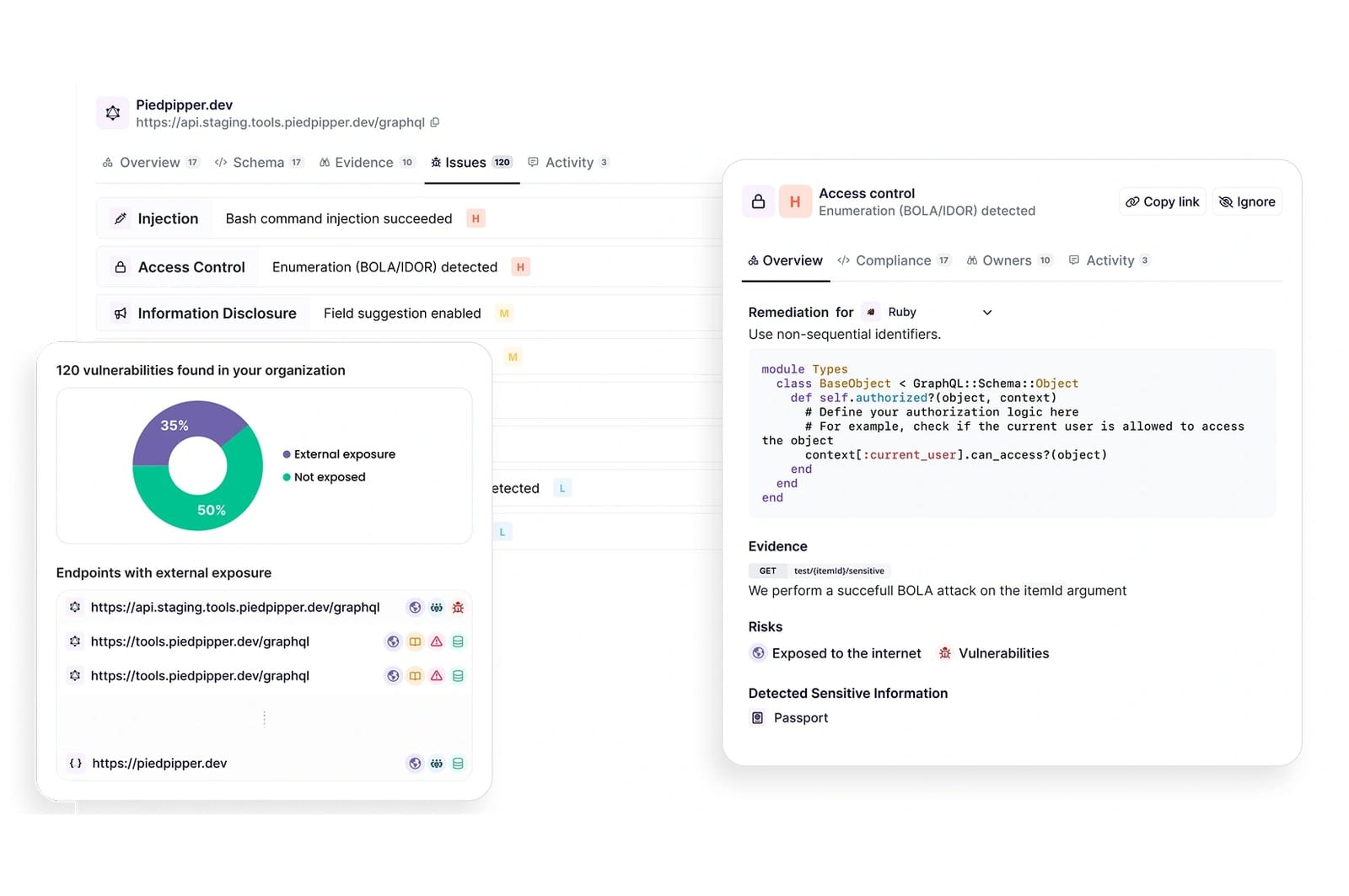
Escape is the newest company on this list and the most specific about what it does well. Its business-logic-aware DAST holds multiple authenticated sessions simultaneously while testing, which is how it catches broken object-level authorization — the flaw where user A can read user B's records through a perfectly valid request. It has first-class GraphQL support, covering batching and alias abuse, deeply nested queries and resolver-level access-control failures, and the team maintains the open-source GraphQL Armor project.
In March 2026 Escape announced an $18 million Series A led by Balderton Capital, with Uncorrelated Ventures, IRIS and Y Combinator participating, alongside a rebrand toward AI-native offensive security. The company states it is used by 2,000+ security teams; named customers include Miro, HealthEquity, Schibsted, Visma, PandaDoc and Arkose Labs.
Best for: Engineering teams with significant GraphQL surface, or anyone whose main worry is authorization logic rather than injection.
Pros - Multi-session testing targets authorization flaws that single-session scanners structurally cannot find. - Genuine GraphQL depth, backed by an open-source project the team maintains publicly. - Returns proof of exploitability — request chains and exploitation graphs — rather than severity-scored maybes. - Available through AWS Marketplace, which simplifies enterprise procurement.
Cons - Smallest company here by disclosed funding, which matters for teams weighing multi-year vendor risk. - Now positions itself as an offensive security platform spanning DAST, AI pentesting and attack surface management; API security is one solution area rather than the whole product. - Testing only — no runtime protection or blocking. - Rebranded in 2026, so older third-party reviews describe a different positioning. No public pricing.
How to choose an API security platform
Start with what you are actually missing, because these tools are not substitutes for each other.
If you do not know what APIs you have, you need discovery, and the traffic-analysis vendors solve that best. Salt Security is the safest choice when nothing may go inline. Akamai makes sense if you already buy Akamai security and want one contract. Cequence is the strongest single-vendor answer when you need discovery and blocking together.
If you know what you have and need to stop attacks in real time, Wallarm and Cequence both enforce inline. Expect an integration project, not a deployment.
If your organization writes OpenAPI specifications and means it, 42Crunch converts that discipline into enforcement — failing builds and rejecting undeclared traffic at runtime. Without contract discipline, the value drops sharply.
If your problem is that nobody fixes the findings you already have, APIsec and Escape both produce proven exploits rather than probabilities, and a working exploit ends an argument with engineering faster than a CVSS score. APIsec is the broader platform with published pricing; Escape is stronger on GraphQL and authorization logic.
Two things to check in every evaluation. First, ask each vendor precisely which parts of the AI and agentic story are shipping today versus roadmap — the repositioning across this category in 2026 has been near-universal and is not uniformly backed by product. Second, confirm how API security fits with the rest of your stack rather than duplicating it, particularly if you already run a CNAPP for cloud posture or guardrails tooling in front of model endpoints. These layers overlap at the edges and paying twice for the same coverage is common.
Frequently Asked Questions
What is API security?
API security is the practice of protecting application programming interfaces from abuse: discovering every API an organization exposes, checking its configuration and authorization logic for weaknesses, and detecting or blocking attacks at runtime. It is distinct from web application security because APIs expose business logic directly, so many attacks use entirely valid requests.
How do you secure APIs?
Four things, in order. Inventory every API including undocumented and deprecated ones. Enforce authentication and object-level authorization on every endpoint. Test both the specification and the running implementation before release. Then monitor production traffic for behavioural abuse. Most breaches trace to a missing authorization check on an API nobody knew was live.
What is API security testing?
API security testing probes an API for exploitable flaws rather than inspecting live traffic. Static testing analyses the OpenAPI contract before code exists; dynamic testing attacks the running service. The hardest class to find is business-logic flaws such as broken object-level authorization, which require holding multiple authenticated sessions to detect.
Is an API gateway enough for API security?
No. A gateway handles authentication, routing and rate limiting, but it does not know that a valid, authenticated request is reading another tenant's records. Gateways also miss shadow APIs deployed outside them entirely. Most of these platforms integrate with gateways rather than replacing them.
Why is API security important?
Because APIs are now the primary interface to business data, and the attacks against them look legitimate. An attacker with valid credentials enumerating object IDs generates traffic no firewall flags. As AI agents increasingly call APIs autonomously, the volume of machine-to-machine traffic — and the blast radius of a single authorization mistake — grows considerably.
Editor's note — sources
Company claims verified against salt.security, akamai.com, cequence.ai, wallarm.com, 42crunch.com, apisec.ai and escape.tech, including Cequence's Series C press release, Escape's March 2026 Series A announcement, APIsec's published pricing page, and 42Crunch's platform, pricing and API security testing pages. Acquisition facts — Noname Security by Akamai, Traceable AI by Harness, Wib by F5 — reflect publicly reported transactions. Customer names, certifications and scale figures are as published by each company. Pricing and feature claims are accurate as of September 2026.