
Top 7 AI Guardrails and LLM Security Platforms in 2026
Cisco AI Defense, Palo Alto Networks Prisma AIRS, Lakera, HiddenLayer, TrueFoundry, NVIDIA NeMo Guardrails, and Guardrails AI compared after a year of acquisitions reshaped the category.
Who this is for: security and platform teams deciding how to stop prompt injection, data leakage, and unsafe agent output before it reaches production — and what changed after two of the category's founders got acquired inside the last twelve months.
AI guardrails sit between a model (or an agent) and the outside world, inspecting what goes in and what comes out. That can mean blocking prompt injection, redacting personal data, catching jailbreak attempts, or stopping an agent from calling a tool it shouldn't. The category consolidated hard through 2025 and into 2026: Cisco bought Robust Intelligence, Palo Alto Networks bought Protect AI, and Check Point bought Lakera. What's left is a mix of large security-vendor platforms, open-source toolkits, and guardrail features built into adjacent infrastructure like AI gateways. Here's how the seven that matter compare as of August 2026: Cisco AI Defense, Palo Alto Networks Prisma AIRS, Lakera, HiddenLayer, TrueFoundry, NVIDIA NeMo Guardrails, and Guardrails AI.
How we picked these
We prioritized products with documented runtime enforcement (not just pre-deployment scanning), a real customer or open-source adoption footprint, and public documentation we could verify claims against. We ranked by breadth of AI-security lifecycle coverage first (discovery, scanning, runtime protection), then by how proven the runtime-guardrail piece specifically is, since that's the part directly comparable across all seven.
Quick comparison
| Company | Best for | Deployment | Pricing model |
|---|---|---|---|
| Cisco AI Defense | Enterprises standardizing AI security on Cisco's broader security stack | SaaS, integrates with Cisco Security Cloud | Custom quote by AI application count and package tier |
| Palo Alto Networks Prisma AIRS | Full AI lifecycle security (model scanning through runtime) in one platform | SaaS, part of Prisma/Strata portfolio | Custom quote |
| Lakera | Fast, focused prompt-injection and jailbreak detection | API/SaaS, self-hosted option for restricted environments | Free tier; paid and enterprise tiers on request |
| HiddenLayer | ML model security plus AI runtime protection under one vendor | SaaS, on-prem, or air-gapped | Free limited tier; custom enterprise pricing |
| TrueFoundry | Teams that want guardrails enforced at the AI gateway alongside routing and observability | Self-hosted in customer's cloud, or managed | Gateway pricing; guardrails included as a gateway feature |
| NVIDIA NeMo Guardrails | Teams that want to self-build programmable guardrails without a vendor | Self-hosted, open source (Apache 2.0) | Free |
| Guardrails AI | Developers who want a lightweight validator library plus a hub of community checks | Self-hosted OSS, or Guardrails Pro managed service | Free OSS; Pro pricing on request |
1. Cisco AI Defense
Cisco AI Defense is what's left of Robust Intelligence after Cisco's roughly $400 million acquisition closed in October 2024. It's now sold as a full-lifecycle product spanning AI application discovery, model and pipeline validation, and runtime guardrails that catch prompt injection, malicious URLs, model denial-of-service attempts, off-topic responses, and code-generation risks. Cisco has also integrated it with NVIDIA NeMo Guardrails so customers can layer Cisco's detection models on top of NeMo's open policy framework.
Best for: large enterprises that already run Cisco security infrastructure and want AI risk folded into the same operational model.
Pros
- Covers the full lifecycle — discovery, pre-deployment validation, and runtime — not just one stage
- Backed by Cisco's existing enterprise security sales, support, and compliance relationships
- Detects a wide range of runtime threats beyond prompt injection, including model DoS and off-topic abuse
- Integrates with NVIDIA NeMo Guardrails rather than replacing it, giving customers an open extension point
Cons
- No public pricing — every deal requires a custom quote tied to AI application count and package tier
- Standalone Robust Intelligence is gone; customers must adopt the Cisco AI Defense product wrapper even if they only want the original runtime engine
- Deepest value requires buying into the broader Cisco Security Cloud ecosystem, which is a heavier commitment than a point solution
2. Palo Alto Networks Prisma AIRS
Palo Alto Networks folded Protect AI, acquired for a reported $650–700 million in July 2025, into Prisma AIRS, its AI security platform. The combined product covers model vulnerability scanning, automated red-teaming, and runtime protection, positioning Palo Alto as a single vendor for end-to-end AI risk rather than requiring separate tools for each lifecycle stage.
Best for: organizations that want model-supply-chain scanning and runtime guardrails from one vendor with an established security platform.
Pros
- Combines Protect AI's model and pipeline scanning with runtime enforcement in one platform
- Automated red-teaming capability goes beyond passive detection into proactive testing
- Backed by one of the largest cybersecurity vendors, with mature enterprise procurement and support paths
Cons
- No public pricing published; requires a sales-led custom quote like Cisco's offering
- Protect AI's previously independent, developer-friendly open-source tooling (including the now-archived LLM Guard project) has been absorbed into the broader platform rather than kept as a standalone lightweight option
- Best fit for organizations already invested in Palo Alto's Strata/Prisma portfolio; less compelling as a narrow point solution
3. Lakera
Lakera was acquired by Check Point in September 2025 and continues to operate its Guard product as a focused, real-time API for detecting direct and indirect prompt injection in LLM inputs and reference content. The company reports detection rates above 98% with sub-50ms latency and a false-positive rate under 0.5%, figures it publishes itself rather than an independently audited benchmark. It offers a free tier for single-endpoint integration, with self-hosted and enterprise tiers priced separately for compliance-restricted environments.
Best for: teams that want a narrow, fast, purpose-built prompt-injection detector rather than a broad security platform.
Pros
- Purpose-built specifically for prompt injection and jailbreak detection, with low reported latency
- Free tier available for initial integration and testing
- Self-hosted option exists for environments that can't call an external API
- Now backed by Check Point's security infrastructure and go-to-market
Cons
- Detection-rate and latency figures are vendor-reported, not third-party audited
- Narrower scope than full-lifecycle platforms — no model scanning or red-teaming built in
- Paid enterprise and self-hosted pricing isn't published; requires direct sales contact
4. HiddenLayer
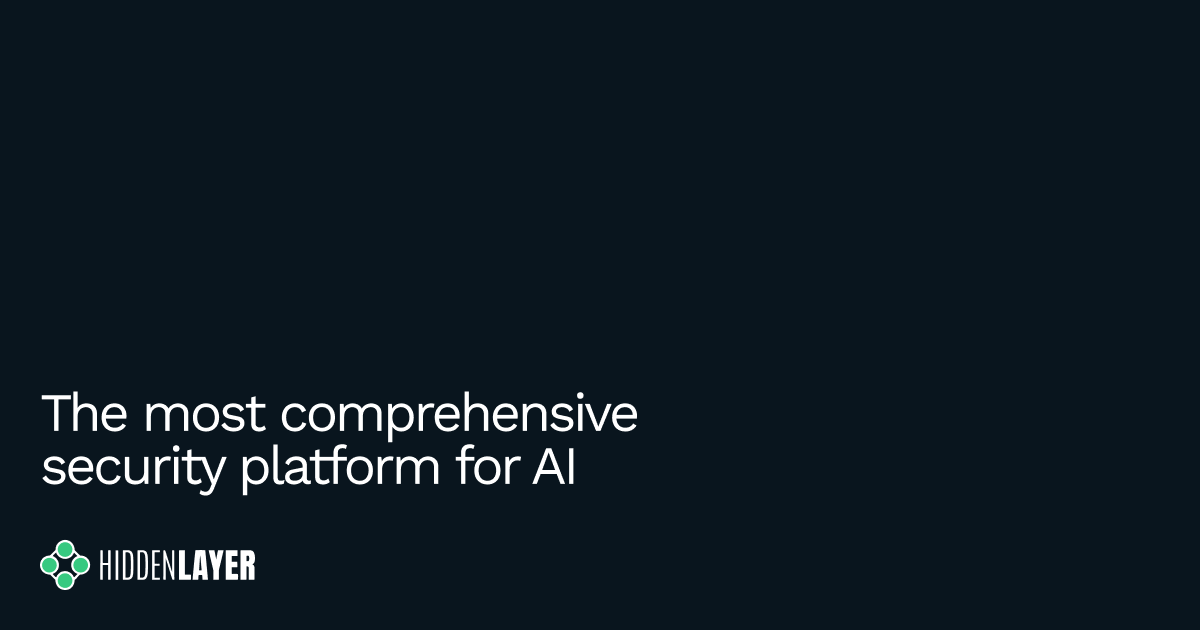
HiddenLayer raised a $50 million Series A and built its platform around securing the full AI stack — discovery of AI assets, supply-chain scanning of models and datasets, adversarial attack simulation, and runtime security for agentic, generative, and predictive AI. It can deploy as SaaS, on-prem, or fully air-gapped, which distinguishes it from cloud-only competitors for regulated or classified environments.
Best for: organizations needing air-gapped or on-prem deployment for AI security, not just SaaS.
Pros
- Deployment flexibility (SaaS, on-prem, air-gapped) that most competitors on this list don't match
- Covers the model supply chain and runtime in one product rather than bolting the two together via acquisition
- Independent company rather than a division absorbed into a much larger security portfolio, which can mean faster product iteration
Cons
- Pricing is entirely custom-quoted; published tier information is thin and inconsistent across sources
- Smaller company than Cisco or Palo Alto Networks, with less enterprise-support infrastructure and fewer existing platform integrations
- Less public third-party benchmarking of detection accuracy than the category's larger, longer-established players
5. TrueFoundry
TrueFoundry doesn't sell guardrails as a standalone security product — it builds them into its AI Gateway and Agent Gateway, which route and observe every LLM call, agent action, and MCP tool invocation from a control plane that runs inside the customer's own cloud. Guardrail rules apply at the input stage (masking PII, filtering prohibited content) and output stage (blocking or rewriting unsafe responses), running in either validate (block) or mutate (modify) mode. Rather than building its own detection models, TrueFoundry integrates third-party engines — Azure PII and Content Safety, AWS Bedrock Guardrails, OpenAI Moderations, Patronus, and policy engines like OPA and Cedar — plus custom guardrail servers, evaluated in sequence with first-match-wins semantics.
Best for: teams that want guardrail enforcement co-located with model routing and observability in one gateway, rather than as a separate security layer to integrate and maintain.
Pros
- Guardrails apply at the same control point as routing and cost tracking, so there's one policy surface instead of two systems to keep in sync
- Self-hosted in the customer's own cloud, which matters for teams that can't send traffic to a third-party SaaS scanner
- Pulls in multiple established detection engines (Azure, AWS, OpenAI, Patronus) rather than locking customers into one vendor's classifier
- Extends guardrail enforcement to agent tool calls and MCP invocations, not just chat completions
Cons
- Not a standalone AI-security product — there's no model scanning, red-teaming, or AI-asset discovery; guardrails are one feature of a broader gateway, not the core product
- Detection quality depends on the third-party engines it wraps (Azure, AWS, Patronus) rather than a proprietary detection model, so accuracy for a given threat is only as good as the underlying integration
- Adopting the guardrails means adopting the AI Gateway itself — teams that only want a guardrail layer without a gateway will find it a bigger footprint than a point solution like Lakera or Guardrails AI
- Public case studies specifically quantifying guardrail-detection accuracy (as opposed to gateway cost savings) are limited
6. NVIDIA NeMo Guardrails
NeMo Guardrails is NVIDIA's open-source, Apache 2.0-licensed toolkit for adding a programmable policy layer between an application and its LLM. It lets teams define explicit rules — don't discuss certain topics, follow a fixed dialog path, extract structured output — using a configuration language (Colang) rather than hand-rolled prompt engineering, and works across multiple model providers, not just NVIDIA's own stack. It has around 6,500 GitHub stars and is maintained directly by NVIDIA.
Best for: teams that want full control over guardrail policy definition without paying a vendor, and are comfortable maintaining it themselves.
Pros
- Fully open source under Apache 2.0, with no usage fees or vendor lock-in
- Model-agnostic — works with OpenAI, Llama, and other providers, not tied to NVIDIA hardware or hosted models
- Programmable policy language gives fine-grained control over exactly what's allowed and blocked
- Backed by NVIDIA's engineering resources and integrated into Cisco AI Defense as an extension point
Cons
- No managed service or enterprise support tier from NVIDIA — you own detection accuracy, latency, and uptime
- Defining and maintaining Colang policies takes real engineering investment compared to a plug-and-play vendor API
- No built-in threat-intelligence feed or continuously updated detection models the way commercial vendors provide
7. Guardrails AI
Guardrails AI is a Python framework built around "Guards" — input and output checks assembled from a catalog of more than 65 community-built validators covering hallucination detection, PII, jailbreaks, and content moderation, distributed through the Guardrails Hub. The core framework and hub are open source and free; Guardrails Pro adds hosted validation, observability dashboards, and enterprise support on top.
Best for: developers who want a lightweight, composable validator library they can assemble themselves without adopting a full security platform.
Pros
- Free, open-source core with a large (65+) catalog of pre-built community validators
- Composable design — pick only the checks relevant to your use case instead of an all-or-nothing platform
- Clear upgrade path to Guardrails Pro for teams that outgrow self-hosting
Cons
- Validator quality varies since many come from the community rather than a single accountable vendor
- No built-in runtime threat intelligence or model-supply-chain scanning — it's a validation library, not a full AI-security platform
- Guardrails Pro pricing isn't publicly listed, requiring direct contact for cost details
How to choose
If you need one vendor to cover AI asset discovery, model scanning, and runtime protection end to end, Cisco AI Defense and Palo Alto Networks Prisma AIRS are the two genuine full-lifecycle platforms, and the choice between them will likely come down to which security vendor you already run. If prompt injection specifically is your top concern and you want the fastest path to a working detector, Lakera is the most narrowly focused option. Teams needing air-gapped or on-prem deployment for compliance reasons should look at HiddenLayer first. If you're already running (or plan to run) an AI gateway for routing and cost control, TrueFoundry lets you enforce guardrails at that same layer instead of standing up a separate system — with the tradeoff that you're adopting a gateway, not just a guardrail. And if budget is the constraint or you want full control over policy logic, NeMo Guardrails and Guardrails AI are both free, open-source, and self-hostable, with NeMo suited to teams wanting programmable dialog control and Guardrails AI suited to teams that just want a composable validator library.
This roundup pairs naturally with our recent coverage of the 7 best AI gateways and LLM observability and tracing tools, since guardrails, gateways, and observability are increasingly sold — and evaluated — together. See also our companion piece on the top 7 AI agent frameworks, since agentic tool-calling is exactly what several of these guardrail products were built to police.
Frequently Asked Questions
What's the difference between AI guardrails and AI security platforms like Cisco AI Defense?
Guardrails specifically refer to runtime checks on model input and output. Full AI security platforms like Cisco AI Defense and Prisma AIRS include guardrails as one component, alongside earlier-stage capabilities like model and pipeline vulnerability scanning and automated red-teaming.
Can I use more than one of these together?
Yes, and many organizations do — for example, running NeMo Guardrails or Guardrails AI as a self-built policy layer while also running a commercial platform like HiddenLayer for model-supply-chain scanning that the open-source tools don't cover.
Why did so many guardrails companies get acquired recently?
Robust Intelligence (Cisco, October 2024), Protect AI (Palo Alto Networks, July 2025), and Lakera (Check Point, September 2025) were all acquired within about a year of each other, reflecting large security vendors moving to add AI-specific detection to their existing platforms rather than building it from scratch.
Is TrueFoundry a replacement for a dedicated AI security vendor?
No. TrueFoundry's guardrails are a policy-enforcement feature of its AI Gateway, built on integrations with engines like Azure Content Safety and AWS Bedrock Guardrails, not a standalone security platform with model scanning or red-teaming. It fits teams that want guardrails enforced where they're already routing model traffic.
Are open-source guardrail toolkits like NeMo Guardrails production-ready?
Yes, but "production-ready" here means you're responsible for maintaining detection accuracy and policy coverage yourself. NeMo Guardrails is Apache 2.0-licensed and maintained by NVIDIA, but it doesn't ship a managed service or support SLA the way commercial vendors do.
Editor's note — sources: Cisco, Palo Alto Networks, Lakera, HiddenLayer, TrueFoundry, NVIDIA/GitHub, Guardrails AI, and independent coverage from Gartner Peer Insights, BankInfoSecurity, and Strategy of Security, all linked inline above.