
Top 7 LLM Evaluation Tools for 2026
Seven LLM evaluation tools for 2026, compared on evaluation depth, deployment, licensing and pricing - Braintrust, LangSmith, Langfuse, Arize Phoenix, DeepEval, Comet Opik and Promptfoo, with real pros and cons for each.


TL;DR
- Best commercial LLM evaluation platform: Braintrust — CI-integrated scorers and datasets; free tier, Pro $249/mo.
- Best open source: Langfuse (MIT) and Comet Opik (Apache-2.0) — self-hostable, with the cheapest cloud tiers here.
- Best as code: DeepEval — Apache-2.0, pytest-native evals that run in CI.
- Watch out: the category consolidated in 2026 — Arize (Dynatrace), Langfuse (ClickHouse), Galileo (Cisco) and Promptfoo (OpenAI) were all acquired; Patronus and Humanloop exited evaluation entirely.
LLM evaluation is how you measure whether a model, prompt, or AI app actually does its job — scoring outputs against test datasets, using LLM-as-judge and custom metrics, and catching regressions before they ship. For 2026 the tools worth your time are Braintrust, LangSmith, Langfuse, Arize Phoenix, DeepEval (Confident AI), Comet Opik, and Promptfoo — a mix of commercial platforms and open-source frameworks.
Evaluation overlaps with production observability, but it is a distinct job. Observability tells you what your LLM app did in production; evaluation tells you whether the output was good, ideally in CI before users ever see it. Most tools here do both, so we weighted each on the depth of its evaluation workflow, not just its tracing.
One thing to watch going in: this category consolidated fast in 2026. Four of these seven tools were acquired this year, and two names you might expect — Patronus AI and Humanloop — are no longer viable eval products. Ownership shapes pricing and roadmap, so it belongs in your evaluation, not just the feature list.
How we picked these
We ranked tools on four criteria: evaluation depth (datasets, LLM-as-judge, custom scorers, CI/regression gates), deployment flexibility (open source and self-host vs SaaS-only), pricing transparency, and adoption. We also tracked ownership, because this category consolidated hard in 2026: Arize was acquired by Dynatrace, Langfuse by ClickHouse, Galileo by Cisco (now Splunk), and Promptfoo by OpenAI. We dropped two names you may expect — Patronus AI, which retired its evaluation product, and Humanloop, which shut down after Anthropic hired its team in 2025. Pricing and licenses are as of November 2026.
Quick comparison
| Tool | Best for | Deployment | Pricing model |
|---|---|---|---|
| Braintrust | Eval-first commercial workflow | SaaS (on-prem on Enterprise) | Per GB + scores; free tier |
| LangSmith | Broad offline + online evals | SaaS, hybrid, self-host | Per seat + traces; free tier |
| Langfuse | Open-source eval + tracing | SaaS or self-host (MIT core) | Per unit; free tier |
| Arize Phoenix | OpenTelemetry-native evals | Self-host (ELv2) or SaaS | Free OSS; AX from $50/mo |
| DeepEval (Confident AI) | Pytest-style CI evals | Local OSS or SaaS | Apache-2.0; SaaS from $200/mo |
| Comet Opik | Cheap OSS eval platform | Self-host or SaaS | Apache-2.0; cloud from $19/mo |
| Promptfoo | CLI evals + red-teaming | Local OSS or SaaS | OSS; enterprise on request |
1. Braintrust
Braintrust is built eval-first rather than observability-first. It gives you built-in scorers (its open-source autoevals), LLM-as-judge, custom code scorers, and dataset management, and it can run evals on every pull request so a regression fails CI. A prompt playground and an AI assistant that suggests prompts and datasets round it out. It also does full production tracing, but the evaluation workflow is the center of gravity. Named customers include Notion, Replit, and Cloudflare.
Best for: AI engineering teams that want a dedicated, CI-integrated evaluation workflow.
Pros - Transparent public pricing with a free Starter tier ($10 model credits, 10k scores) and unlimited users. - First-class scorers, datasets, and CI regression runs on every PR. - Online scoring of production traces with LLM judges.
Cons - Closed source; on-prem deployment is Enterprise-only. - Billing is per GB processed plus per 1,000 scores, which is harder to forecast than per-seat. - Starter retention is only 14 days.

2. LangSmith
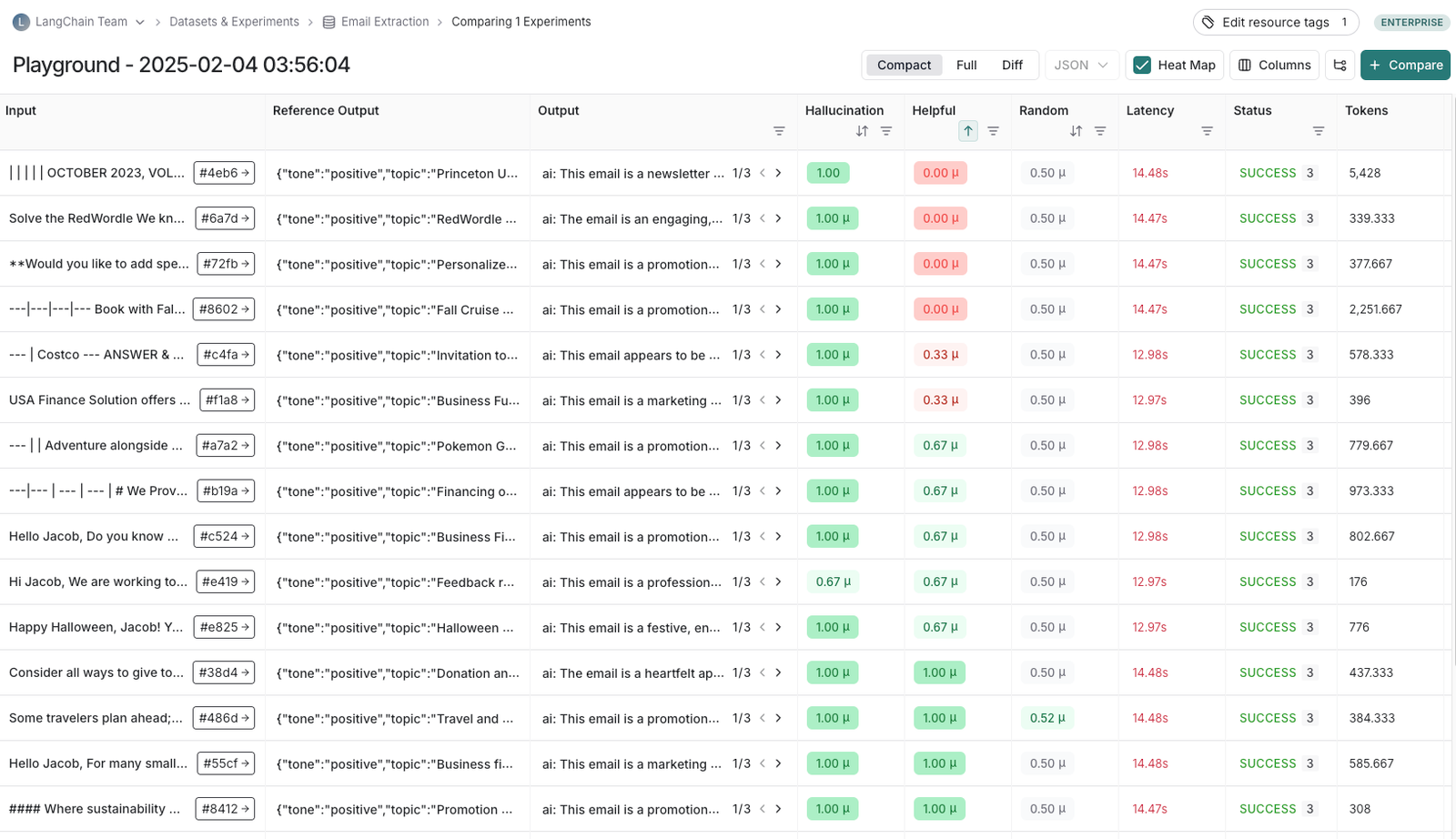
LangSmith from LangChain has the broadest evaluation surface here. Datasets can come from curated examples, production traces, or synthetic data, and offline experiments support human review, code rules, LLM-as-judge, and pairwise comparison. Online evaluators run against live traffic with sampling filters, and a Studio helps debug agents. It traces non-LangChain apps too, but the pull toward the LangChain/LangGraph ecosystem is real. LangChain raised a Series B at a $1.25B valuation in late 2025 and remains independent.
Best for: teams already building on LangChain, or anyone wanting offline and online evals in one tool.
Pros - Offline and online evals with human, LLM-judge, and pairwise evaluators. - Hybrid and fully self-hosted deployment options exist (self-host is Enterprise). - Large, well-funded, independent vendor with heavy adoption.
Cons - Pricing combines per-seat ($39/seat/mo on Plus) and per-trace charges, and per-trace overage rates are not listed publicly. - Self-hosting and hybrid are gated to Enterprise. - Strongest ergonomics still favor the LangChain stack.
3. Langfuse
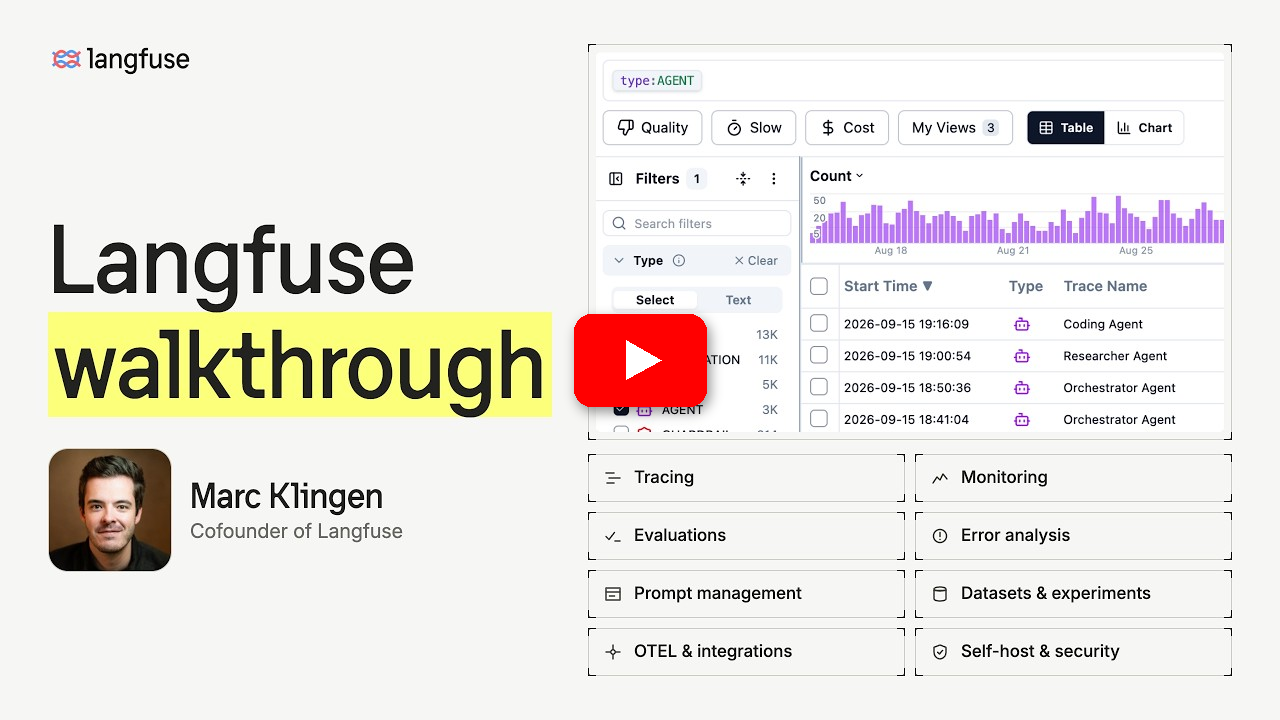
Langfuse is the most-adopted open-source option, pairing tracing with a real evaluation toolkit: LLM-as-judge on live traces, code evaluators, datasets and experiments, annotation queues, and a GitHub Action that fails a job with a RegressionError when scores miss a threshold. The core is MIT-licensed and self-hostable via Docker, Helm, or Terraform. ClickHouse acquired Langfuse in January 2026; the team says it stays open source with no planned licensing changes.
Best for: teams that want open-source, self-hostable evaluation plus tracing.
Pros - MIT-licensed core (some enterprise features live in separately-licensed ee folders), fully self-hostable. - CI regression gate via an official GitHub Action. - Cheap, transparent cloud tiers starting at $29/mo (a free Hobby tier covers 50k units/month).
Cons - The ClickHouse acquisition adds some roadmap-direction uncertainty. - Enterprise features are not under the MIT license. - Fewer prebuilt scorers than dedicated eval-first tools.
4. Arize Phoenix
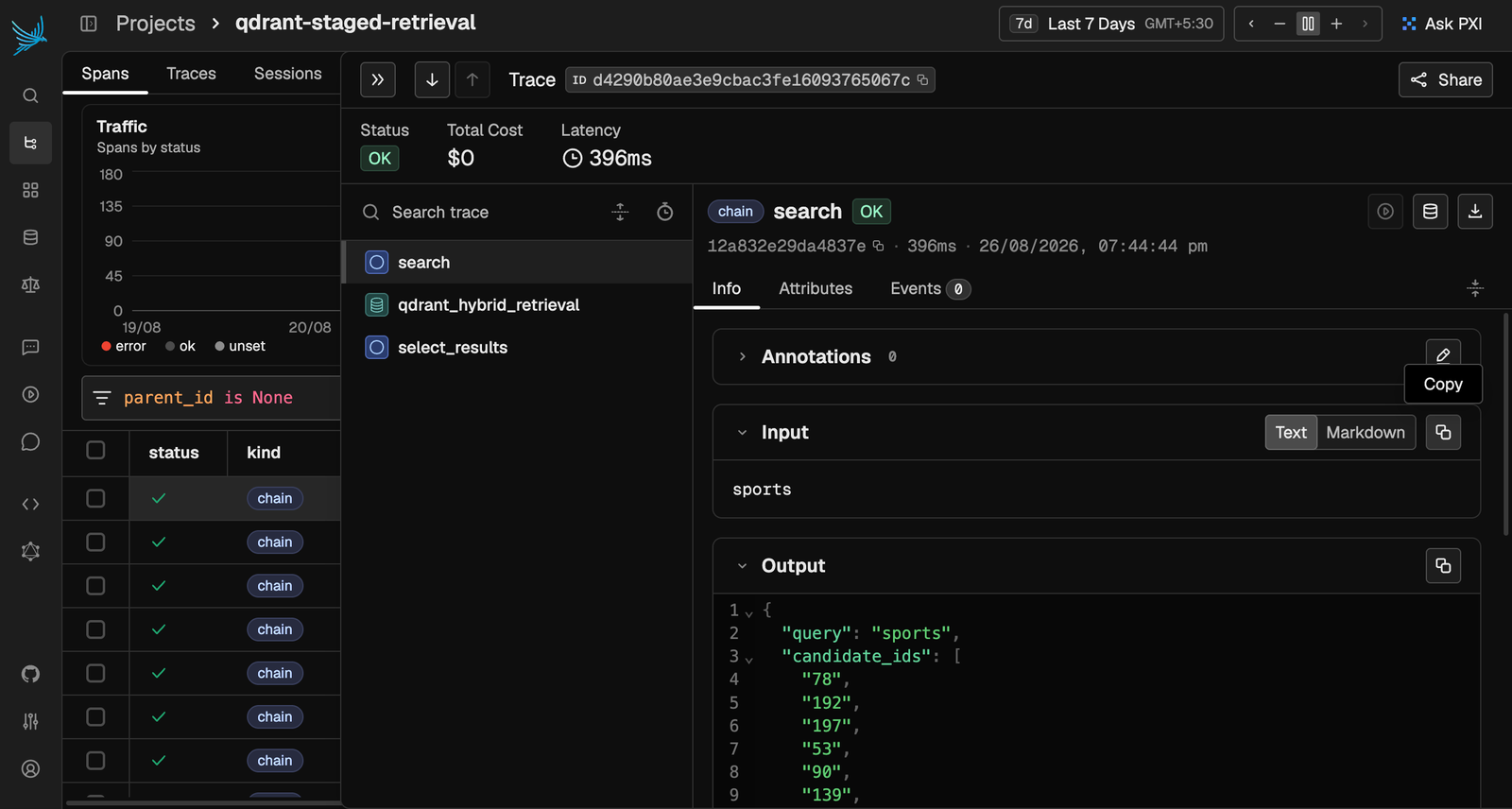
Arize Phoenix is the OpenTelemetry-native choice. Phoenix is a self-hostable tool for AI tracing and evaluation, with an arize-phoenix-evals package of LLM-based and dataset evaluators and integrations with libraries like Ragas and DeepEval. It is built on OpenInference, whose GenAI instrumentation was donated to OpenTelemetry in 2026. The hosted product, Arize AX, adds a managed tier. Note the license: Phoenix uses Elastic License 2.0, which is source-available, not OSI open source. Dynatrace completed its acquisition of Arize in October 2026; Phoenix remains available as an open project.
Best for: teams standardizing on OpenTelemetry who want portable instrumentation.
Pros - Free, self-hostable Phoenix with strong OTel/OpenInference tracing. - Integrates third-party eval libraries (Ragas, DeepEval, Cleanlab). - Managed Arize AX free tier covers 25k spans/month; Pro is $50/mo.
Cons - Phoenix is ELv2 (source-available), not OSI open source — check the terms before you assume freedom. - Now Dynatrace-owned, so direction and pricing may shift. - Evaluation depth is lighter than the eval-first commercial tools.
5. DeepEval (Confident AI)
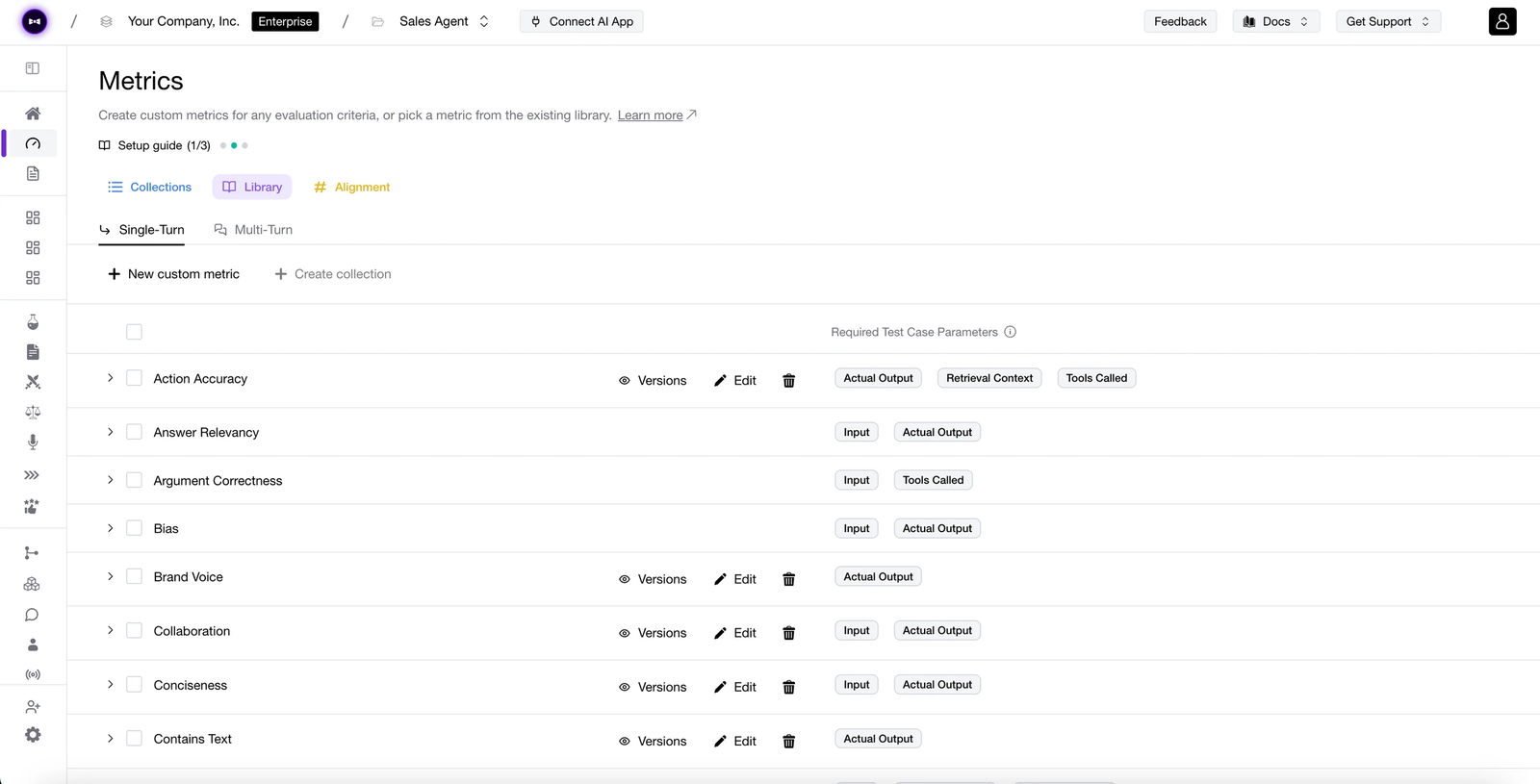
DeepEval is an Apache-2.0 open-source evaluation framework that works like pytest: you write LLM "unit tests" with a large library of metrics (faithfulness, answer relevancy, hallucination, RAG metrics, and more) and run them in CI. Confident AI is the hosted platform on top, adding online evals, trace grading, and team features. For engineers who want evaluation to live in their existing test suite rather than a separate dashboard, this is the most natural fit.
Best for: engineering teams that want evaluation as code, inside CI.
Pros - Apache-2.0 and pytest-native — evals run in your existing test pipeline. - Large built-in metric library, including RAG-specific scorers. - Transparent SaaS tiers and an independent vendor.
Cons - The free SaaS tier allows only 5 test runs per week. - A steep jump from $200/mo Starter to $2,000/mo Team. - LLM-as-judge metrics bill your own judge-model tokens on top.
6. Comet Opik
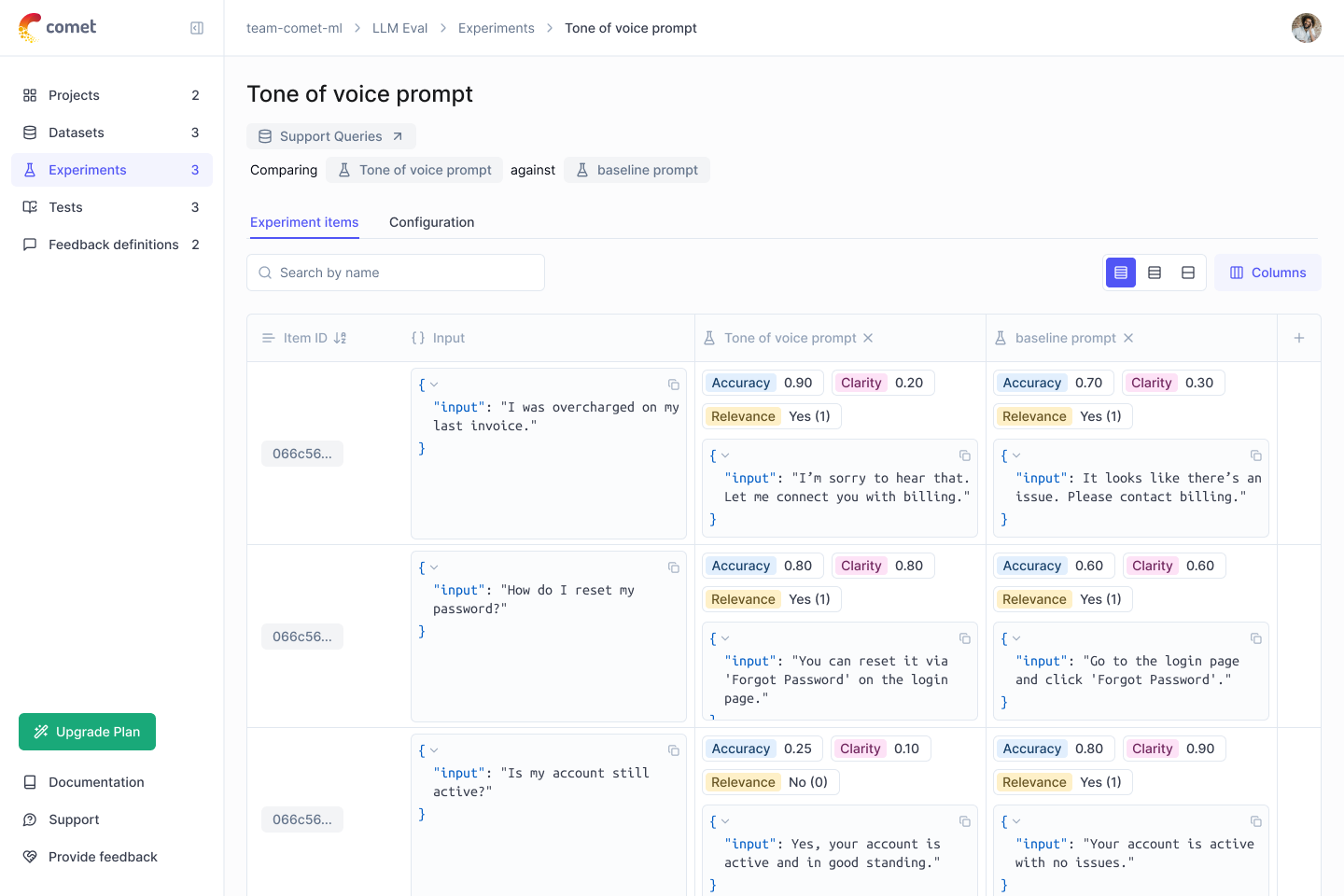
Opik from Comet is an Apache-2.0 open-source platform covering tracing, datasets, experiments, LLM-as-judge metrics (hallucination, moderation, RAG), and a pytest integration for CI. Its draw is price and permissiveness: the full feature set is available self-hosted for free, and the cloud tiers are the cheapest here. It is newer than LangSmith or Langfuse but has grown a large community quickly, and Comet remains independent.
Best for: teams that want a permissively-licensed eval platform without SaaS lock-in.
Pros - Apache-2.0 with the full feature set available self-hosted for free. - Cheapest cloud tiers in this list — Pro is $19/mo. - LLM-as-judge metrics plus a pytest integration for CI.
Cons - Younger product than Langfuse or LangSmith, with a smaller feature history. - Depends on Comet's broader platform and roadmap. - Fewer enterprise-grade eval references than the market leaders.
7. Promptfoo
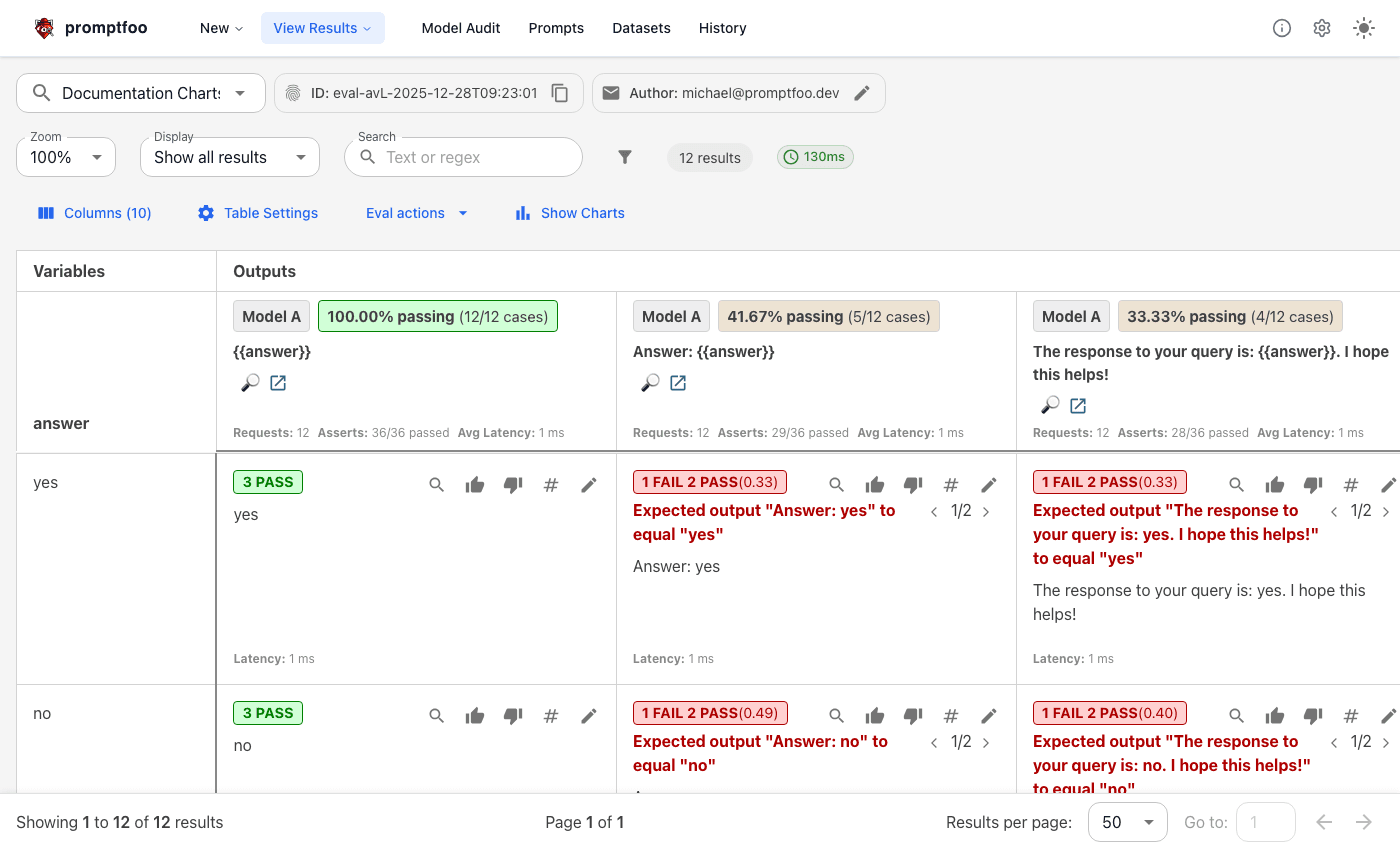
Promptfoo is a developer-first, config-driven tool for evals and LLM red-teaming. You define test cases in YAML and run them from the CLI or CI to compare prompts and models side by side, and its red-teaming catches prompt-injection and safety failures. It is open source and widely used for pre-deployment testing, and its red-teaming overlaps with dedicated AI guardrails and LLM security platforms. OpenAI announced an agreement to acquire Promptfoo in March 2026; the team said it will remain open source.
Best for: developers who want fast, scriptable evals and security red-teaming in CI.
Pros - Open source and config-driven — evals live in version-controlled YAML. - Strong red-teaming for prompt-injection and safety testing, not just quality. - Free Community tier includes evals and red-teaming.
Cons - Now OpenAI-owned (announced 2026), which some buyers will weigh. - CLI/config-first, with less of a managed dashboard than platform tools. - Enterprise and on-prem pricing is quote-only.
How to choose
Match the evaluation style to your workflow first. Offline evals score a fixed dataset before release and suit regression testing in CI; online evals score live production traffic and suit catching drift after launch. Braintrust, LangSmith, Langfuse, and Opik support both; DeepEval and Promptfoo are strongest offline, in your test pipeline.
Then pick by how your team works:
- You want a commercial, eval-first platform with CI gating → Braintrust.
- You build on LangChain, or want the broadest offline + online evals → LangSmith.
- You need open source and self-hosting → Langfuse (MIT) or Comet Opik (Apache-2.0).
- You standardize on OpenTelemetry → Arize Phoenix.
- You want evals as pytest-style code → DeepEval.
- You want scriptable evals plus security red-teaming → Promptfoo.
Evaluation rarely stands alone: teams building retrieval systems should read it alongside our enterprise RAG platforms guide, and teams shipping autonomous agents alongside our AI agent frameworks roundup — both are categories where evaluation is the hardest part.
Two practical notes. First, check who owns the tool — four of these seven were acquired in 2026, which can affect pricing and roadmap even when the product stays open. Second, remember that LLM-as-judge metrics cost tokens: a large eval suite run on every commit can add real inference spend, so budget for the judge model, not just the platform.
Frequently Asked Questions
What is LLM evaluation?
LLM evaluation is the practice of measuring the quality of a language model's outputs against defined criteria — accuracy, faithfulness, relevance, safety, and task success. It uses test datasets, reference answers, rule-based checks, and LLM-as-judge scoring. The goal is to quantify whether a model, prompt, or AI application performs well enough to ship, and to catch regressions when you change anything.
How do you evaluate LLM output quality?
You build a dataset of inputs with expected behavior, run your model or app against it, and score the outputs with metrics. Metrics range from exact-match and similarity to LLM-as-judge (a separate model grades responses) and task-specific scorers like faithfulness for RAG. Running these in CI on every change turns evaluation into a regression gate rather than a one-off check.
What is the best tool for LLM evaluation?
There is no single best tool — it depends on your stack. Braintrust and LangSmith lead for commercial, full-featured platforms; Langfuse and Comet Opik are the strongest open-source options; DeepEval fits teams that want evals as pytest code; and Promptfoo is best for CLI-driven evals plus red-teaming. Match the tool to your deployment and workflow.
What is the difference between LLM evaluation and observability?
Observability monitors what your LLM application does in production — traces, latency, cost, and errors. Evaluation measures whether the outputs are actually good, often offline and in CI before release. They overlap, and most tools here do both, but they answer different questions: observability is "what happened?" and evaluation is "was it correct?"
Can you run LLM evaluations in CI?
Yes. Most tools here integrate with CI pipelines: DeepEval and Opik run as pytest tests, Promptfoo runs from the CLI, Braintrust evaluates on every pull request, and Langfuse ships a GitHub Action that fails a job when scores drop below a threshold. Running evals in CI catches quality regressions before they reach production.
Editor's note — sources: Pricing, licenses and ownership are drawn from vendor pages and primary coverage, verified November 2026: Braintrust pricing, LangChain/LangSmith pricing, Langfuse pricing, Arize pricing, Confident AI/DeepEval pricing, Comet Opik pricing, and Promptfoo. Acquisitions: Dynatrace–Arize, ClickHouse–Langfuse, Cisco–Galileo and OpenAI–Promptfoo (company announcements); Humanloop's shutdown via TechCrunch. Patronus AI's evaluation product is marked retired in its own docs.