
XPeng's $900 Million Bet on a Robot That Looks Too Human
How a viral "is there a person inside it" moment turned into China's largest embodied-AI funding round.

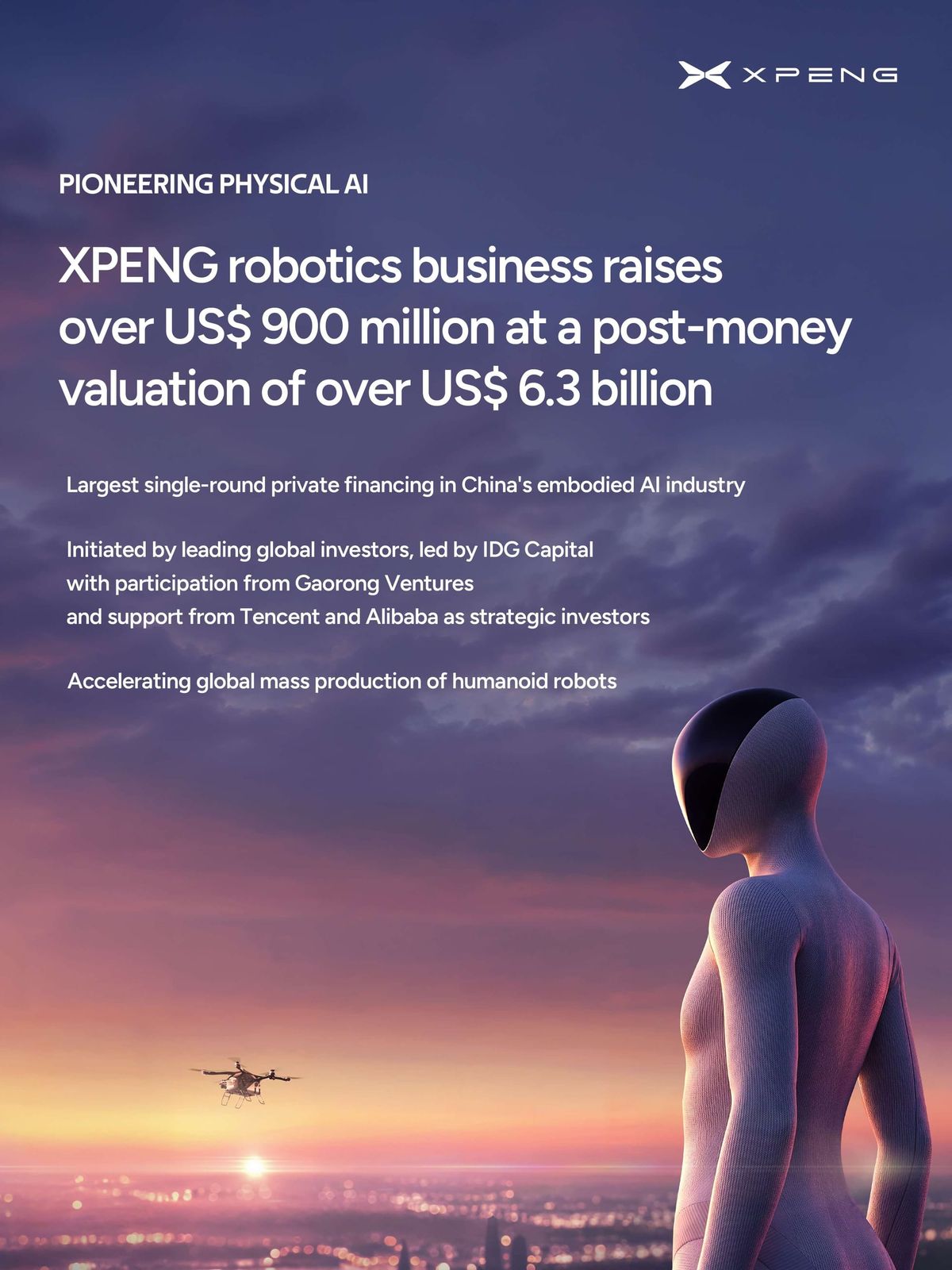
XPeng's $900 Million Bet on a Robot That Looks Too Human
How a viral "is there a person inside it" moment turned into China's largest embodied-AI funding round
XPeng just raised more money for a humanoid robot than most startups raise for their entire company — and the robot's uncanny realism is part of the pitch, not a liability.
In November 2025, XPeng's IRON humanoid walked onto a stage in Guangzhou and immediately became a problem for the company's PR team. Its gait was so smooth, its hips swayed with such convincing weight shift, that clips of the walk went viral with viewers insisting a person had to be inside the suit — some pointed to what they said was the outline of an ear, others to what looked like the contour of women's underwear beneath the back panel. XPeng chairman and CEO He Xiaopeng eventually took a pair of scissors to IRON's leg on camera, cut through the covering, and unzipped its back to expose a mesh-patterned torso and a whirring cooling fan, telling the crowd his team "felt quite wronged" by the rumor, according to the South China Morning Post.
Ten months later, that viral moment of doubt has turned into the largest single check any embodied-AI company in China has raised in one round. XPeng's robotics division has closed north of $900 million at a post-money valuation above $6.3 billion, the company announced on August 24. The round was led by IDG Capital, with Gaorong Ventures, Tencent and Alibaba joining as strategic investors — the kind of backer list that reads like a checklist of the companies that will eventually want to deploy robots inside their own warehouses, stores and factories.
What XPeng actually built
IRON is not a research demo bolted onto a car company's balance sheet. XPeng has spent more than a decade building an in-house stack for electric vehicles — batteries, autonomous-driving silicon, manufacturing lines — and it is now redirecting that stack at a humanoid body. The robot runs on three of XPeng's own Turing AI chips, delivering a combined 2,250 TOPS of on-device compute, which lets IRON run its physical-AI foundation model locally rather than phoning home to a data center for every decision, according to XPeng's press release. The body carries 76 degrees of freedom, with 21 in each hand alone — a dexterity spec aimed squarely at tasks that require fine manipulation, not just walking and waving. That in-house silicon strategy echoes the broader scramble among chip makers racing to control both training and inference rather than depend on a single outside vendor.
That combination of automotive-grade manufacturing discipline and in-house compute is the actual thesis behind the valuation. TechMonitor reported that the financing gives XPeng's robotics arm a standalone market valuation for the first time, ahead of what the company says will be mass production by the end of 2026 and the start of commercial deployments — first inside XPeng's own stores and campuses, then in China and overseas markets — in 2027. The Robot Report notes that of the roughly $900 million raised, about $600 million came from outside investors, with the remainder split between an XPeng subsidiary and company leadership — a structure that keeps XPeng in control of the unit while still letting outside capital set an independent price on it.
Why investors are pricing this now, not later
Humanoid robotics has spent the past three years oscillating between viral demo videos and skepticism about whether any of it ships. What's different about this round, according to AIBusiness, is that IDG and Gaorong are underwriting a company that already knows how to manufacture hundreds of thousands of complex machines a year — XPeng builds and sells electric cars — rather than a lab that has only ever built a handful of hand-assembled prototypes. Gaorong's own statement, cited in the funding announcement, frames IRON as a "gateway to real-world data," feeding what the firm calls a self-reinforcing loop of production, data, models and deployment, a flywheel argument nearly identical to the one Tesla makes for its own Optimus program.
For XPeng, the deal solves two problems at once. It converts a robotics division that would otherwise sit as a line item on a car company's income statement into a business with its own price tag and, according to Electrek, its own equity to attract and retain robotics talent — a persistent bottleneck as Chinese and American labs bid up salaries for the same small pool of engineers who can make legs walk and hands grip reliably. It also hands XPeng a war chest for the unglamorous, expensive part of the business: automotive-grade quality control applied to a machine with far more moving joints than a car has.
For Tencent and Alibaba, the strategic stakes are different. Both companies already run the cloud and AI infrastructure that Chinese manufacturers, logistics operators and retailers lean on; a working humanoid robot fleet is a hardware complement to software they already sell, and an early stake buys visibility into a physical-AI standard before a foreign rival — most obviously Tesla's Optimus or any of the well-funded U.S. humanoid startups — locks in the category.
The part investors are pricing around, not away from
The viral "is that a person in there" moment matters more to this financing than it might seem. Investors underwriting a $6.3 billion valuation are betting that IRON's uncanny realism — the thing that made strangers on the internet refuse to believe it was a machine — is precisely the product feature that will let it work alongside people in stores, warehouses and eventually homes without triggering the discomfort that blockier, more obviously robotic designs invite. That is a bet on aesthetics functioning as a go-to-market strategy, which is unusual for a hardware category that has mostly competed on torque curves and battery life.
It is also a bet that hasn't been tested against a full year of real-world deployment yet. IRON's mass-production timeline points to late 2026, with actual commercial rollouts — the point where uptime, repair rates and unit economics stop being projections and start being reported numbers — arriving in 2027. Every claim in this round, from the 2,250 TOPS compute figure to the "largest single-round financing in China's embodied AI industry" framing, comes from XPeng and its investors rather than from independent operational data, which is normal for a private funding round but worth remembering the next time the number gets repeated as settled fact.
The bigger pattern
XPeng's raise lands in the same window as Chinese rival Unitree's stock-market debut and the U.K.'s Humanoid closing $152 million at a $1.35 billion valuation — a sign that capital is now flowing into humanoid robotics across multiple geographies and business models at once, not just concentrating in one Silicon Valley favorite. What ties XPeng's bet to the rest of that wave is a shared assumption: that the company which controls the full stack — chips, the foundation model, the manufacturing line, and now enough capital to run all three at once — will be the one still standing when the current round of humanoid demos has to become a shipping product with a warranty. XPeng is wagering that a decade of building cars, not robots, taught it exactly the discipline that decides who wins that race — the same full-stack logic behind AMD's decade-long push to break Nvidia's software moat and Nvidia's own bet on open-source robotics models to widen the pool of hardware its chips can run.
Frequently Asked Questions
How much did XPeng's robotics unit raise, and at what valuation?
XPeng's robotics business raised more than $900 million in a single round at a post-money valuation above $6.3 billion, announced August 24, 2026. The company says it is the largest single-round private financing in China's embodied AI industry to date, led by IDG Capital with Tencent and Alibaba as strategic investors.
What is XPeng's IRON humanoid robot?
IRON is XPeng's general-purpose humanoid robot, built on the company's automotive manufacturing base. It uses three in-house Turing AI chips for 2,250 TOPS of on-device compute and has 76 degrees of freedom, including 21 per hand, aimed at tasks requiring fine dexterity rather than just walking.
Why did XPeng's robot go viral before this funding round?
In November 2025, footage of IRON walking convinced some viewers a human was hidden inside the suit because its gait looked so lifelike. CEO He Xiaopeng cut open the robot's covering on camera to prove it was a machine, a moment that drew wide attention to the robot's design ahead of this funding round.
When will XPeng's IRON robot be commercially available?
XPeng says IRON is expected to enter mass production by the end of 2026, with initial deployment inside XPeng's own stores and campuses, followed by commercial deliveries in China and overseas markets starting in 2027.
Editor's note — sources: XPeng press release (xpeng.com), TechMonitor, Electrek, The Robot Report, AIBusiness, South China Morning Post.