
Anthropic IPO: What the S-1 Really Reveals
Anthropic filed its S-1 ahead of a Nasdaq IPO under ticker ANT, disclosing $16.3B in first-half 2026 revenue and an $80.7B net loss. We read the filing, separate the accounting from the cash, and explain what it means if you build on Claude.

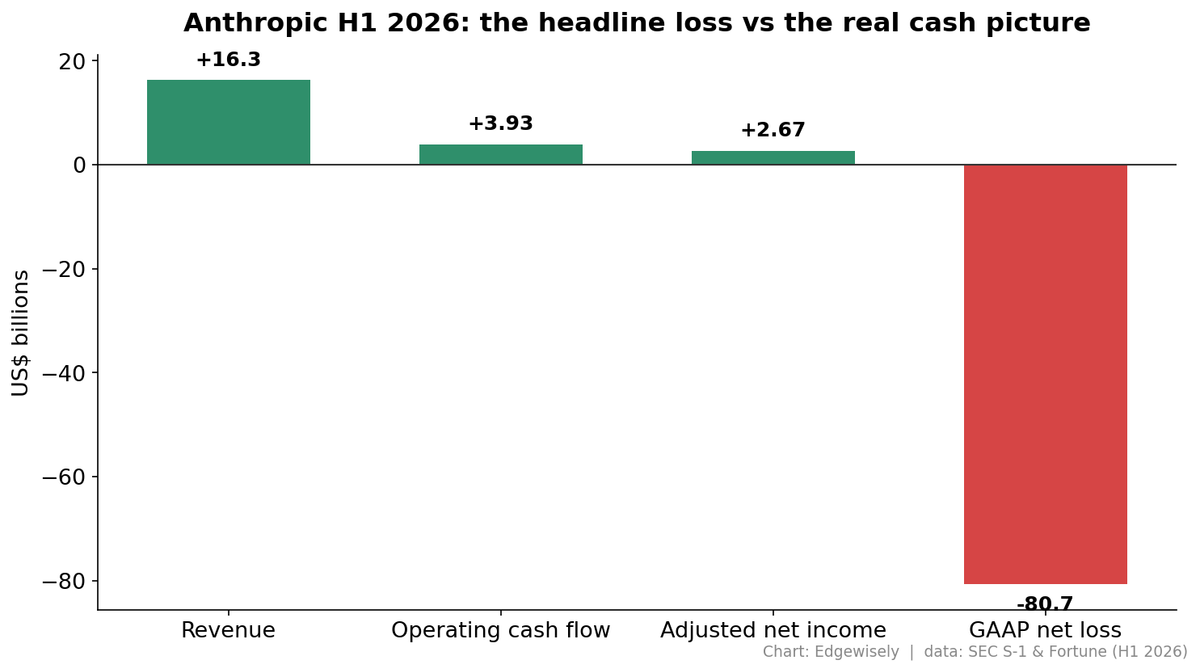
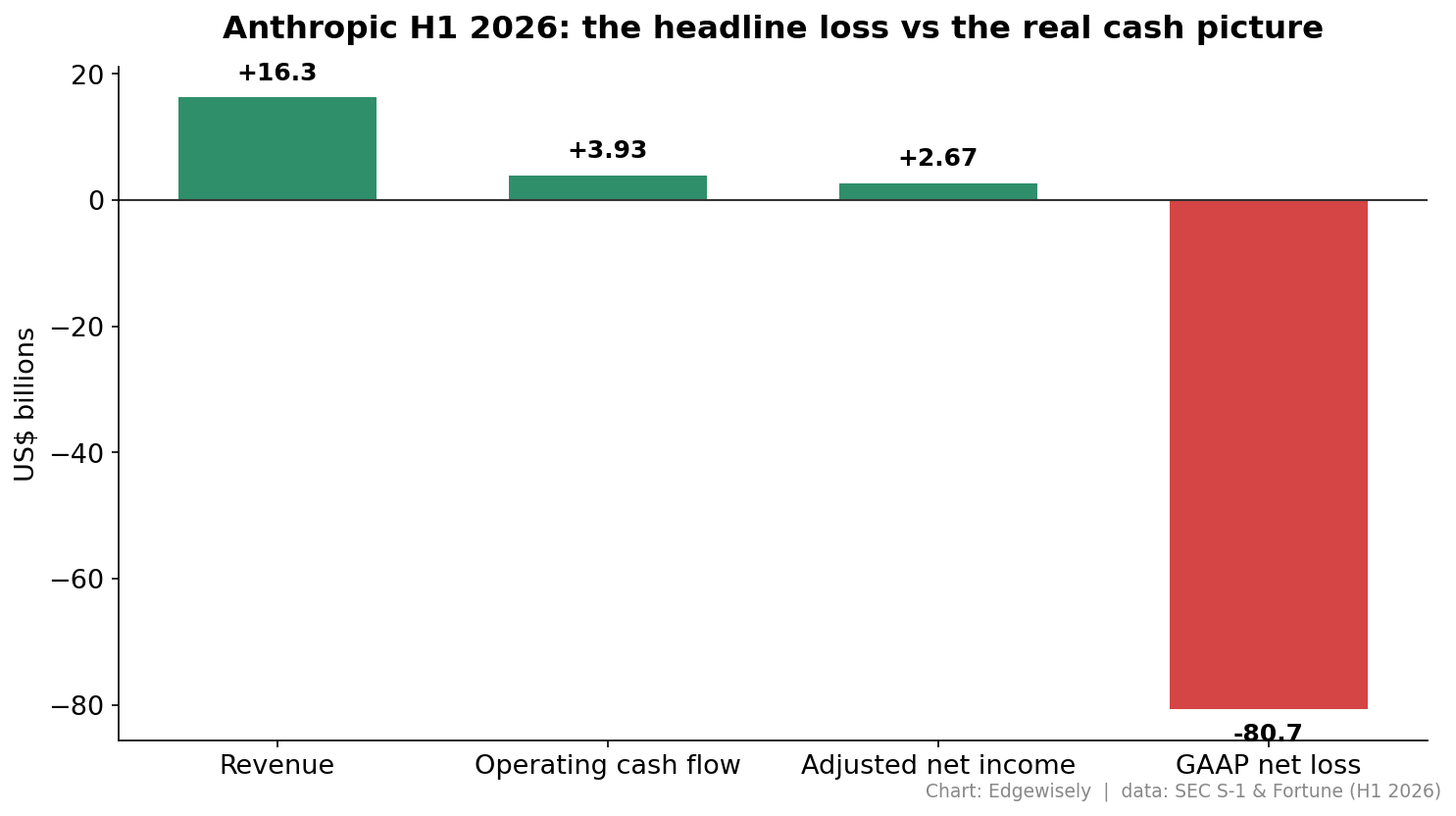
The Anthropic IPO is now a real filing, not a rumour. On 26 October 2026, Anthropic filed a Form S-1 with the SEC to list on Nasdaq under the ticker "ANT". The headline numbers: $16.3B in revenue for the first half of 2026 and an $80.7B net loss for the same period. The loss looks catastrophic. It mostly isn't cash. Here is what the filing actually shows.
TL;DR
- Anthropic filed an S-1 on 26 October 2026 to IPO on Nasdaq as "ANT", with Goldman Sachs and Morgan Stanley leading. (SEC EDGAR)
- Revenue: $16.3B for the six months ended 30 June 2026 — up from $4.59B for all of 2025 and $386M in 2024. (SEC EDGAR)
- The $80.7B net loss is mostly non-cash, driven by the fair-value remeasurement of convertible instruments as the valuation rose. Anthropic actually collected $3.93B from operations in H1 2026 and reports positive adjusted results. (Fortune)
- Valuation under discussion: $1.5T–$2T, versus a $965B private mark as of May 2026. (Yahoo Finance)
- Verdict: Anthropic is a fast-growing, cash-generative business carrying enormous locked-in compute commitments and a governance structure where public shareholders get almost no control.
What is the Anthropic IPO?
Anthropic, the maker of Claude, filed its S-1 on 26 October 2026 to go public on Nasdaq under "ANT". The filing disclosed $16.3B in first-half 2026 revenue and an $80.7B net loss that is overwhelmingly non-cash accounting, not money spent. Pricing is reportedly being discussed at a $1.5T to $2T valuation. No offering date is set yet.
What did Anthropic's S-1 reveal?
The anthropic s-1 is the first time outsiders get audited financials for a frontier AI lab. The revenue curve is the standout.
Revenue went from $41M (2023) to $386M (2024) to $4.59B (2025), then to $16.3B in the first six months of 2026 alone — roughly 13x the prior-year half. (SEC EDGAR) Within 2026, Q1 was about $4.7B and Q2 about $11.6B. The business roughly doubled quarter over quarter.
Headcount was about 5,300 as of 30 September 2026, which puts revenue per employee north of $6M — a figure no traditional software company approaches. (Yahoo Finance)
One structural thing the filing does not give you: a clean gross margin. There is no cost-of-revenue line in the income statement. Compute and infrastructure sit inside operating expenses — $7.33B for 2025 and $8.95B for H1 2026. (SEC EDGAR) You have to infer unit economics; the company doesn't hand them to you.
How much revenue does Anthropic make?
Anthropic revenue was $16.3B for the first half of 2026 (six months ended 30 June 2026). For context, that already exceeds the $4.59B it booked across all of 2025. (SEC EDGAR)
The revenue is enterprise-led and consumption-based — you pay per token, not per seat. Around 48% of H1 2026 revenue flowed through cloud marketplaces such as AWS and Google Cloud. (Fortune) The S-1 does not break out API/developer revenue versus Claude.ai consumer subscriptions — that split is not disclosed.
Concentration is real. The five largest customers were about one-quarter of revenue in the first nine months of 2026. More than 11,900 customers spend at least $100,000 a year, and roughly 250 spend $10M or more. (Fortune)
Why is Anthropic posting an $80B loss?
Because the loss is mostly an accounting artefact. The vast bulk of the $80.7B H1 2026 net loss — roughly $72B by one analysis — is non-cash, tied to the remeasurement of convertible instruments whose value rises as the company's valuation rises. (Forbes) When your paper value climbs toward $2T, the accounting value of those convertibles balloons, and that shows up as a "loss" even though no cash left the building.
Look at the cash instead. Anthropic collected $3.93B from operations in H1 2026, and on an adjusted basis the business is in the black — adjusted operating income of about $1.6B (a 9%+ margin) once non-cash charges are stripped out. (Fortune) The S-1's own non-GAAP measure tells the same story: Adjusted Net Income of +$2.67B for H1 2026, versus −$1.74B a year earlier. (SEC EDGAR)
The balance sheet is not stressed either — cash and short-term investments were about $122B after a $65B raise in May 2026. (Fortune) Read the $80.7B headline as a function of how the fundraising was structured, not as the burn rate.
What is Anthropic's valuation and ticker?
Anthropic will trade as "ANT" on Nasdaq. Its last private mark was $965B as of May 2026, and the IPO is reportedly being discussed in a $1.5T to $2T range. (Yahoo Finance)
At $2T against a Q2-annualised revenue of roughly $46B, that is about 43x revenue — rich even by megacap standards, where Nvidia and Microsoft trade at far lower multiples. (Forbes) The multiple only looks sane if you believe the growth rate holds.
Here is how the disclosed numbers stack up against the nearest comparable:
| Metric (as of) | Anthropic | OpenAI |
|---|---|---|
| Revenue | $16.3B (H1 2026, S-1) | ~$50B+ annualised run-rate (reported, 2026) |
| Net loss | $80.7B (H1 2026, mostly non-cash) | Not publicly disclosed |
| Operating cash flow | +$3.93B (H1 2026, S-1) | Not publicly disclosed |
| Valuation | $1.5T–$2T (IPO range discussed) | >$1.4T (raise reported) |
| Public filing | S-1 filed 26 Oct 2026 | Confidential S-1, June 2026 |
The two account for cloud-partner revenue differently, so the top lines are not strictly comparable. (Fortune)
When is the Anthropic IPO?
No date is set. The S-1 was filed on 26 October 2026, which begins an SEC review that typically runs weeks. Reporting points to a listing later in the autumn of 2026, with Goldman Sachs and Morgan Stanley leading. (Yahoo Finance) Until a price range and roadshow are announced, treat any specific date as speculation.
What the S-1 means if you build on Claude
Two things in the filing matter to you directly. First, the compute commitments. Anthropic has signed non-cancelable capacity deals running into the hundreds of billions of dollars — reported figures range from about $441B in guaranteed commitments to roughly $630B in total contract value, the bulk of it non-cancelable, including about $111B with Google and $110B with Amazon. (Fortune) Second, the governance: the company is founder-controlled, and a Long-Term Benefit Trust appoints a majority of the board, while public Class A holders get one vote per share. (SEC EDGAR)
Together those tell you the roadmap is locked in and the decisions aren't yours to influence. That's the trade-off of standardising on Claude — the same one worth weighing across any provider, as we covered in our Claude Code vs GitHub Copilot verdict.
Our take
Strip away the headline and the Anthropic IPO is a cleaner story than "$80B loss" suggests — but it comes with two risks a builder should price in now.
Start with the loss, because almost every write-up gets it wrong. The $80.7B net loss is not cash out the door. The vast bulk of it is the remeasurement of convertible instruments — a mechanical consequence of the company's paper value climbing toward $2T. The instruments get marked up, that mark-up lands as a loss, and no money moved. The honest picture is the $3.93B Anthropic collected from operations in H1 2026, the ~$1.6B in adjusted operating income, and the +$2.67B in non-GAAP adjusted net income the S-1 itself reports. This is a cash-generative business growing revenue roughly 13x year over year. Anyone telling you Anthropic is "losing more than it earns" in a cash sense is reading the wrong line.
Now the growth. $16.3B in a single half, after $4.59B for all of 2025, is the strongest evidence yet that frontier-model demand is real and enterprise-paid, not a free-tier mirage. That demand is what underwrites the roadmap you depend on. But it also explains the scariest part of the filing: the compute. Hundreds of billions in largely non-cancelable commitments is a bet that demand keeps compounding. If it does, those contracts are a moat. If growth stalls — and the back half of 2026 reportedly decelerated from the Q1-to-Q2 doubling — Anthropic is on the hook for payments that outlast the demand that justified them. The S-1's own risk factors say as much: infrastructure obligations can outlive falling demand or pricing. That is the single biggest structural risk in the document, and it sits upstream of your token bill.
Which brings me to pricing, where I'll flag this as opinion. I don't read these commitments as an imminent reason to expect cheaper tokens. The absence of a disclosed gross margin is telling — Anthropic buries compute inside operating expenses rather than showing cost of revenue, which keeps the real unit economics opaque. A company carrying hundreds of billions in locked compute spend needs utilisation and price discipline, not a price war. Expect pricing stability to ride on volume growth, not margin generosity. If you want insulation from any single provider's pricing moves, an abstraction layer is the sane hedge — the logic we laid out in our guide to AI gateways and token cost.
The governance is the part I'd push back on hardest, and it's underplayed in most coverage. Public investors buy Class A stock with one vote per share, while founders retain control and the Long-Term Benefit Trust appoints a majority of the board. (The obscure trust over Anthropic's IPO) You can own the stock and have effectively no say in direction, safety trade-offs, or model-release decisions. For a mission-first public-benefit corporation that may be defensible. As a shareholder, understand you're a financier, not a governor.
So what does the IPO signal if you build on Claude? Stability, mostly. A company this well-capitalised (about $122B in cash and investments), growing this fast, with compute locked in for years, is not going anywhere — your roadmap and SLAs are safe. But the same facts that guarantee stability also deepen lock-in: concentrated infrastructure, opaque margins, and a pricing posture built to service huge fixed commitments. The verdict: build on Claude with confidence in its longevity, keep a provider-agnostic escape hatch for cost, and don't mistake going public for going democratic. For the wider competitive backdrop, see our read on the Big Tech AI slowdown pact.
Frequently Asked Questions
When is the Anthropic IPO?
No date is confirmed. Anthropic filed its S-1 on 26 October 2026, which begins an SEC review that usually takes several weeks. Reporting suggests a listing later in autumn 2026 on Nasdaq under "ANT", led by Goldman Sachs and Morgan Stanley. Watch for a price range and roadshow announcement.
How can you buy Anthropic stock before the IPO?
For most people, you can't directly. Pre-IPO Anthropic shares are held by employees and accredited institutional investors. Retail access before listing is generally limited to specialised pre-IPO marketplaces or funds, often with high minimums and lock-ups. The straightforward route is buying "ANT" once it trades publicly on Nasdaq.
How much revenue does Anthropic make?
Anthropic reported $16.3B in revenue for the first half of 2026, per its S-1 — more than its $4.59B for all of 2025 and $386M in 2024. Quarterly, Q1 2026 was about $4.7B and Q2 about $11.6B. The filing does not split API versus consumer subscription revenue.
What is Anthropic's valuation?
Anthropic's last private valuation was about $965B as of May 2026. Its IPO is reportedly being discussed in a $1.5T to $2T range, though no offering price is set. At $2T, that is roughly 43x annualised Q2 revenue — a premium multiple that depends on continued rapid growth.
Is Anthropic profitable?
Not on a GAAP basis — it reported an $80.7B net loss for H1 2026. But the vast bulk of that is non-cash remeasurement of convertible instruments, not cash spent. Anthropic generated +$3.93B in operating cash flow and reports positive adjusted results for the half, so operationally it is in far better shape than the headline implies.
Editor's note — sources
- Anthropic, PBC Form S-1 — SEC EDGAR — revenue by year/period, operating expenses, Adjusted Net Income, share structure and Long-Term Benefit Trust.
- Fortune — Anthropic's S-1, by the numbers — operating cash flow, adjusted operating income, cash balance, compute commitments, customer concentration, cloud-marketplace revenue share.
- Forbes — Anthropic's IPO: what its S-1 reveals — non-cash composition of the net loss and valuation multiples.
- Yahoo Finance — Anthropic IPO live updates — ticker, Nasdaq, $965B private valuation, headcount, underwriters, timing.
- The obscure trust over Anthropic's IPO — Long-Term Benefit Trust board-appointment detail.