
Best Embedding Model in 2026: RAG Picks
A sourced comparison of the best embedding models for RAG and semantic search across OpenAI, Google, Cohere, Voyage and open-weight options like Qwen3 and BGE-M3 — dimensions, price per 1M, MTEB scores and a clear verdict on which to pick.


The best embedding model for most teams building RAG or semantic search is Google's gemini-embedding-001 — top-tier multilingual quality at $0.15 per 1M tokens. If cost rules, OpenAI's text-embedding-3-small at $0.02 per 1M is the value pick. For open weights you self-host, Qwen3-Embedding-8B leads the pack.
That is the short answer. The longer answer depends on your language mix, document length, budget, and whether you can run your own GPUs. Below is a built comparison across proprietary and open models, plus the cost math that makes this choice stickier than most people expect.
TL;DR
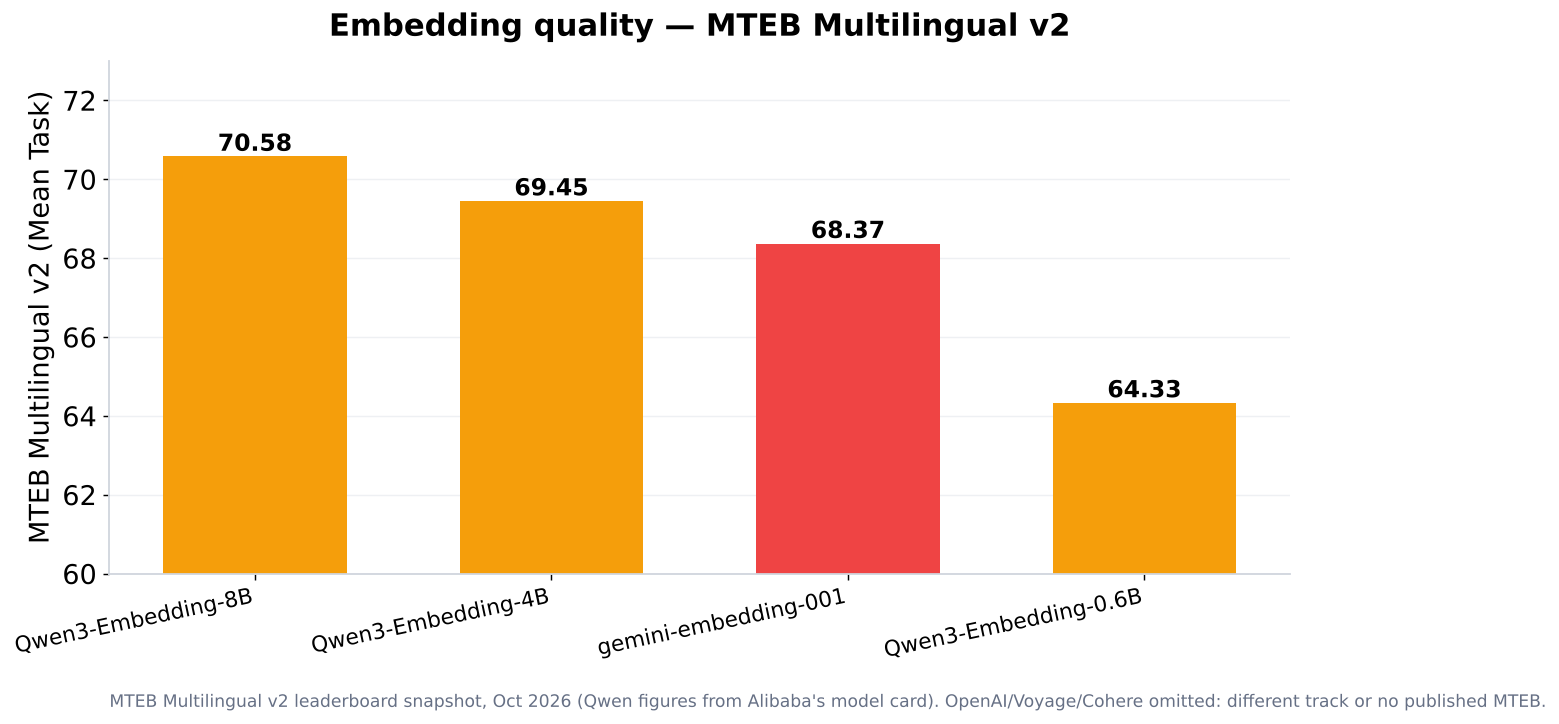
- Best overall default (managed API): gemini-embedding-001 — scores 68.37 on MTEB Multilingual v2 and supports 100+ languages with flexible Matryoshka dimensions.
- Best value: OpenAI text-embedding-3-small at $0.02 per 1M tokens, or Voyage's voyage-4-lite at the same price for retrieval-tuned workloads.
- Best open-source embedding model: Qwen3-Embedding-8B — 70.58 on MTEB Multilingual v2, Apache-2.0, free to self-host.
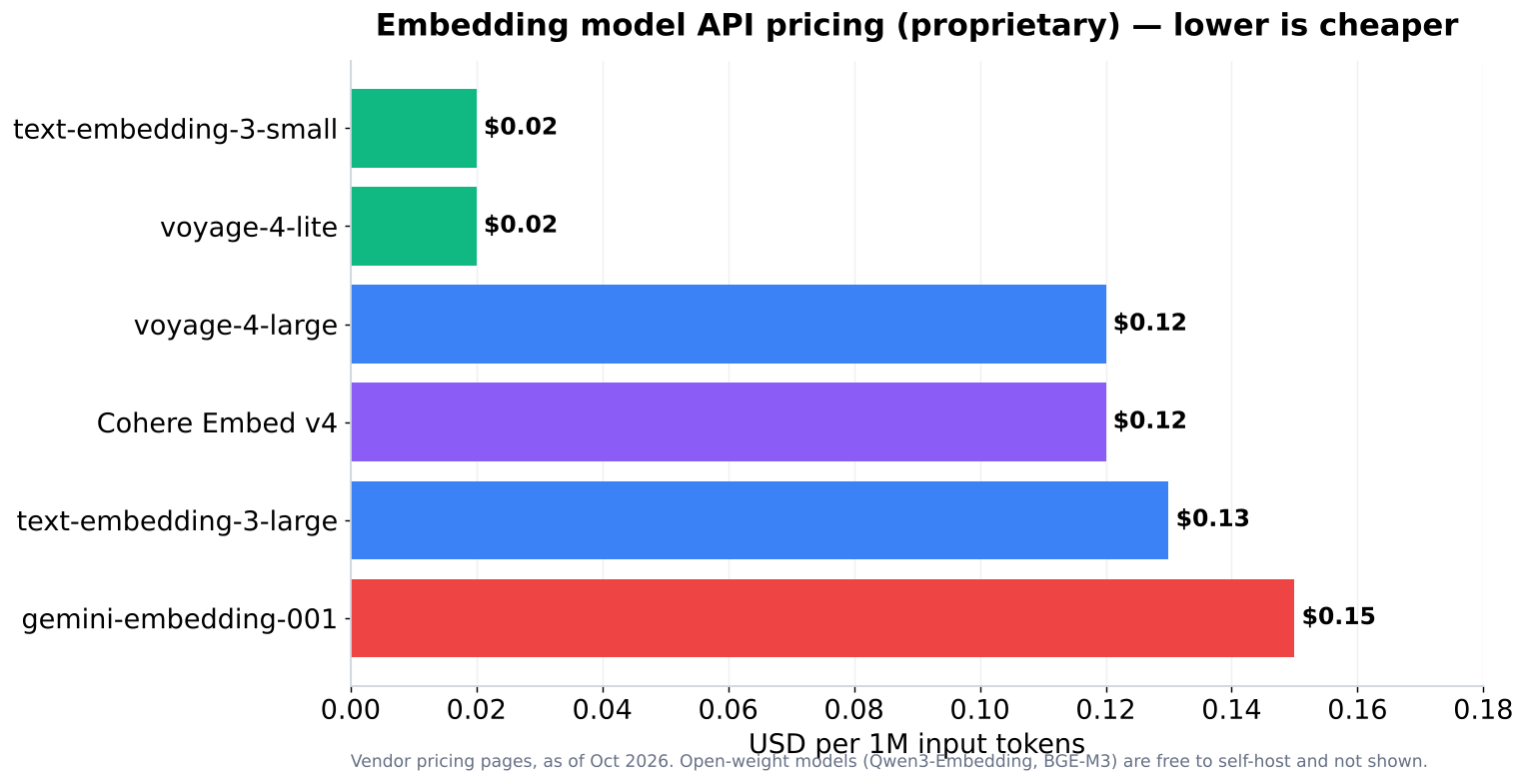
- Price range: roughly $0.02 to $0.15 per 1M tokens for proprietary APIs; $0 in API fees for open weights (you pay for GPUs instead).
- The one caveat: MTEB rank is not your-data performance. A model that tops the leaderboard can lose on your actual corpus. Always run a small retrieval eval before you commit.
What is an embedding model?
An embedding model turns text into a vector — a list of numbers — so that similar meanings land close together in vector space. Search "how do I reset my password" and the model places it near a support doc titled "Account recovery steps," even with no shared keywords.
That is the whole trick behind semantic search, retrieval-augmented generation (RAG), clustering, deduplication, and recommendation. You embed your documents once, store the vectors, and at query time embed the question and find the nearest neighbors.
Text embedding models differ on four axes that matter: dimensions (vector size, which drives storage and speed), max input tokens (how much text fits in one call), quality (how well nearest-neighbor actually matches intent), and price or license.
What is the best embedding model right now?
For a managed API with no infrastructure to run, gemini-embedding-001 is the best embedding model for most teams. It holds a top spot on the MTEB Multilingual leaderboard, outputs up to 3,072 dimensions with Matryoshka Representation Learning so you can truncate to 1,536 or 768, and costs $0.15 per 1M input tokens per Google's Gemini Embedding GA announcement.
Here is the full field, confirmed against vendor docs and model cards as of October 2026.
| Model | Maker | Dims (default) | Max tokens | Price / 1M | MTEB | License | Best for |
|---|---|---|---|---|---|---|---|
| text-embedding-3-small | OpenAI | 1,536 | 8,192 | $0.02 | 62.3 (MTEB Eng., vendor) | Proprietary API | Cheapest English RAG at scale |
| text-embedding-3-large | OpenAI | 3,072 | 8,192 | $0.13 | 64.6 (MTEB Eng., vendor) | Proprietary API | Higher-quality English in the OpenAI stack |
| gemini-embedding-001 | 3,072 (MRL) | 2,048 | $0.15 | 68.37 (MTEB Multiling. v2) | Proprietary API | Best managed default, multilingual | |
| Embed v4 | Cohere | 1,536 (MRL) | 128,000 | $0.12 | Not published | Proprietary API | Multimodal, long docs and PDFs |
| voyage-4-large | Voyage AI | 1,024 (MRL) | 32,000 | $0.12 | Not published | Proprietary API | Top retrieval quality, long context |
| voyage-4-lite | Voyage AI | 1,024 (MRL) | 32,000 | $0.02 | Not published | Proprietary API | Value retrieval at scale |
| Qwen3-Embedding-8B | Alibaba | 4,096 (MRL) | 32,000 | Self-host | 70.58 (MTEB Multiling. v2) | Apache-2.0 | Best open quality |
| Qwen3-Embedding-0.6B | Alibaba | 1,024 (MRL) | 32,000 | Self-host | 64.33 (MTEB Multiling. v2) | Apache-2.0 | Small, cheap open model |
| BGE-M3 | BAAI | 1,024 | 8,192 | Self-host | Not published | MIT | Hybrid dense + sparse + multi-vector |
| nomic-embed-text-v2-moe | Nomic AI | 768 (MRL) | 512 | Self-host | Not published | Apache-2.0 | Lightweight multilingual MoE |
A note on the MTEB column. These numbers come from different MTEB tracks and are not directly comparable. OpenAI's 62.3 and 64.6 are the company's own MTEB (English) figures from its embeddings guide; the Gemini and Qwen numbers are from the MTEB Multilingual v2 board, which runs 131 tasks across many languages. "Not published" means the vendor (Voyage, Cohere) reports its own retrieval benchmarks rather than an MTEB score — treat their quality claims as vendor claims and verify on your own data.
Best embedding model for RAG
For RAG specifically, the question is retrieval quality on your chunks, not a generic leaderboard. Three models cover most cases, and the model you pick is only half the system — the vector database that stores and searches the vectors is the other half.
Pick gemini-embedding-001 if you want one managed default. Strong multilingual retrieval, Matryoshka dimensions to trade quality for storage, and a free tier through Google AI Studio. The one catch: its max input is 2,048 tokens, so you must chunk aggressively — fine for most RAG, awkward for long documents.
Pick voyage-4-large if retrieval quality is the whole game. Voyage's docs call it the "best general-purpose and multilingual retrieval quality", with a 32,000-token context and 1,024-dimension default (truncatable to 256/512/2048). At $0.12 per 1M tokens it sits between OpenAI and Gemini on price. Voyage does not publish MTEB, so benchmark it yourself.
Pick Cohere Embed v4 if your RAG is multimodal. It embeds text, images, and mixed-modality inputs like PDFs into a shared space, handles a 128k-token context, and offers Matryoshka dimensions from 256 to 1,536, per Cohere's Embed docs. That makes it the standout for retrieval over scanned documents and slide decks.
For English-only RAG on a tight budget, text-embedding-3-small still earns its keep at $0.02 per 1M tokens with per-model pricing listed in OpenAI's docs.
Best open-source embedding model
The best open source embedding model today is Qwen3-Embedding-8B. Alibaba's model card reports 70.58 on MTEB Multilingual v2, with up to 4,096 dimensions (adjustable down to 32), a 32,000-token context, support for 100+ languages, and an Apache-2.0 license. Self-hosted, you pay only for the GPU.
If 8B is too heavy, the family scales down: Qwen3-Embedding-4B (2,560 dims, 69.45) and Qwen3-Embedding-0.6B (1,024 dims, 64.33) run on far less hardware while staying competitive.
Two other open models are worth knowing. BGE-M3 from BAAI is the pragmatic hybrid pick: 1,024 dimensions, 8,192-token input, MIT license, and native support for dense, sparse (lexical), and multi-vector (ColBERT-style) retrieval in one model, per its HuggingFace card. nomic-embed-text-v2-moe is the featherweight — a mixture-of-experts model with ~305M active parameters, 768 default dimensions (Matryoshka to 256), ~100 languages, and Apache-2.0, though its 512-token input forces small chunks.
How much do embedding models cost?
Proprietary text embedding models range from $0.02 to $0.15 per 1M input tokens as of October 2026. Open-weight models cost nothing in API fees; you pay for GPUs and ops instead.
But the per-token price is the smallest part of the bill. Two bigger costs hide behind it.
Storage scales with dimensions. A vector of 3,072 floats at 4 bytes is ~12KB before indexing overhead; at 768 dimensions it is ~3KB. Across 50 million chunks that is the difference between roughly 600GB and 150GB of vector index — real money in a managed vector database. This is why Matryoshka models matter: you can drop dimensions and cut storage without re-embedding.
Re-embedding is the sticky cost. If you switch models later, every vector in your store is invalid — embeddings from different models are not comparable. You must re-embed your entire corpus and rebuild the index. For a large knowledge base that is a multi-day, multi-thousand-dollar job. Your first model choice is closer to a database schema decision than a model-router toggle.
How do you choose an embedding model?
Work down this list and stop at the first clear answer.
- Must you self-host (privacy, air-gap, cost at scale)? Start with Qwen3-Embedding-8B, drop to 0.6B or BGE-M3 if hardware is tight.
- Multilingual corpus? gemini-embedding-001 or Qwen3-Embedding — both cover 100+ languages.
- Images or PDFs in the mix? Cohere Embed v4.
- Long documents? Voyage (32k) or Cohere (128k) beat Gemini's 2,048-token cap.
- English-only, cost-sensitive, high volume? text-embedding-3-small or voyage-4-lite at $0.02.
- Want the strongest managed default and don't want to think hard? gemini-embedding-001.
Then do the one step most teams skip: build a small eval set — 50 to 100 real queries with known-good documents — and measure recall@k on two or three candidates against your own data before you embed a single production vector. If you are still deciding whether to embed at all or lean on a long-context model, that is its own debate — see our take on RAG versus long context.
Our take
Chasing the number-one spot on MTEB is the most common mistake we see, and it is usually the wrong move.
MTEB is a useful shortlisting tool and nothing more. The Multilingual v2 board aggregates a mean across 131 tasks, and its own maintainers frame the ranking as directional, not a universal quality verdict. A model trained to do well on public benchmark tasks is, to some degree, trained to do well on public benchmark tasks — leaderboard overfitting is real, and the gap between the #1 and #4 model is often a point or two of mean score that evaporates on your specific corpus of support tickets, legal clauses, or product descriptions. We have watched a mid-ranked model beat a leaderboard leader on a narrow domain more than once. The benchmark cannot see your data; only your eval can.
The second trap is confusing the sticker price with the total cost. At $0.02 to $0.15 per 1M tokens, the embedding API is almost never the expensive part of a RAG system — the LLM calls and the vector database are. What actually hurts is the decision's permanence. Because embeddings from different models live in different vector spaces, changing your model means re-embedding everything and rebuilding every index. That stickiness should push you toward two things: a provider you expect to still exist and support the exact model version in two years, and a model with Matryoshka dimensions so you can tune storage cost later without a full re-embed. It also quietly favors open weights for anyone at scale — a self-hosted Qwen3 or BGE-M3 model can never be deprecated out from under you, re-priced, or rate-limited, and the weights you run today will run identically in 2029.
That is the real case for open models, and it is stronger than the benchmark case. Qwen3-Embedding-8B genuinely competes with the best proprietary APIs on quality, but even where an open model trails by a point, portability and cost control can outweigh the gap. If you are embedding hundreds of millions of tokens a month, the GPU bill for a self-hosted 0.6B or BGE-M3 model undercuts any per-token API, and you own the latency.
So where does that leave the proprietary options? They win on time-to-first-value and on frontier quality you cannot easily reproduce. If you are a small team shipping a RAG feature this quarter, gemini-embedding-001 behind one API key is the correct call — do not stand up a GPU fleet to save money you are not yet spending. If your retrieval quality is a competitive differentiator and you have the budget, Voyage's voyage-4-large is worth benchmarking against Gemini head-to-head; Voyage's refusal to post MTEB numbers is annoying, but its retrieval-first positioning tends to hold up in practice. Cohere Embed v4 is the clear answer the moment images or PDFs enter your corpus, and nothing else on this list matches its unified multimodal space.
Our verdict, stated plainly. Best for most RAG teams: gemini-embedding-001 — top multilingual quality, flexible dimensions, trivial to adopt. Best for serious retrieval at scale on open weights: Qwen3-Embedding-8B. Best value: text-embedding-3-small or voyage-4-lite at $0.02. Avoid Gemini if your documents are long (its 2,048-token input will force painful chunking), avoid any proprietary API if deprecation risk or data residency is a hard constraint, and avoid picking on MTEB rank alone — the leaderboard is where you start the search, not where you end it. Run the eval. The right model is the one that retrieves your data best, and only you can measure that.
Frequently Asked Questions
What is an embedding model?
An embedding model converts text into a numeric vector so that similar meanings sit close together in vector space. That lets software compare meaning rather than keywords, which powers semantic search, RAG, clustering, and recommendations. You embed documents once, store the vectors, then embed each query to find the nearest matches.
How do embedding models work?
They map text to a fixed-length vector using a neural network trained so related texts produce nearby vectors. At query time you embed the question and compute similarity (usually cosine) against stored document vectors, returning the closest ones. Dimensions set the vector's size; more dimensions can capture more nuance but cost more storage and compute.
What is the best embedding model for RAG?
For most teams, gemini-embedding-001 is the best managed default, scoring 68.37 on MTEB Multilingual v2 at $0.15 per 1M tokens. For maximum retrieval quality use voyage-4-large; for multimodal or PDF-heavy RAG use Cohere Embed v4; for open-weight self-hosting use Qwen3-Embedding-8B. Always benchmark on your own corpus.
Does DeepSeek have an embedding model?
No. As of October 2026, DeepSeek's API docs list only chat and reasoning models such as deepseek-flash and deepseek-v4-pro, with no dedicated embeddings endpoint. For embeddings, use a purpose-built model like gemini-embedding-001, text-embedding-3-small, or an open option such as Qwen3-Embedding or BGE-M3.
What is the best open source embedding model?
Qwen3-Embedding-8B, which reports 70.58 on MTEB Multilingual v2 under an Apache-2.0 license and supports 100+ languages. Smaller Apache-2.0 options include Qwen3-Embedding-0.6B and the MIT-licensed BGE-M3, which adds hybrid dense, sparse, and multi-vector retrieval in one model. All are free to self-host on your own hardware.