
GPT-6.1 Terra: Price, Benchmarks, Verdict
OpenAI's GPT-6.1 Terra is a fast, cheap agentic model built for computer use and coding, priced at $1 per 1M input and $5 per 1M output with a 1.1M-token context. Here is what the benchmarks show, how it stacks up against Claude Opus 5.5 and Gemini 4 Argon, and whether it should be your default for

TL;DR
- Price: $1.00 per 1M input tokens, $5.00 per 1M output, $0.05 cached. OpenAI's Flex tier halves that to $0.50 / $2.50.
- Context: ~1.1M tokens (1,050,000 input, 128K max output).
- Headline benchmark: 50.3% on Terminal-Bench 4.0 at max effort (OpenAI's own number); Artificial Analysis independently scores it 48 on its Intelligence Index.
- Positioning: A fast, low-cost agentic model tuned for computer use, screenshots, terminal and coding work.
- Verdict: The best-value default for high-volume agent and computer-use workloads today. Reach for GPT-6.1 Sol, Claude Opus 5.5 or Gemini 4 Argon when a task needs more raw reasoning.
GPT-6.1 Terra is OpenAI's new mid-tier model for agents, coding and computer use, launched on 26 October 2026. It costs $1 per 1M input tokens and $5 per 1M output, carries a ~1.1M-token context, and is tuned to read screenshots and drive terminals. It is worth using as your default agent model when volume and cost matter more than peak reasoning.
What is GPT-6.1 Terra?
Terra is the middle tier of OpenAI's GPT-6.1 family. Above it sits GPT-6.1 Sol ($2/$10), the stronger reasoning model; below it sits GPT-6 Luna ($0.10/$0.50), the budget option. Terra's job is the high-volume middle: agent loops, coding tasks, and workflows that read on-screen content.
The API model id is gpt-6.1-terra. It takes text and image input and returns text, with a knowledge cutoff of 1 June 2026. One notable addition: Terra supports a none reasoning-effort setting, so you can run it as a fast non-reasoning model when latency matters.
OpenAI's framing is that Terra is strong at understanding screenshots and on-screen content. That is the pitch — a model priced for scale that still does the vision-and-action work agents actually need. (OpenAI launch post)
How much does GPT-6.1 Terra cost?
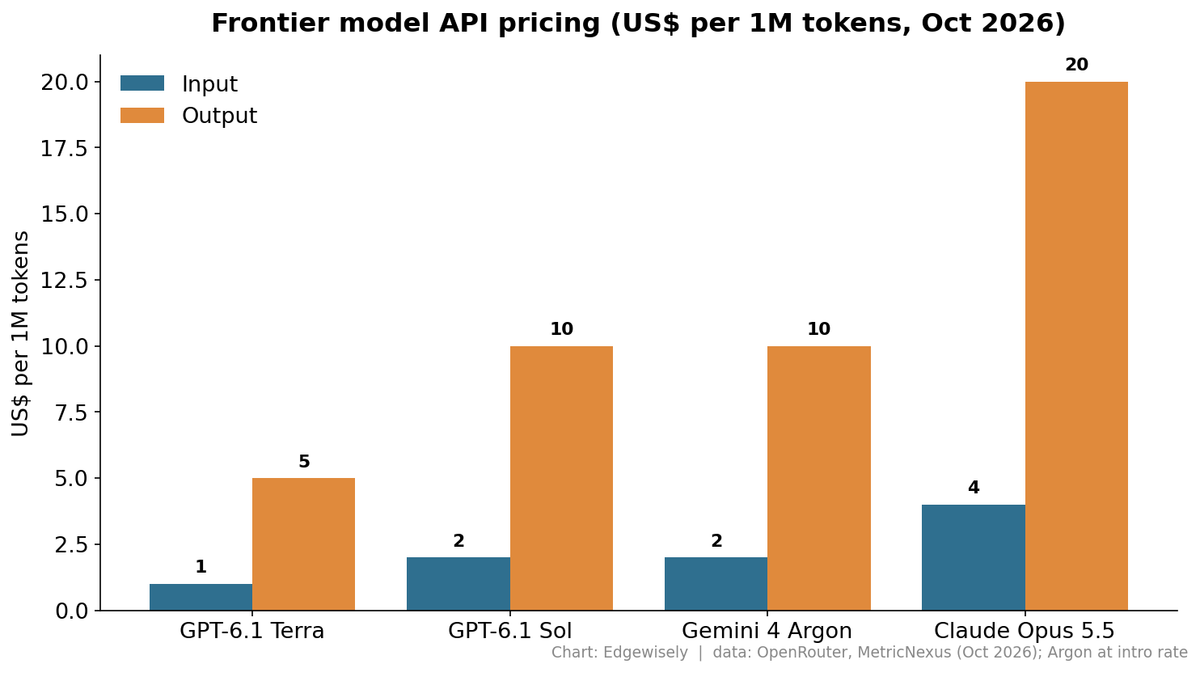
On the standard tier, Terra is $1.00 per 1M input tokens, $5.00 per 1M output, and $0.05 per 1M cached input, per OpenRouter's model page (as of October 2026). Prompts over 272K input tokens step up to $2.00 input and $7.50 output.
Two cheaper paths exist. The Batch/Flex tier runs at $0.50 input / $2.50 output for latency-tolerant work. Cache writes cost more than reads, so prompt caching pays off fast on repetitive agent loops.
The number that matters: Terra is half the per-token price of GPT-6.1 Sol on both input and output.
Cost per token is not cost per task. Artificial Analysis estimates Terra at about $0.40 to run its full evaluation suite at max effort, versus roughly $0.72 for Sol (as of October 2026). At lower effort settings the per-task cost falls to a few cents — which is the whole point of the model. (Artificial Analysis)
How good is GPT-6.1 Terra? (benchmarks)
Treat the launch numbers carefully. Most come from OpenAI at max reasoning effort, which is the model's most expensive, slowest configuration — not what you would run in production.
OpenAI's self-reported figures:
- Terminal-Bench 4.0: 50.3% at max effort, a large jump over the previous Terra generation, per OpenAI's launch post (as of October 2026).
- Computer use: materially stronger than the prior Terra at medium effort, and described as on par with a far pricier model at a fraction of the per-token cost.
- Vision (MMMU-Pro): reported in the mid-80s percent at max effort.
The one independent number available on launch day: Artificial Analysis scores Terra 48 on its Intelligence Index at max effort, ranking it near the top tier of models tracked (as of October 2026). For comparison, AA puts GPT-6.1 Sol at 52. So Terra gives up roughly four Index points to Sol for half the price.
One caveat worth knowing: AA noted Terra burned far more output tokens than the median model to complete its Index at max effort. The model reasons verbosely when you let it. Those headline scores are the ceiling, not the daily driver.
GPT-6.1 Terra vs Claude vs Gemini
Here is where Terra sits against OpenAI's own Sol and the current flagships from Anthropic and Google. Every figure is dated; configs differ, so read the notes.
| Model | Maker | Context | Input $/1M | Output $/1M | Key benchmark | Best for |
|---|---|---|---|---|---|---|
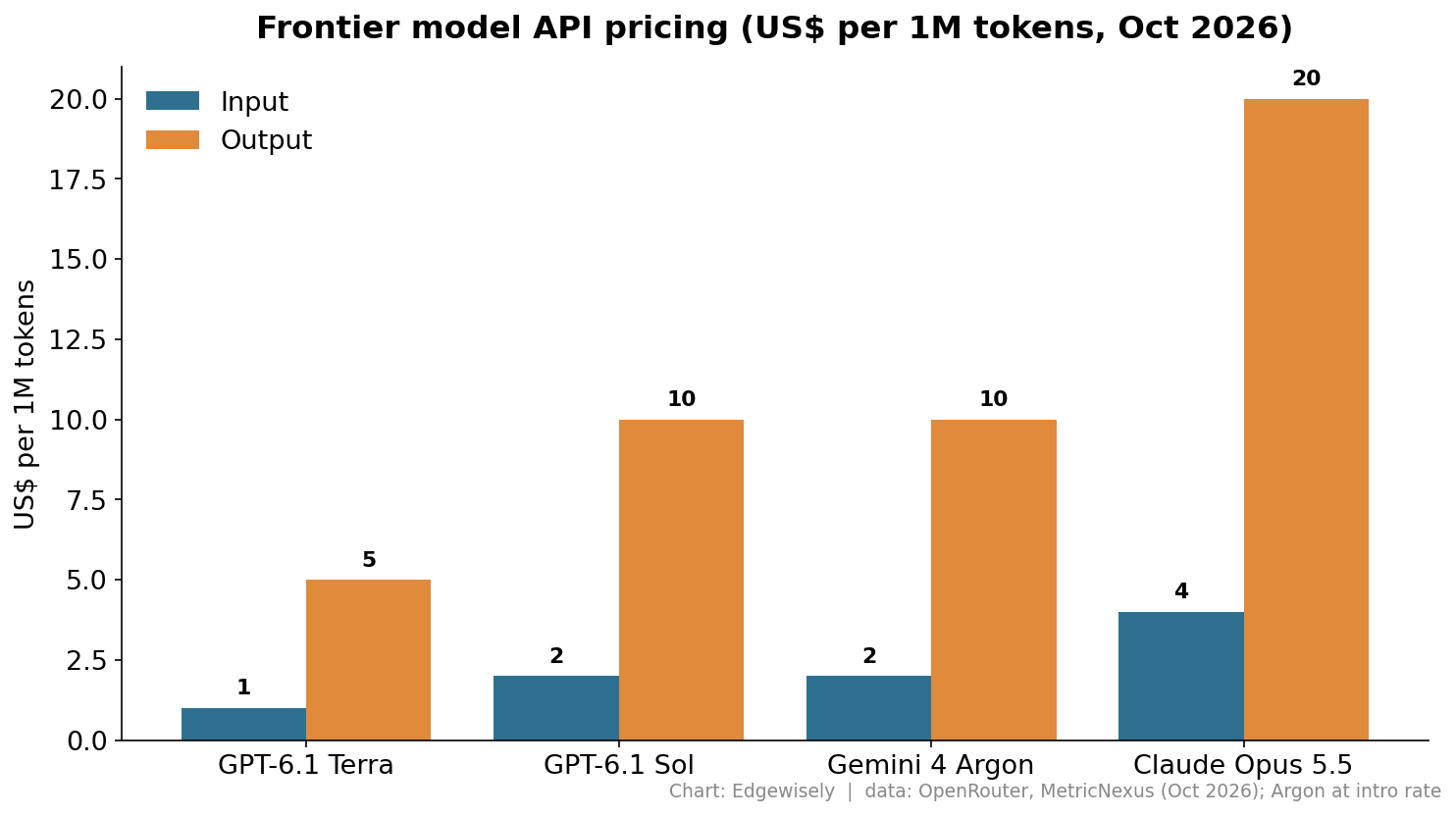
| GPT-6.1 Terra | OpenAI | ~1.1M | $1.00 | $5.00 | Terminal-Bench 4.0 50.3% (OpenAI, max); AA Index 48 | High-volume agents, computer use, cost control |
| GPT-6.1 Sol | OpenAI | ~1.05M | $2.00 | $10.00 | AA Index 52 | Harder reasoning and coding in the OpenAI stack |
| Claude Opus 5.5 | Anthropic | 1M | $4.00 | $20.00 | Terminal-Bench 4.0 66.4% (Anthropic) | Top-end agentic coding and reliability |
| Gemini 4 Argon | ~1.05M | $2.00* | $10.00* | Terminal-Bench 4.0 ~57% (Google) | Multimodal breadth, long context |
Sources and dates: Terra price/context OpenRouter; Opus 5.5 price and benchmarks (Sep–Oct 2026); Gemini 4 Argon price and benchmarks (Oct 2026). *Argon's $2/$10 is an introductory rate through 30 November 2026; standard pricing rises afterwards.
The clean read: on raw benchmark scores, Claude Opus 5.5 leads on Terminal-Bench by a wide margin, with Gemini 4 Argon and GPT-6.1 Sol in the middle. But Opus 5.5 costs four times Terra's input price and four times its output price. Those Terminal-Bench numbers also come from different harnesses and effort settings, so the gaps are directional, not exact.
A note on the lineups: Opus 5.5 is the model Anthropic now recommends starting with for most work, as of October 2026. Google's Gemini 4 Argon is its current top model and launched with an introductory discount that undercuts Claude on price.
If you are choosing a gateway or router to juggle these models, our LiteLLM vs OpenRouter comparison covers the routing trade-offs.
Who should use GPT-6.1 Terra?
Use Terra if you are building agents that run at volume — customer-facing assistants, RPA-style computer-use flows, batch coding jobs, or anything that loops many times per task. The $1/$5 pricing and the none/low effort settings are built for exactly this.
Use Terra if your agent reads screenshots, dashboards or terminals. That is the capability OpenAI tuned, and it is the clearest reason to pick Terra over a cheaper general model like Luna.
Do not reach for Terra as a frontier reasoning model. If you need the highest score on a hard coding or math task and cost is secondary, Sol, Opus 5.5 or Argon will serve you better. If you are comparing agentic coding tools specifically, our Claude Code vs GitHub Copilot breakdown is a useful companion read, and our roundup of the top AI agent platforms for 2026 covers where these models get deployed.
Our take
The price is the story. Everything else is detail.
OpenAI shipped a model that scores 48 on an independent intelligence index — four points off its own Sol — and charges half as much for it. At $1 input and $5 output, Terra undercuts Claude Opus 5.5 by 4x and matches Gemini 4 Argon's introductory rate while beating Argon's post-November standard price. For anyone running agents at scale, that is not a marginal improvement. It changes the arithmetic of what you can afford to automate.
Here is the reasoning behind the verdict. Agent workloads are token-hungry in a way that chat is not. A single agent task can fan out into dozens of model calls, each re-reading context, screenshots and tool output. At Opus 5.5 prices, a long-running agent loop gets expensive fast, which pushes teams toward shorter context, fewer retries and more aggressive summarisation — all of which hurt quality. Terra's pricing removes that pressure. You can let the agent read the whole screen, keep more history, and retry on failure without watching the meter. In my view, that operational headroom is worth more to most agent builders than four points on a benchmark they will never run at max effort anyway.
The benchmark picture supports the positioning but does not oversell it. Terra's 50.3% on Terminal-Bench 4.0 is OpenAI's own number at max effort — the slowest, priciest setting — so read it as a ceiling. Claude Opus 5.5's 66.4% on the same benchmark is genuinely higher, and if your agent's success depends on nailing hard terminal tasks on the first try, that gap is real and Opus earns its premium. But most production agents do not run at max effort, because max effort is slow and costs several times what low effort costs on the same model. The honest comparison is Terra-at-low-effort against the rivals at their production settings, and that comparison is not in any launch table. Treat every number here as directional.
Where Terra clearly wins: computer use and vision-driven agents. OpenAI's claim that Terra matches a far pricier model on computer-use evaluations at a fraction of the per-token price is a vendor claim, not independently verified — but it is consistent with the Artificial Analysis cost-per-task data, which shows Terra completing the full suite for about $0.40 against Sol's ~$0.72. If your agent spends its day reading dashboards and clicking through interfaces, Terra is the obvious default. That is the use case OpenAI built it for, and the pricing makes it the rational choice.
Where it does not win: anything that needs sustained, hard reasoning. If you are doing frontier-level code generation, complex multi-step math, or research-grade analysis, the four-point Index gap to Sol and the larger gap to Opus 5.5 will show up as failed tasks and wasted retries. At that point a pricier model is cheaper, because a model that gets it right once beats a cheap model that needs five attempts.
Concrete guidance for agent builders. Make Terra your default, and route up only when you measure a quality shortfall. Start agents on Terra at low or medium effort. Instrument task success rate, not token cost. When a specific task class fails too often, escalate that class — and only that class — to Sol or Opus 5.5. Use Flex pricing ($0.50/$2.50) for anything latency-tolerant, and lean on prompt caching at $0.05/M for repetitive context. A model router makes this tiering automatic rather than hand-coded.
The one risk to flag: Terra reasons verbosely. Artificial Analysis found it burning far more output tokens than the median model to hit its scores. Since output is your most expensive token at $5/M, an agent that over-reasons can quietly erode the price advantage. Watch output token counts in production and cap effort where you can.
Verdict. GPT-6.1 Terra is the best price-to-performance agentic model available today, as of October 2026. Best for high-volume agents, computer use and coding where cost and latency matter. Avoid it as a frontier reasoning engine — for the hardest tasks, Sol, Claude Opus 5.5 or Gemini 4 Argon are the better spend. Default to Terra; escalate on evidence.
Frequently Asked Questions
How much does GPT-6.1 Terra cost?
GPT-6.1 Terra costs $1.00 per 1M input tokens and $5.00 per 1M output on the standard tier, with cached input at $0.05 per 1M, as of October 2026. OpenAI's Flex/Batch tier halves this to $0.50 input and $2.50 output. Prompts over 272K input tokens cost $2.00 input and $7.50 output.
What is GPT-6.1 Terra's context window?
GPT-6.1 Terra has a context window of roughly 1.1 million tokens — about 1,050,000 input tokens with a maximum output of 128,000 tokens, as of October 2026. That is large enough to hold long agent histories, multiple documents, or an entire codebase in a single prompt, which matters for agents that accumulate context across many steps.
Is GPT-6.1 Terra better than Claude?
Not on raw benchmarks. Claude Opus 5.5 scores higher on Terminal-Bench 4.0 (66.4% Anthropic-reported vs Terra's 50.3% OpenAI-reported), as of October 2026. But Terra costs a quarter of Opus 5.5's price. Terra wins on price-to-performance for high-volume agents; Opus 5.5 wins when you need top-end reasoning reliability.
What is GPT-6.1 Terra good at?
GPT-6.1 Terra is tuned for agentic workflows: computer use, reading screenshots and on-screen content, driving terminals, and coding tasks. OpenAI positions it as particularly strong at understanding screenshots. It is designed for high-volume, cost-sensitive deployments rather than frontier-level reasoning, where the pricier GPT-6.1 Sol performs better.
What is the difference between GPT-6.1 Terra and Sol?
Sol is OpenAI's higher reasoning tier at $2/$10 per 1M tokens; Terra is the mid tier at $1/$5, as of October 2026. Artificial Analysis scores Sol 52 on its Intelligence Index versus Terra's 48. Sol is stronger on hard coding and reasoning; Terra is half the price and tuned for agents and computer use.
Editor's note — sources
- OpenAI — introducing GPT-6.1 Terra — launch date, positioning and self-reported benchmarks.
- OpenRouter — GPT-6.1 Terra — pricing, context window, API id.
- Artificial Analysis — GPT-6.1 Terra — independent Intelligence Index, cost-per-task, output-token note.
- MetricNexus — Claude Opus 5.5 benchmarks and pricing — Opus 5.5 price and Terminal-Bench.
- MetricNexus — Gemini 4 Argon benchmarks and pricing — Argon price and Terminal-Bench.