
Best LLM for Math (2026): Benchmarks & Verdict
The best LLM for math is GPT-6.1 Sol, top of MathArena's uncontaminated board at 80.6% - plus the best open and best-value picks. Verified Nov 2026.


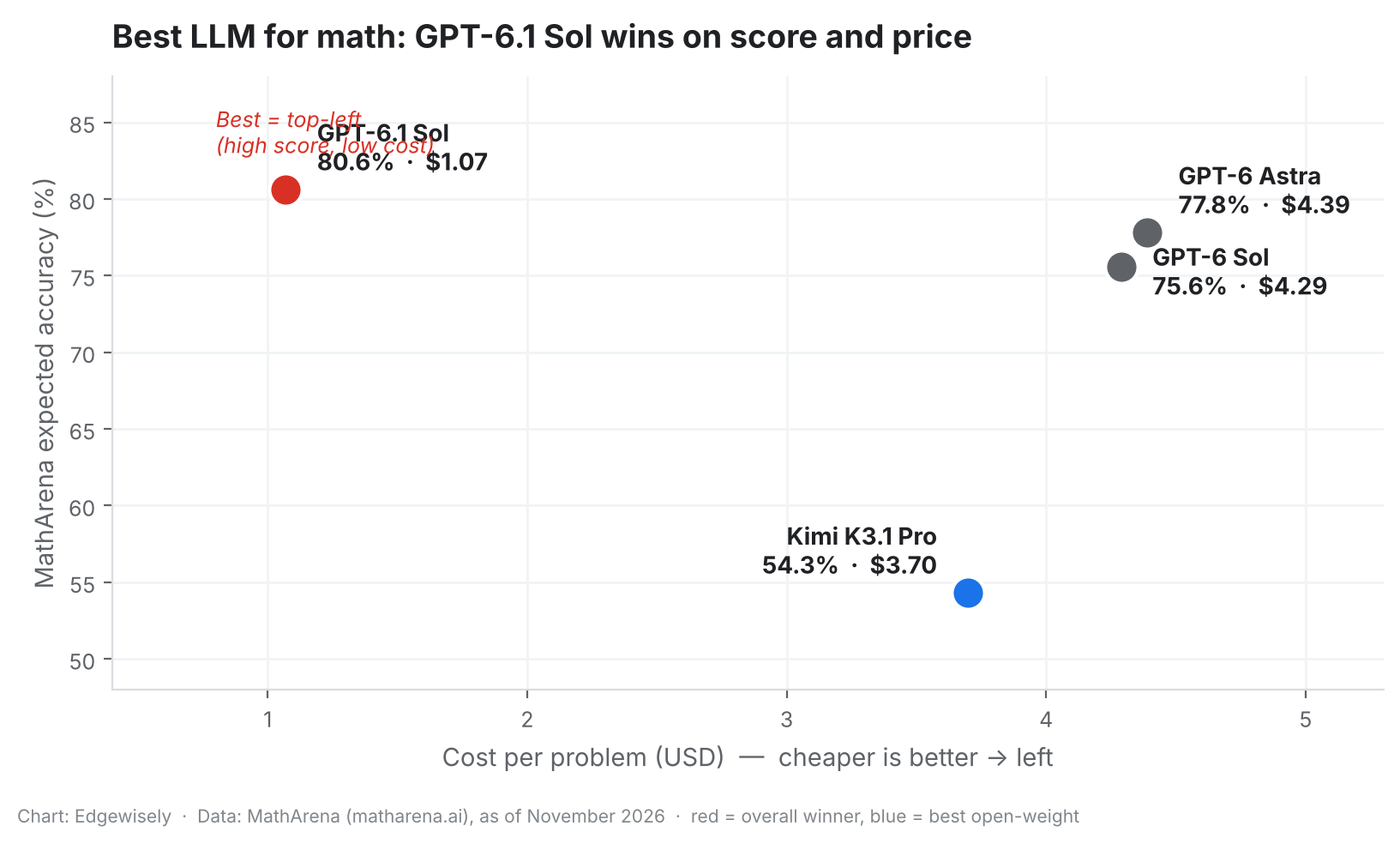
The best LLM for math right now is OpenAI's GPT-6.1 Sol, which tops MathArena's contamination-resistant competition-math leaderboard at about 80.6% expected accuracy — and it does it for roughly $1.07 per problem, cheaper than the models just behind it. The best open-weight pick is Kimi K3.1 Pro at 54.3%. Just know that math is far from solved.
TL;DR
- Overall winner: GPT-6.1 Sol, ~80.6% on MathArena's uncontaminated competition-math board (as of November 2026).
- Best open-source LLM for math: Kimi K3.1 Pro, ~54.3% — the strongest open-weight model, but a clear step below the frontier.
- Best value: also GPT-6.1 Sol. It posts the top score and the lowest cost per problem (~$1.07 vs ~$4+ for its closest rivals), which inverts the usual "pay more for better" rule.
- The caveat that matters: on fresh olympiad problems the model never saw (IMO 2025), the best systems still score under 40%. Benchmarks that models trained on overstate ability — so trust the uncontaminated ones.
- Don't confuse "smartest" with "best at math": Gemini 4 Carbon leads the overall Artificial Analysis Intelligence Index but does not top the competition-math board.
What is the best LLM for math right now?
If you want one answer: use GPT-6.1 Sol for hard math.
On MathArena — the benchmark that tests models on competitions released after their training cutoff — GPT-6.1 Sol sits at the top with an expected competition-math score of about 80.6% (±2.4%), accessed November 2026. The two models directly behind it are also OpenAI's: GPT-6 Astra at 77.8% and GPT-6 Sol at 75.6%.
Here's the twist that makes the pick easy. GPT-6.1 Sol isn't just the most accurate — it's also the cheapest of the three, at roughly $1.07 per problem versus about $4.39 and $4.29 for Astra and Sol. You rarely get the top score and the lowest price in the same row.
One important framing fact before you read any "smartest AI" headline. Gemini 4 Carbon sits at the top of the general-purpose Artificial Analysis Intelligence Index (scoring 59 as of early November 2026). But leading the general intelligence index is not the same as leading at math. A model can be at the very top overall and not #1 at competition math — which is exactly why you need a math-specific, contamination-resistant benchmark instead of a vendor's press release.
How are these models tested? (Why MathArena)
Most math scores you see online are contaminated. A model that trained on the public web has likely seen AIME 2024, old Putnam problems, and thousands of solved olympiad sets. Score it on those and you're measuring memory, not reasoning.
MathArena (built by researchers at ETH Zurich) fixes this with a simple, strict rule: evaluate models on competitions released after their training cutoff, so the problems are genuinely new. In their words, "by evaluating models as soon as new problems are released, we effectively eliminate the risk of contamination" (MathArena paper, arXiv 2505.23281).
The design holds up because:
- Problems come from live competitions (AIME, HMMT, BRUMO, SMT and olympiad sets), pre-vetted by organizers for originality.
- Models released after a competition date are flagged, so you can tell when contamination is even possible.
- Each model runs once per competition with the provider's recommended settings, no tuning, generating multiple responses per question.
- Code, data and raw model responses are published.
MathArena even documents contamination it found elsewhere: signals in AIME 2024, and eight AIME 2025 problems with near-identical versions already online. That's the whole point — when the test leaks, the leaderboard lies.
The headline MathArena number is an "expected performance" figure: a normalized average across current competitions that gives each question equal weight, using observed scores where available and an item-response-theory estimate to fill gaps. It's not a single exam's raw percentage, and it shifts slightly as competitions are added or retired. So treat it as a well-constructed ranking, dated, rather than a fixed grade.
Here's the verified board, as of November 2026.
| Model | Maker | Open or closed | MathArena competition-math (Nov 2026) | Cost per problem | Best for |
|---|---|---|---|---|---|
| GPT-6.1 Sol (max) | OpenAI | Closed | 80.6% | ~$1.07 | Overall best + best value |
| GPT-6 Astra (max) | OpenAI | Closed | 77.8% | ~$4.39 | Frontier reasoning, cost no object |
| GPT-6 Sol (max) | OpenAI | Closed | 75.6% | ~$4.29 | Strong closed alternative |
| Kimi K3.1 Pro | Moonshot AI | Open weights | 54.3% | ~$3.70 | Best self-hostable / open |
Source: all rows from matharena.ai (linked above), accessed November 10, 2026. Figures are MathArena "expected performance" and expected cost per problem, each with an uncertainty band on the site.
Best open-source LLM for math
If you need weights you can host, the pick is Kimi K3.1 Pro from Moonshot AI, which MathArena labels the top open model at about 54.3%. (It's the same model that anchors our Kimi vs DeepSeek open-weight comparison.)
Be honest with yourself about the gap, though. The best open model trails the best closed model by roughly 26 points (54.3% vs 80.6%). For a startup doing applied math inside a product, that gap is often fine. For olympiad-grade reasoning, it isn't.
The trajectory is the encouraging part. Moonshot's earlier Kimi models sat well below 50% on this board; K3.1 Pro climbed to 54.3% as the best-open pick within a few months. Open-weight math reasoning is improving fast — it's just not at the frontier yet.
Best value: math performance per dollar
This is the part that should change how you think about model selection.
Usually the best model is the expensive one. Here it isn't. GPT-6.1 Sol posts the highest score and the lowest cost — about $1.07 per problem against $4+ for the models right behind it. On a per-problem basis you're paying roughly a quarter of the price for a higher score.
So the "value" pick and the "best" pick are the same model. For a math-heavy product where you run thousands of problems, that compounds into a large, real difference in your bill. (If raw price is your main axis, our cheapest AI API breakdown ranks the field on $/token.)
The open route can still win on total cost of ownership if you already run GPU infrastructure and care about data staying in-house — Kimi K3.1 Pro gives you self-hostable weights. But purely on hosted price-per-correct-answer, the frontier API is, unusually, also the cheap option.
Can LLMs actually do hard math?
Not fully — and this is where the hype gets ahead of reality.
On IMO 2025, a proof-based olympiad released after training, MathArena reports the best models scored "slightly less than 40%" (per its arXiv paper, cited above). These are the same models clearing 75–80% on shorter-answer competition sets. Long, proof-heavy, genuinely novel problems still break them.
Two more things to internalize:
- Arithmetic is a weak spot, not a strength. Large models fumble long multi-digit arithmetic and bookkeeping without tools. Competition reasoning and reliable calculation are different skills.
- Tool use changes the picture. Give a model a code interpreter or calculator and its applied-math reliability jumps, because it offloads the error-prone parts. Many MathArena-style evaluations measure the model alone; your production setup probably shouldn't.
So "good at math" is really three questions: competition reasoning, applied/engineering math, and plain arithmetic reliability. No single number covers all three.
Which model should you use for your math task?
Match the model to the job:
- Competition / olympiad / contest prep: GPT-6.1 Sol. Top of the uncontaminated board, and cheapest of the leaders.
- Applied or engineering math (derivations, numerical methods, modeling): GPT-6.1 Sol with a code interpreter enabled. The reasoning gets you the approach; the tool gets you correct numbers.
- Self-hosting / data can't leave your infra: Kimi K3.1 Pro — best open weights, with a known ~26-point gap to the frontier.
- "Smartest overall" general work with math on the side: Gemini 4 Carbon leads the general index, but if math is the point, don't assume it leads there too — check the math board.
This is the same job-by-job logic we used to pick the best LLM for research and the best LLM for writing: the right model depends entirely on the task, and the overall leaderboard rarely settles it.
Our take: which math model actually earns the pick
Our thesis is blunt: the best math LLM is now also one of the cheapest — and that only stays true as long as you benchmark on problems the model never saw. Two forces are colliding here, and you should hold both in your head.
First, the price inversion is real and worth exploiting. For years the rule was "the best model costs the most." On MathArena today, GPT-6.1 Sol is simultaneously the most accurate and the lowest-cost of the frontier trio. If you're choosing a math model and you default to the most expensive option because you assume it's the best, you'd be wrong twice — paying more for less. That's rare enough that it's worth acting on now, before the next release cycle reshuffles it.
Second, and more important: the ranking you trust is only as good as its resistance to contamination. We're deliberately leaning on MathArena rather than vendor model cards because the contamination problem is not theoretical. MathArena itself found that eight AIME 2025 problems had near-duplicates already online, and that AIME 2024 showed contamination signals. When a vendor reports a glittering AIME score, you often can't tell whether you're seeing reasoning or recall. A benchmark that tests models the day a competition drops removes that ambiguity. That design choice is the single most important reason to trust one leaderboard over another — more than which specific model is on top this month.
It also reframes "good at math." A model that scores 80% on short-answer competition math and under 40% on fresh olympiad proofs isn't "superhuman at math" — it's excellent at a specific, bounded slice of it. And none of these systems are reliable at long arithmetic on their own. In our opinion, the most consequential setup decision you'll make isn't the model; it's whether you give it tools. A mid-tier model with a code interpreter will out-perform a frontier model doing mental arithmetic on any task that bottoms out in actual calculation. If you're shipping a math feature and you haven't wired up a calculator or sandbox, you're leaving reliability on the table — that's an engineering choice, not a model-selection one.
Concrete picks, by who you are:
- If you're a student: Use GPT-6.1 Sol for working through contest-style problems — it's the strongest and the cheapest. But verify its arithmetic, and don't trust a slick proof on a genuinely hard problem; the sub-40% olympiad number is your reality check.
- If you're a quant or engineer: GPT-6.1 Sol with a code interpreter, always. You care about correct numbers, not vibes. Let the model reason and let the sandbox compute. Treat ungrounded arithmetic as a bug source.
- If you're building a math-heavy product: Start on the best hosted API for quality-per-dollar (currently GPT-6.1 Sol), instrument accuracy on your real inputs, and keep Kimi K3.1 Pro on the shortlist for when data-residency, cost at scale, or self-hosting tips the economics toward open weights. Re-check the board quarterly — these rankings move.
One opinion stated as opinion: we expect the open-weight gap to keep closing faster than the frontier improves, because the top open model climbed more than ten points on this board in a matter of months. If that pace holds, "good enough, open, and self-hosted" becomes the default for most applied math work within a year. That's a forecast, not a fact — but it's the way we'd bet.
Frequently Asked Questions
What is the best AI model for math?
As of November 2026, the best AI model for math is OpenAI's GPT-6.1 Sol, which leads MathArena's contamination-resistant competition-math leaderboard at about 80.6%. It's also the cheapest of the top models, at roughly $1.07 per problem, making it both the strongest and the best-value choice for hard math.
Is ChatGPT or Gemini better at math?
For competition math, the ChatGPT/OpenAI family leads. OpenAI's GPT-6.1 Sol tops MathArena's math board, while Gemini 4 Carbon leads the general Artificial Analysis Intelligence Index but does not top the math-specific leaderboard. Being the smartest model overall doesn't mean being the best at math.
Can open-source LLMs do math well?
They're getting close but aren't at the frontier. The best open-weight model, Kimi K3.1 Pro, scores about 54.3% on MathArena — strong, but roughly 26 points behind the top closed model. For applied, in-product math that gap is often acceptable; for olympiad-grade reasoning it isn't. Open models are improving quickly.
Why do LLMs make math mistakes?
Because they predict text rather than calculate, they fumble long arithmetic and bookkeeping, and they struggle with genuinely novel, proof-based problems — top models still score under 40% on fresh IMO problems. Giving a model a calculator or code interpreter sharply improves reliability by offloading the error-prone computation.
Is GPT-6 good at math?
Yes. The GPT-6 family dominates MathArena's competition-math board, taking the top three spots: GPT-6.1 Sol (80.6%), GPT-6 Astra (77.8%) and GPT-6 Sol (75.6%), as of November 2026. GPT-6.1 Sol is the standout because it pairs the highest score with the lowest cost per problem.
Editor's note — sources: All competition-math scores and per-problem costs are MathArena "expected performance" figures from matharena.ai, accessed November 10, 2026; the contamination methodology and IMO 2025 result are from the MathArena arXiv paper. The general-index framing is from Artificial Analysis coverage. (All three are linked at the relevant claims above.) MathArena's figures are normalized, dated estimates with uncertainty bands and move as competitions are added — treat the ranking as current-as-of-date, not fixed. Rows we could not verify on the live board (several Claude, Gemini, DeepSeek and Grok figures) were deliberately left out.