
Kimi vs DeepSeek: Which Model Wins in 2026?
Kimi K3.1 Pro is the smarter model on Artificial Analysis's v5 index (46), but DeepSeek V4.1 Flash (33) and V4 Pro (23) win on price, speed, and genuinely open MIT weights you can self-host. A full head-to-head on benchmarks, pricing, licensing, and coding - with a clear verdict for builders.


Kimi vs DeepSeek comes down to one trade-off. Moonshot's Kimi K3.1 Pro is the smarter model on Artificial Analysis's v5 index; DeepSeek is cheaper, faster, and genuinely open-weight under MIT. Pick Kimi K3.1 Pro for hard agentic reasoning through an API. Pick DeepSeek V4.1 Flash when cost, speed, or self-hosting matter most.
TL;DR
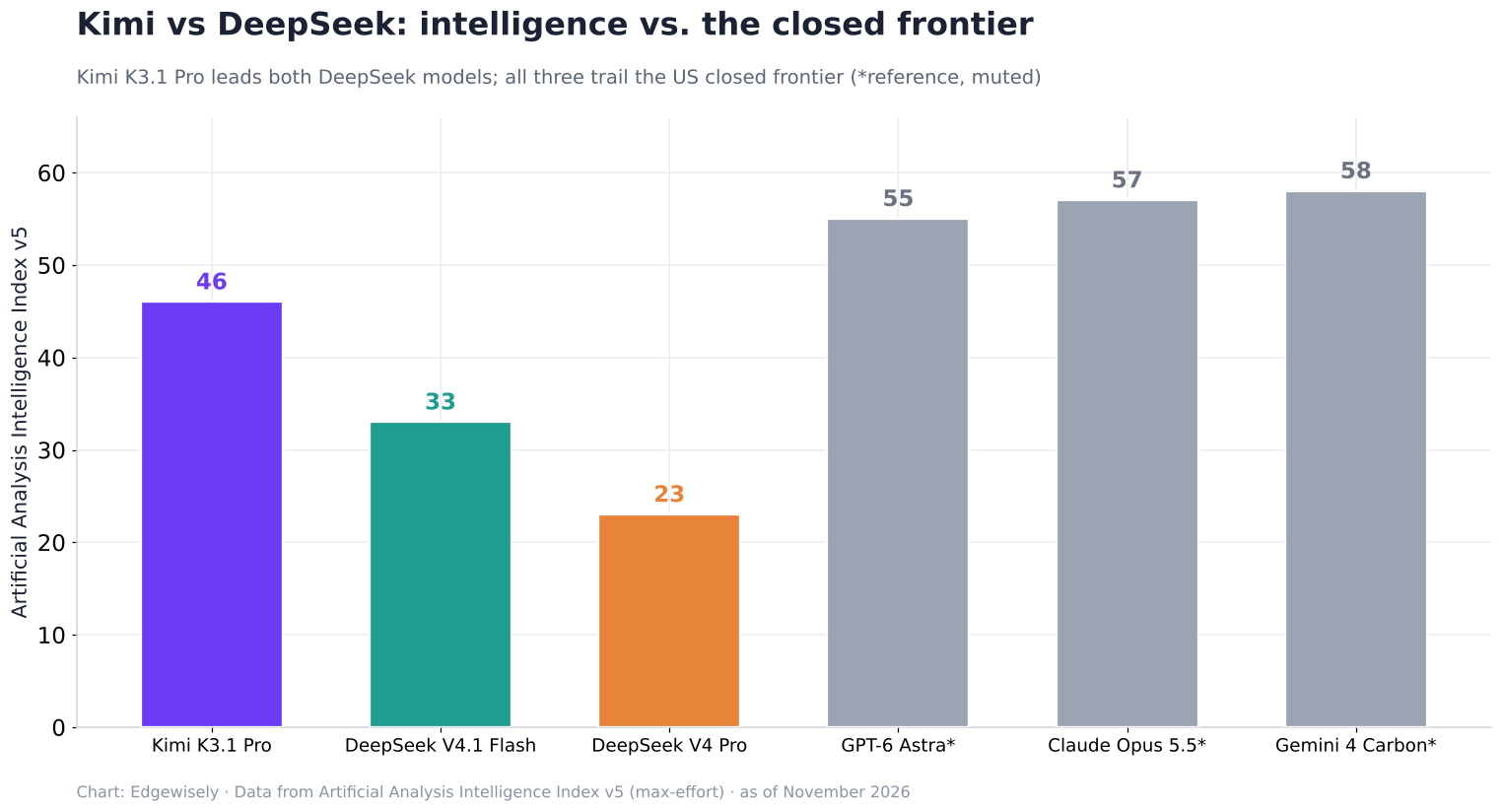
- Intelligence (AA Index v5, as of November 2026): Kimi K3.1 Pro scores 46, DeepSeek V4.1 Flash 1017 scores 33, and DeepSeek V4 Pro 0813 scores 23. Kimi leads both DeepSeek models on raw intelligence.
- The DeepSeek inversion: The smaller, newer V4.1 Flash (33) outscores the bigger V4 Pro (23) on v5. The flagship is no longer the smartest DeepSeek.
- Price: DeepSeek is far cheaper. V4.1 Flash runs about $0.30 in / $1.20 out per 1M tokens; Kimi K3.1 Pro is $2.00 in / $10.00 out. DeepSeek also halves prices off-peak.
- Open weights: DeepSeek V4 Pro and V4.1 Flash ship with downloadable MIT weights. Kimi K3.1 Pro is API-first and listed as closed-weight on Artificial Analysis as of November 2026.
- Verdict: Kimi K3.1 Pro for maximum intelligence via API; DeepSeek for price, throughput, and true self-hosting.
Kimi vs DeepSeek: which is better?
There is no single winner, because "better" splits cleanly along two axes: intelligence and openness.
On raw intelligence, Kimi wins. Moonshot's Kimi K3.1 Pro posts a v5 Intelligence Index of 46 on Artificial Analysis, ahead of both DeepSeek releases as of November 2026.
On cost, openness, and speed, DeepSeek wins. Its two current models carry permissive MIT weights you can download from Hugging Face, and they cost a fraction of Kimi's API rate.
The honest answer for most teams: if you are hitting an API and want the strongest reasoning, choose Kimi K3.1 Pro. If you care about price, latency, or running the model on your own hardware, choose DeepSeek.
Here is the head-to-head, with every cell verified against primary sources as of November 2026.
| Model | Maker | AA Index v5 | Params (total / active) | Context | Input $/1M | Output $/1M | License | Best for |
|---|---|---|---|---|---|---|---|---|
| Kimi K3.1 Pro | Moonshot AI | 46 | 2.8T / 104B (MoE) | 1M | $2.00 | $10.00 | Proprietary (API-first) | Hardest reasoning / agentic tasks |
| DeepSeek V4 Pro 0813 | DeepSeek | 23 | 1.6T / 49B (MoE) | 1M | $1.32 | $3.96 | MIT | Text-only flagship, self-host |
| DeepSeek V4.1 Flash 1017 | DeepSeek | 33 | 552B / 16B (MoE) | 1M | $0.30 | $1.20 | MIT | Cheap, fast, multimodal, self-host |
| Kimi K2.7 Code | Moonshot AI | Not listed | ~1T / 32B (reported) | 256K | Not disclosed | Not disclosed | Open weights (reported) | Coding agents |
Prices are standard peak API rates. DeepSeek rates are cache-miss input; both DeepSeek models drop by half off-peak. Kimi K3.1 Pro's input price reflects a 90% cached-input discount when the cache is hit.
How do Kimi K3.1 Pro and DeepSeek V4 compare on benchmarks?
The comparison that matters is the kimi k3.1 pro vs deepseek question on a single, consistent yardstick: the Artificial Analysis Intelligence Index v5.
Kimi K3.1 Pro = 46. DeepSeek V4.1 Flash 1017 = 33. DeepSeek V4 Pro 0813 = 23.
Two things jump out.
First, Kimi clears both DeepSeek models by a wide margin. A 46-vs-23 gap against the DeepSeek flagship is not noise.
Second, DeepSeek's own lineup inverts. The smaller V4.1 Flash scores 33 while the larger V4 Pro scores 23 on the max-effort setting. On a newer architecture and a reasoning-tuned release, the 552B Flash beats the 1.6T Pro. If you were about to default to "the Pro is the smart one," the data says otherwise.
For context on the same index, the US closed frontier sits higher: Gemini 4 Carbon lands around 58-60, Claude Opus 5.5 near 57, and GPT-6 Astra about 55. Both Chinese models trail that frontier on raw measured intelligence, but they do it at a fraction of the price and, in DeepSeek's case, with open weights.
One caution: AA v5 re-baselined every score much lower than earlier index versions. An older "Kimi K3 = 57" figure you might find is a different index and a different model. Do not compare v5 numbers to pre-v5 numbers.
Which is cheaper, Kimi or DeepSeek?
DeepSeek, and it is not close.
Kimi K3.1 Pro's published API price is $2.00 per 1M input tokens and $10.00 per 1M output, with a 90% discount on cached input. On AA's standard task mix, that works out to roughly $3.68 per Intelligence Index task.
DeepSeek undercuts that heavily. Per the official DeepSeek pricing page:
- V4 Pro 0813: $1.32 in / $3.96 out per 1M (peak, cache miss); cache hits drop input to about $0.044.
- V4.1 Flash 1017: $0.30 in / $1.20 out per 1M (peak, cache miss); cache hits drop input to about $0.006.
DeepSeek also halves all rates off-peak (roughly 16:30-00:30 UTC), so a batch job scheduled overnight runs V4.1 Flash at about $0.15 in / $0.60 out.
On cost per task, V4 Pro comes in near $1.77 and V4.1 Flash near $0.60 — versus Kimi's $3.68. If you are shipping high volume, DeepSeek V4.1 Flash is five to six times cheaper than Kimi per unit of work. For the fuller picture across every provider, see our cheapest AI API cost guide.
Are Kimi and DeepSeek open source, and can you self-host them?
This is where the "best open source llm china" framing needs a correction, because the two vendors are not in the same place right now.
DeepSeek is genuinely open-weight. Both DeepSeek V4 Pro and DeepSeek V4.1 Flash list MIT licenses, and the weights sit in DeepSeek's public Hugging Face organization. MIT means commercial use with essentially no restrictions. If you have the GPUs, you can run them yourself today.
Kimi K3.1 Pro is, as of November 2026, API-first. Artificial Analysis lists its "Open Source (Weights)" status as No and the model as proprietary, and reporting at launch said the model was available only through Moonshot's API with open weights planned for release. An open-weight drop is signaled, but until the repo is public and a license is confirmed, treat Kimi K3.1 Pro as a closed, hosted model for self-hosting decisions.
Note the contrast with Moonshot's own history: earlier Kimi models, including the Kimi K2.7 Code coding model, were released with downloadable weights. So Kimi K3.1 Pro's closed status looks like a launch-sequencing choice, not a permanent policy. For now, though, if "can I run it on my own cluster this quarter?" is the question, DeepSeek is the only yes of the two.
Which is better for coding, Kimi or DeepSeek?
For coding agents specifically, both makers field tuned options, and the pick depends on whether you can self-host.
Moonshot's Kimi K2.7 Code is a dedicated coding model with a 256K context and open weights in the Kimi family — useful when you want a self-hostable agent that keeps a large repo in context. Kimi K3.1 Pro itself is strong on long-horizon, multi-step tasks, which is where agentic coding lives.
DeepSeek's edge for coding is throughput and price. V4.1 Flash runs at roughly 165 tokens/sec versus Kimi K3.1 Pro's ~31 tokens/sec, per Artificial Analysis's leaderboard. In an interactive coding loop, a 5x speed difference is felt on every keystroke-to-suggestion cycle.
Our read: use Kimi K3.1 Pro (via API) when the coding task is genuinely hard and multi-step and you want the highest reasoning ceiling. Use DeepSeek V4.1 Flash when you want fast, cheap, good-enough completions at volume, or Kimi K2.7 Code when you need a self-hosted coding agent with a long context.
Who should use which?
- Pick Kimi K3.1 Pro if: you want the strongest measured reasoning of the two, you are fine calling a hosted API, and your workloads are agentic or long-horizon rather than high-volume.
- Pick DeepSeek V4.1 Flash if: you want the best cost-per-token, the fastest throughput, image input, or you need MIT-licensed weights you can self-host.
- Pick DeepSeek V4 Pro 0813 if: you specifically want the larger DeepSeek flagship under MIT and your work is text-only — though note V4.1 Flash now scores higher on v5, so this is a narrower case than it used to be.
- Pick Kimi K2.7 Code if: you are building a self-hosted coding agent and want open weights with a 256K window.
If you are weighing these against the closed frontier or other open models, our DeepSeek vs Claude and DeepSeek vs Qwen comparisons cover the neighbours.
Our take
Here is our thesis, stated plainly: both Kimi and DeepSeek are Chinese frontier-adjacent models that trail the US closed frontier on raw AA v5 intelligence, but win decisively on cost and (for DeepSeek) openness — so the real decision is not "which is smarter" but "which trade-off fits your constraint." This is analysis, not vendor fact.
Start with what the AA Intelligence Index captures and what it misses. It captures a broad, consistent blend of reasoning, knowledge, and problem-solving at max effort. It is the right tool for a one-number ranking, and on that number Kimi K3.1 Pro's 46 is a real lead over DeepSeek. But the index says nothing about throughput, and that omission is where the Kimi-vs-DeepSeek story actually turns. Kimi K3.1 Pro is slow — around 31 tokens/sec. DeepSeek V4.1 Flash is roughly 165. For an interactive product or a high-fan-out agent, that gap can outweigh a dozen index points, because latency is a product feature and intelligence-per-token is not the same as intelligence-per-second.
The Flash-beats-Pro inversion inside DeepSeek's own lineup is the most interesting data point here, and it is easy to misread. A 552B model outscoring a 1.6T model on v5 is not a story about parameters; it is a story about reasoning tuning and recency. The lesson for builders: stop defaulting to the biggest model in a family. On this evidence, DeepSeek V4.1 Flash is the better default than V4 Pro for most work — cheaper, faster, multimodal, and smarter on the index. We would need a specific text-only or licensing reason to reach for V4 Pro instead.
Then there is the API-vs-self-host cost crossover, which is where openness stops being ideology and becomes a line item. At DeepSeek's API prices, almost nobody should self-host for cost reasons alone; the API is too cheap to beat with your own idle GPUs. Self-hosting DeepSeek earns its keep for data residency, privacy, latency control, fine-tuning, or air-gapped deployment — not for shaving cents. That reframes the "open weights" advantage: MIT weights are insurance and optionality, most valuable to regulated teams and to anyone who wants to fine-tune or guarantee a model never changes under them. For that buyer, DeepSeek is simply in a different category than Kimi K3.1 Pro right now, because you cannot self-host a model whose weights are not out.
That brings us to Kimi's actual position. Calling Kimi K3.1 Pro "the best open source LLM from China" today is, strictly, wrong — Artificial Analysis lists it as closed-weight, and it launched API-only. Its pitch is different and genuinely strong: the highest reasoning ceiling of this pair, with notable agentic and long-horizon strengths, delivered as a managed endpoint. If you are building an agent that needs to plan and execute many steps and you are not price- or latency-bound, Kimi K3.1 Pro is a defensible first choice. Just budget for it — at $10 per 1M output tokens it is the premium option here, and the slow throughput means you feel the cost in wall-clock time too.
So our verdict, grounded in the figures above and flagged as opinion:
- Best for maximum intelligence via API, agentic/long-horizon work: Kimi K3.1 Pro. Avoid if you are cost-sensitive, latency-sensitive, or need to self-host this quarter.
- Best all-round open model for builders: DeepSeek V4.1 Flash. Avoid only if you need the absolute top reasoning score and can pay for it.
- The DeepSeek V4 Pro flagship: increasingly a specialist pick, not a default, now that Flash outscores it on v5.
Watch the open-weight release closely. The moment Kimi K3.1 Pro's weights land under a usable license, the calculus shifts — you would then weigh Kimi's higher intelligence against DeepSeek's lower cost and faster speed with both models self-hostable, which is a much tighter race than the one you face in November 2026.
Frequently Asked Questions
Is Kimi K3.1 Pro better than DeepSeek V4?
On raw intelligence, yes. Kimi K3.1 Pro scores 46 on the Artificial Analysis Intelligence Index v5, versus 23 for DeepSeek V4 Pro 0813 and 33 for the newer V4.1 Flash 1017, as of November 2026. But DeepSeek is far cheaper, faster, and open-weight, so "better" depends on your priorities.
Which is cheaper, Kimi or DeepSeek?
DeepSeek, by a wide margin. DeepSeek V4.1 Flash costs about $0.30 per 1M input and $1.20 per 1M output tokens, with prices halved off-peak. Kimi K3.1 Pro lists $2.00 input and $10.00 output per 1M. On cost per task, DeepSeek runs roughly five to six times cheaper, as of November 2026.
Are Kimi and DeepSeek open source, and can you self-host them?
DeepSeek V4 Pro and V4.1 Flash ship with downloadable MIT-licensed weights on Hugging Face, so you can self-host them today. Kimi K3.1 Pro is API-first and listed as closed-weight on Artificial Analysis as of November 2026, with an open-weight release signaled but not yet confirmed available for self-hosting.
What is Kimi K3.1 Pro's context window?
Kimi K3.1 Pro has a 1 million token context window, per Artificial Analysis as of November 2026. That matches DeepSeek V4 Pro 0813 and V4.1 Flash 1017, which also offer 1M-token context. Moonshot's coding-focused Kimi K2.7 Code uses a smaller 256K-token window.
Which is better for coding, Kimi or DeepSeek?
It depends on hosting. Kimi K3.1 Pro has the higher reasoning ceiling for hard, multi-step coding via API, and Kimi K2.7 Code offers open weights with a 256K context for self-hosted agents. DeepSeek V4.1 Flash is far faster (about 165 vs 31 tokens/sec) and cheaper for high-volume completions.
Editor’s note — sources: Intelligence scores, parameter counts, context windows, throughput and open-weight status are from Artificial Analysis Intelligence Index v5. DeepSeek per-token prices are from DeepSeek’s official pricing; DeepSeek weights and MIT licenses from DeepSeek on Hugging Face. Kimi K3.1 Pro’s API-first status is per Artificial Analysis and launch reporting. All figures as of November 2026; verify against the source before relying on them.