
Cheapest AI API in 2026: Real Price Comparison
The cheapest AI API depends on what you need. We verified per-1M-token prices against each vendor's own page: Qwen-Flash at $0.05/$0.40, DeepSeek V4.1 Flash at $0.15/$0.60, open-weight models on DeepInfra at $0.02/$0.04, plus how caching and batch cut the real bill.

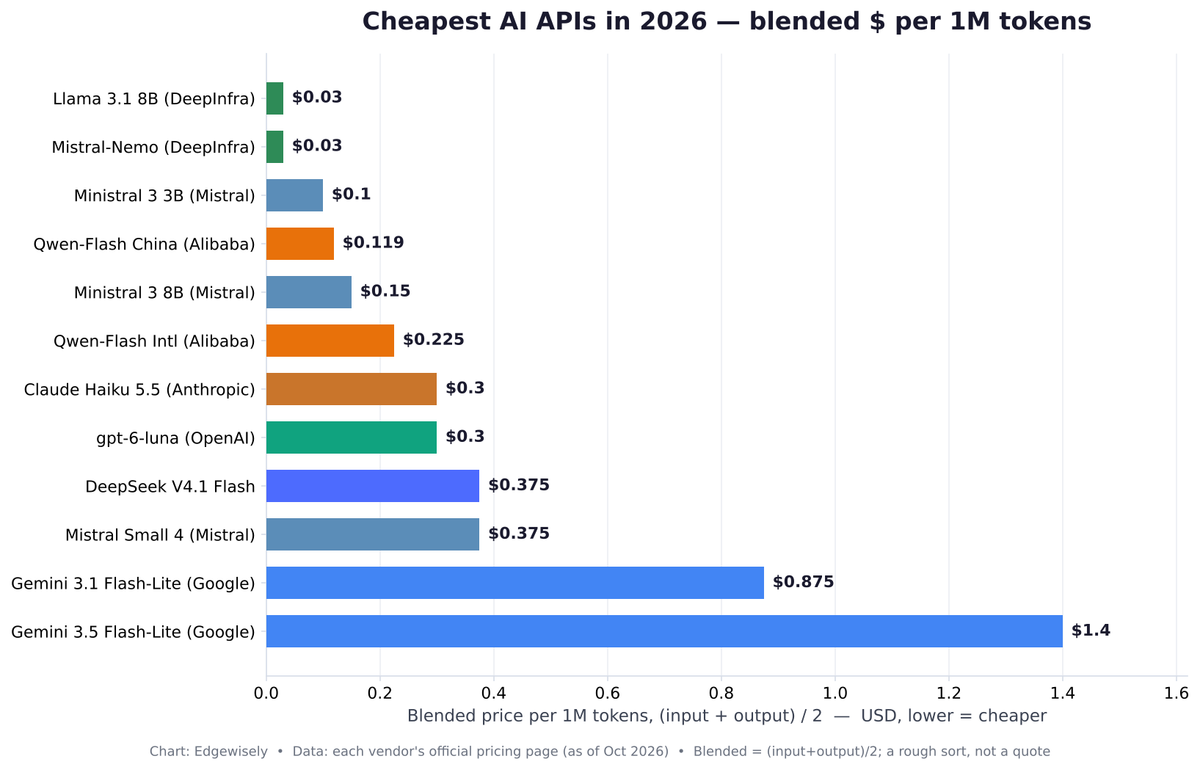
The cheapest AI API depends on what you mean by cheap. For near-frontier quality at the lowest price, DeepSeek V4.1 Flash ($0.15/$0.60 per 1M off-peak) and Gemini 3.1 Flash-Lite ($0.25/$1.50) are the practical floor. For the lowest number on the invoice, a small open-weight model on DeepInfra runs $0.02–$0.04 — but you trade away capability.
TL;DR
- The cheapest AI API that is still genuinely capable is Alibaba Qwen-Flash at $0.05 input / $0.40 output per 1M tokens (International/Singapore endpoint), with DeepSeek V4.1 Flash ($0.15/$0.60 off-peak) and Google Gemini 3.1 Flash-Lite ($0.25/$1.50) close behind. All three are near-frontier. (Verified against vendor pricing pages, Oct 2026.)
- Absolute cheapest: a small open-weight model served on a budget host — Llama 3.1 8B Turbo on DeepInfra at ~$0.02 input / $0.04 output per 1M. It is cheap because the model is tiny, not because it is a steal.
- Cheapest with Western data residency: Claude Haiku 5.5 and OpenAI gpt-6-luna, both $0.10 / $0.50.
- Caching and batch cut your real bill more than the sticker rate. DeepSeek cache-hit input drops to $0.003–$0.006; batch mode is 50% off at Google, OpenAI, Anthropic and Mistral.
- Prices move monthly and some carry promo end dates (Gemini Flash list prices double on Jan 1, 2027). Always check the live vendor page before you commit.
What is the cheapest AI API in 2026?
The cheapest AI API is Qwen-Flash on Alibaba's International endpoint at $0.05 input / $0.40 output per 1M tokens among brand-name models that are good enough for real work. If you will host your own open-weight model on a budget inference provider, you go lower still — around $0.02–$0.04 per 1M on DeepInfra for Llama 3.1 8B.
There is no single "cheapest" number, because three different prices answer three different questions.
Cheapest capable managed model. Qwen-Flash International at $0.05/$0.40, DeepSeek V4.1 Flash at $0.15/$0.60 (off-peak), and Gemini 3.1 Flash-Lite at $0.25/$1.50 are the floor for models that can handle reasoning, tool use and long context.
Cheapest raw tokens. A 4B–8B open-weight model on DeepInfra: Llama 3.1 8B Turbo at $0.02/$0.04, Mistral-Nemo at $0.029/$0.03. These win on price and lose on capability.
Cheapest from a US/EU-hosted lab. Claude Haiku 5.5 and OpenAI gpt-6-luna, both $0.10/$0.50.
All figures per 1M tokens, as of Oct 2026, from each vendor's own pricing page.
Cheapest AI API: full price comparison
Here is the verified table. Every row traces to a primary source listed at the end. Prices are per 1M tokens, as of Oct 2026.
| Model | Provider | Input $/1M | Output $/1M | Cheapest tier (batch/cache) | Open weights? | Good enough for |
|---|---|---|---|---|---|---|
| Llama 3.1 8B Turbo | DeepInfra (host) | 0.02 | 0.04 | — | Yes (Llama license) | High-volume classification, extraction, cheap drafts |
| Mistral-Nemo | DeepInfra (host) | 0.029 | 0.03 | — | Yes (Apache 2.0) | Tagging, simple chat |
| Qwen-Flash (China) | Alibaba | 0.022 | 0.216 | tiered by context | Varies | China-region general tasks |
| Qwen-Flash (Intl) | Alibaba | 0.05 | 0.40 | tiered by context | Varies | General tasks, long context |
| Ministral 3 3B | Mistral | 0.10 | 0.10 | Batch −50% | Varies | Edge/cheap narrow tasks |
| Claude Haiku 5.5 | Anthropic | 0.10 | 0.50 | Batch −50% | No | Fast assistants, tool use, Western data |
| gpt-6-luna | OpenAI | 0.10 | 0.50 | Batch/Flex 0.05 / 0.25 | No | General, deep tooling ecosystem |
| Ministral 3 8B | Mistral | 0.15 | 0.15 | Batch −50% | Varies | Balanced small EU-hosted |
| DeepSeek V4.1 Flash | DeepSeek | 0.15 (off-peak) / 0.30 (peak) | 0.60 / 1.20 | Cache-hit input 0.003–0.006 | Yes (MIT) | Near-frontier reasoning, coding, agents |
| Mistral Small 4 | Mistral | 0.15 | 0.60 | Batch −50% | Varies | Balanced EU-hosted |
| Gemini 3.1 Flash-Lite | 0.25 | 1.50 | Batch/Flex 0.125 / 0.75 | No | Multimodal, long context, cheap scale | |
| Gemini 3.5 Flash-Lite | 0.30 | 2.50 | Batch 0.15 / 1.25 | No | Newer Flash-Lite tier | |
| DeepSeek V4-Pro | DeepSeek | 0.66 / 1.32 | 1.98 / 3.96 | cache-hit input 0.022 / 0.044 | Yes (MIT) | Harder reasoning |
| Grok 4.7 | xAI | 2.00 | 6.00 | — | No | Reference point, not a budget model |
| Claude Sonnet 5.5 | Anthropic | 2.00 | 10.00 | Batch −50% | No | Quality reference, not a budget model |
Notes on the table:
- Qwen-Flash is billed in tiers by input context length. The International (Singapore) rate is $0.05/$0.40 for prompts up to 256k, rising to $0.25/$2 above that. China-region rates are lower but route through Beijing.
- DeepSeek off-peak is half of peak. Peak is 01:00–04:00 and 06:00–10:00 UTC, Mon–Fri. Everything else, including weekends, is off-peak. Cache-hit input is the headline story: as low as $0.003.
- Claude Haiku 5.5 is $0.10/$0.50 up to 100K-token prompts, then $0.50/$2.50 above that.
- Gemini 3.8 Flash and Gemini 4 Argon carry introductory prices that increase at year-end; Flash-Lite tiers above are the stable cheap options.
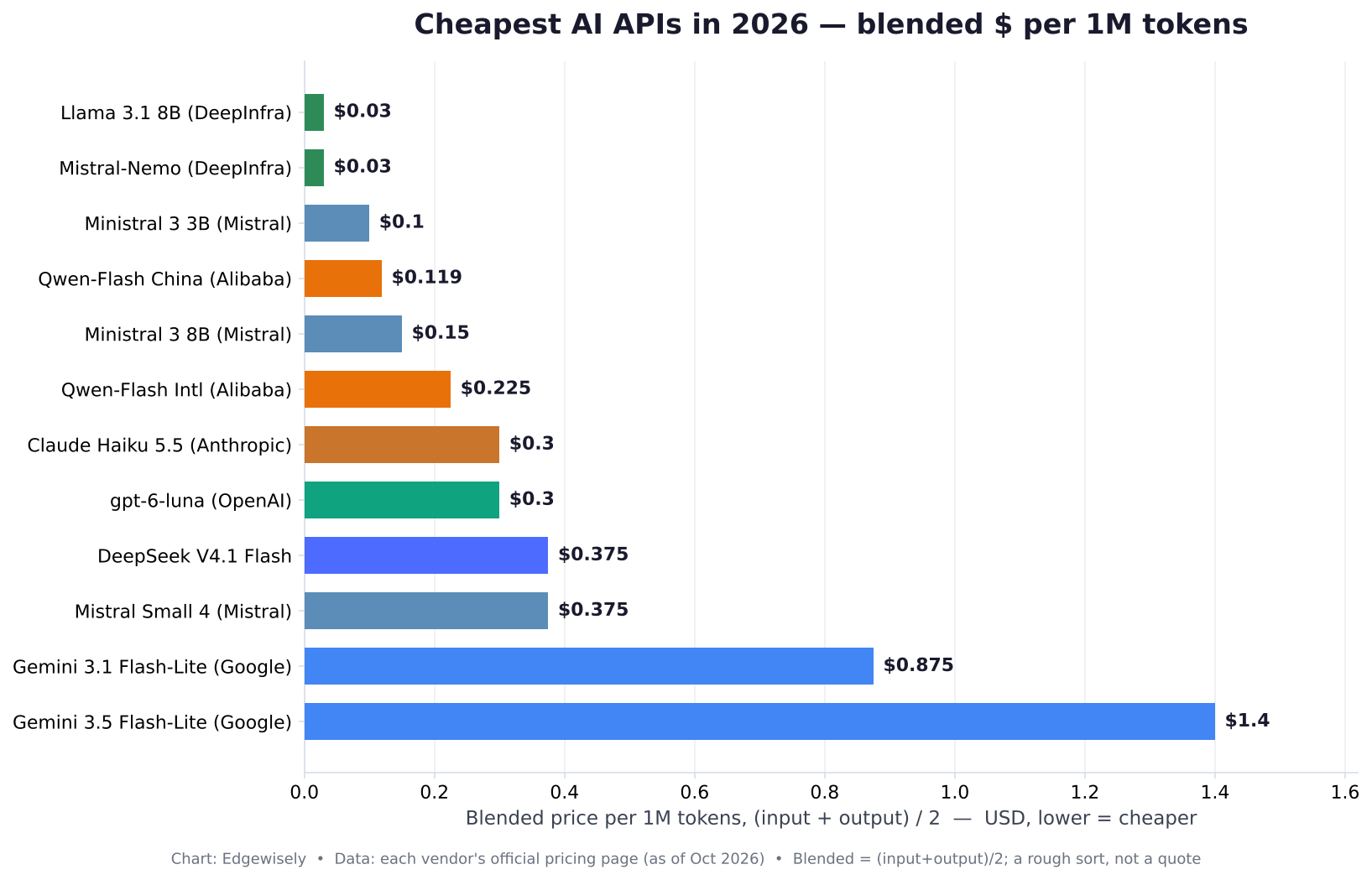
The chart ranks a blended rate — simply (input + output) / 2 — to put models on one axis. Treat it as a rough sort, not a quote. Real workloads are rarely 50/50; a retrieval pipeline is input-heavy, a chat agent is output-heavy, and output tokens are where the Flash-Lite and Gemini tiers get expensive relative to DeepSeek and Qwen.
Is DeepSeek the cheapest LLM API?
No — but it is the cheapest near-frontier LLM API, which is usually what people mean. On headline rate, Qwen-Flash International ($0.05/$0.40) and small open-weight models on DeepInfra ($0.02–$0.04) are cheaper per token.
DeepSeek V4.1 Flash wins on price-for-capability. At $0.15/$0.60 off-peak you get a model that holds its own on reasoning, coding and agent tasks, with MIT-licensed weights you can self-host if you ever need to leave the API. Few models at that quality cost that little. We put it head-to-head with a frontier closed model in our DeepSeek vs Claude breakdown.
Two things make the real DeepSeek bill lower than the table suggests.
Cache hits. Repeated prefixes — system prompts, few-shot examples, long documents re-sent across turns — bill at $0.003–$0.006 per 1M input tokens, a 25–50x discount versus cache-miss. For agents and RAG that re-send context, this dominates the input line.
Off-peak scheduling. If your batch jobs can run outside the UTC peak windows, you pay half. For overnight pipelines in the Americas that is close to free money.
The catch is not price. It is data residency and governance — covered in Our take.
How do you make any AI API cheaper?
Stop optimizing the sticker rate and start optimizing the two tiers that most teams ignore: prompt caching and batch. They routinely cut a real bill by 40–90% without changing models.
Prompt caching. Every major vendor now discounts tokens you have sent before. DeepSeek charges as little as $0.003/1M for cache hits. Gemini, OpenAI and Anthropic all price cached input far below fresh input. If your prompts share a long, stable prefix, structure them so the prefix is identical byte-for-byte and you stop paying full freight for it.
Batch / Flex mode. Non-interactive work — evals, backfills, bulk summarization — does not need a synchronous response. Batch tiers are 50% off at Google, OpenAI, Anthropic and Mistral. gpt-6-luna drops from $0.10/$0.50 to $0.05/$0.25. Gemini 3.1 Flash-Lite drops to $0.125/$0.75.
Right-size the model per task. Route classification and extraction to an 8B open-weight model at $0.02/1M; reserve the near-frontier model for the 10% of calls that need it. A router in front of two models beats one expensive model for everything — the same logic behind most AI gateway tools.
Cut output tokens. Output is 3–10x the price of input on most of these models. Constrain response length, use structured output, and stop asking for chain-of-thought you throw away.
Watch promo clocks. Gemini Flash list prices double on Jan 1, 2027; Gemini 4 Argon doubles Dec 1, 2026. Budgets built on introductory rates will break.
Which cheap API should you pick?
Pick by constraint, not by lowest number. Here is the segmented verdict.
Side project or prototype, cost is everything. Use a small open-weight model on DeepInfra (Llama 3.1 8B Turbo, $0.02/$0.04) or Qwen-Flash International ($0.05/$0.40). You want the lowest possible spend while you learn whether the idea works. Capability gaps matter less when traffic is tiny.
Production, need near-frontier quality cheaply. Use DeepSeek V4.1 Flash ($0.15/$0.60 off-peak, MIT weights) or Gemini 3.1 Flash-Lite ($0.25/$1.50). Both are reliable, both scale, both are genuinely capable. DeepSeek is cheaper; Gemini gives you Google's uptime, multimodal input and a Western-hosted option.
Western data residency is a hard requirement. Use Claude Haiku 5.5 or OpenAI gpt-6-luna, both $0.10/$0.50. You pay a small premium over the offshore options for US-hosted inference, strong tooling and procurement teams that already approve these vendors.
EU-hosted and open-weight friendly. Use Mistral — Ministral 3 3B at $0.10/$0.10 for cheap narrow tasks, Mistral Small 4 at $0.15/$0.60 for balanced work.
High-volume, mixed difficulty. Route. Cheap open-weight model for the bulk, DeepSeek Flash or a Flash-Lite tier for the hard calls, batch mode for anything non-interactive.
Our take
Our thesis: the headline per-token price is the wrong thing to optimize, and the race to the absolute cheapest API is usually a false economy. The number that belongs on your dashboard is cost per successfully completed task, and on that metric a $0.02 model that fails a third of the time is more expensive than a $0.15 model that does not. This is analysis, grounded in the verified prices above, and we will flag where it is opinion.
Start with the real floor. For most production workloads, the pragmatic floor is DeepSeek V4.1 Flash or Gemini 3.1 Flash-Lite, not the sub-$0.05 open-weight hosts. Here is why. The ultra-cheap tier on DeepInfra — Llama 3.1 8B at $0.02/$0.04 — is cheap because the model is small. An 8B model is fine for classification, tagging and extraction, and genuinely bad at multi-step reasoning, long-context synthesis and reliable tool use. When you price in retries, human review of bad outputs, and the engineering time to babysit a model that drifts, the "cheap" option gets expensive fast. That is the false economy. (Opinion, but it matches how these models behave.)
Caching and batch change the picture more than switching vendors does. This is the part teams underestimate. DeepSeek's cache-hit input at $0.003/1M is a 50x discount over its own cache-miss rate; for an agent that re-sends a 20k-token system prompt on every turn, caching is the difference between a viable product and a burned budget. Batch at 50% off turns every overnight eval and backfill into a half-price job. We would rather a team run Gemini Flash-Lite with disciplined caching and batching than Llama 8B with neither — the disciplined expensive-on-paper setup often wins on the invoice. (Opinion.)
Then there is the catch nobody puts in the price table: data residency and governance. The cheapest offshore options — Qwen-Flash and DeepSeek — route through Singapore, Frankfurt or Beijing depending on endpoint. For a hobby project that is irrelevant. For regulated data, customer PII, or anything touching enterprise procurement, the geopolitics and residency terms can be a hard blocker regardless of price. DeepSeek's MIT-licensed weights are a real hedge here: if the API's jurisdiction becomes a problem, you can self-host the same model. Qwen's API-model weight status is less clean — we marked it "varies" because we could not verify open weights for the exact Flash endpoint from the pricing page. If governance matters, Claude Haiku 5.5 and gpt-6-luna at $0.10/$0.50 are the cheapest answers that will clear a Western security review, and the premium over DeepSeek is small enough that fighting it is rarely worth the political capital. (Opinion.)
So the clean verdict splits by stage:
- Cheapest for a side project: a small open-weight model on DeepInfra, or Qwen-Flash International. Spend almost nothing while you validate the idea. Reliability is not yet your problem.
- Cheapest for production: DeepSeek V4.1 Flash if its jurisdiction is acceptable, Gemini 3.1 Flash-Lite or Claude Haiku 5.5 if it is not. Pair whichever you pick with aggressive caching and batch. That combination, not the lowest sticker price, is the actual cost floor for work that has to be right.
One more thing we will say plainly: these prices will be wrong soon. The Gemini Flash promo clock alone resets list prices upward in weeks. Build your cost model on the live vendor page, re-check it quarterly, and keep your prompts portable so switching providers is a config change, not a rewrite. If you are weighing a cheap API against a premium one for a specific job, our Grok vs Gemini comparison walks through exactly that price-versus-quality trade.
Frequently Asked Questions
Which is the cheapest AI API?
Among capable managed models, Qwen-Flash International is cheapest at $0.05 input / $0.40 output per 1M tokens (Oct 2026). For the lowest raw-token price, a small open-weight model like Llama 3.1 8B on DeepInfra runs about $0.02/$0.04 per 1M, trading capability for price.
What is the cheapest AI API?
It depends on your constraint. The cheapest near-frontier option is DeepSeek V4.1 Flash at $0.15/$0.60 per 1M off-peak. The cheapest with Western data residency is Claude Haiku 5.5 or OpenAI gpt-6-luna at $0.10/$0.50. The cheapest raw tokens come from open-weight models on DeepInfra.
Is DeepSeek the cheapest LLM API?
Not on headline rate — Qwen-Flash and small open-weight hosts are cheaper per token. DeepSeek V4.1 Flash is the cheapest for its quality level, at $0.15/$0.60 off-peak with MIT-licensed weights and cache-hit input as low as $0.003/1M. That price-for-capability is its real advantage.
Are there free AI APIs?
Yes, with limits. Google's Gemini Developer API has a free tier for several models, and many labs offer trial credits. Free tiers cap rate and volume and often use your data differently than paid tiers, so they fit prototyping, not production. Check each vendor's free-tier terms before relying on one.
How can I reduce AI API costs?
Use prompt caching (DeepSeek cache hits cost $0.003–$0.006/1M), run non-interactive jobs in batch mode (50% off at Google, OpenAI, Anthropic, Mistral), route easy tasks to a small cheap model and hard ones to a capable one, and cut output tokens, which cost several times more than input on most models.
Editor's note — sources: All prices were verified against each vendor's official pricing page as of October 2026 and are listed per 1M tokens: DeepSeek, Google Gemini, Anthropic, OpenAI, Alibaba Cloud Model Studio, Mistral and DeepInfra. AI API pricing changes frequently and several models here carry introductory rates with scheduled increases (Gemini 4 Argon on Dec 1, 2026; Gemini Flash tiers on Jan 1, 2027). Confirm current figures on the live vendor page before you build a budget. Where a figure could not be verified from a primary source, it is marked "varies" or omitted rather than estimated.