
Hunyuan vs Wan: Best Open Video Model?
Hunyuan vs Wan, settled for self-hosters: Wan 2.2 is the Apache-2.0 default that runs on a 24GB RTX 4090; HunyuanVideo-1.5 is the lighter, license-restricted Tencent alternative. Full comparison with VRAM, licenses and a verdict.


TL;DR
- Wan 2.2 is the pragmatic default for most self-hosters. It ships under Apache-2.0 (truly permissive, commercial-safe) and its TI2V-5B model runs on a single 24GB consumer GPU (RTX 4090) at 720p/24fps.
- HunyuanVideo-1.5 (released Nov 20, 2025) is the efficient Tencent alternative — 8.3B params, runs from ~14GB VRAM with offloading, upscales to 1080p. But it ships under the Tencent Hunyuan Community License, which excludes the EU, UK and South Korea and caps use at 100M monthly active users.
- License is the deciding factor for startups: Apache-2.0 (Wan) vs a restricted community license (Hunyuan).
- Neither tops the hosted frontier. On Artificial Analysis's AA-Video-T2V v2.1 arena, Alibaba's hosted Wan 3.0 ranks #1 (Elo 1174); HunyuanVideo is not on that arena. You self-host for control, cost and no filters, not to win the arena.
- The newest Wan you can actually download is still Wan 2.2. Wan 2.5/2.7/3.0 are hosted/API only.
For the open-weight, run-it-yourself question, Wan 2.2 wins by default: it is Apache-2.0 licensed, and its 5B TI2V variant runs on a single 24GB consumer GPU. HunyuanVideo-1.5 is the strong, efficient Tencent counter — newer and light on VRAM — but its community license has real commercial restrictions. Pick on license and hardware first, aesthetics second.
What is the difference between HunyuanVideo and Wan?
They are the two leading open-weight Chinese video-generation families, and the practical hunyuan vs wan split comes down to license and hardware, not a single quality number.
HunyuanVideo is Tencent's line. The original model landed Dec 3, 2024 with over 13 billion parameters, which Tencent called the largest open-source video model at the time. The current efficient model, HunyuanVideo-1.5, released Nov 20, 2025 at 8.3B parameters.
Wan is Alibaba's line. The current open release is Wan 2.2, out Jul 28, 2025. It is not one model but a family: two big mixture-of-experts models, one small dense model that runs on consumer hardware, plus speech-to-video and character-animation variants.
The headline difference: Wan 2.2 is Apache-2.0 (fully permissive). HunyuanVideo ships under the Tencent Hunyuan Community License, which is not permissive. More on that below.
Both are open-weight alternatives to hosted frontier systems like Kling, Seedance and Veo. You run them locally in ComfyUI for control, cost and privacy.
Which open video model needs less VRAM?
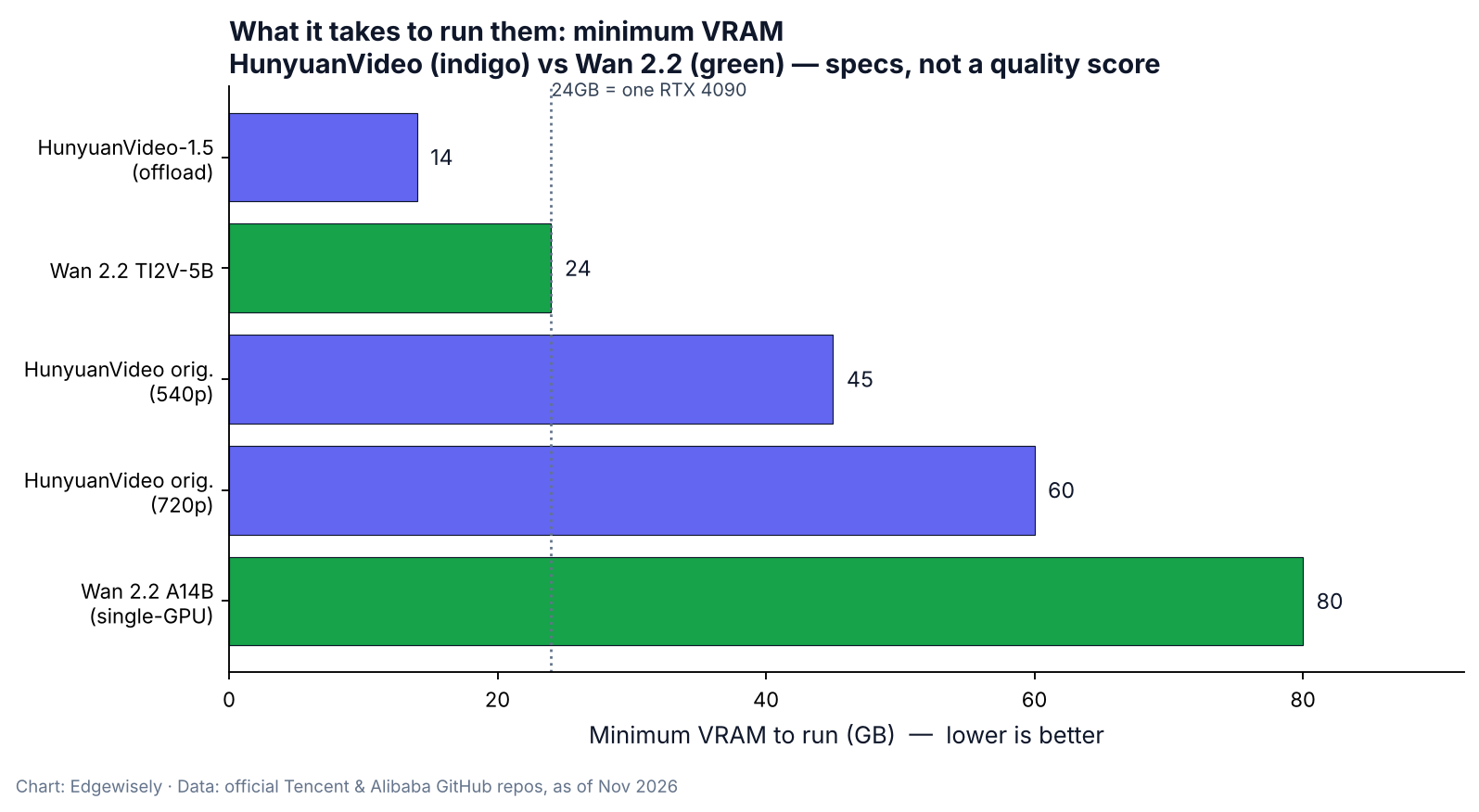
HunyuanVideo-1.5 needs the least to start (~14GB with offloading); Wan 2.2's TI2V-5B is the easiest consumer path (24GB, a single RTX 4090). The big models in both families need far more.
Here are the verified minimums, straight from each repo:
- HunyuanVideo-1.5: 14GB VRAM with model offloading enabled.
- Wan 2.2 TI2V-5B: at least 24GB VRAM, with the RTX 4090 cited as the example card; 720p at 24fps.
- Original HunyuanVideo (13B): 45GB at 540p, 60GB at 720p; tested on a single 80GB GPU.
- Wan 2.2 A14B (T2V / I2V / S2V): ~80GB for the single-GPU path.
So the two "it runs on my desk" options are HunyuanVideo-1.5 and Wan 2.2 TI2V-5B. Everything else wants a rented 80GB datacenter GPU (A100/H100 class).
One caveat on the 14GB figure: it is a minimum-to-run number with offloading, which trades VRAM for speed. Expect slower generation than on a card with headroom. Tencent does not disclose a resolution tied to that 14GB floor.
Which has the better license?
Wan 2.2 has the cleaner license by a wide margin. It is Apache-2.0 — permissive, commercial-safe, no user caps, no territory carve-outs; the Wan repo states the models are "licensed under the Apache 2.0 License".
HunyuanVideo ships under the Tencent Hunyuan Community License Agreement, and the text has teeth. Verified from the license file:
- It does not apply in the European Union, the United Kingdom, or South Korea. Use outside the licensed territory is unauthorized.
- A 100-million-monthly-active-user cap: above that, you must request a separate license from Tencent, which it may grant or refuse at its discretion.
For a solo creator posting clips, neither clause bites. For a funded startup building a product on top of the model — especially one with EU users — that is a legal review, not a footnote. Apache-2.0 removes that entire conversation.
This is the single biggest reason the open-source community defaults to Wan for anything commercial.
Open video model comparison table
Every row is dated and sourced from the official repo. Params are total; "active" notes the MoE active count per step.
| Model | Maker | Params | License | Min VRAM | Max res / fps | Released | Best for |
|---|---|---|---|---|---|---|---|
| HunyuanVideo (orig.) | Tencent | 13B dense | Tencent Hunyuan Community | 45GB@540p / 60GB@720p | 720p, 129 frames (~5s) | Dec 3, 2024 | Legacy max-quality |
| HunyuanVideo-1.5 | Tencent | 8.3B dense | Tencent Hunyuan Community | ~14GB (offload) | 480p/720p base, 1080p via super-res; 121-frame default | Nov 20, 2025 | Efficient current Tencent model |
| Wan 2.2 TI2V-5B | Alibaba | 5B dense | Apache-2.0 | 24GB (RTX 4090) | 720p @ 24fps | Jul 28, 2025 | Consumer single-GPU |
| Wan 2.2 T2V-A14B | Alibaba | 27B total / 14B active (MoE) | Apache-2.0 | ~80GB | 480p/720p | Jul 28, 2025 | Max-quality open text-to-video |
| Wan 2.2 I2V-A14B | Alibaba | 27B / 14B active (MoE) | Apache-2.0 | ~80GB | 480p/720p | Jul 28, 2025 | Image-to-video |
| Wan 2.2 S2V-14B | Alibaba | 14B | Apache-2.0 | ~80GB | 480p/720p | Aug 26, 2025 | Speech-to-video |
| Wan 2.2 Animate-14B | Alibaba | 14B | Apache-2.0 | Not disclosed | Not disclosed | Sep 19, 2025 | Character animation / replacement |
Note: Tencent also ships HunyuanVideo-I2V, HunyuanCustom and HunyuanVideo-Avatar variants of the original line.
Which has the broader toolkit?
Wan 2.2 has the broader variant family. Out of one Apache-2.0 repo you get text-to-video, image-to-video, a consumer-grade 5B model, speech-to-video (S2V-14B) and character animation/replacement (Animate-14B). If your project spans lip-synced avatars, motion transfer and plain T2V, Wan covers it under one license.
Tencent's line is also broad — I2V, HunyuanCustom and the Avatar model — but spread across repos and under the restricted community license. For an avatar or talking-head pipeline, both vendors have an answer; Wan's is commercially simpler.
Which looks better?
Honest answer: there is no clean, current, independent head-to-head we can cite without caveats, so treat "which looks better" as unsettled. Both vendors publish self-run evaluations that favor their own model, and the standard academic benchmark (VBench) lags the newest versions.
What we can verify:
- Tencent's own human eval of the original 13B HunyuanVideo (1,533 prompts, 60+ professional evaluators) ranked it #1 of six models at 41.3% overall. That is Tencent's self-run result, not independent.
- HunyuanVideo-1.5 ships a technical report (arXiv:2511.18870) with vendor comparisons; again, vendor-reported.
Because we could not verify a current VBench Total-Score head-to-head for the exact shipping versions from the official leaderboard, we are not quoting one. Fabricating a number here would be worse than omitting it. Instead, the chart above compares the one thing every repo states precisely — hardware cost to run — and the chart below adds the hosted-arena standings as market context.
Where does the hosted frontier sit?
At the top of the text-to-video arena, Alibaba's hosted Wan 3.0 leads — but you cannot download it. On the Artificial Analysis AA-Video-T2V v2.1 arena, Wan 3.0 ranks #1 at Elo 1174, with Wan 2.7 further down; HunyuanVideo does not appear at all.
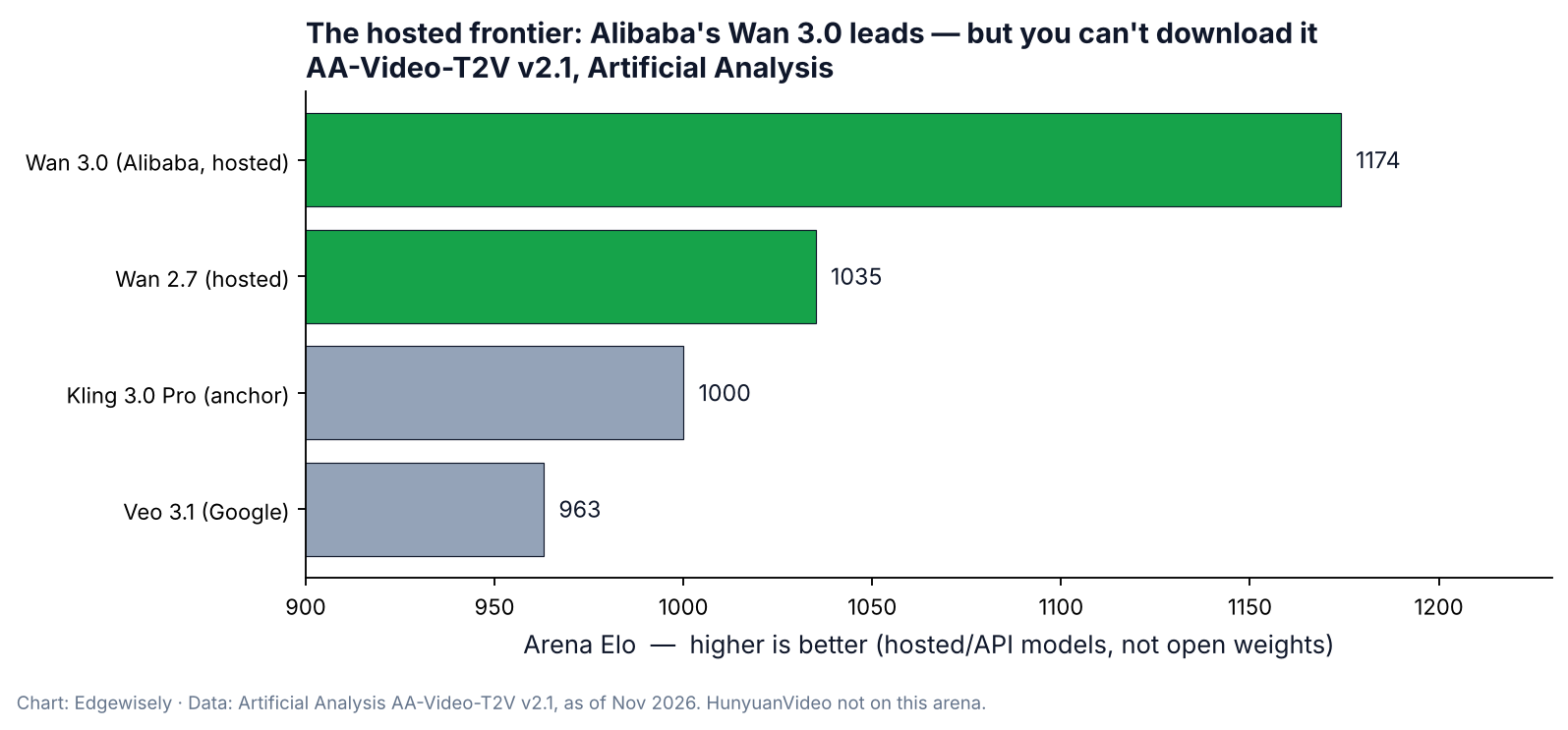
The point of the chart is the gap between what leads and what you can run. Wan 3.0 and Wan 2.7 are hosted/API models — not open weights. The newest Wan you can download is still Wan 2.2. If you want frontier quality without self-hosting, a hosted model (Wan, Kling, Veo, Seedance) is the call; if you want control, you self-host 2.2 or HunyuanVideo-1.5.
Our take
Wan 2.2 is the right default for most people running open video locally, and HunyuanVideo-1.5 is the model you reach for when VRAM is tight or you prefer Tencent's motion look. That is an opinion, grounded in three facts you can check: the license, the hardware floor, and the variant spread. (Analysis, flagged as analysis.)
Start with what the benchmarks do and don't capture. The only quality numbers either vendor publishes are self-run — Tencent's 41.3% human-eval win for the original 13B model was graded by evaluators Tencent organized, and Alibaba's Wan-Bench claims are Alibaba's. VBench, the academic standard, measures component traits (motion smoothness, subject consistency, aesthetic quality) on a fixed prompt set, but it is slow to cover the newest shipping versions, and a high VBench score does not guarantee better prompt adherence or more natural motion on your actual prompts. We declined to quote a stale or unverifiable VBench row rather than dress up a number. So on raw "which looks better," our position is deliberately soft: both are good enough that license and hardware should decide, and you should run a 10-clip bake-off on your own prompts before committing. That is the honest state of the evidence.
The license difference, by contrast, is not soft at all. Wan 2.2 is Apache-2.0. You can fine-tune it, ship it in a product, and sell the output with no user cap and no territory exclusion. HunyuanVideo's Tencent Community License excludes the EU, UK and South Korea and imposes a 100M-MAU ceiling. For a hobbyist, irrelevant. For a startup, this is the whole ballgame: if you have European users or plan to, Wan removes a legal risk that Hunyuan introduces. We think most builders underweight this because licenses are boring — right up to the diligence call where an investor's lawyer finds the clause. Opinion: license, not aesthetics, should be the first filter for anyone building commercially.
Then hardware. The single most practical fact in this comparison is that Wan 2.2's TI2V-5B runs on one 24GB RTX 4090 at 720p/24fps. That is a card enthusiasts already own. HunyuanVideo-1.5 counters with a lower floor still — ~14GB with offloading — which genuinely matters on 16GB laptops and older cards, at the cost of speed. Everything above that (Wan's A14B, the legacy 13B Hunyuan) assumes you rent an 80GB GPU by the hour. So the hardware map is clean: 16GB and scrappy, lean HunyuanVideo-1.5; a 24GB desktop card, Wan TI2V-5B; a rented 80GB GPU chasing max quality, Wan A14B.
The bigger strategic point for builders: you are not self-hosting to top the arena. Artificial Analysis's board is led by hosted systems — Alibaba's own Wan 3.0 at Elo 1174, with Seedance, Kling and Veo clustered below — and none of the open weights you can download appear there. The frontier is a paid API. You run Hunyuan or Wan locally for the things an API can't give you: no per-second billing, no content filter, no data leaving your box, and full control to fine-tune. Measured against that, both families are winners; the hosted Elo race is a different product. This mirrors the open-weight versus closed debate in image models — you trade a little peak quality for control and cost.
Where each fits, bluntly:
- Hobbyist on one consumer GPU: Wan 2.2 TI2V-5B on a 24GB card; HunyuanVideo-1.5 if you have less than 24GB. Best for: getting good 720p clips today. Avoid: the A14B and 13B models — you'll be renting GPUs.
- Startup needing commercial-safe licensing: Wan 2.2, full stop. Apache-2.0. Avoid HunyuanVideo for anything shipping to EU/UK/South Korea users.
- Max quality, will rent an 80GB GPU: Wan 2.2 T2V-A14B (27B MoE) as the open flagship; benchmark it against HunyuanVideo-1.5 on your prompts before deciding.
- I2V / avatar / speech-to-video niches: Wan 2.2 for speech-to-video (S2V-14B) and character animation (Animate-14B) under one permissive license; HunyuanVideo-Avatar is a credible Tencent alternative if the license fits.
Verdict: Wan 2.2 is the default. HunyuanVideo-1.5 is the efficient specialist. Choose on license and VRAM, confirm with your own bake-off, and ignore the arena unless you're buying an API instead. If hosted quality is what you're after, our Kling vs Sora and Veo vs Sora comparisons cover the API side.
Frequently Asked Questions
Is Hunyuan or Wan better?
For most self-hosters, Wan 2.2 is the better default: Apache-2.0 licensing and a 5B model that runs on a 24GB RTX 4090. HunyuanVideo-1.5 wins on VRAM floor (~14GB with offloading). Neither has a clean, current independent quality benchmark we can verify, so test both on your own prompts.
Can Wan 2.2 run on an RTX 4090?
Yes. Wan 2.2's TI2V-5B model is built for it — the official repo lists a minimum of 24GB VRAM, citing the RTX 4090, generating 720p video at 24fps. The larger A14B models need roughly 80GB on a single GPU, so those require a datacenter-class card, not a 4090.
Is HunyuanVideo free for commercial use?
Partly. It ships under the Tencent Hunyuan Community License, which allows commercial use but excludes the European Union, United Kingdom and South Korea, and requires a separate Tencent license above 100 million monthly active users. That is more restrictive than Wan 2.2's Apache-2.0, which has no territory or user limits.
Which open video model is best in 2026?
For downloadable open weights, Wan 2.2 is the strongest all-rounder as of November 2026 — permissive license, consumer-GPU option, and the widest variant family. The highest-rated Wan on Artificial Analysis's arena, Wan 3.0 (Elo 1174), is hosted/API only; the newest weights you can actually run are Wan 2.2.
How much VRAM do I need for open-source video generation?
The practical floor is about 14GB for HunyuanVideo-1.5 with offloading, or 24GB for Wan 2.2's TI2V-5B (a single RTX 4090) for a smoother experience. The flagship models — Wan 2.2 A14B and the original 13B HunyuanVideo — need roughly 45–80GB, meaning a rented A100/H100-class GPU.
Editor's note — sources: All specifications, VRAM figures and licenses verified against the official Tencent and Alibaba GitHub repositories (github.com/Tencent-Hunyuan/HunyuanVideo-1.5, github.com/Tencent-Hunyuan/HunyuanVideo, github.com/Wan-Video/Wan2.2) and the Tencent Hunyuan Community License text; arena standings from Artificial Analysis (AA-Video-T2V v2.1, artificialanalysis.ai). Vendor evaluations are labelled as vendor-reported. We did not cite a VBench head-to-head because we could not verify current per-version scores from the official leaderboard. Figures current as of November 2026.