
Best LLM for Data Analysis (2026): Tested
No single model wins data analysis — the code interpreter and database tooling matter more than raw intelligence. The best LLMs for data analysis in 2026, with a real benchmark and a verdict by analyst type.


TL;DR
- No single model "wins" data analysis. The code interpreter and database tooling wrapped around the model matter more than a point or two of raw intelligence. Pick the harness first, the model second.
- Best all-round picks (Nov 2026): Claude Opus 5.5 ($4/$20 per 1M tokens, Artificial Analysis Intelligence Index 59) and GPT-6.2 Sol ($2/$10, 57). Frontier ceiling: Claude Fable 5.2 (65) and GPT-6.2 Astra (62).
- The only public benchmark built for real data analysis, DABStep, still tops out around 37% on its Hard split for a clean base model (Claude Sonnet 4.5, Jan 2026) against ~62% for humans. Multi-step analysis is not a solved problem.
- Cheap and high-volume: DeepSeek V4.1 Flash ($0.30/$1.20 per 1M, 1M context). Text-to-SQL: GPT-6.2 Sol or Claude Sonnet 5.5.
The best LLM for data analysis is the one paired with a working code interpreter and database access, not the one topping a chat leaderboard. For solo analysts: Claude Opus 5.5 or Gemini 4 in-app. For analytics agents built via API: Claude Sonnet 5.5. For text-to-SQL: GPT-6.2 Sol. For cheap bulk work: DeepSeek V4.1 Flash.
What makes an LLM good at data analysis?
Data analysis is not raw intelligence. It is five separate skills, and the best chat model is not automatically best at all five.
Reasoning over messy, multi-step problems. Real questions ("why did refunds spike in the EU in Q3?") need a plan, not a single answer. The model has to decompose, branch, and backtrack.
Reliable code execution. Most analysis happens in Python or SQL the model writes and runs. A model that writes elegant pandas but hallucinates a column name is useless. Execution and self-correction beat eloquence. This is the same reason coding ability tracks closely with analysis ability.
Tool use. The model needs a code interpreter, a database connection, or a file sandbox. Without tools it guesses. With them it computes. This harness is the single biggest lever on quality.
Honesty about uncertainty. A good analyst says "this join dropped 4% of rows" instead of quietly returning a confident wrong number. Calibration matters more here than in most tasks.
Handling scale. Big schemas, wide CSVs and long logs eat context. A 1M-token window (now standard on most frontier models) lets you paste a schema and a sample without truncation. Cost at high token volume then decides what is affordable.
Hold those five in mind, because they explain why the leaderboard order and the data-analysis order are not the same.
Which LLM is best for data analysis?
For most people the honest answer is Claude Opus 5.5 or GPT-6.2 Sol — both are frontier-class, both have mature code interpreters in their consumer apps, and both are reliable with tools. If you want the absolute accuracy ceiling and cost is no object, Claude Fable 5.2 (Intelligence Index 65) and GPT-6.2 Astra (62) sit a notch higher.
Here is the current shortlist, with everything we could verify from vendor pages as of November 2026. The index values come from the Artificial Analysis Intelligence Index, a general-reasoning ranking.
| Model | Maker | Context | Price in / out (per 1M tokens) | AA Intelligence Index | Best for |
|---|---|---|---|---|---|
| Claude Fable 5.2 | Anthropic | up to 1M | $8 / $40 | 65 | Hardest multi-step reasoning, accuracy regardless of cost |
| GPT-6.2 Astra | OpenAI | up to 1M | $8 / $40 | 62 | Frontier reasoning + the most mature code interpreter |
| Claude Opus 5.5 | Anthropic | up to 1M | $4 / $20 | 59 | Best all-round in-app analyst; dependable tool use |
| GPT-6.2 Sol | OpenAI | up to 1M | $2 / $10 | 57 | Best-value frontier; text-to-SQL and agents |
| Claude Sonnet 5.5 | Anthropic | up to 1M | $2 / $10 | 55 | Analytics agents via API at scale |
| Gemini 4 Argon | 1M | $4 / $20 (promo $2 / $10 thru Nov 30) | 50 | Large CSVs in AI Studio; Google-stack BI | |
| GPT-6.1 Terra | OpenAI | up to 1M | $0.50 / $2.50 | 51 | Cheaper high-volume reasoning |
| DeepSeek V4.1 Flash | DeepSeek | 1M | $0.30 / $1.20 | 33 | Cheap bulk work + very large context |
| Claude Haiku 5.5 | Anthropic | up to 1M | $0.10 / $0.50 | 36 | Cheapest classification/extraction at volume |
Prices and Intelligence Index are dated November 2026; see sources below. Google's Gemini 4 Neon (Index 61), Carbon (60) and Hydrogen (54) score higher than Argon but are not listed on Google's official pricing pages yet, so we omit their prices rather than quote a third-party number. The Intelligence Index is a general-reasoning proxy, not a data-analysis score — treat it as a shortlist filter, not a verdict.
Which benchmark actually tests data analysis?
DABStep is the one to watch — and its scores are humbling. Built by Adyen and Hugging Face, it contains over 450 real-world data-analysis tasks split into Easy and Hard. Tasks mix structured CSV/JSON data with messy documentation, and answers are graded strictly right or wrong.
The Hard split is deliberately brutal. At launch (Feb 2025), frontier models scored in the low teens: o3-mini 16%, DeepSeek R1 13%, Claude 3.5 Sonnet 12%, DeepSeek V3 6%. Humans average ~62% on Easy tasks after three-plus hours of work.
By early 2026 the best clean base-model run on Hard was Claude Sonnet 4.5 at 37% — better, still nowhere near a competent human. That is the real state of autonomous, multi-step analysis.
The chart below shows the DABStep Hard-split accuracy for clean base models, as recorded on the public DABStep leaderboard in January 2026.
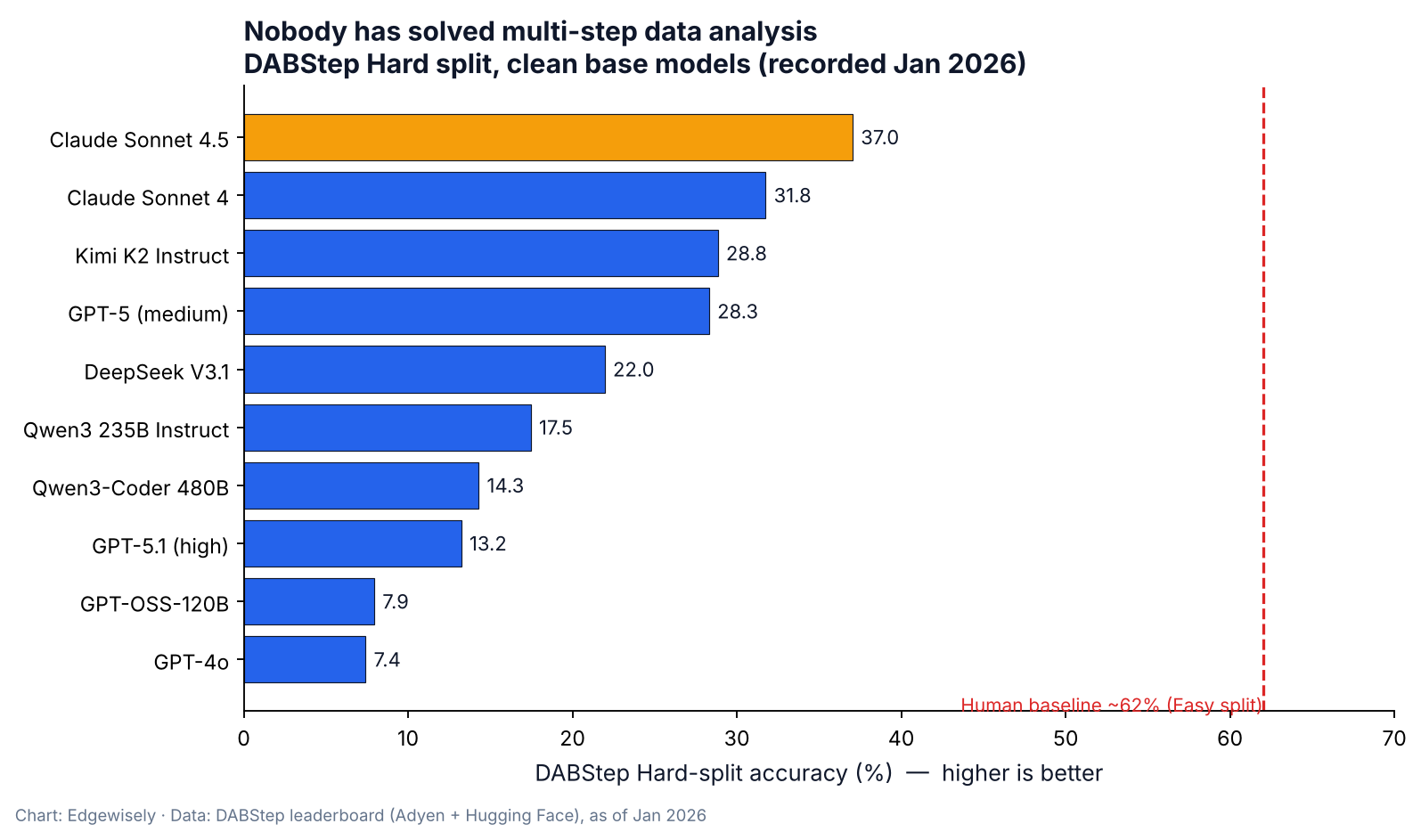
Two caveats, stated plainly. First, these are early-2026 model generations — the newest Nov-2026 flagships (Opus 5.5, GPT-6.2, Gemini 4) have not posted clean base-model DABStep runs, so we do not have a current apples-to-apples number for them. Second, the live public DABStep leaderboard has moved on: as of its August 2026 update it is topped by heavily engineered agent submissions — custom harnesses, deterministic fee engines, multi-model ensembles — scoring up to 100% on Hard. Those entries pair base models (Claude, Qwen, DeepSeek, GPT) with bespoke scaffolding.
That jump from 37% (bare model) to ~100% (engineered agent) is the whole lesson: the harness does most of the work.
What does the best LLM for data analysis cost?
Output tokens dominate your bill, because analysis generates long reasoning traces and code. At current rates (per 1M tokens, Nov 2026), confirmed on Anthropic's pricing page, OpenAI's pricing and DeepSeek's pricing:
- Frontier, cost-no-object: Fable 5.2 and GPT-6.2 Astra at $40 output. Reserve for the hardest problems.
- Best value at the frontier: GPT-6.2 Sol and Claude Sonnet 5.5 at $10 output — roughly a quarter of the price for a few points less Index.
- Cheap and scalable: GPT-6.1 Terra $2.50, DeepSeek V4.1 Flash $1.20, Claude Haiku 5.5 $0.50. Fine for extraction, classification and first-pass triage over big datasets.
A concrete gap: a pipeline that burns 50M output tokens a month costs ~$2,000 on Opus 5.5, ~$500 on Sonnet 5.5, and ~$60 on DeepSeek V4.1 Flash. If the cheap model clears your accuracy bar on your data, the savings are an order of magnitude. Test before you commit, and compare it against the cheapest AI API options for your volume.
Best LLM for text-to-SQL and BI?
For natural-language-to-SQL and BI copilots, pick a strong frontier model with a tight schema in context and a validation step — GPT-6.2 Sol or Claude Sonnet 5.5 are the value sweet spot. Text-to-SQL rewards precise schema grounding and cheap retries more than it rewards the last point of raw intelligence, so paying for Fable 5.2 on every query is usually waste.
Two rules that matter more than model choice. Give the model the actual schema and a few sample rows, not just table names. And execute the generated query against the database, then feed errors back for a retry — a one-line guardrail that lifts accuracy far more than swapping models.
For the Google stack, Gemini 4 models integrate cleanly with BigQuery and AI Studio and handle very large CSVs in a 1M-token window. If your analysis leans on retrieval over documents, the model choice interacts with your embedding model too.
Our take
Here is our thesis, flagged as opinion: in late 2026, the model is no longer the bottleneck in data analysis — the harness and your own discipline are. The gap between the frontier models on this list is a handful of Intelligence Index points. The gap between a model with a code interpreter and database access and the same model answering from memory is the difference between a correct number and a confident guess. DABStep makes this measurable: the same base models that score in the 20s and 30s on the bare Hard split climb toward 100% once wrapped in a purpose-built agent. The scaffolding does the work.
That reframes the buying decision. If you are a solo analyst, you are not really choosing a model — you are choosing an app and its code interpreter. Claude (Opus 5.5) and ChatGPT (GPT-6.2 Astra/Sol) both run Python sandboxes that read your uploaded CSV, write code, execute it, see the error, and fix it. That loop is worth more than any benchmark. Best for: upload-and-ask analysis, ad hoc exploration, chart generation. Avoid if: you need reproducible, version-controlled pipelines — a notebook beats a chat window there.
If you are a data team building an analytics agent via API, optimize for reliable tool calls and cost at volume, not peak Index. Claude Sonnet 5.5 ($2/$10) and GPT-6.2 Sol ($2/$10) are the workhorses: frontier-adjacent reasoning, dependable function calling, a quarter of the flagship price. Reserve Opus 5.5 or Fable 5.2 for an escalation tier when the cheap model's self-check fails. Best for: scheduled pipelines, retrieval-augmented analytics, agents that run thousands of times a day. Avoid if: you skip the execution-and-retry loop — no model is reliable enough to trust un-validated SQL in production.
For text-to-SQL and BI, the differentiator is engineering, not the model. Schema grounding, sample rows, a query validator and a retry path move accuracy more than a model swap. Spend your budget on GPT-6.2 Sol or Sonnet 5.5 plus that plumbing. Avoid if: you are tempted to point a raw LLM at an undocumented warehouse and expect correct joins — it will invent columns.
For cheap, high-volume work — tagging thousands of support tickets, extracting fields from scanned forms, first-pass anomaly flags — DeepSeek V4.1 Flash ($0.30/$1.20, 1M context) and Claude Haiku 5.5 ($0.10/$0.50) are the picks. The 1M-token windows swallow large documents whole. Avoid if: the task needs multi-step reasoning — these models are built for throughput, and DABStep shows the small-and-cheap tier collapses on Hard tasks (GPT-OSS-120B scored 7.9%).
The honest bottom line: no LLM can replace an analyst yet. DABStep's Hard split — frontier base models still under 40%, humans at 62% — is the clearest evidence we have that autonomous, end-to-end analysis is unsolved. What these models do extremely well is compress the mechanical middle of the job: writing the query, running it, drawing the chart, drafting the summary. The judgement — is this the right question, is this data trustworthy, does this result make sense — stays with you. Buy the model that makes that loop fast and cheap, wrap it in a code interpreter and a validator, and keep a human reading the output. That, not a leaderboard rank, is the best LLM setup for data analysis.
Frequently Asked Questions
What is the best LLM for data analysis?
For most users it is Claude Opus 5.5 or GPT-6.2 Sol, used inside their apps with a code interpreter. Both are frontier-class (Artificial Analysis Index 59 and 57) and reliable with tools. Pay up for Claude Fable 5.2 (Index 65) only when you need the absolute accuracy ceiling.
Which LLM is best for data analysis on a budget?
DeepSeek V4.1 Flash at $0.30 input / $1.20 output per 1M tokens, with a 1M-token context window, is the best cheap pick for high-volume extraction and classification. Claude Haiku 5.5 ($0.10/$0.50) is cheaper still. Both struggle on hard multi-step reasoning, so validate accuracy on your own data first.
Which LLM is best for text-to-SQL?
GPT-6.2 Sol or Claude Sonnet 5.5 — both $2/$10 per 1M tokens — hit the value sweet spot. More important than model choice: feed the model the real schema and sample rows, then execute each generated query and feed errors back for a retry. That guardrail lifts accuracy more than upgrading the model.
Can LLMs replace data analysts?
No. The DABStep benchmark, built for real analysis tasks, still shows clean frontier base models under 40% on its Hard split versus ~62% for humans, as of early-to-mid 2026. LLMs automate the mechanical middle — writing and running queries, drafting summaries — but the judgement about which question to ask and whether the data is trustworthy stays human.
How much context window do I need for large datasets?
Most frontier models now offer up to 1M tokens (~750,000 words), enough for a full schema, documentation and sample rows. For whole large files, DeepSeek V4.1 Flash and Gemini 4 (both 1M) are strong. But do not paste a million rows — summarize or query the data and let the model reason over the result, which is cheaper and more accurate.
Editor's note — sources: Artificial Analysis Intelligence Index and model pages (artificialanalysis.ai); Anthropic pricing (claude.com/pricing); OpenAI API pricing (developers.openai.com); Google Cloud Vertex AI pricing (cloud.google.com); DeepSeek API pricing (api-docs.deepseek.com); DABStep benchmark — Adyen + Hugging Face (huggingface.co/blog/dabstep, arXiv 2506.23719) and the public DABStep leaderboard (adyen-dabstep.hf.space), with Hard-split base-model standings as recorded January 2026. All benchmarks and prices dated November 2026 unless otherwise noted. Vendor capability claims are attributed to the vendor.