
DeepSeek vs Claude: Open vs Closed Frontier
DeepSeek vs Claude compared on price, AA Intelligence Index v5.0, SWE-bench coding, context, and open weights vs closed API — with a clear builder's verdict.

In the deepseek vs claude decision, Claude Opus 5.5 wins on raw capability and DeepSeek wins decisively on cost. Opus 5.5 tops the Artificial Analysis Intelligence Index v5.0 at 58; DeepSeek's open models trail but cost a fraction — V4.1 Flash runs $0.30/$1.20 per million tokens against Opus 5.5 at $4/$20, and you can self-host it under an MIT license.
TL;DR
- Verdict: Pick Claude Opus 5.5 when quality and agentic reliability are non-negotiable; pick DeepSeek (V4.1 Flash for volume, V4 Pro for heavy reasoning) when cost or data control decides.
- Price gap: DeepSeek V4.1 Flash is $0.30 in / $1.20 out per 1M tokens; Claude Opus 5.5 is $4 in / $20 out. That is roughly 13x cheaper on input and ~17x on output.
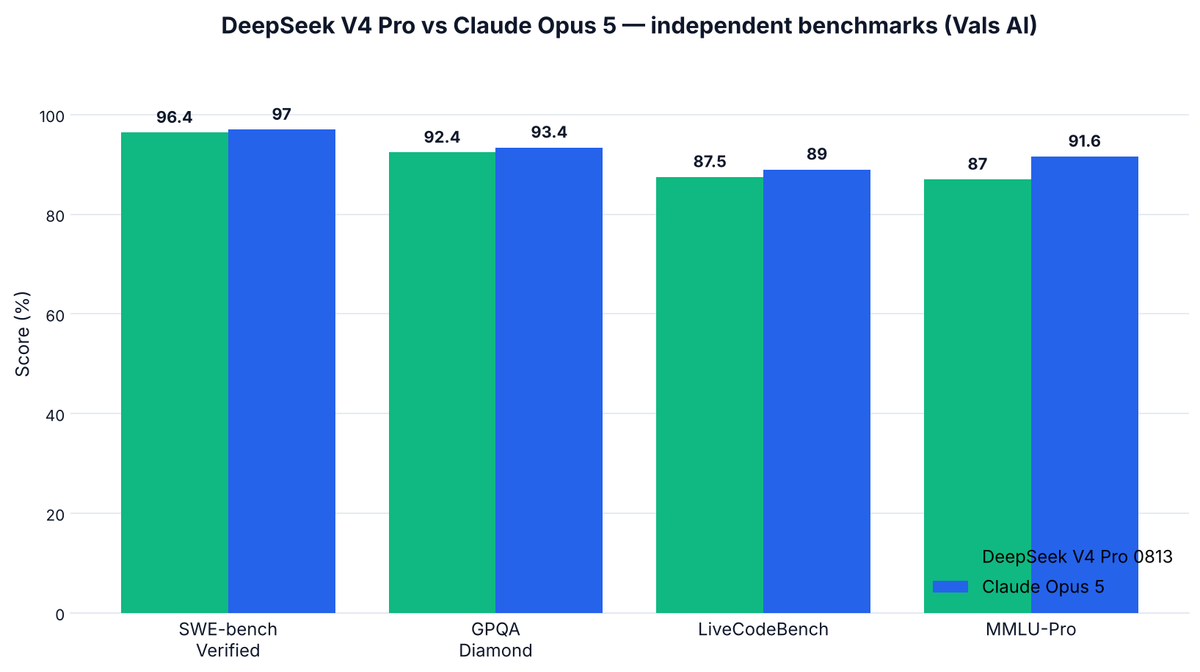
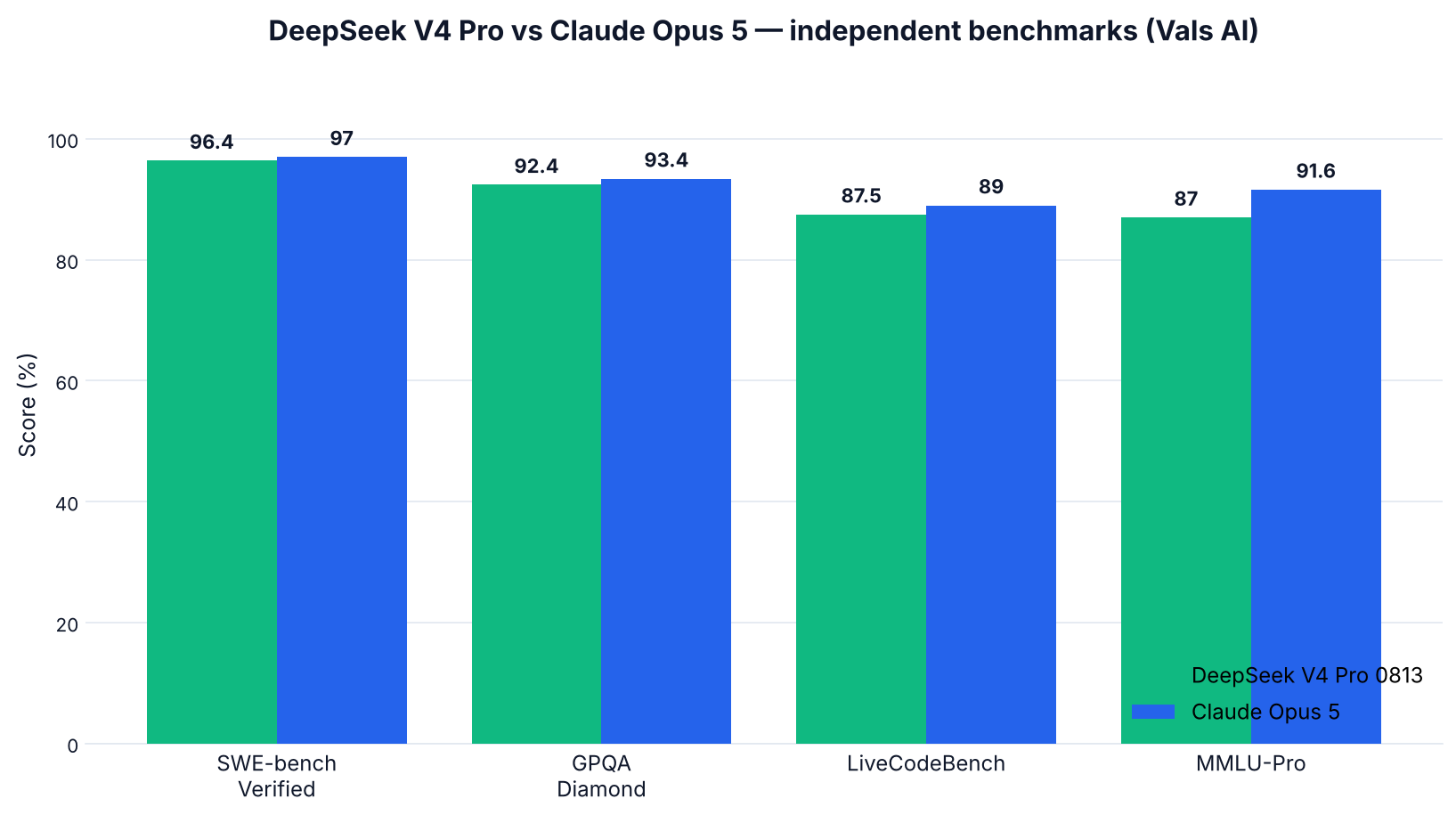
- Capability gap: Opus 5.5 leads the Artificial Analysis Intelligence Index v5.0 at 58 (as of Oct 2026). On independent Vals AI SWE-bench, DeepSeek V4 Pro 0813 scores 96.4% — within a point of Claude's flagship.
- Context: All four models here offer a 1M-token context window.
- Licensing: DeepSeek ships MIT-licensed open weights you can download and self-host. Claude is closed — API only.
DeepSeek vs Claude at a glance
The deep comparison below uses current models as of October 2026. Every price and score is dated and sourced in the sections that follow.
| Model | Maker | License | Context | Price (in / out per 1M) | AA Intelligence Index v5.0 | Modalities | Best for |
|---|---|---|---|---|---|---|---|
| DeepSeek V4 Pro 0813 | DeepSeek | MIT (open weights) | 1M | $1.32 / $3.96 (peak) | ~23 (approx.) | Text | Cost-sensitive heavy reasoning; self-host |
| DeepSeek V4.1 Flash 1017 | DeepSeek | MIT (open weights) | 1M | $0.30 / $1.20 | ~32 (approx.) | Text + image | Cheapest high-volume + vision |
| Claude Opus 5.5 | Anthropic | Proprietary (closed API) | 1M | $4 / $20 | 58 | Text + image | High-stakes agentic coding |
DeepSeek's AA v5.0 figures are approximate — the index was rebuilt in late October 2026 (more below) and DeepSeek re-scoring was still settling at writing. Claude Sonnet 5.5 ($2 in / $10 out) sits between these tiers as Anthropic's cheaper option; it is discussed in the pricing section.
DeepSeek vs Claude: which is better?
There is no single winner. The honest answer to "is DeepSeek better than Claude" depends on what you optimize for.
Claude Opus 5.5 is the stronger model. It sits at the top of the Artificial Analysis Intelligence Index v5.0 at 58, ahead of every open-weight model, and Anthropic's agentic and coding reliability remains the reference point for production work.
DeepSeek is the better deal. Its open models deliver 80–95% of frontier capability on most independent benchmarks at a fraction of the price, and they ship as downloadable weights you own.
So in claude vs deepseek terms: Claude is the premium closed frontier; DeepSeek is the cheap open frontier. The rest of this article quantifies that trade, because the gap is narrower on benchmarks than the price gap is on your invoice.
How do DeepSeek and Claude compare on price?
This is where deepseek vs claude pricing stops being close and becomes a chasm.
Claude Opus 5.5 costs $4 per million input tokens and $20 per million output on the API (Anthropic pricing). Prompt-cache reads drop input to $0.20/1M, which matters for long agent loops.
DeepSeek V4.1 Flash 1017 costs $0.30 in / $1.20 out. DeepSeek V4 Pro 0813 runs $1.32 in / $3.96 out at peak hours and roughly $0.44 / $0.87 off-peak, per DeepSeek's platform pricing (DeepSeek API docs).
Put the flagships side by side. Opus 5.5 output at $20/1M is about 17x the price of Flash's $1.20, and 5x V4 Pro's peak $3.96. On a typical 3:1 input-to-output blend, Opus 5.5 lands near $8/1M, Flash near $0.53.
Claude Sonnet 5.5 ($2 in / $10 out) halves Opus pricing but is still 6–7x DeepSeek V4.1 Flash. There is no Claude tier that competes with DeepSeek on raw token cost.
If your workload runs millions of tokens a day — batch extraction, classification, RAG, high-volume agents — the DeepSeek bill is a rounding error next to Claude's. If you run a few thousand high-value requests, the price gap is noise and quality wins. For a wider view of open-vs-closed economics, see our DeepSeek vs Gemini comparison.
DeepSeek vs Claude for coding
Deepseek vs claude for coding is the query that pays the bills, and here DeepSeek is genuinely competitive.
On SWE-bench Verified measured independently by Vals AI, DeepSeek V4 Pro 0813 scored 96.4% (ranked 2nd of 88 models), against 97.0% for Claude Opus 5 — its immediate predecessor and the latest Claude build Vals had benchmarked (Vals AI). That is a statistical tie on the headline coding benchmark.
The vendors measure differently. Anthropic reports Claude Opus 5.5 at 89.9% on SWE-bench Pro (a harder variant) in its system card — a self-reported number on a different test. DeepSeek reports 80.6% on SWE-bench Verified in its own technical report, well below the 96.4% Vals measured independently. When vendor and independent numbers diverge this much, trust the independent eval and treat self-reported figures as a ceiling.
Where Claude still separates itself is agentic coding — multi-step tool use, staying on task across a long session, not breaking a working build. Opus 5.5 posts 66.4% on Terminal-Bench 4.0 (self-reported), the kind of long-horizon agent work where small reliability edges compound. DeepSeek closes the single-shot gap; Claude holds the multi-step one.
For solo scripts, refactors, and high-volume code generation, DeepSeek V4 Pro gives you near-Claude quality at a fifth of the cost. For an autonomous coding agent you leave running on a production repo, Opus 5.5's reliability is still worth the premium.
Can you self-host DeepSeek? (and why that matters)
Yes — and this is the structural difference no benchmark captures.
DeepSeek ships MIT-licensed open weights on Hugging Face for both models (DeepSeek on Hugging Face). You can download them, run them on your own hardware, fine-tune them, and keep every token on your own network. Claude has no equivalent — it is API-only, closed weights, forever.
For regulated, air-gapped, or data-residency-bound workloads, that is often the whole decision. No data leaves your perimeter; no vendor sees your prompts.
But self-hosting DeepSeek is not free, and the cost is hidden. V4 Pro 0813 is a roughly 1.6-trillion-parameter Mixture-of-Experts model; the posted FP8 weights are roughly 893 GB. Serving them needs on the order of eight H200-class GPUs (141 GB each) just to hold the weights — before KV cache for that 1M-token context, before redundancy, before an ops team to keep it running. That is a six-figure capital outlay or a substantial cloud-rental line item.
DeepSeek V4.1 Flash 1017 changes the math. At 552B total / 16B active, it is far lighter to serve, which is why many teams that want self-hosting choose Flash over Pro despite Pro's higher benchmark ceiling.
The real comparison is not "cheap DeepSeek vs expensive Claude." It is: DeepSeek's low API price (if you let them host) or high ops burden (if you self-host), against Claude's simple, higher-priced, zero-ops API. You are choosing where the cost lives. For a deeper open-weight hosting breakdown, see our DeepSeek vs Qwen head-to-head.
DeepSeek vs Claude on benchmarks
Read benchmarks carefully this month, because the ground moved.
Artificial Analysis launched Intelligence Index v5.0 in late October 2026, rebuilt around roughly 60% private or held-out tests to fight contamination. It re-baselined every model much lower, and v5.0 scores are not comparable to older index versions. On v5.0, Claude Opus 5.5 leads at 58 (Artificial Analysis), while DeepSeek's open models land far below — roughly the low-30s for V4.1 Flash and low-20s for V4 Pro as scoring settled.
That re-baseline is the story for builders. When private coding and agent tests carry more weight, the gap between a polished closed frontier and a cheap open model widens — contamination was flattering open models more than the leaderboards admitted.
Independent single-benchmark numbers tell a kinder DeepSeek story. On Vals AI's evaluations, V4 Pro 0813 posts GPQA Diamond 92.4%, LiveCodeBench 87.5%, and MMLU-Pro 87.0% — within a few points of Claude Opus 5 across the board. DeepSeek's lighter V4.1 Flash self-reports GPQA Diamond 90.9% at max reasoning, strong for its size and price.
The lesson: on any single public benchmark, DeepSeek looks nearly even with Claude. On the contamination-resistant composite index, Claude's lead is real and larger than the public tests suggest.
Which should you use?
Pick Claude Opus 5.5 if: you run high-stakes agentic coding or long autonomous sessions, quality and reliability outweigh token cost, you want zero infrastructure, and your data policy permits a closed US API. Avoid if your budget is token-volume-bound or you need on-prem control.
Pick DeepSeek V4.1 Flash 1017 if: you run high-volume, cost-sensitive workloads (classification, extraction, RAG, chat), you want the cheapest capable model, or you need image input. Avoid if you need top-tier long-horizon agent reliability.
Pick DeepSeek V4 Pro 0813 if: you want near-frontier reasoning and coding at open-weight prices, or you must self-host for compliance and can afford the GPU footprint. Avoid if you lack the ops capacity to serve a 1.6T MoE and don't want to pay DeepSeek's API.
Pick Claude Sonnet 5.5 if: you want Anthropic quality and ecosystem at half the Opus price and DeepSeek's licensing or hosting isn't a fit.
Our take
Our thesis is simple: for most builders in 2026, DeepSeek is the correct default and Claude Opus 5.5 is the justified exception — and the Artificial Analysis v5.0 re-baseline is the most important thing to understand before you choose.
Here is what that re-baseline actually tells you. When Artificial Analysis rebuilt its index around private tests and watched open models fall further behind the closed frontier than the old public leaderboards implied, it exposed a quiet truth: a lot of open-model parity was benchmark parity, not capability parity. Public test sets leak into training data, and cheap models that train aggressively on web-scraped evals benefit most. So when you see DeepSeek V4 Pro at 96.4% on Vals SWE-bench, one point behind Claude, believe it for that specific, well-run test — but don't generalize it to "DeepSeek equals Claude." The composite index exists precisely to stop you from doing that, and on the composite, Claude's lead is substantial.
That said, benchmarks — public or private — still don't capture what breaks real agent and coding workloads. They don't measure how a model behaves on hour three of an autonomous session, whether it fabricates a passing test, whether it quietly corrupts a file it was told to edit, or how gracefully it recovers from a bad tool call. In our experience those failure modes, not raw reasoning scores, decide whether an agent is shippable. This is the one place Claude's premium is most defensible: Anthropic has spent its reputation on exactly this reliability, and it shows in long-horizon work.
Now the cost picture, honestly stated. The API price gap is enormous and real — DeepSeek V4.1 Flash at $0.30/$1.20 against Opus 5.5 at $4/$20 is not a rounding difference, it is a different cost structure. But the self-host story that makes DeepSeek exciting is also where teams underestimate cost. A 1.6T-parameter MoE with ~893 GB of weights is not something you spin up on a spare GPU; it is eight H200s and an on-call rotation. The moment you price in hardware, utilization, and ops headcount, self-hosted V4 Pro can cost more per useful token than Claude's API until you reach serious scale. The honest framing is a crossover: below some volume, Claude's zero-ops API is cheaper all-in; above it, self-hosted DeepSeek wins big; and in the middle, DeepSeek's own hosted API splits the difference with no ops burden at all.
So where does each genuinely fit? The solo developer should use DeepSeek's hosted API for volume and reach for Claude when a task actually matters — the price gap funds a lot of Claude calls. The cost-sensitive startup should build on DeepSeek V4.1 Flash and treat Opus 5.5 as a premium tier for the 5% of requests that need it. The regulated or on-prem enterprise that cannot send data to a closed US API has, functionally, one choice: self-hosted DeepSeek, GPU bill and all — Claude simply isn't an option behind an air gap. And the team running high-stakes autonomous agents on production systems should pay for Opus 5.5 and not think twice; the cost of one bad agentic run exceeds a month of token savings.
Our verdict: start on DeepSeek, graduate specific workloads to Claude. Default your high-volume and cost-sensitive traffic to V4.1 Flash, keep V4 Pro in reserve for heavy reasoning or compliance self-hosting, and route your highest-stakes agentic and coding work to Claude Opus 5.5. Best for cost, control, and volume: DeepSeek. Best for reliability at the frontier: Claude. Avoid DeepSeek if you lack ops capacity and need top-tier agent reliability; avoid Claude if your economics are token-bound or your data can't leave the building. Most serious stacks in 2026 will run both. For the opposite proprietary matchup, see our Grok vs Claude comparison, and for Anthropic's business model, our Anthropic S-1 analysis.
Frequently Asked Questions
Is DeepSeek better than Claude?
Not on raw capability. Claude Opus 5.5 leads the Artificial Analysis Intelligence Index v5.0 at 58, ahead of DeepSeek's open models. But DeepSeek is far cheaper and ships open weights you can self-host. DeepSeek is the better value; Claude is the better model.
Is DeepSeek cheaper than Claude?
Dramatically. DeepSeek V4.1 Flash costs $0.30 input and $1.20 output per million tokens, versus Claude Opus 5.5 at $4 and $20 — roughly 13x cheaper on input and 17x on output. Even Claude Sonnet 5.5 ($2/$10) is several times pricier than DeepSeek.
Can DeepSeek be self-hosted?
Yes. Both DeepSeek V4 Pro 0813 and V4.1 Flash 1017 ship as MIT-licensed open weights on Hugging Face, so you can run them on your own hardware. V4 Pro needs roughly eight H200-class GPUs for its ~893 GB of weights; V4.1 Flash is much lighter. Claude cannot be self-hosted.
Which is better for coding, DeepSeek or Claude?
For single-shot coding they are nearly tied — DeepSeek V4 Pro scored 96.4% on independent Vals AI SWE-bench against Claude Opus 5's 97.0%. For long, autonomous agentic coding, Claude Opus 5.5's reliability still leads. Use DeepSeek for cost, Claude for high-stakes agents.
Is DeepSeek safe for enterprise use?
The open weights make DeepSeek uniquely suited to air-gapped and data-residency-bound deployments, since nothing leaves your network when you self-host. If you use DeepSeek's hosted API instead, apply the same data-governance review you would for any third-party provider. Self-hosting is the enterprise-control advantage Claude cannot match.
Editor's note — sources
- Claude Opus 5.5 and Sonnet 5.5 API pricing: Anthropic pricing (accessed Oct 2026).
- DeepSeek open weights, parameters, and MIT license: DeepSeek on Hugging Face.
- DeepSeek API pricing (V4 Pro peak/off-peak): DeepSeek API docs.
- Independent SWE-bench, GPQA, LiveCodeBench, MMLU-Pro (DeepSeek V4 Pro 0813): Vals AI.
- Artificial Analysis Intelligence Index v5.0 (Claude Opus 5.5 = 58; v5.0 re-baseline, ~60% private tests): Artificial Analysis.
All model versions, prices, and benchmark figures verified against primary sources as of 30 October 2026. Vendor self-reported benchmarks are labeled as such; independent figures are from Artificial Analysis and Vals AI. Artificial Analysis Intelligence Index v5.0 scores are not comparable to earlier index versions.