
Nano Banana vs Seedream: Which Image Model Wins?
Google’s Nano Banana 2.1 leads the image arena at 1176 ELO and now undercuts Seedream 5.0 Pro on price. Seedream wins on multilingual text and layer editing. Here is the sourced head-to-head, with a benchmark chart and a verdict by use case.
Nano Banana vs Seedream: pick Nano Banana (Google) for most work. Google's newest model, Nano Banana 2.1, tops the Artificial Analysis Text-to-Image Arena at 1176 ELO and renders in-image text more cleanly than any rival. Seedream (ByteDance) wins on native multilingual text and layer-based editing — and its flagship undercuts Google's Pro tier on price.
TL;DR
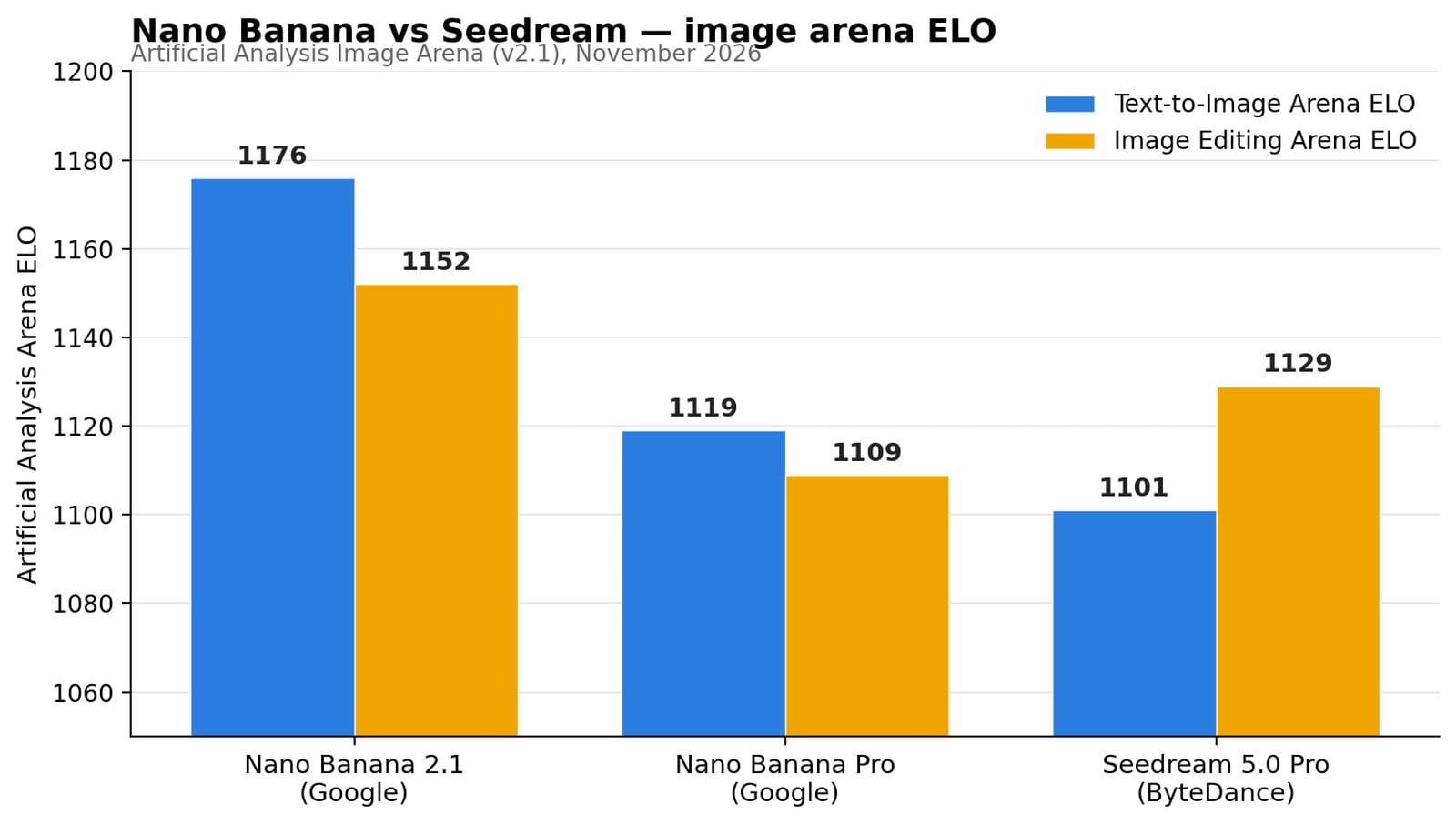
- Overall winner: Nano Banana. Google's Nano Banana 2.1 leads the Text-to-Image Arena (1176 vs Seedream 5.0 Pro's 1101, as of November 2026) and the Image Editing Arena (1152 vs 1129).
- The gap is wider on generation than editing. On editing, Seedream 5.0 Pro (1129) actually beats Google's reasoning flagship Nano Banana Pro (1109). The race there is close.
- Price reversed in October 2026. After a price cut, Nano Banana 2.1 costs $0.0336 per 1K image — cheaper than Seedream 5.0 Pro's $0.045. But Seedream still badly undercuts Nano Banana Pro ($0.134–$0.24).
- Seedream's real edge: multilingual text and layers. Native text in up to 14 languages (including right-to-left), plus editable poster layers.
- Pick Nano Banana for English text graphics, photorealism, and Gemini/SynthID production pipelines. Pick Seedream for non-English typography, layer editing, and cheap access to Pro-grade quality.
Nano Banana vs Seedream: which is better?
Nano Banana wins overall in November 2026. Google's line holds the top three non-OpenAI slots on the Artificial Analysis Text-to-Image Arena, led by Nano Banana 2.1 at 1176 ELO. The best confirmed Seedream — Seedream 5.0 Pro — sits at 1101.
That 75-point generation gap is real but not a blowout. On editing, the two lines nearly converge.
The decision isn't "which is better." It's "which is better for your job." Text rendering, editing style, multilingual support, and price pull in different directions.
What is Nano Banana?
Nano Banana is the nickname for Google's Gemini-family image generation and editing models. It started as Gemini 2.5 Flash Image in 2025.
The line now spans three current tiers. Nano Banana Pro (Gemini 3 Pro Image) launched November 20, 2025 — a reasoning-heavy model for complex, multi-turn composition. Nano Banana 2 (Gemini 3.1 Flash Image) followed in February 2026. Google then launched Nano Banana 2.1 on October 6, 2026, calling it its "latest image generation and editing model."
All current tiers output up to 4K, embed Google's SynthID invisible watermark on every image, and accept up to 14 reference images for subject consistency. They run through the Gemini API, AI Studio, and Vertex AI.
What is Seedream?
Seedream is ByteDance's text-to-image and editing family, built by its Seed research unit. Seedream 4.0 shipped September 9, 2025, raising max resolution "from 2K to 4K" and running roughly 10x faster than 3.0.
The current confirmed flagship is Seedream 5.0 Pro, which rolled out across fal, Magnific, and ByteDance's own ModelArk API around July–August 2026. It adds native text generation in up to 14 languages with right-to-left support, region-level editing, and the ability to split a poster into editable layers (text, subject, background).
One caution: a Seedream 5.5 appears on the Artificial Analysis editing leaderboard, but ByteDance has not officially confirmed it. Treat 5.0 Pro as the current flagship. Seedream is served via BytePlus, Dreamina, Jimeng, fal, OpenRouter, and Replicate — not a first-party developer cloud like Google's.
How do their benchmarks compare?
The cleanest apples-to-apples signal is the Artificial Analysis Image Arena — blind human preference votes, not vendor self-reports. Numbers below are from the v2.1 leaderboards, as of November 2026.
| Model | Maker | Version (date) | Max resolution | Price per image | T2I Arena ELO | Editing Arena ELO | Best for |
|---|---|---|---|---|---|---|---|
| Nano Banana 2.1 | Oct 6, 2026 | Up to 4K | $0.0336 (1K) / $0.113 (4K) | 1176 | 1152 | Fast default, text, high volume | |
| Nano Banana Pro (Gemini 3 Pro Image) | Nov 20, 2025 | Up to 4K | $0.134 (1K–2K) / $0.24 (4K) | 1119 | 1109 | Reasoning-heavy composition, infographics | |
| Seedream 5.0 Pro | ByteDance | ~Jul–Aug 2026 | 2K (4K rolling out) | $0.045 (≤2.36MP) / $0.09 (2K) | 1101 | 1129 | Multilingual text, layer editing |
Two things stand out. Google's Nano Banana 2.1 leads both arenas. But on editing, Seedream 5.0 Pro (1129) beats Nano Banana Pro (1109) and roughly ties Nano Banana 2 (1125). Seedream is a genuine editing contender — just not the leader.
Quality dimensions, side by side
| Dimension | Nano Banana (2.1 / Pro) | Seedream 5.0 Pro |
|---|---|---|
| In-image text (English) | Best in class (Google-reported low error rates) | Strong |
| Native multilingual text | Good | Best — up to 14 languages, RTL |
| Photorealism | Arena-leading (1176 T2I) | Competitive (1101 T2I) |
| Editing consistency | Leads at 2.1; Pro trails Seedream | Strong (1129 editing; layer editing) |
| Watermarking | SynthID on every image | Not prominently disclosed |
| Max resolution | Up to 4K | 2K at launch; 4K rolling out |
How much does each cost?
The price story flipped in October 2026. Per Google's AI Studio pricing, Nano Banana 2.1 costs $0.0336 per 1K image and $0.0504 at 2K — below Seedream 5.0 Pro's $0.045 (≤2.36MP) and $0.09 (2K).
So "Seedream is the cheap alternative" is now only true against Google's Pro tier. Nano Banana Pro runs $0.134 per standard image and $0.24 at 4K — roughly 3x Seedream 5.0 Pro. If you want Pro-grade quality at a lower bill, Seedream delivers it.
Seedream adds a wrinkle: the first reference image is free, then $0.003 each. For multi-reference workflows at scale, that matters. If raw per-token model economics are your real question, see our cheapest AI API breakdown for the LLM side of the bill.
Which is better for text in images?
Nano Banana for English; Seedream for everything else. Google's models post the lowest reported text-error rates and handle infographics, labels, and in-image translation cleanly.
Seedream's advantage is breadth: native rendering in up to 14 languages, including Arabic and other right-to-left scripts. For Chinese, Japanese, Korean, or Arabic typography, Seedream is often the safer pick.
Which is better for editing and photorealism?
Photorealism goes to Nano Banana — the 1176 vs 1101 T2I gap reflects aesthetic preference in blind voting.
Editing is a near-tie. Nano Banana 2.1 leads the Image Editing Arena at 1152, but Seedream 5.0 Pro (1129) beats Google's Pro model. Seedream's layer-based editing — splitting a poster into editable text/subject/background — is a workflow Google doesn't match natively.
Which should you use?
Default to Nano Banana 2.1 unless you have a specific reason not to. It leads both arenas, costs less than Seedream at matched tiers, and plugs into Google's production stack with SynthID provenance.
Reach for Seedream 5.0 Pro when you need non-English typography, layer editing, or Pro-grade output at a third of Nano Banana Pro's price.
Our take
Here's our thesis: for most builders shipping images in November 2026, Nano Banana 2.1 is the correct default, and the margin got wider — not narrower — when Google cut its price in October. The specific job where Seedream still wins is multilingual, layered creative — and that job is real, not a consolation prize.
Start with what the arena ELO does and doesn't capture. It's a blind aesthetic-preference vote. It rewards images people like — lighting, composition, "does this look good." It is a decent proxy for photorealism and overall polish, which is why Google's 1176 is meaningful. But it under-weights two things that decide production fit: instruction-following precision and editing consistency across turns. A model can win the beauty contest and still drift when you ask it to change one object and keep everything else fixed. That's why we treat the editing arena as the more load-bearing number for anyone doing iterative work — and there, Seedream 5.0 Pro's 1129 is close enough to Google that the price and language features break the tie.
The price/quality trade-off is where the conventional wisdom is now wrong. For a year, the pitch was "Seedream is the budget ByteDance alternative to expensive Google." After October 6, that's only true against Nano Banana Pro. Against Nano Banana 2.1 — which is both the arena leader and priced at $0.0336 per 1K image — Seedream 5.0 Pro is slightly more expensive at comparable resolution. If you're generating hundreds of thousands of images programmatically, Google now offers the better quality-per-dollar at the fast tier, with batch pricing cutting it further. That's a genuine reversal, and it's the single most important fact in this comparison.
Text rendering and editing consistency are the real decision axes — not raw photorealism, which both lines clear. If your output is English marketing creative, product shots, or data-heavy infographics, Nano Banana's text accuracy and SynthID watermarking make it the production-safe choice. SynthID cuts both ways: it's mandatory provenance you can't strip, which enterprises increasingly want and some creators resent. Seedream's watermarking is not prominently disclosed, which is a feature for unbranded output and a governance gap for regulated teams. Decide which side of that you're on before you commit a pipeline.
Ecosystem seals it for production. Nano Banana runs on Google's first-party Gemini API, AI Studio, and Vertex AI, with documented limits, enterprise terms, and provisioned throughput — the same Gemini lineup we sized up in Grok vs Gemini. Seedream reaches you through third-party resellers — fal, OpenRouter, Replicate, BytePlus — which is fine for prototyping but adds a dependency and a trust hop for anything mission-critical.
So, concretely:
- Marketing creative (English): Nano Banana 2.1. Text accuracy and photorealism win.
- Product and e-commerce imagery: Nano Banana 2.1 for quality; Nano Banana Pro if you need multi-reference consistency across a catalog.
- Design iteration and posters: Seedream 5.0 Pro. Layer editing is the deciding feature.
- High-volume programmatic generation: Nano Banana 2.1 — best quality-per-dollar after the price cut, with batch discounts.
- Non-English / text-heavy graphics: Seedream 5.0 Pro. Fourteen-language native text, including RTL.
One honest caveat: this field moves weekly. A rumored Seedream 5.5 already shows up on the editing arena. If ByteDance confirms it and it holds 1159 editing ELO, the editing verdict shifts. If your generative needs extend to video, we ran the same arena-based head-to-head on Veo 3.1 vs Sora 2. Re-check the live leaderboards before you lock a vendor.
Frequently Asked Questions
Is Nano Banana better than Seedream?
For most use cases, yes. Google's Nano Banana 2.1 leads both the Artificial Analysis Text-to-Image Arena (1176) and Image Editing Arena (1152) as of November 2026, versus Seedream 5.0 Pro's 1101 and 1129. Seedream wins on native multilingual text and layer-based editing, but Nano Banana wins overall.
Is Seedream cheaper than Nano Banana?
Not against Google's cheapest tier anymore. Nano Banana 2.1 costs $0.0336 per 1K image after its October 2026 price cut, below Seedream 5.0 Pro's $0.045. But Seedream is far cheaper than Nano Banana Pro, which runs $0.134 per image and $0.24 at 4K.
Which is best for text in images?
Nano Banana for English text; Seedream for other languages. Google's models report the lowest text-error rates and excel at infographics and labels. Seedream 5.0 Pro renders native text in up to 14 languages, including right-to-left scripts like Arabic, making it stronger for non-English typography.
Can Seedream edit images like Nano Banana?
Yes, and competitively. Seedream 5.0 Pro scores 1129 on the Artificial Analysis Image Editing Arena, beating Nano Banana Pro (1109) and roughly tying Nano Banana 2. It also offers layer-based editing — splitting a poster into editable text, subject, and background — which Google doesn't match natively.
Which AI image model is best in 2026?
By blind human-preference voting, OpenAI's GPT Image 2.6 tops the Artificial Analysis arenas. Among the two covered here, Nano Banana 2.1 is the best all-round pick in November 2026 — leading on generation quality, editing, and price-per-image at the fast tier.
Editor's note — sources: Artificial Analysis Text-to-Image Arena and Image Editing Arena (ELO, v2.1, Nov 2026); Google AI Studio pricing (per-image costs); Decrypt (Nano Banana 2.1 launch, Oct 6 2026); Google Cloud Vertex AI docs (Gemini 3.1 Flash Image / Nano Banana 2); VentureBeat (Nano Banana Pro specs, SynthID, 14 reference images); ByteDance Seed (Seedream 4.0 release, 4K); TestingCatalog (Seedream 5.0 Pro features, 14 languages, layers); OpenRouter and Atlas Cloud (Seedream pricing).