
Best TTS Model (2026): Ranked, Priced, Compared
ElevenLabs Eleven v4 tops the Artificial Analysis Speech Arena at 1319 Elo - the best TTS model overall. Cartesia Sonic 3.6 wins for voice agents, Kokoro 82M is the best open-source model, Gemini 3.8 Flash is the value pick. Ranked by Elo, price and latency, with a verdict by use case.

The best TTS model overall is ElevenLabs' Eleven v4, which tops the Artificial Analysis Speech Arena at 1319 Elo as of late 2026. But "best TTS model" splits by job: Cartesia Sonic 3.6 wins for voice agents on latency, Kokoro 82M is the best open-source TTS model, and Google's Gemini 3.8 Flash TTS is the value pick for most builders.
TL;DR
- Most natural / overall: Eleven v4 (ElevenLabs) leads the Speech Arena at 1319 Elo; flagship pricing is ~$80 per 1M characters.
- Best for voice agents: Cartesia Sonic 3.6 — 1279 Elo, ~$49 per 1M chars, a measured 341ms time-to-first-audio.
- Best open-source TTS model: Kokoro 82M v1.0 (Apache 2.0) — 1063 Elo, free to self-host or ~$0.63 per 1M chars hosted. Chatterbox (MIT) is the open pick for voice cloning.
- Cheapest capable API: Deepgram Aura-2 around $30 per 1M chars; Gemini 3.8 Flash TTS lands near $16 per 1M on promotional pricing.
- Elo scores and prices move monthly. Verify on vendor pages before you commit at scale.
The best TTS models at a glance
Here are the models worth your shortlist, ranked by Speech Arena Elo, with verified pricing and the latency numbers vendors and benchmarks actually disclose.
| Model | Maker | Type (license) | Price / 1M chars | Speech Arena Elo | Latency (TTFA) | Best for |
|---|---|---|---|---|---|---|
| Eleven v4 | ElevenLabs | API | ~$80 | 1319 | ~75ms (vendor claim) | Most natural, overall |
| Sonic 3.6 | Cartesia | API | ~$49 | 1279 | 341ms (measured) | Voice agents |
| Gemini 3.8 Flash TTS | API | ~$16 | 1265 | not disclosed | Value, multilingual | |
| Realtime TTS-2 | Inworld | API | ~$21 | 1246 | 169ms (measured) | Real-time agents |
| MiniMax 2.8 HD | MiniMax | API | ~$100 | 1170 | not disclosed | Expressive long-form |
| Eleven v3 | ElevenLabs | API | ~$100 | 1169 | 588ms (measured) | Legacy expressive |
| Kokoro 82M v1.0 | Hexgrad | open (Apache 2.0) | ~$0.63 / free | 1063 | fast on CPU/GPU | Best open default |
| gpt-4o-mini-tts | OpenAI | API | token-priced | 929 (Voice Arena) | 812ms (measured) | OpenAI-stack apps |
| Chatterbox | Resemble AI | open (MIT) | $0 self-host | n/d | GPU-dependent | Open voice cloning |
| Aura-2 | Deepgram | API | ~$30 | not on AA | not disclosed | Low-cost enterprise agents |
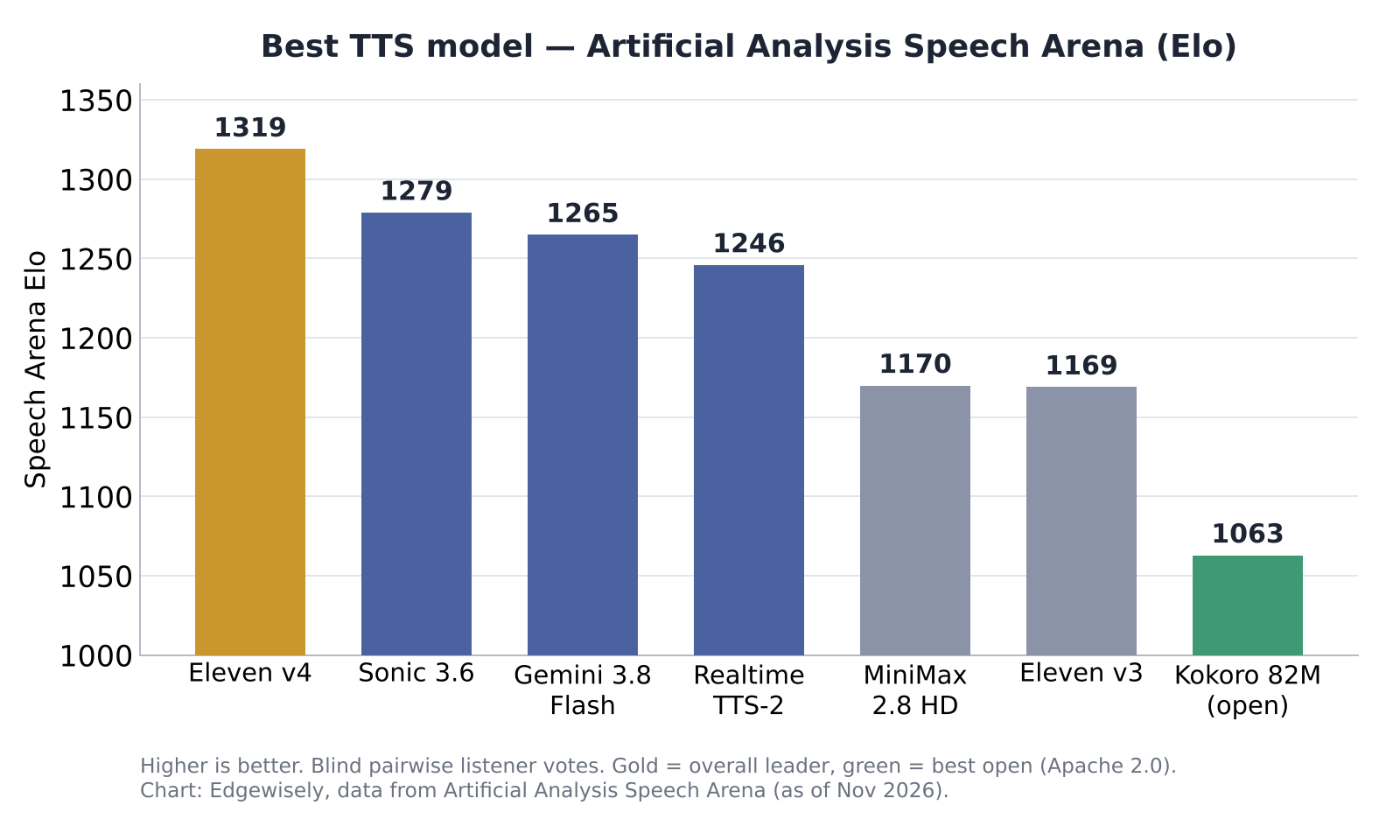
Notes: Elo is the Artificial Analysis Speech Arena; latency P50 time-to-first-audio is from the companion Voice Arena (the board that measures it). Figures read late Sept–Nov 2026; prices from vendor pages and dated roundups. OpenAI and Gemini price by tokens, not characters, so per-1M-char figures are approximate. ElevenLabs sells via subscription credits, so effective rates can run higher than list.
What makes a TTS model good?
Four things, in roughly this order for production work: naturalness, latency, price, and control.
Naturalness is what leaderboards measure. The Artificial Analysis Speech Arena ranks models by Elo from blind listener votes — two samples of the same text, pick the one that sounds more human. The HuggingFace TTS Arena V2 does the same with a Bradley-Terry fit, requiring 100 votes before a model appears and marking it preliminary until 300.
Latency decides whether a model can hold a live conversation. The signal that matters is time-to-first-audio (TTFA) — how fast the first byte of speech comes back. Few vendors publish it honestly, so measured numbers from Voice Arena beat marketing claims.
Price is per 1M characters or per minute of audio. The two don't convert cleanly: a minute of speech runs roughly 750–1,000 characters, so a $50/1M model is about $0.04–0.05 per minute.
Control means voice cloning, emotion tags, pacing, and language coverage. This is where open models and specialist APIs beat the giants.
Which TTS model sounds most natural?
Eleven v4 sounds the most natural in blind testing. It went straight to the top of the arena at 1319 Elo, well clear of the next tier, after ElevenLabs added it on Sept 28, 2026.
Behind it, the gap is small and the order shifts weekly. Cartesia Sonic 3.6 (1279), Gemini 3.8 Flash TTS (1265), and Inworld Realtime TTS-2 (1246) all cluster within ~75 Elo of the leader — close enough that most listeners won't reliably tell them apart on clean text.
One caveat: Elo rewards short, clean prompts. It does not capture how a model handles a 20-minute audiobook chapter, odd proper nouns, or code-switching between languages. For long-form naturalness, ElevenLabs' flagship and Cartesia Sonic remain the safe calls; both were built for sustained narration rather than one-line demos.
What do TTS models cost?
Expect $30–$100 per 1M characters for premium API models, and effectively free for open-weight models you self-host (you pay for GPU instead).
Verified pricing, dated:
- ElevenLabs flagship (v4): ~$80 per 1M chars list; v4 Turbo at roughly $40 per 1M, per the ElevenLabs API pricing page and a dated September 2026 ranking. Sold as subscription credits, so effective rates can run higher.
- Cartesia Sonic 3.6: about $49 per 1M chars, roughly $0.03–0.05 per minute.
- Deepgram Aura-2: around $30 per 1M chars pay-as-you-go — the cheapest capable enterprise-agent option.
- MiniMax Speech 2.8 HD: about $100 per 1M chars; the Turbo tier near $60.
- Google Gemini 3.8 Flash TTS: token-priced, landing near $16 per 1M chars on promotional pricing.
- OpenAI gpt-4o-mini-tts: token-priced (roughly $0.60 per 1M input text tokens plus $12 per 1M audio output tokens); treat per-char figures as estimates.
- Kokoro 82M: Apache 2.0 — free to self-host, or ~$0.62–0.65 per 1M hosted.
The spread is the story: commodity narration costs almost nothing open-source, while the last few Elo points of naturalness cost a premium. For how that premium-vs-commodity split plays out across model APIs generally, see our cheapest AI API guide.
Which open-source TTS model is best?
Kokoro 82M v1.0 is the best open-source TTS model for most people. It carries a clean Apache 2.0 license (commercial use allowed), posts 1063 Elo on the Speech Arena — competitive with hosted commercial models — and at 82M parameters runs fast on a CPU. For general narration where you want zero per-character cost and no license friction, start here.
Pick by need:
- Voice cloning / expressivity: Chatterbox (Resemble AI), MIT licensed — the open pick for cloning.
- Multi-speaker dialogue: Dia 1.6B (Nari Labs), Apache 2.0, built for tagged conversation, per BentoML's open-source TTS guide.
- Real-time on CPU: MeloTTS (MIT) — no cloning, but fast and multilingual.
- Agent-style speech: Orpheus 3B and Sesame CSM-1B, both Apache 2.0.
Watch the licenses. XTTS-v2 (Coqui) ships under the non-commercial Coqui Public Model License, and Fish Speech / OpenAudio uses CC-BY-NC-SA-4.0 — great quality, but you cannot ship them commercially without a paid license. Voxtral TTS (Mistral) is CC BY-NC 4.0, also non-commercial. If you're building a product, "open" and "usable" are not the same word. Embeddings follow the same open-vs-managed split — our best embedding model guide walks the equivalent trade-off for retrieval.
Which TTS model is best for voice agents?
Cartesia Sonic 3.6 is the best TTS for voice agents. It pairs strong naturalness (1279 Elo) with the latency a live conversation needs — a measured 341ms P50 time-to-first-audio, and Cartesia claims sub-90ms model latency across 44 languages.
Two strong alternatives:
- Inworld Realtime TTS-2 — 1246 Elo and a measured 169ms TTFA, the fastest first-byte among the top-ranked models, at roughly $21/1M.
- Deepgram Aura-2 — the cost play at ~$30/1M, purpose-built for high-volume enterprise call flows.
ElevenLabs competes here too: Eleven v4 Turbo targets ~150ms vendor-claimed latency at ~$40/1M. For agents, the decision rarely comes down to the last few Elo points. It comes down to tail latency under load, barge-in / interruption handling, and cost per minute at scale — where a $49/1M model versus a $100/1M model is the difference between a viable unit economic and a dead one.
Which TTS model should you pick?
- You want the most human voice, cost is secondary: Eleven v4. It leads the arena and nothing else is clearly better.
- You're building a voice agent: Cartesia Sonic 3.6 for the quality/latency balance; Inworld Realtime TTS-2 if first-byte speed is everything; Deepgram Aura-2 to cut cost at volume.
- You want value for general narration: Google Gemini 3.8 Flash TTS while the promo pricing holds.
- You need open-weight / on-device / no per-character cost: Kokoro 82M (Apache 2.0) as the default; Chatterbox (MIT) for cloning.
- Avoid if: you need commercial rights — steer clear of XTTS-v2, Fish Speech, and Voxtral TTS without a paid license.
Our take
Our thesis: there is no single "best TTS model" anymore, and the builders still searching for one are asking a 2024 question. The category fragmented hard in 2026. Naturalness has commoditized at the top — the spread between the #1 and #4 models on the Speech Arena is about 75 Elo, a margin most end users cannot hear on clean text. When the quality difference is inaudible, it stops being the deciding factor. Latency and price now decide production choices, and that reorders everything the leaderboards imply.
This is clearest in voice agents, the fastest-growing use case. A leaderboard tells you Eleven v4 (1319) beats Cartesia Sonic 3.6 (1279). A production engineer does not care. They care that Sonic answers with the first byte of audio in a measured 341ms, holds up across dozens of languages, and costs roughly half per million characters. At a million minutes a month, that price gap is the entire margin. The "best" model on paper is the wrong model in the stack. (Opinion, grounded in the pricing and latency figures above.)
What the leaderboards do not capture is the second half of the story. Speech Arena Elo rewards short, clean, English prompts — the exact conditions a vendor optimizes a demo for. It says little about a model mangling a medical term in paragraph nine of an audiobook, about code-switching mid-sentence, about how a voice degrades under SSML pacing control, or about tail latency when your GPU pool is saturated at 9am. Expressivity and intelligibility are different axes, and a model can win the preference vote while being harder to direct. Treat every Elo number, including the ones in this article, as a starting filter, not a verdict. Run your own text through the top three before you commit. (Analysis.)
The API-versus-open gap is real but narrowing unevenly. At the frontier, closed models still win: Eleven v4 and Sonic 3.6 are genuinely ahead of anything open-weight, and that lead is widening at the very top as the labs pour compute into expressivity. But at the commodity tier — straightforward narration, notifications, IVR prompts — the gap has effectively closed. Kokoro 82M at 1063 Elo runs on a laptop CPU under an Apache 2.0 license and costs nothing per character. For a huge share of real workloads, that is not "good enough for free," it is simply the correct engineering choice, and paying $80/1M for marginally warmer vowels is waste.
Our cost/quality judgement: the money is justified only at the extremes. Pay premium API rates when the voice is the product — a flagship audiobook, a consumer companion, a brand's signature agent — where the top 50 Elo points are worth real money. Everywhere else, the value frontier runs through Gemini 3.8 Flash, Deepgram Aura-2, and Kokoro, and most teams overspend by defaulting to the name they recognize.
The verdict. Best overall: Eleven v4. Best for voice agents: Cartesia Sonic 3.6. Best open: Kokoro 82M, with Chatterbox for cloning. Best value: Gemini 3.8 Flash TTS. Avoid the non-commercial open models (XTTS-v2, Fish Speech, Voxtral) for any product you intend to ship — the license, not the audio, will be the thing that bites you.
Frequently Asked Questions
What is the best TTS model?
The best TTS model overall is ElevenLabs Eleven v4, which leads the Artificial Analysis Speech Arena at 1319 Elo as of late 2026. But "best" depends on the job: Cartesia Sonic 3.6 wins for voice agents, Kokoro 82M for open-source, and Gemini 3.8 Flash for value.
What is the best open-source TTS model?
Kokoro 82M v1.0 is the best open-source TTS model for most uses. It is Apache 2.0 licensed, scores 1063 Elo, and runs on a CPU. For voice cloning, choose Chatterbox (MIT). Avoid XTTS-v2 and Fish Speech commercially — both carry non-commercial licenses despite being open-weight.
What is the best TTS model for voice agents?
Cartesia Sonic 3.6 is the best TTS model for voice agents, combining 1279 Elo naturalness with a measured 341ms time-to-first-audio at roughly $49 per 1M characters. For fastest first-byte audio, Inworld Realtime TTS-2 measured 169ms; for lowest cost, Deepgram Aura-2 runs about $30 per 1M.
How much do TTS models cost?
Premium TTS APIs cost $30–$100 per 1M characters. ElevenLabs flagship is about $80/1M (~$40 for Turbo), Cartesia Sonic about $49/1M, Deepgram Aura-2 around $30/1M, and MiniMax up to $100/1M. Open-weight models like Kokoro are free to self-host. Figures are from vendor pages, Sept–Nov 2026.
Which TTS model sounds the most natural?
Eleven v4 sounds the most natural in blind listening tests, topping the Artificial Analysis Speech Arena at 1319 Elo. Cartesia Sonic 3.6 (1279) and Gemini 3.8 Flash TTS (1265) are close behind — within a margin most listeners cannot reliably distinguish on clean, short text.
Editor's note — sources: Artificial Analysis Speech Arena and companion Voice Arena; ElevenLabs API pricing; DigitalApplied's dated September 2026 ranking; OrcaRouter's Eleven v4 arena report; BentoML open-source TTS guide; vendor pricing pages (Sept–Nov 2026). Elo scores and prices change frequently — verify on vendor pages before committing at scale. Vendor latency claims are attributed as claims, not independent measurements.