
Qwen vs Llama 2026: Best Open-Weight LLM
Qwen3.8 Max vs Meta's Muse Spark Open (the Llama successor): benchmarks, licenses, self-host cost and a verdict by use case. Verified October 2026.


TL;DR
- Verdict: In late 2026, "Qwen vs Llama" is close on quality and decided by license, modality and serving cost — not leaderboard points. Alibaba's Qwen3.8 Max edges raw intelligence; Meta's Muse Spark Open — the open-weight successor to Llama 4 — serves far faster and cheaper and adds native multimodality.
- The brand shift: Meta retired the "Llama" name for its newest open line. Its current open-weight flagship is Muse Spark Open (released 15 Oct 2026). Llama 4 is the prior generation.
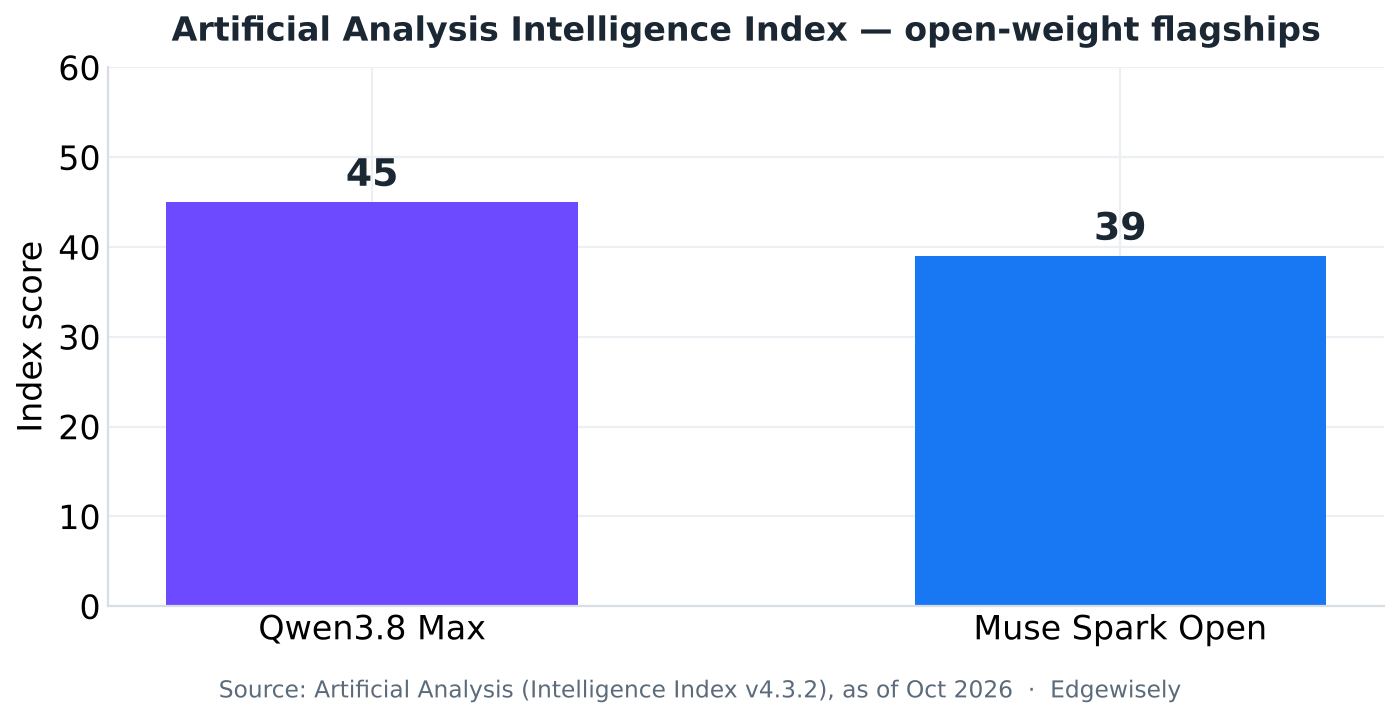
- Intelligence: On the same Artificial Analysis Intelligence Index (v4.3.2, Oct 2026), Qwen3.8 Max scores 45, Muse Spark Open 39.
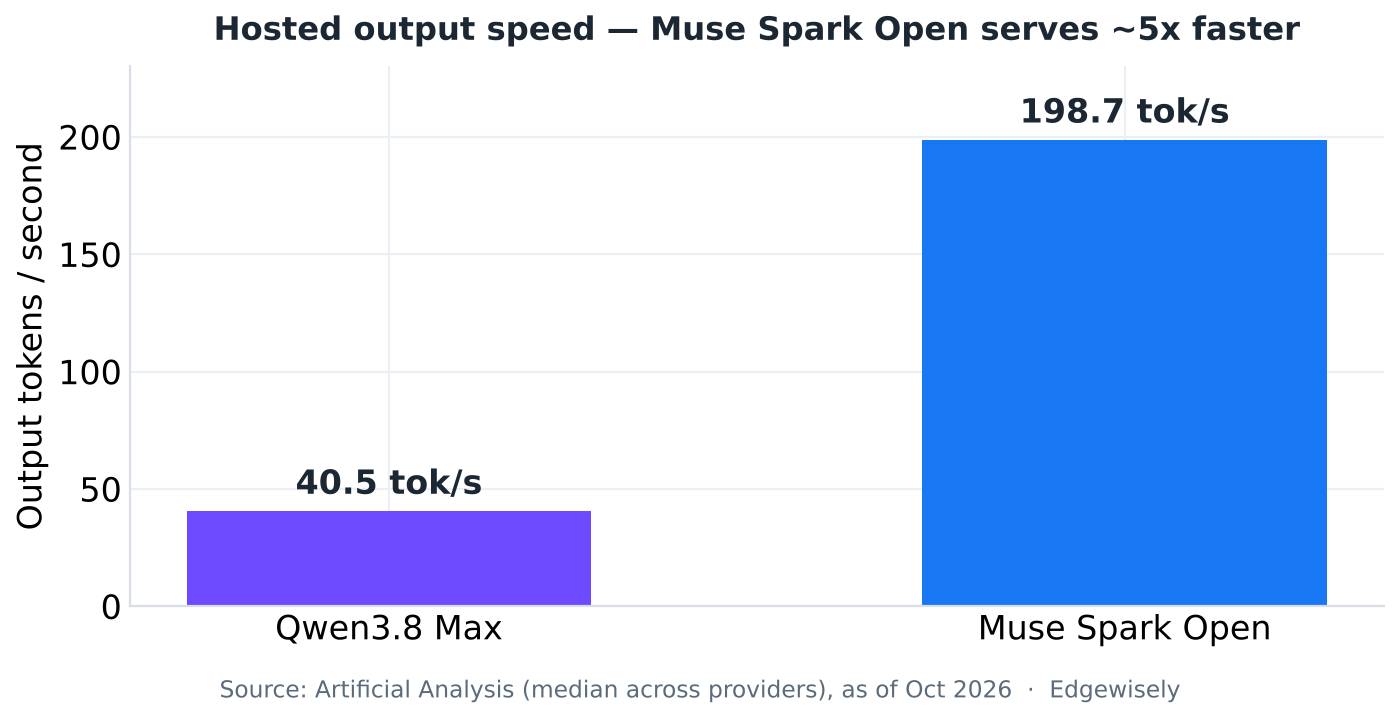
- Speed and price: Muse Spark Open serves at ~199 tok/s versus Qwen3.8 Max's ~41 tok/s, at a lower blended price ($1.25/$4.25 vs $2/$6 per 1M). Throughput, not accuracy, is the real gap.
- Licenses (the real story): Neither flagship is Apache 2.0. Qwen3.8 Max carries a $50M revenue gate; Muse Spark Open a $20M API-service gate plus a "Built with Muse Spark Open" credit. The one clean, permissive option is the small Qwen3.8-27B (Apache 2.0).
Qwen vs Llama in late 2026 is a near-tie on quality. Pick Qwen3.8 Max (or the Apache-2.0 Qwen3.8-27B) for text-only work and the most permissive small-model license; pick Meta's Muse Spark Open for native multimodality, a 1M-token context and much faster, cheaper hosted inference. For most teams, license terms and throughput decide this, not benchmark scores.
What's the difference between Qwen and Llama?
Qwen is Alibaba's open-weight family; "Llama" is Meta's — but Meta renamed its newest open line to Muse in 2026. When people search "qwen vs llama" today, the honest head-to-head is Qwen3.8 vs Meta's Muse Spark Open, the direct successor to Llama 4.
Both flagships are mixture-of-experts (MoE) models that activate only a slice of their weights per token, but the shapes differ sharply.
- Qwen3.8 Max (2.4T-A95B) (Alibaba, released August 2026): a 2.4-trillion-parameter MoE with roughly 95B active per token. It is text-only — Qwen's vision capability lives in separate variants. Context runs to ~984k tokens on the hosted API (Artificial Analysis, Oct 2026).
- Muse Spark Open (Meta, released 15 October 2026): 816B total parameters with 42B active per token, a 1M-token context, and it is natively multimodal — text, image, video and audio in, text out (VentureBeat, Oct 2026).
The shapes tell the strategy. Qwen went very large and sparse and kept it text-focused. Meta went smaller, multimodal and optimised for fast serving — Muse Spark Open is explicitly built to run on Apple silicon.
Qwen vs Llama benchmarks: who wins?
It's close, and it depends on which number you weight. On the independent Artificial Analysis Intelligence Index (v4.3.2, the same harness for both, Oct 2026), Qwen3.8 Max scores 45 and Muse Spark Open scores 39. That six-point edge to Qwen is real but modest — both sit in the same tier, well below the top proprietary models.
Meta's own model card (reported by VentureBeat) puts Muse Spark Open at 76.4 on Terminal-Bench 2.1, 61.8 on JobBench and 89.2 on MCP-Atlas, and claims it leads other US open-weight models — while trailing Chinese open models Kimi K3 (85.0) and GLM-5.3 (83.9) on Terminal-Bench. Treat those as Meta's own claims; vendor cards run at maximum reasoning effort and flatter the home team.
What the benchmarks miss is the real separator: throughput. Artificial Analysis clocks Muse Spark Open at ~199 tokens/sec against Qwen3.8 Max at ~41 tokens/sec on hosted endpoints — a roughly 5x gap that matters far more for most production workloads than six points of index score.
Qwen vs Llama for coding?
For agentic coding it's roughly even, with Qwen leaning ahead on raw intelligence and Muse winning on speed and cost. Both flagships target tool use and long-horizon coding agents, and both report strong terminal-task scores on their own cards.
The honest limitation: there is no clean, same-harness software-engineering benchmark (like SWE-bench Verified) published for both current flagships from a single source, so direct coding comparisons rely on vendor self-reports. What we can say from independent testing is that Qwen3.8 Max holds a small overall intelligence edge, while Muse Spark Open's ~5x throughput changes the economics of agents that loop thousands of tool calls.
Practical read: if your agent hammers tool calls, Muse Spark Open's throughput usually beats a small accuracy gap. If you want peak text accuracy and work in a text-only pipeline, Qwen3.8 Max has the edge. For picking a serving stack to run either, see our vLLM vs SGLang breakdown.
Qwen vs Llama licenses: which is safer for commercial use?
Neither flagship is a clean Apache-2.0 open-source license — and that's the single most important thing most comparison pages get wrong. For truly permissive commercial use, the safest pick is the small Qwen3.8-27B (Apache 2.0). Above that, both flagships carry revenue gates.
- Qwen3.8-27B — Apache 2.0. No revenue gate, no attribution. The genuinely permissive option, and it scored 52 on the Artificial Analysis Intelligence Index at launch (Aug 2026).
- Qwen3.8 Max — "Qwen3.8-Max license." Businesses running a model-as-a-service or AI-work-assistant with aggregate revenue above US$50M in any 12-month period must obtain a separate license from Alibaba; internal use is exempt (South China Morning Post, Aug 2026).
- Muse Spark Open — Muse Model License. If you offer model access as a service and your aggregate gross revenue exceeds US$20M in any 12-month period, you must notify Meta and sign a separate agreement, and you must display "Built with Muse Spark Open." Internal and research use is exempt; it is marked not for under-18s (VentureBeat, Oct 2026).
For a startup or platform team under those thresholds, both flagships are usable commercially without paying either vendor — you just carry the compute cost and, for Muse, the attribution string. For how Qwen's licensing compares against its closest open rival, see our DeepSeek vs Qwen comparison.
Qwen vs Llama for self-hosting: hardware and cost?
Self-hosting the flagships is a data-center or high-end-workstation job; self-hosting a usable model on a single GPU means going smaller. Both 800B-plus and 2.4T-class models need serious memory.
Meta designed Muse Spark Open to be runnable on Apple silicon. Its reference desktop setup is two M5 Ultra Mac Studios (up to 512GB unified memory each, ~1TB combined), and the model card lists at least 700GB of accelerator memory for the NVFP4 build and ~2TB for BF16 (TechCrunch, Oct 2026). Qwen3.8 Max, at 2.4 trillion parameters, is heavier still and is realistically a multi-node or hosted-API deployment.
The practical self-host story: if you want to run open weights on hardware you actually own, Qwen3.8-27B (Apache 2.0) is the sane target — a single high-memory GPU or a quantized local build — not either giant flagship. To choose a local runtime, see Ollama vs llama.cpp.
Hosted API pricing (Oct 2026): Muse Spark Open runs about $1.25 input / $4.25 output per 1M tokens (median across providers) versus Qwen3.8 Max's $2 / $6 on Alibaba's API. Muse is cheaper and faster through third-party providers; if you'd rather not self-host either, compare vendors in our AI inference providers guide.
Qwen vs Llama: the deep comparison
| Model | Maker | Params (active/total) | Context | License | Modality | Best for |
|---|---|---|---|---|---|---|
| Qwen3.8 Max | Alibaba | ~95B / 2.4T | ~984k | Qwen3.8-Max license ($50M rev. gate) | Text only | Max text accuracy, agentic automation |
| Qwen3.8-27B | Alibaba | 27B (dense) | native | Apache 2.0 | Text | Permissive self-hosting, local/edge |
| Muse Spark Open | Meta | 42B / 816B | 1M | Muse Model License ($20M API-rev. gate + attribution) | Multimodal | Multimodal agents, fast cheap serving |
| Llama 4 Maverick | Meta | 17B / 400B | 1M | Llama 4 Community License (700M MAU gate) | Multimodal | Prior-gen baseline |
Figures from vendor model cards, Artificial Analysis and TechCrunch, as of October 2026. Llama 4 Maverick (April 2025) is the last "Llama"-branded open-weight flagship, kept here for baseline context.
Our take
Here's the thesis most comparison pages miss: in late 2026 the open-weight race between Alibaba and Meta is no longer decided by benchmarks — it's decided by license terms and serving economics. Qwen3.8 and Muse Spark Open are close enough on quality that, for almost every builder, the model you should pick is the one whose license and cost profile fits your business, not the one six points higher on an intelligence index. This is our analysis, grounded in the verified numbers above.
Start with what the benchmarks actually tell you, because it's less than the scoreboards imply. On the one clean same-methodology measure we have — the Artificial Analysis Intelligence Index — Qwen3.8 Max sits at 45 and Muse Spark Open at 39. That's a genuine Qwen edge, but it's the kind of gap that disappears the moment your specific workload favours multimodality or long context. Vendor model cards paint wider, prettier gaps, but they run at maximum reasoning effort on each maker's own harness, and Meta's card tellingly shows Muse trailing Chinese open models Kimi K3 and GLM-5.3 on Terminal-Bench. The honest conclusion is that on knowledge and reasoning these two are peers, and anyone claiming a decisive winner is reading noise.
The real separation is throughput, and it's dramatic. Muse Spark Open serves at roughly five times Qwen3.8 Max's token rate on hosted endpoints, at a lower price per token. For an agent that burns millions of tokens a day, that gap dwarfs a six-point accuracy difference — it changes which products are financially viable at all. Meta clearly optimised Muse for serving, not for topping a leaderboard, and for production builders that was the right call.
The license reality is where builders should spend their attention, and it cuts against the lazy narrative. For two years the shorthand was "Qwen is Apache, Llama is restricted." That's dead. Qwen's flagship now ships under the bespoke Qwen3.8-Max license with a $50M revenue gate; Muse Spark Open carries a $20M API-service gate plus a mandatory "Built with Muse Spark Open" credit. Both are generous to anyone below those thresholds — a seed-stage startup or an internal platform team can deploy either for free — but neither is OSI open source, and your legal team should read the actual text before you build a product on top. The one genuinely clean option is the smaller Qwen3.8-27B under Apache 2.0, which is why, for commercial builders who want zero licensing risk, the correct answer to "Qwen or Llama?" is often "neither flagship — ship the 27B."
Self-hosting reinforces the point. Both flagships are heavy deployments: Muse Spark Open wants ~1TB of memory even in its Apple-silicon reference setup, and Qwen3.8 Max at 2.4 trillion parameters is heavier still. Unless you already run the hardware, you are renting these through an inference provider — which puts you back in a pricing comparison Muse wins. The teams who truly self-host will mostly run quantized mid-size models, and that again favours the Apache-2.0 27B over either giant.
So where does each fit? Choose Qwen3.8 Max if you want the strongest text-only accuracy and you're under the $50M gate. Choose Muse Spark Open if you need native multimodality, a true 1M-token context, and the fastest, cheapest hosted serving, and can live with the attribution string. Choose Qwen3.8-27B if license cleanliness and single-box deployment matter more than frontier scores. Avoid the flagships entirely if your use case is latency-sensitive and single-GPU — a 27–32B model from either camp will make you happier. The uncomfortable truth for Meta is that its biggest 2026 story isn't winning this race; it's that it had to retire the Llama brand and gate its weights to stay in it. The uncomfortable truth for Alibaba is that it walked away from the Apache-2.0 openness that made Qwen a default. The winner, as usual, is the builder who reads the license.
What this means for you
- Solo dev running locally: Skip both flagships. Run Qwen3.8-27B (Apache 2.0) on a high-memory GPU or a quantized build. No revenue gate, no attribution, no multi-node bill.
- Startup self-hosting (under the gates): Either flagship is free to use commercially. Pick Muse Spark Open for multimodal agents and cheaper, faster serving; pick Qwen3.8 Max for peak text accuracy. Read both licenses before launch.
- Platform team serving at scale: Favour Muse Spark Open — ~5x throughput and a lower price per token usually beat Qwen's small accuracy edge. Benchmark on your traffic before committing.
- Enterprise with license-compliance needs: Watch the thresholds — Qwen3.8-Max: $50M revenue gate; Muse Model License: $20M API-service gate plus mandatory attribution. If you're near either, get written terms, or standardise on Apache-2.0 Qwen3.8-27B and remove the question.
Frequently Asked Questions
Is Qwen better than Llama?
Neither clearly wins in late 2026. On the Artificial Analysis Intelligence Index (Oct 2026), Qwen3.8 Max scores 45 to Muse Spark Open's 39, so Qwen leads on raw intelligence. But Meta's Muse Spark Open serves ~5x faster and cheaper and adds native multimodality. For text accuracy, lean Qwen; for multimodal speed and cost, lean Muse.
Did Meta stop making Llama?
Effectively, for new releases — Meta retired the "Llama" brand for its newest open line in 2026 and now ships under the Muse name. Muse Spark Open (released 15 October 2026) is the open-weight successor to Llama 4. The older Llama 4 models remain available, but new open releases carry Muse branding and the Muse Model License.
What is the best open-weight LLM right now?
It's workload-dependent. Qwen3.8 Max and Meta's Muse Spark Open are the two strongest Western-accessible open-weight flagships as of October 2026, with Chinese models Kimi K3 and GLM-5.3 also competitive. For a genuinely permissive, self-hostable option, Qwen3.8-27B (Apache 2.0) is the pragmatic pick for most teams.
Which is cheaper to run, Qwen or Llama?
For hosted APIs, Muse Spark Open is cheaper: about $1.25/$4.25 per 1M input/output tokens versus Qwen3.8 Max's $2/$6 (Oct 2026), and it serves faster. For self-hosting, both flagships need heavy memory, so the cheapest route to run open weights on your own hardware is the smaller Qwen3.8-27B.
Is Qwen or Llama safe for commercial use?
Both are usable commercially below their revenue gates, but neither flagship is OSI open source. Qwen3.8 Max requires a separate Alibaba license above $50M revenue; Muse Spark Open requires a Meta agreement above $20M API-service revenue plus "Built with Muse Spark Open" attribution. For zero restrictions, use Apache-2.0 Qwen3.8-27B.
Editor's note — sources (accessed October 2026): Meta Research — Muse Spark Open; TechCrunch — Meta's Mac-runnable open model; VentureBeat — Muse Spark Open specs, license and benchmarks; Artificial Analysis — Qwen3.8 Max and Muse Spark Open (intelligence index, price, speed); South China Morning Post (Qwen licensing); Simon Willison (Qwen3.8-27B Apache 2.0 and index score); TechCrunch — Llama 4 (prior-gen specs and license). Benchmark figures are vendor self-reported or independently measured as noted; treat vendor numbers as claims. Prices and benchmarks are dated October 2026 and will move — re-verify before relying on them.