
Grok vs Claude: Which to Pick in 2026
Grok 4.7 vs Claude Opus 5.5: benchmarks, pricing, coding and agents. Claude leads on quality, Grok wins on price. Which to pick, by use case.


TL;DR
- Pick Claude Opus 5.5 for hard reasoning, coding and agents; pick Grok 4.7 when cost and throughput matter more than the last few points of quality. Opus 5.5 is the higher-quality model; Grok 4.7 is the cheaper, faster one.
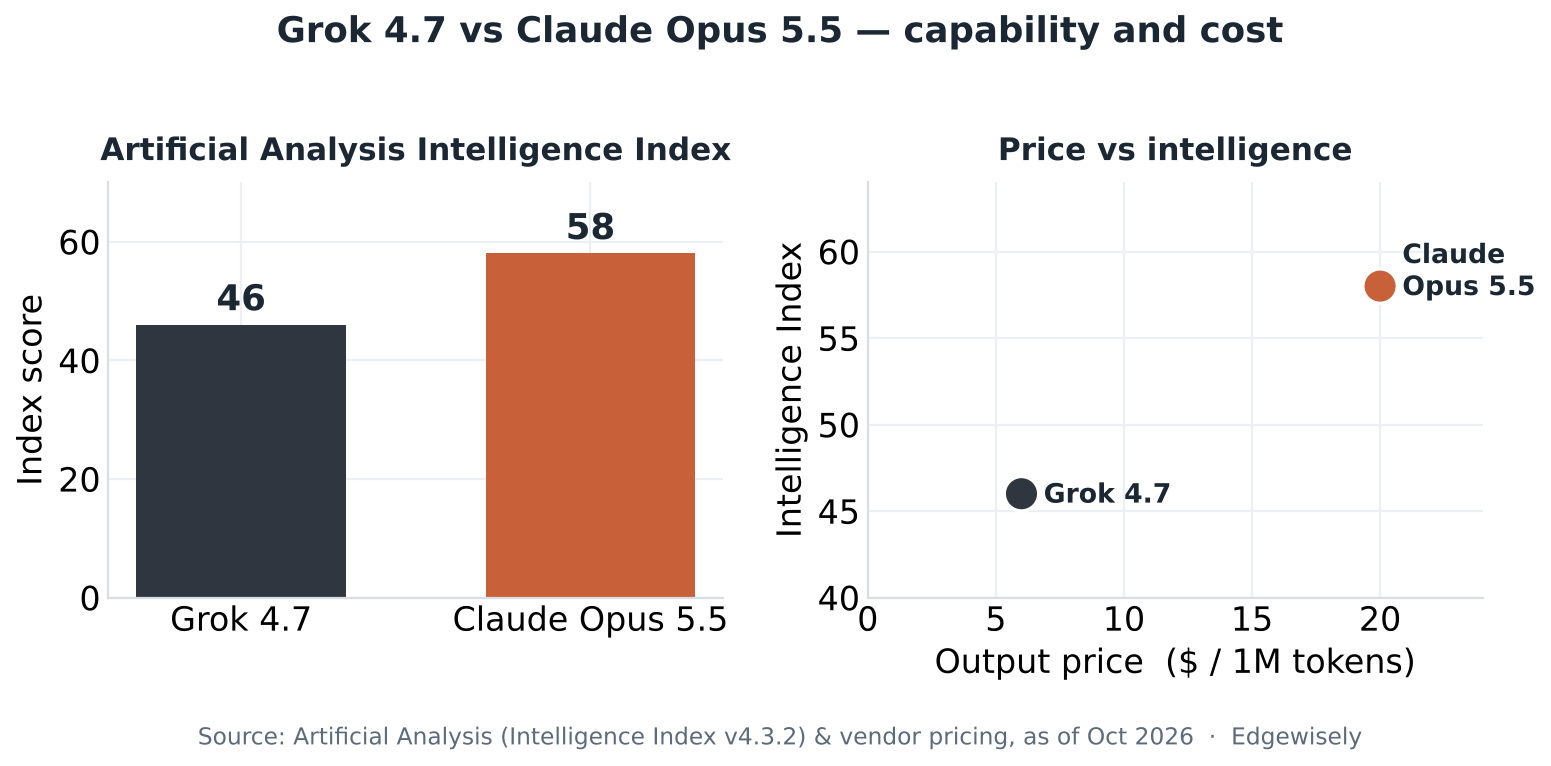
- Quality: Claude Opus 5.5 scores 58 on the Artificial Analysis Intelligence Index versus Grok 4.7's 46 (v4.3.2, as of Oct 2026) — the cleanest same-methodology number available.
- Price: Grok 4.7 is $2 / $6 per 1M input/output tokens. Opus 5.5 is $4 / $20. Grok's output is roughly 3.3x cheaper (vendor pricing, Oct 2026).
- Context: Opus 5.5 has a 1M-token window; Grok 4.7 has 500k.
- What changed: Both shipped new flagships in late September 2026 — Grok 4.7 on 21 Sep, Opus 5.5 on 22 Sep. If you're reading an older "Grok 4 vs Claude 4 Opus" piece, every model name and number in it is stale.
For most engineers and founders choosing today, Claude Opus 5.5 is the stronger model for coding, multi-step reasoning and agents, while Grok 4.7 is the better value for high-volume or cost-sensitive work. Claude leads independent quality benchmarks; Grok wins on price and speed. Is Grok better than Claude? On raw capability, no — but on price-performance it is genuinely competitive.
Both are current flagships: xAI shipped Grok 4.7 on 21 September 2026, and Anthropic shipped Claude Opus 5.5 the next day. This comparison pins those two versions.
What's the difference between Grok and Claude?
Claude Opus 5.5 is Anthropic's quality-first flagship; Grok 4.7 is xAI's cheaper, faster, X-integrated flagship. They target the same frontier tier but make opposite trade-offs.
Claude Opus 5.5 ships with a 1M-token context window, 128K max output, and a configurable reasoning-effort control. It costs $4 per 1M input tokens and $20 per 1M output, with prompt-cache reads discounted to $0.20 per 1M (Anthropic model docs, Oct 2026). Anthropic positions it as its best coding and agent model.
Grok 4.7 ships with a 500k-token context window and configurable reasoning effort (xAI exposes "high" and "xhigh" levels). It costs $2 per 1M input and $6 per 1M output below a 200k-token prompt, rising to $4 / $12 above that (xAI pricing docs, Oct 2026).
The deeper difference is temperament. Grok is tied into X and leans toward fewer refusals and more real-time data. Claude leans toward careful instruction-following, long-horizon agent reliability and published safety tooling. Your choice often comes down to which of those you value.
Full head-to-head
| Claude Opus 5.5 | Grok 4.7 | |
|---|---|---|
| Maker | Anthropic | xAI |
| Released | 22 Sep 2026 | 21 Sep 2026 |
| Context window | 1M tokens | 500k tokens |
| Max output | 128K tokens | not disclosed |
| Input price (/1M) | $4.00 | $2.00 |
| Output price (/1M) | $20.00 | $6.00 |
| AA Intelligence Index (v4.3.2, Oct 2026) | 58 | 46 |
| Output speed (AA, Oct 2026) | 98.4 tok/s | 88.1 tok/s |
| Best for | Hard reasoning, coding, agents | Cost/throughput, real-time, high volume |
The Artificial Analysis Intelligence Index is an independent, same-methodology score, so it's the cleanest apples-to-apples number here. The coding benchmarks below are vendor-reported on each maker's own harness — treat the gaps as directional, not exact.
Grok vs Claude for coding: which is better?
Claude Opus 5.5 is the better coding model. It leads the coding-adjacent benchmarks both vendors publish, and Anthropic markets it specifically as a coding and agent flagship.
Anthropic reports Opus 5.5 ahead on multi-step terminal and editor tasks (Terminal-Bench and CursorBench). xAI reports a competitive 71.0% on DeepSWE v1.1 for Grok 4.7, and independent testing backs the direction too: in an August 2026 comparison of the prior versions, DataCamp found Claude Opus 5 ahead of Grok 4.6 on SWE-bench Pro (79.2%) and DeepSWE v1.1 (68.8% vs 65.9%).
Grok isn't weak, and it's meaningfully cheaper per token. For high-volume, lower-stakes code generation — boilerplate, test scaffolding, bulk refactors — Grok's price can win. For agentic coding, debugging across a large repo, or anything you'll ship without heavy review, Claude is the safer pick.
If you're choosing a coding assistant rather than a raw API, that decision is downstream of the model. Our Claude Code vs GitHub Copilot comparison and Devin vs Claude Code breakdown cover the tooling layer where these models actually run.
Grok vs Claude pricing: which is cheaper?
Grok 4.7 is cheaper at the flagship tier — half the input cost and under a third of the output cost of Claude Opus 5.5. But Claude's smaller models undercut Grok at the bottom.
Flagship pricing per 1M tokens (vendor pages, Oct 2026):
| Model | Context | Input | Output |
|---|---|---|---|
| Claude Opus 5.5 | 1M | $4.00 | $20.00 |
| Claude Sonnet 5.5 | 1M | $2.00 | $10.00 |
| Claude Haiku 5.5 | 1M | from $0.10 | from $0.50 |
| Grok 4.7 | 500k | $2.00 | $6.00 |
Grok 4.7's output is 3.3x cheaper than Opus 5.5. But note the bottom of the table: Claude Haiku 5.5 starts at $0.10 / $0.50, below anything in xAI's public lineup. So "Claude is expensive" is only true at the top tier. Anthropic's $0.20/1M cache-read discount cuts real-world cost further on repetitive agent loops.
The honest read: if you pin both to their flagships, Grok is cheaper. If you route easy work to a smaller model, Claude's tiered lineup can come out ahead.
Grok vs Claude for agents?
Claude Opus 5.5 is the stronger agent model, mainly on long-horizon reliability and its larger context window. Agents fail on compounding errors and context limits, and both favour Claude here.
Opus 5.5's 1M-token context (versus Grok's 500k) matters when an agent accumulates tool output, file contents and history across a long run. It also runs slightly faster on Artificial Analysis's measurement — 98.4 versus 88.1 tokens/sec — so the quality lead doesn't cost you latency.
Grok 4.7 is viable for agents where cost dominates and tasks are shorter. But for autonomous, high-stakes loops, Claude's edge on reliability and context is the deciding factor. If you're building on an agent framework rather than raw models, our guide to the top AI agent platforms for 2026 covers where each model slots in.
Is Grok or Claude better at reasoning?
Claude Opus 5.5 is better at reasoning by the clearest independent measure. It scores 58 versus 46 for Grok 4.7 on the Artificial Analysis Intelligence Index (v4.3.2, Oct 2026) — a 12-point gap on the same harness.
Both models expose adjustable reasoning effort, so you can trade latency and cost for depth on either. The practical takeaway: for genuinely hard problems — multi-step math, dense technical analysis, planning — Claude has the edge. For everyday reasoning at scale, Grok is good enough and cheaper.
When should you use Grok vs Claude?
- Use Claude Opus 5.5 when quality, coding accuracy, long context or agent reliability are the priority, and you can absorb $20/1M output.
- Use Grok 4.7 when you need frontier-ish capability at roughly a third of the output cost, want faster real-time or X-connected answers, or run high volume where price dominates.
- Use a cheaper tier of either when the task is easy — Claude Haiku 5.5 (from $0.10/$0.50) or Sonnet 5.5 ($2/$10); grok's lower reasoning-effort setting for Grok.
What this means for you
Solo dev / indie: Default to Opus 5.5 for anything you'll ship, and route cheap tasks to Haiku 5.5. If your bill is the constraint, Grok 4.7 at $2/$6 is a reasonable everyday driver with Claude kept for the hard problems.
Platform team: Claude's 1M context and agent reliability justify the premium for production agents and coding tools. Use prompt caching to blunt the cost. Keep Grok 4.7 as a cost-optimised fallback for high-volume, lower-stakes endpoints.
Startup on a budget: Grok 4.7 gives you most of the capability for a third of the output cost — a defensible default. Reach for Opus 5.5 selectively on your hardest paths. Mixing providers is the cheapest way to not overpay.
Enterprise: Claude Opus 5.5 ships with published system cards and broad cloud availability that procurement teams tend to want. That, plus the capability lead, makes it the lower-risk default; Grok fits as a secondary provider for cost or data-recency reasons.
Our take
Our thesis: Claude Opus 5.5 is the better model, Grok 4.7 is the better deal, and in late 2026 that gap is narrow enough that the right answer is "run both." Treat this as our opinion, grounded in the verified numbers above — not as a vendor claim.
Start with what the benchmarks actually say. The one clean, same-methodology comparison we have is the Artificial Analysis Intelligence Index: 58 for Opus 5.5, 46 for Grok 4.7. Twelve points is real, but it's not a chasm. The vendor coding numbers show wider gaps, but those run on each maker's own harness, which systematically flatters the home team. We'd weight the independent index far more heavily than any self-reported figure, and so should you.
Here's what the benchmarks don't capture. None of them measure the two things that actually decide production outcomes: how a model fails, and how it behaves over a long agent run. Claude's advantage, in our reading, is less about peak score and more about graceful degradation — it tends to ask, caveat or stop rather than confidently hallucinate, which is exactly what you want in an autonomous loop. Grok's advantage, conversely, is throughput economics: at $6/1M output it changes which products are financially viable at all. A benchmark table shows you neither of those.
For people building agents specifically, this is the crux. Agent cost scales with tokens, and agents burn tokens fast — long contexts, repeated tool calls, retries. That cuts both ways. Grok's lower per-token price can make a marginal agent profitable. But Claude's 1M-token context and stronger long-horizon reliability mean fewer catastrophic mid-run failures, and a failed agent run costs more than an expensive successful one. Our judgement: for agents you'll trust to run unattended, Claude's reliability premium is worth paying. For agents with a human in the loop on every step, Grok's economics often win.
On cost versus quality, the math is less lopsided than the sticker prices suggest. Yes, Opus 5.5 output is 3.3x Grok's. But Anthropic's cache discount and its cheaper tiers (Sonnet 5.5 at $2/$10, Haiku 5.5 from $0.10/$0.50) mean a well-architected Claude stack rarely pays flagship rates on every call. The teams overpaying for Claude are the ones sending everything to Opus. The teams overpaying for Grok are the ones using it on problems that need the extra 12 points of intelligence and then eating the rework. Routing — not loyalty — is the cost strategy.
Where does each genuinely fit? Claude Opus 5.5 is best for production coding, autonomous agents, long-document reasoning and regulated settings where the system card and cloud availability matter. Avoid it if your workload is high-volume, latency-sensitive and quality-tolerant and you won't set up routing — you'll overpay. Grok 4.7 is best for cost-constrained builders, real-time and X-connected use cases, and high-throughput pipelines. Avoid it if you're shipping unreviewed code, running unattended agents on hard tasks, or need the largest context window.
The honest verdict: if you can only pick one and budget isn't the binding constraint, pick Claude Opus 5.5 — it's the model we'd trust with the expensive-to-get-wrong work. If budget is the binding constraint, pick Grok 4.7 and keep Claude in your back pocket for the 20% of tasks that need it. The era of one model to rule them all is over; the competent move in late 2026 is a two-model stack with a router in front. If you're weighing a third option, our GPT-6.1 "Terra" review covers where OpenAI's flagship lands against these two.
Frequently Asked Questions
Is Grok better than Claude?
No, not on capability. Claude Opus 5.5 scores 58 on the Artificial Analysis Intelligence Index versus Grok 4.7's 46 (Oct 2026) and leads the coding benchmarks both vendors publish. Grok 4.7 is "better" only on price and speed — it's roughly 3.3x cheaper on output tokens.
Which is cheaper, Grok or Claude?
Grok 4.7 is cheaper at the flagship tier: $2/$6 per 1M input/output tokens versus Claude Opus 5.5's $4/$20. But Claude's smaller models go lower — Haiku 5.5 starts at $0.10/$0.50 per 1M, below anything in xAI's public lineup. The cheapest option depends on which tier you use.
Is Grok or Claude better for coding?
Claude Opus 5.5. It leads the terminal and editor coding benchmarks both vendors report, and Anthropic markets it as a coding flagship. Grok 4.7 is cheaper and fine for bulk, lower-stakes generation, but Claude is the pick for anything you'll ship.
What's the latest version of Grok and Claude?
As of October 2026, xAI's flagship is Grok 4.7 (released 21 September 2026) and Anthropic's is Claude Opus 5.5 (released 22 September 2026). Comparisons that reference Grok 4 or Claude Opus 4.x are out of date.
Do Grok and Claude have the same context window?
No. Claude Opus 5.5 has a 1M-token context window; Grok 4.7 has 500k. For long documents or long-running agents that accumulate context, Claude's larger window is a meaningful advantage.
Editor's note — sources: Anthropic — Claude Opus 5.5 and Claude model docs; xAI — Grok 4.7 and xAI model/pricing docs; Artificial Analysis — Claude Opus 5.5 and Grok 4.7; DataCamp — Grok 4.6 vs Claude Opus 5 (prior-version independent benchmarks). All prices and benchmarks are dated October 2026 and reflect the then-current flagships. Vendor-reported benchmarks run on each maker's own harness and are not directly comparable; the Artificial Analysis Intelligence Index is the independent, same-methodology figure.