
Tenable vs Qualys: Which One to Pick in 2026
Every page ranking for "tenable vs qualys" is published by someone selling one of them. A neutral comparison with verified 2026 pricing, the current product names after both vendors renamed their lineups, and a verdict on which to pick.
TL;DR
- Tenable publishes prices. Qualys does not. Tenable One Vulnerability Management is $3,500/year for 100 assets; Nessus Professional is $4,790/year. Qualys publishes no list price for VMDR — only a 30-day trial.
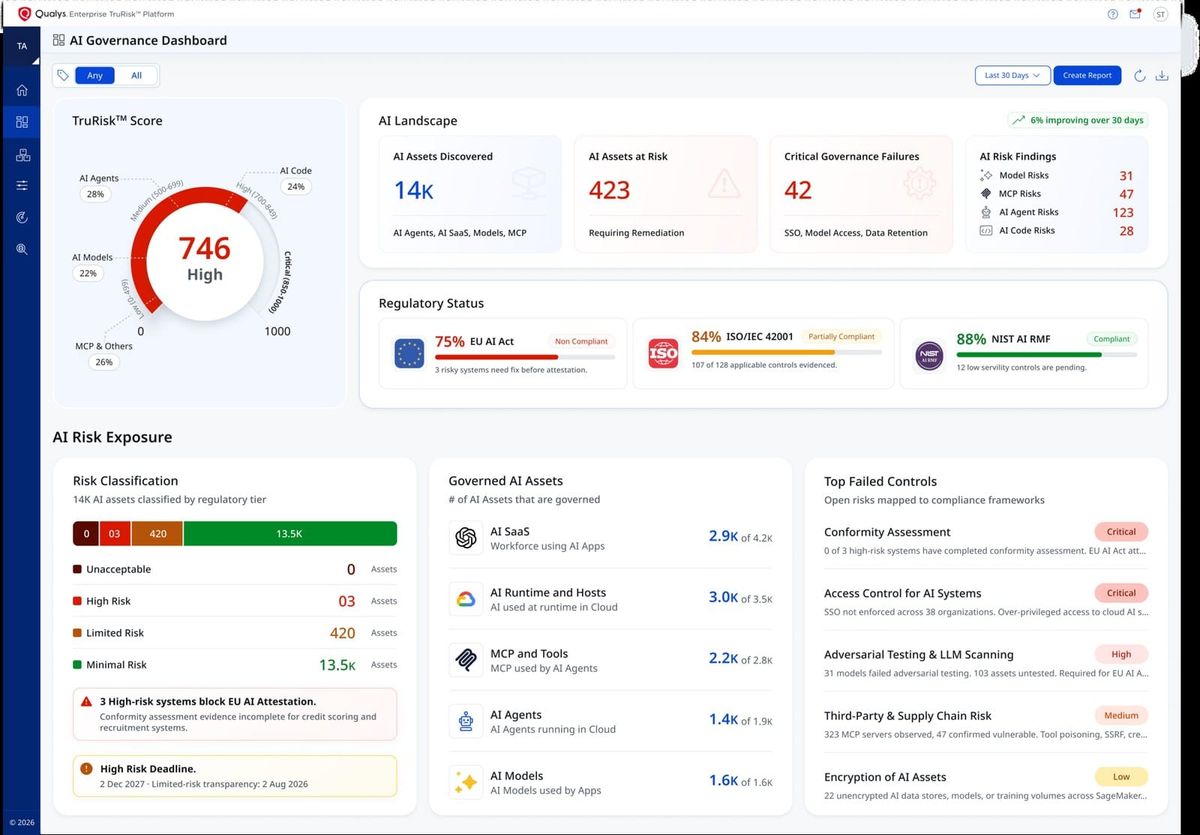
- Both renamed their lineups. Tenable's platform now sells as Tenable One Foundation and Tenable One Advanced. Qualys runs on the Enterprise TruRisk Platform (VMDR, TotalCloud, TotalAI).
- Qualys is ahead on AI model security. TotalAI red-teams LLMs and MCP servers against the OWASP LLM and MCP Top 10. Tenable One AI Exposure governs AI usage and supports only ChatGPT Enterprise and the Microsoft Copilot family.
- Verdict: Tenable under ~5,000 assets, or if you want to buy without a sales call. Qualys for large regulated estates that want scan-to-patch in one license.
Pick Tenable if you want the broadest raw scan coverage, published entry pricing, and strong OT and identity exposure. Pick Qualys if you need one agent covering scanning, patching and compliance in a single license, plus deeper AI model testing. Tenable publishes prices; Qualys does not. Neither leads on every dimension.
Why every page ranking for this question is selling you something
Search tenable vs qualys and page one has no neutral editorial result.
Four of the ten results are the two vendors themselves — Qualys twice, including a page built purely to convert Tenable customers, and Tenable once. Two more are review aggregators that collect scores and deliberately decline to conclude. Two others are competing security vendors with their own product to pitch. One is a thin aggregator. One is a Reddit thread.
That is the gap. Every page currently answering this query was published by someone with money riding on the answer.
Neutrality is the one thing a publisher can offer that a vendor structurally cannot. So here is a verdict, with the sourcing to check it.
What are the current product names?
Both vendors renamed their lineups, and most ranking pages still use the older names. If a comparison you are reading says "Tenable.io," it predates the current catalogue by years.
| What you're buying | Tenable (current name) | Qualys (current name) |
|---|---|---|
| Platform | Tenable One — Foundation or Advanced | Enterprise TruRisk Platform |
| Core VM | Tenable One Vulnerability Management | VMDR |
| On-prem console | Tenable Security Center | Qualys on-prem / private cloud |
| Standalone scanner | Nessus Professional / Expert | — |
| Cloud security | Tenable Cloud Security / CNAPP | TotalCloud |
| AI security | Tenable One AI Exposure | TotalAI |
Tenable went further than a rename. Its Tenable One pricing page now sells exactly two packages — Foundation for unified visibility and Advanced for attack path analysis and risk scoring — with CNAPP, AI governance and identity security sold as add-ons on top. Both packages are quote-only.
Tenable vs Qualys: the differences that matter
| Dimension | Tenable | Qualys |
|---|---|---|
| Heritage | Nessus scanner, since 1998 | SaaS scanning, founded 1999 |
| Published pricing | Yes — card checkout at 100 assets | No |
| Entry point | Nessus Pro, $4,790/yr, unlimited assessments | 30-day VMDR trial, then quote |
| Patching | Tenable Patch Management (separate product) | Bundled in the VMDR motion |
| OT/ICS | Strong — dedicated OT Security product | Available, less emphasised |
| Identity | Identity Exposure for AD and Entra ID (add-on) | Via platform modules |
| AI security posture | Governs AI usage | Tests AI models |
| Scale claim | Not stated on product pages | 10,000+ subscription customers |
The structural difference is this. Qualys sells a single agent and one platform where scanning, patching and compliance share a license and a risk score. Tenable sells best-of-breed depth per domain, assembled into Tenable One.
That maps cleanly onto team shape. One platform team that owns everything tends to prefer Qualys. Separate vulnerability, cloud and OT teams tend to prefer Tenable. Our 2026 vulnerability management tools roundup covers where the rest of the field lands.
What does each one actually cost?
Tenable publishes real numbers. Qualys publishes none.
| Product | Published price |
|---|---|
| Tenable One Vulnerability Management, 100 assets | $3,500 / 1 yr |
| Same, 3 years | $9,975 |
| Tenable One Web App Scanning, 5 FQDNs | $3,578 / 1 yr |
| Nessus Professional | $4,790 / 1 yr |
| Nessus Expert | $6,790 / 1 yr |
| Nessus Advanced Support | +$400 |
| Tenable One Foundation / Advanced | Not published — quote only |
| Qualys VMDR, TotalCloud, TotalAI | Not published |
Those Tenable figures come straight off Tenable's Nessus Professional page, which carries the full buy widget. Third-party sites quote per-asset Qualys ranges; none of it is vendor-published, so treat it as hearsay in a negotiation.
Practical read: Tenable is the only one of the two you can evaluate and buy without talking to sales. Above a few thousand assets both go to quote, and the published number stops being the relevant number.
Which one is better for AI security?
Qualys, clearly, if you mean securing AI models. Tenable, if you mean governing how staff use AI tools. They solved different halves of the problem.
Qualys TotalAI discovers shadow AI, cloud AI services, AI agents, models, MCP servers, AI containers and browser-based AI. It uses eBPF kernel-level instrumentation to see what AI workloads actually execute. It red-teams LLMs for prompt injection and jailbreaks, and MCP servers for tool poisoning, SSRF and rug-pull attacks, mapped to the OWASP LLM and MCP Top 10 and the EU AI Act. Qualys announced those governance capabilities on 29 July 2026.
The groundwork landed earlier. On 29 April 2025, Qualys expanded TotalAI to detect 40 different attack scenarios, added multimodal detection for payloads hidden in images, audio and video, and shipped an internal LLM scanner for on-premises testing.
Tenable One AI Exposure is narrower by design. It tracks who uses AI, for what, and with what data; flags AI misconfigurations; and detects prompt injection against the platforms it covers. Per Tenable's own FAQ, that list is OpenAI ChatGPT Enterprise, Microsoft Copilot, 365 Copilot and Studio Copilot. Free ChatGPT is explicitly unsupported.
So if you are shipping models or running MCP servers, Qualys tests the thing you built. If you are worried about staff pasting source code into Copilot, Tenable watches that. If your AI risk is mostly cloud-shaped, check our CNAPP platform comparison too.
How do Rapid7, Tenable and Qualys compare?
All three abandoned "vulnerability management" as the product and sell exposure management instead. Rapid7 made the sharpest break: InsightVM is now part of Exposure Command, sold as Exposure Command Essentials (InsightVM plus attack surface management) or Exposure Command Ultimate (adds cloud and application security). Rapid7's own framing: "Same scanner. Wider context."
Rapid7 wins when you want vulnerability data in the same console as SIEM and MDR. On our reading of the three product catalogues, it is the weakest of the three on OT and on AI model testing. Pick it for consolidation of detection and response, not for scan depth.
If endpoint coverage is the real question behind your search, CrowdStrike vs SentinelOne is the comparison you want instead.
What this means for you
If you run under 500 assets or you're a consultant: Nessus Professional at $4,790/year with unlimited assessments. Nothing else here is close on cost per scan.
If you're a platform team at 500–5,000 assets: Tenable One Vulnerability Management. $3,500 for 100 assets, buyable today, scales up without re-platforming.
If you're a regulated enterprise above 10,000 assets: Qualys. One agent, one license covering scanning, patching and compliance reporting, and the better audit story. Budget for a procurement cycle — there is no price to check.
If you ship AI products or run MCP servers: Qualys TotalAI. It is the only one of the two that adversarially tests models and MCP servers.
If you have significant OT or Active Directory risk: Tenable. Dedicated OT Security and Identity Exposure products, with deeper coverage than Qualys markets.
If you already own a Rapid7 SIEM: Exposure Command Essentials, and stop shopping.
Frequently Asked Questions
Is Tenable better than Qualys?
Not universally. Tenable is better for scan breadth, OT and identity exposure, and it publishes prices you can buy at. Qualys is better for single-agent consolidation, bundled patching and compliance, and AI model testing. For most teams under 5,000 assets, Tenable is the faster, cheaper start.
What is the difference between Tenable and Qualys?
Tenable grew from the Nessus scanner and sells best-of-breed depth per domain, assembled under Tenable One Foundation or Advanced. Qualys grew as cloud-native SaaS and sells one agent on the Enterprise TruRisk Platform, where scanning, patching and compliance share a license and a single TruRisk score.
Is Nessus the same as Tenable?
No. Nessus is Tenable's standalone vulnerability scanner, sold as Nessus Professional at $4,790/year or Nessus Expert at $6,790/year. Tenable is the company and the broader Tenable One platform. Nessus provides the scan engine; Tenable One adds prioritisation, cloud, OT, identity and AI exposure on top.
Which is more expensive, Tenable or Qualys?
Unanswerable from public data, because Qualys publishes no list price. Tenable publishes $3,500/year for 100 assets. Any Qualys figure you find online is a third-party estimate, not vendor-published. At enterprise scale both are negotiated, and the discount matters far more than list.
Which handles AI security better?
Qualys TotalAI, for securing AI you build — it red-teams LLMs and MCP servers against the OWASP LLM and MCP Top 10 and covers 40 attack scenarios. Tenable One AI Exposure is for governing AI your staff use, limited to ChatGPT Enterprise and the Microsoft Copilot family.
Editor's note — sources: Pricing and product-name claims verified against Tenable's Nessus Professional page and Tenable One pricing page on 5 October 2026; AI capability claims against Tenable One AI Exposure, the Qualys TotalAI governance release (29 July 2026) and the April 2025 TotalAI expansion release; Rapid7 positioning against the InsightVM product page. Qualys publishes no list price for VMDR, TotalCloud or TotalAI; we state that rather than reproducing third-party estimates. The assessment of Rapid7's relative OT and AI-model coverage is Edgewisely's reading of the three vendors' published catalogues, not a vendor claim.