
Top 7 Identity and Access Management (IAM) Solutions in 2026
Seven IAM solutions ranked on coverage, deployment and published pricing - plus what each one leaves out. Palo Alto closed the CyberArk deal, SailPoint is public again, and everyone shipped agent identity.


Who this is for: security and IT leaders picking an identity and access management platform in 2026. What changed: Palo Alto Networks closed its CyberArk acquisition in February and rebranded the portfolio Idira, SailPoint is public again, and every vendor on this list shipped an AI-agent identity product in the last 18 months.
- Widest coverage: Microsoft Entra ID — but no real privileged access management, and eight-plus separately priced SKUs.
- Most transparent pricing: JumpCloud publishes 20 à la carte line items. Least: SailPoint's own pricing URL returns a 404.
- Nobody covers all five categories well. Workforce SSO, customer identity, governance, privileged access and machine identity still means two vendors for most buyers.
- Entry list price ranges from $3/user/month (Ping, behind a 5,000-seat minimum) to $20,000+/year floors with no published per-seat rate at all.
Identity and access management is the set of tools that decide who — or what — can reach which systems. In 2026 the leaders are Microsoft Entra ID and Okta for authentication, Palo Alto Networks' Idira (formerly CyberArk) for privileged access, and SailPoint and Saviynt for governance. The split matters: governance vendors are not identity providers, and identity providers are weak at privileged access. Most enterprises buy two.
Below: seven IAM solutions ranked, with published pricing where it exists and the gaps each one leaves.
How we picked these
Four criteria, applied in this order:
- Breadth of the identity control plane. How many of the five real categories a product covers: workforce SSO/MFA, customer identity (CIAM), identity governance (IGA), privileged access (PAM), and machine plus AI-agent identity.
- Deployment honesty. SaaS-only, self-hostable, or genuinely hybrid — and whether the self-hosted product is the same product.
- Pricing transparency. Whether a buyer can model cost without a sales call. This separates the field sharply.
- Machine and agent identity. Machine identities now outnumber human ones by a wide margin, and every vendor here shipped agent identity tooling between March 2025 and September 2026.
Ranking is by breadth and maturity, not by revenue. All pricing and feature claims are as of September 2026.
Quick comparison
| Solution | Best for | Deployment | Published pricing |
|---|---|---|---|
| Microsoft Entra ID | Organizations already on Microsoft 365 | SaaS + hybrid to on-prem AD | Yes — $7–$12/user/mo |
| Okta | Largest independent identity provider | SaaS only | Yes — $6–$17/user/mo |
| Idira (Palo Alto Networks) | Privileged and machine identity depth | SaaS and hybrid | No |
| SailPoint | Enterprise identity governance | SaaS and self-hosted | No |
| Saviynt | ERP and cross-application access governance | SaaS | No |
| Ping Identity | Identity orchestration, self-managed federation | SaaS, self-managed, hybrid | Yes — $3–$6/user/mo |
| JumpCloud | SMB and mid-market identity plus devices | SaaS | Yes — $9–$13/user/mo |
1. Microsoft Entra ID
Microsoft renamed Azure Active Directory to Entra ID and has since built out the widest portfolio on this list. Entra ID handles workforce SSO and MFA. Entra External ID covers customer and partner identity. Entra ID Governance adds access reviews and lifecycle workflows as a separate SKU that requires P1 or P2 underneath. Entra Workload ID covers service principals and managed identities, priced per workload identity rather than per user.
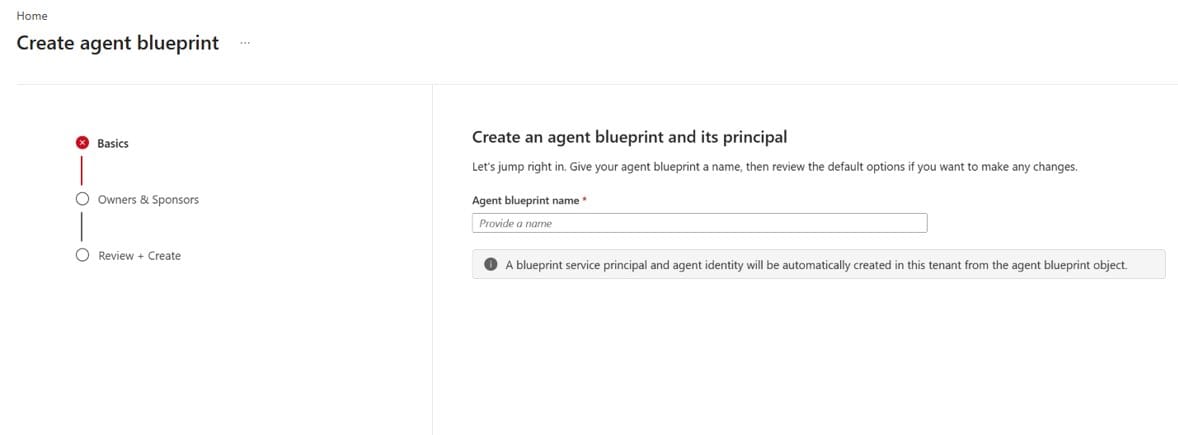
The notable 2026 addition is Entra Agent ID, which extends identity lifecycle, Conditional Access and access packages to AI agents. Microsoft's documentation covers agent identity blueprints, a sidecar auth SDK, sponsor-based lifecycle workflows and Conditional Access templates for autonomous and on-behalf-of agents. Parts of it are still marked Preview in Microsoft's own docs.
What Entra does not do is privileged access management. Privileged Identity Management elevates Entra and Azure roles; there is no credential vault, no session recording and no secrets management.
Best for: Any organization already paying for Microsoft 365 E3 or E5, where Entra P1 or P2 is the cheapest competent option on the market.
Pros
- Published per-user pricing across the whole range: Entra ID P1 at $7.00/user/month, P2 at $10.00, Entra Suite at $12.00, ID Governance at $7.00, on annual commitment.
- Covers four of five categories — workforce, CIAM, governance and machine/agent identity — from one vendor.
- External ID is free for the first 50,000 monthly active users, which undercuts every dedicated CIAM product at small scale.
- Hybrid path to on-premises Active Directory via Entra Connect is mature and well documented.
Cons
- No true PAM. Buyers need Idira, Delinea or BeyondTrust alongside it.
- Microsoft retires SKUs. Entra Permissions Management reached end of sale in April 2025 and customers were auto-offboarded on 1 November 2025, pointed at Defender CSPM or third parties instead.
- Licensing is genuinely complicated: eight-plus separately priced SKUs, Governance gated behind P1/P2, and Entra Suite bundling network products (Private Access, Internet Access) that most identity buyers do not want.
- Entra Agent ID has no published price — it does not appear on the pricing page at all.
- Economics only work if you are already a Microsoft shop; standalone, the bundle logic disappears.
2. Okta
Okta is the largest identity vendor that does not also sell you an operating system. It runs two distinct customer identity platforms — Okta Customer Identity and Auth0, acquired in an all-stock deal worth roughly $6.5 billion that completed in May 2021 and still ships as a separate product. Okta Identity Governance covers access certification and lifecycle management. Okta Privileged Access exists but is licensed in opaque "Resource Units" rather than seats.
Okta has been the loudest vendor on agent identity. It introduced the Cross App Access protocol in June 2025, shipped Okta for AI Agents, and in September 2026 announced the Blueprint Alliance with AWS, Google Cloud, CrowdStrike, Salesforce and ServiceNow — twelve vendors backing an open reference architecture for agent governance.
Best for: Enterprises that want a vendor-neutral identity provider covering workforce and customer identity without committing to Microsoft's stack.
Pros
- Broadest standalone coverage: workforce, CIAM (two products), governance, some PAM and machine identity.
- Published entry pricing — Workforce Starter at $6/user/month, Core Essentials at $14, Essentials at $17, billed annually.
- Auth0 remains a genuinely strong developer-facing CIAM platform, distinct from the workforce product.
- Convenes the broadest cross-vendor agent-identity effort in the category.
Cons
- Two support-system breaches on the public record. In January 2022 a Lapsus$ actor reached a support engineer's laptop at subcontractor Sitel over a five-day window. In October 2023, an actor had access to Okta's support case management system from 28 September to 17 October, affecting 134 customers; some files were HAR files containing session tokens, and sessions were hijacked at five customers. 1Password, BeyondTrust and Cloudflare disclosed being targeted.
- Add-on sprawl. On Starter, Adaptive MFA, Device Access, API Access Management, Access Gateway, Privileged Access and Lifecycle Management are all add-ons. Identity Governance is unavailable below Essentials.
- PAM licensing is opaque — Resource Units, not seats, with Essentials including "2 Privileged Access admins."
- Suites force a unified license count across included products, so you cannot buy governance for a subset of users.
- Customer Identity starts at a $3,000/month platform floor before usage add-ons, and Workforce carries a $1,500 annual contract minimum.
- Bundled support is 24 hours a day, five days a week; 24/7 requires a paid Premier plan.
3. Idira — formerly CyberArk
This is the entry that changed most this year. Palo Alto Networks completed its acquisition of CyberArk on 11 February 2026, paying CyberArk shareholders $45.00 in cash plus 2.2005 PANW shares per share against a deal announced the previous July at roughly $25 billion in equity value. The portfolio now sits under the Idira brand on Palo Alto's site, and the company has said it intends a secondary Tel Aviv listing using CyberArk's old CYBR ticker.
The product substance is unchanged and remains the deepest privileged-access stack available: Privileged Access Manager, Endpoint Privilege Manager, Vendor Privileged Access, plus a strong machine-identity line covering secrets management, unified secrets governance, application credentials delivery and certificate management. Idira Agentic Identities extends the same controls to AI agents. Palo Alto says CyberArk's solutions "will continue to be available as a standalone platform."
Best for: Regulated enterprises where privileged access, secrets and machine identity are the primary risk — and buyers already standardized on Palo Alto.
Pros
- The most complete privileged access and secrets management portfolio in the category, spanning human, machine and agent identity.
- Machine identity is a first-class product line, not an afterthought bolted onto a workforce IdP.
- Covers IGA and workforce IAM alongside PAM, so it is not a single-purpose tool.
- Acquisition puts it inside a platform with network security and SecOps, which matters if you already run Strata or Cortex.
Cons
- A twenty-year-old enterprise brand was renamed mid-2026. Docs, runbooks, certifications, integration guides and support URLs all move, and Palo Alto's own language defers cross-platform benefits to "over time."
- Zero pricing transparency. No per-user figure is published anywhere; every call to action is a demo request.
- No CIAM product at all — not a candidate if you need consumer identity.
- Deep platform lock-in is the stated strategy, not a side effect: the roadmap is integration into Palo Alto's broader ecosystem.
- PAM deployments carry heavy implementation lift — vault architecture, session brokering, account discovery, refactoring application credentials.

4. SailPoint
SailPoint is the reference point for enterprise identity governance and does essentially nothing else. Identity Security Cloud is the SaaS product; IdentityIQ is the on-premises one. Around them sit Non-Employee Risk Management, Access Risk Management, cloud entitlement management and a large connector library.
It went private with Thoma Bravo in 2022 and returned to public markets in February 2025, pricing an upsized IPO at $23.00 per share across 60 million shares to raise $1.38 billion, and began trading on Nasdaq as SAIL on 13 February 2025. On agents, Harbor Pilot shipped in March 2025 and Agentic Fabric launched on 11 May 2026.
Best for: Large enterprises running a formal governance program — access certification campaigns, separation-of-duties rules, audit evidence — on top of an identity provider they already have.
Pros
- The deepest governance feature set in the category, with the largest connector ecosystem for application onboarding.
- Genuinely offers both SaaS and self-hosted, which few competitors here do.
- Public company since February 2025, so financials, retention and R&D spend are disclosed quarterly.
- Agentic Fabric extends certification and lifecycle to AI agent identities.
Cons
- Not an identity provider. No SSO, no MFA, no CIAM, no privileged access vault. SailPoint presupposes Entra, Okta or Ping underneath, which is a real second-vendor cost.
- No published pricing at all — the sailpoint.com/pricing URL returns a 404.
- Two different products under one name. Moving from IdentityIQ to Identity Security Cloud is a migration project, not an upgrade; SailPoint publishes marketing encouraging it.
- Governance programs are long and consulting-heavy: role mining, SoD ruleset design, application onboarding and campaign design typically run for quarters.
- Newly public with concentrated private-equity governance; the IPO prospectus itself flagged Thoma Bravo advisory fees among the uses of proceeds.
5. Saviynt
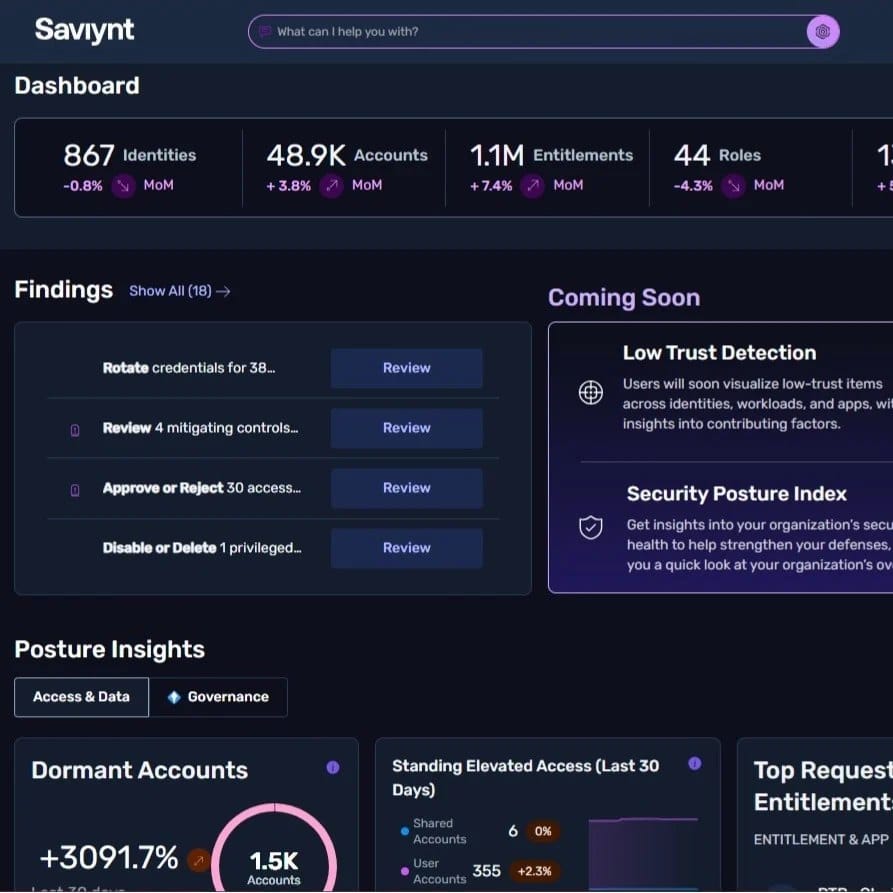
Saviynt competes with SailPoint on governance but differentiates on depth inside applications. Its Application Access Governance module does permission-level control and cross-application separation of duties, which makes it the usual answer for SAP and other ERP estates where entitlement risk lives inside the application rather than at the directory. Around that sit converged PAM, Identity Security Posture Management, external identity management for contractors and partners, a dedicated non-human identity product, and an MCP server.
The company raised $700 million in December 2025 at approximately a $3 billion valuation, led by funds managed by KKR with Sixth Street Growth, TenEleven and existing investor Carrick Capital. Saviynt states more than 600 enterprise customers, including over 20% of the Fortune 100. Its agent-identity platform is branded Zuma.
Best for: Enterprises whose access risk sits inside ERP and business applications, where fine-grained SoD matters more than directory-level governance.
Pros
- Cross-application SoD at permission level is a real differentiator over directory-centric governance tools.
- Converges IGA, PAM, ISPM and non-human identity in one platform rather than as separate purchases.
- Well capitalized after a $700M round, with KKR, Sixth Street and Carrick on the cap table.
- Ships an MCP server and dedicated non-human identity product, so agent and service identity are addressed directly.
Cons
- Zero pricing transparency. Three named tiers — Essentials, Pro, Premium — with feature lists and no dollar figures.
- Not an identity provider, and no CIAM. Like SailPoint, it needs Entra, Okta or Ping underneath. "External Identity Management" covers partners and contractors, not consumer scale.
- Very heavy implementation lift. The platform's strength — cross-app SoD, permission-level governance, ERP modernization — is precisely the work that takes quarters and leans on systems integrators.
- PAM and ISPM are newer entrants competing against Idira, Delinea and BeyondTrust on their home turf; Saviynt's own December 2025 release describes them as recently added.
- No public financials, so revenue and retention figures circulate only as third-party estimates.
6. Ping Identity
Ping Identity is the most deployment-flexible option here and the strongest on identity orchestration — building authentication journeys as no-code flows rather than configuration. PingOne covers workforce and customer identity; PingFederate, PingAccess and PingDirectory remain self-managed software you run yourself; PingOne Advanced Services is the hybrid middle. PingOne Verify, Protect and Authorize add identity verification, risk signals and dynamic authorization.
Thoma Bravo took Ping private in 2022, then acquired ForgeRock for roughly $2.3 billion and combined it into Ping in August 2023. Its agent product, Identity for AI, reached general availability at the end of March 2026 with three components: Agent IAM Core, Agent Gateway and Agent Detection.
Best for: Complex authentication requirements — B2B federation, self-managed deployments, orchestrated multi-step journeys — at organizations large enough to clear the seat minimum.
Pros
- Genuinely all three deployment models: SaaS, self-managed software, and a managed hybrid tier. Few competitors offer real self-managed federation.
- Identity orchestration is a meaningful differentiator for multi-step and conditional authentication flows.
- Lowest published per-seat list price in this list: $3/user/month for Workforce Essential, $6 for Workforce Plus.
- Strong CIAM alongside a distinct B2B motion, plus verification and fraud signals in the same platform.
Cons
- A 5,000-user minimum applies to that per-seat pricing. At $3/user/month that is roughly a $180,000 annual floor — SMB and most mid-market buyers are out of scope at list price.
- CIAM is priced only as an annual floor — from $35,000 for Essential, $50,000 for Plus — with no per-MAU transparency, so you cannot model growth.
- Merged-codebase overhang. Ping and ForgeRock were direct competitors; three years on there is still functional overlap and unresolved migration questions for former ForgeRock customers.
- Governance is the weak spot. No certification and attestation product comparable to SailPoint or Saviynt.
- Private equity-owned, so no public financials. Self-managed products carry conventional on-premises upgrade burden.

7. JumpCloud
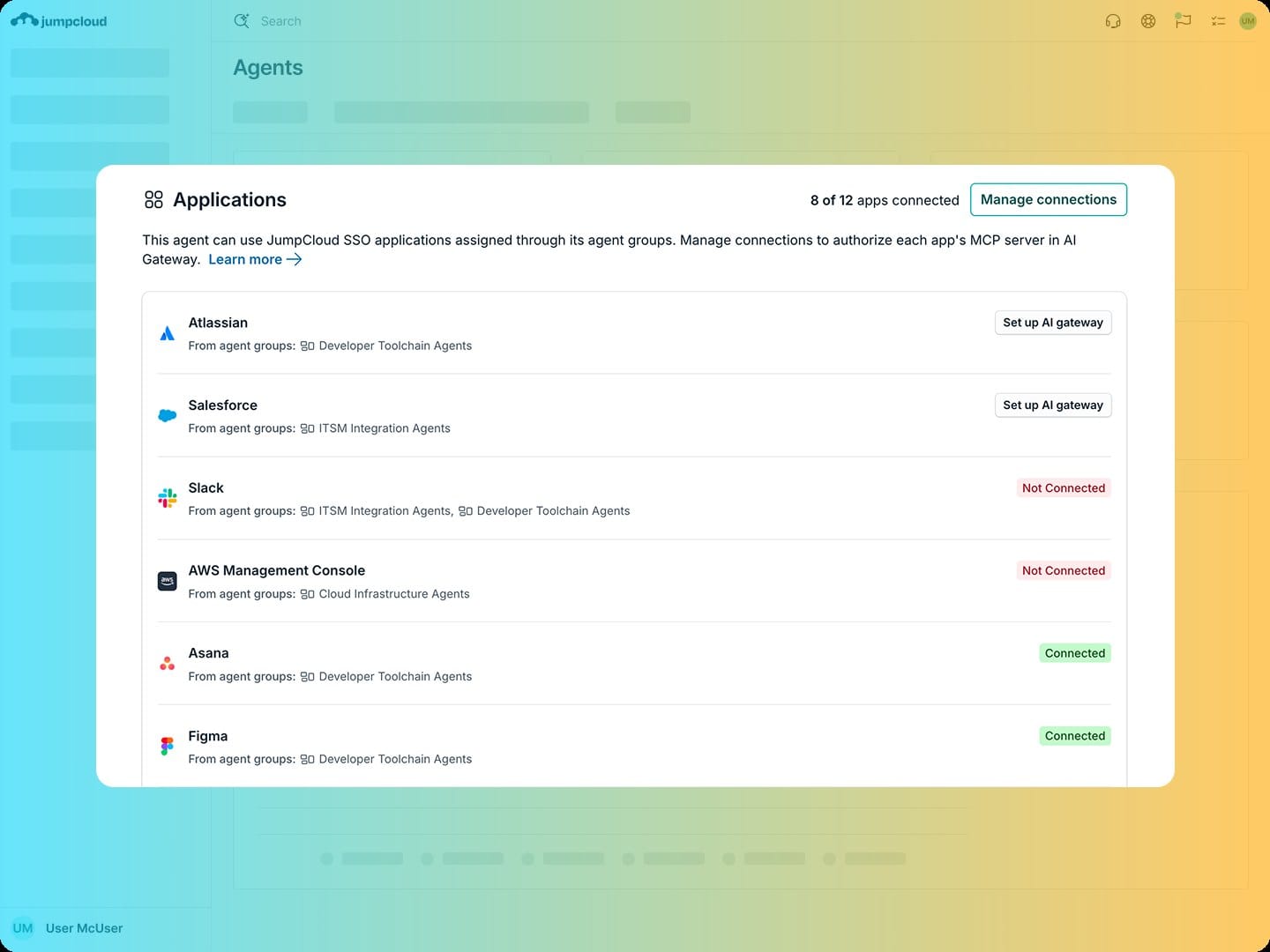
JumpCloud is the outlier: an identity platform that takes device management equally seriously, aimed at organizations replacing on-premises Active Directory without buying into Microsoft's licensing. The cloud directory is the core, with SSO, MFA, passwordless via JumpCloud Go, Cloud LDAP, Cloud RADIUS and conditional access around it — and Apple MDM, Windows, Linux, Android EMM, patch management and asset management alongside.
It also publishes more pricing detail than anyone else here: three fixed packages plus roughly twenty à la carte line items at $3–$5 per user per month each. The company raised a $225 million Series F led by Sapphire Ventures, closing in October 2021 at a $2.625 billion valuation, and stated more than 120,000 organizations and 5,000 paying customers at the time. Agentic IAM Lifecycle Management is now in the platform.
Best for: SMB and mid-market teams that want identity and device management from one vendor, with a price they can calculate before talking to sales.
Pros
- The most transparent pricing in the category. Packages at $9, $11 and $13 per user per month on annual billing, plus about twenty individually priced modules.
- Identity plus device management from one console is a real operational saving for small IT teams.
- Free tier for small user counts and a 30-day trial, with no sales call required to start.
- Genuine Active Directory replacement path, including Cloud LDAP and Cloud RADIUS for legacy applications.
Cons
- Hard 300-user ceiling on Platform Essentials, stated on the pricing page — an awkward wall mid-growth.
- Transparency stops where the newer features start. Agentic IAM, zero trust, SaaS management, PAM and premium support all sit in the three quote-only tiers.
- Suspended users are still billed. JumpCloud's FAQ states suspended users "are billed as normal users" — a commonly missed cost.
- No CIAM and no certification-grade governance. Access requests and lifecycle management exist; certification campaigns do not.
- À la carte pricing invites sprawl; a full identity-plus-device build from line items passes the package prices quickly. Monthly billing runs materially above annual on every SKU.
How to choose
If you already pay for Microsoft 365 E3 or E5: start with Entra ID P1 or P2 and only look elsewhere for what it genuinely lacks — which is privileged access. Buying a separate IdP on top of a licence you already own is hard to justify.
If you want vendor neutrality: Okta, with eyes open about add-on SKUs. Price the full configuration including Adaptive MFA and Lifecycle Management before comparing to Entra, not the Starter number.
If privileged access or secrets sprawl is the actual risk: Idira, formerly CyberArk. Expect a real implementation project and no published price. Pair it with Entra or Okta for workforce authentication.
If auditors are the forcing function: SailPoint for directory-centric governance, Saviynt if the risk lives inside SAP or other business applications. Neither is an identity provider, so budget for two vendors.
If you need self-managed federation or complex journeys: Ping Identity — provided you have 5,000 seats. Below that, its list pricing does not apply to you.
If you are under 300 employees and replacing Active Directory: JumpCloud, and check the Platform Essentials seat cap against your hiring plan before signing.
On AI agents: every vendor here shipped something between March 2025 and September 2026. Almost none of it is priced publicly, and several components are still in preview. Treat agent identity as a roadmap conversation, not a shipping differentiator, and ask for the SKU and the rate in writing.
Adjacent reading: our top 7 SIEM tools covers where identity telemetry lands, CNAPP platforms covers cloud entitlement risk, and AI guardrails and LLM security platforms covers the policy layer for agents once they have identities.
Frequently Asked Questions
What is identity and access management?
Identity and access management is the discipline and tooling that controls which users, services and AI agents can access which systems, and what they can do there. It covers authentication (proving identity), authorization (granting permissions), lifecycle management (joiners, movers, leavers) and audit evidence for compliance.
What is the difference between identity management and access management?
Identity management handles the identity record itself — creating accounts, maintaining attributes, deprovisioning on departure. Access management decides what that identity may reach, enforcing authentication and authorization at the point of use. Most commercial platforms bundle both, but governance tools like SailPoint focus on the identity side and identity providers on the access side.
Why is identity and access management important?
Credential abuse and excessive privilege are now the dominant enterprise attack paths, and machine identities substantially outnumber human ones in most estates. IAM reduces standing privilege, limits lateral movement after a compromise, and produces the access evidence auditors require under frameworks like SOC 2, ISO 27001 and SOX.
What is customer identity and access management?
Customer identity and access management, or CIAM, handles identity for external consumers rather than employees — registration, social login, consent, and scale into millions of monthly active users. Microsoft Entra External ID, Okta Customer Identity and Auth0, and PingOne for Customers are the main options here. SailPoint, Saviynt and JumpCloud do not offer CIAM.
Do IAM tools cover AI agent identity?
All seven vendors here shipped agent identity products between March 2025 and September 2026 — Microsoft Entra Agent ID, Okta for AI Agents, Ping's Identity for AI, SailPoint Agentic Fabric, Saviynt Zuma, Idira Agentic Identities and JumpCloud's Agentic IAM. Most are unpriced publicly and several components remain in preview.
Editor's note — sources: Microsoft Entra pricing and Permissions Management retirement notice; Okta pricing page and its 2023 support-system root cause analysis; Palo Alto Networks' CyberArk acquisition completion release and Idira product pages; SailPoint's IPO pricing release and Agentic Fabric announcement; Saviynt's December 2025 funding release; Ping Identity's platform pricing page and developer documentation, plus Thoma Bravo's ForgeRock release; JumpCloud's pricing page and Series F close. All pricing and feature claims verified as of September 2026.