
Top 7 Carbon Accounting Software Platforms for Corporate Emissions Reporting in 2026
Who this is for: sustainability, finance, and operations teams choosing software to measure Scope 1-3 emissions, and what's changed as CSRD and other disclosure rules push carbon accounting from spreadsheets into dedicated platforms.


Top 7 Carbon Accounting Software Platforms for Corporate Emissions Reporting in 2026
Who this is for: sustainability, finance, and operations teams choosing software to measure Scope 1–3 emissions, and what's changed as CSRD and other disclosure rules push carbon accounting from spreadsheets into dedicated platforms.
Carbon accounting software measures a company's Scope 1 (direct), Scope 2 (purchased energy), and Scope 3 (value chain) emissions, then turns that data into the reports regulators, investors, and customers increasingly demand. The category has consolidated around platforms with real independent recognition — Sweep topped the 2026 IDC MarketScape among 17 vendors, Watershed remains the best-known enterprise brand, and Persefoni offers a genuinely free entry tier that undercuts the industry's usual quote-only pricing. As of August 2026, these are the seven worth evaluating, ranked by enterprise maturity, independent recognition, and breadth of verified methodology.
How we picked these
We weighed four factors: independent third-party recognition (analyst reports like IDC MarketScape and Verdantix Green Quadrant, not vendor self-claims), methodology rigor (verified emission factors, third-party audits of the calculation engine), breadth across Scope 1–3 and adjacent ESG reporting, and company stability — several platforms in this space have recently been acquired or merged, which we treat as a real factor for buyers signing multi-year contracts.
Quick comparison
| Company | Best for | Deployment | Pricing model |
|---|---|---|---|
| Watershed | Large enterprises wanting an all-in-one sustainability platform | SaaS | Custom quote (not published) |
| Sweep | Enterprises wanting analyst-validated ESG + carbon in one platform | SaaS | Custom quote (not published) |
| Persefoni | Teams wanting to start free before committing budget | SaaS (free tier + paid) | Free (Pro) / custom quote (Advanced) |
| Normative | Enterprises with complex global supply chains and Scope 3 exposure | SaaS + dedicated climate expert | Custom quote (not published) |
| Sinai Technologies | Industrial and hard-to-abate sectors needing decarbonization financial modeling | SaaS | Custom quote (not published) |
| Plan A | European companies wanting TÜV-certified methodology with reduction roadmaps | SaaS | Custom quote (not published) |
| Greenly | SMBs and mid-market companies new to carbon accounting | SaaS | Custom quote (not published) |
1. Watershed
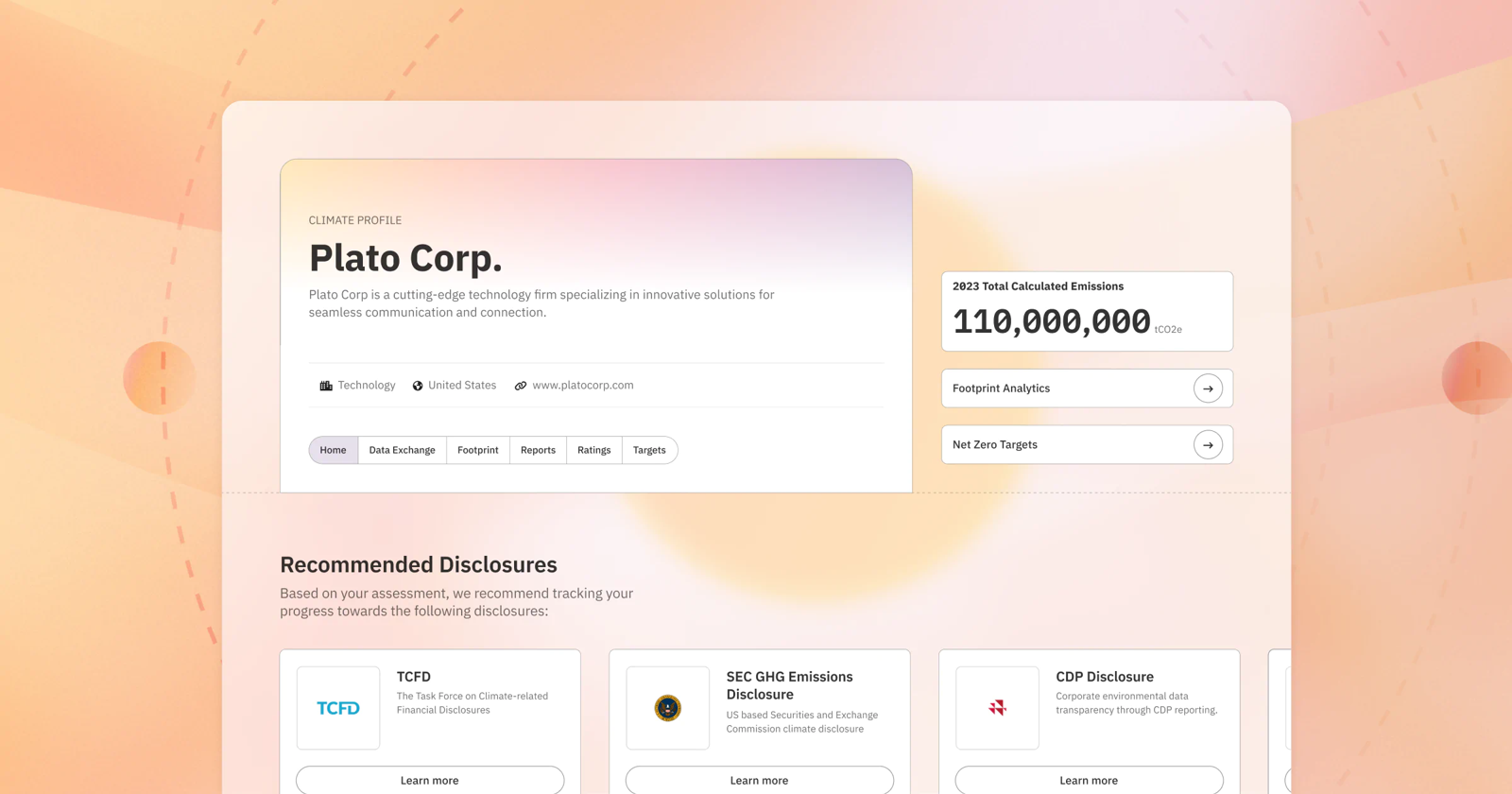
Watershed is a sustainability platform that combines carbon accounting with broader ESG data management, positioning itself as a "sustainability AI platform" for enterprise customers tracking emissions across multiple entities, subsidiaries, and integrated data sources. The company publishes its own thought-leadership guides on ESG software buying, reflecting a strategy built around being the default enterprise choice rather than the cheapest one. Watershed does not publish pricing; the platform runs on annual subscriptions, and third-party deal-intelligence sources estimate typical enterprise contracts fall between $50,000 and $250,000+ per year depending on the complexity of the customer's footprint, though Watershed itself discloses no figures publicly.
Best for: large enterprises that want a single sustainability platform rather than a narrower carbon-only tool.
Pros - Widely recognized as one of the category's best-known enterprise brands, reducing procurement risk for large buyers - Combines carbon accounting with broader ESG data management rather than emissions alone - Publishes its own detailed buyer's guides, suggesting deep familiarity with enterprise procurement needs - Built for multi-entity, multi-subsidiary organizations with complex data integration requirements
Cons - No published pricing anywhere — every deal is negotiated individually, and third-party estimates put contracts at $50,000–$250,000+ annually - That opacity makes it hard for smaller or mid-market buyers to self-qualify before engaging sales - Enterprise-first positioning means less obvious fit for smaller companies just starting Scope 1–2 measurement - Because pricing is fully custom, buyers need competitive quotes from rivals to negotiate effectively
2. Sweep
Sweep is a carbon and ESG management platform, founded in France with offices in London and, since 2026, Denver. It extends past pure carbon accounting into full ESG data management, including double-materiality assessment and impacts-risks-opportunities (IRO) tooling required under frameworks like CSRD, built around what the company describes as a small number of explainable AI agents working on a shared, validated data foundation. Sweep says its platform supports millions of rows of data with real-time validation, using a "load once, use everywhere" model so the same dataset feeds reporting, analysis, and decision-making. In 2026, Sweep was ranked highest among all 17 vendors shortlisted for both capabilities and strategy in the IDC MarketScape for Worldwide Carbon Accounting and Management Applications, and was also named a Leader in Verdantix's 2026 Green Quadrant for enterprise carbon management.
Best for: enterprises that want independently validated leadership in both carbon accounting and broader ESG reporting.
Pros - Ranked #1 of 17 vendors on both capabilities and strategy in the 2026 IDC MarketScape - Also named a Leader in Verdantix's 2026 Green Quadrant for enterprise carbon management - Goes beyond carbon into double-materiality and IRO assessment needed for CSRD compliance - Built to handle millions of rows of data with real-time validation, suited to large, messy datasets
Cons - Pricing is not published anywhere; prospective buyers must request a quote - North American presence is newer — the Denver office only opened in 2026, so US-based support and account management have less track record than in Europe - Heavy reliance on an "explainable AI agent" architecture is a relatively new approach compared to more established manual-review workflows at competitors - Broad ESG scope (beyond carbon) may be more platform than smaller companies focused purely on emissions need

3. Persefoni
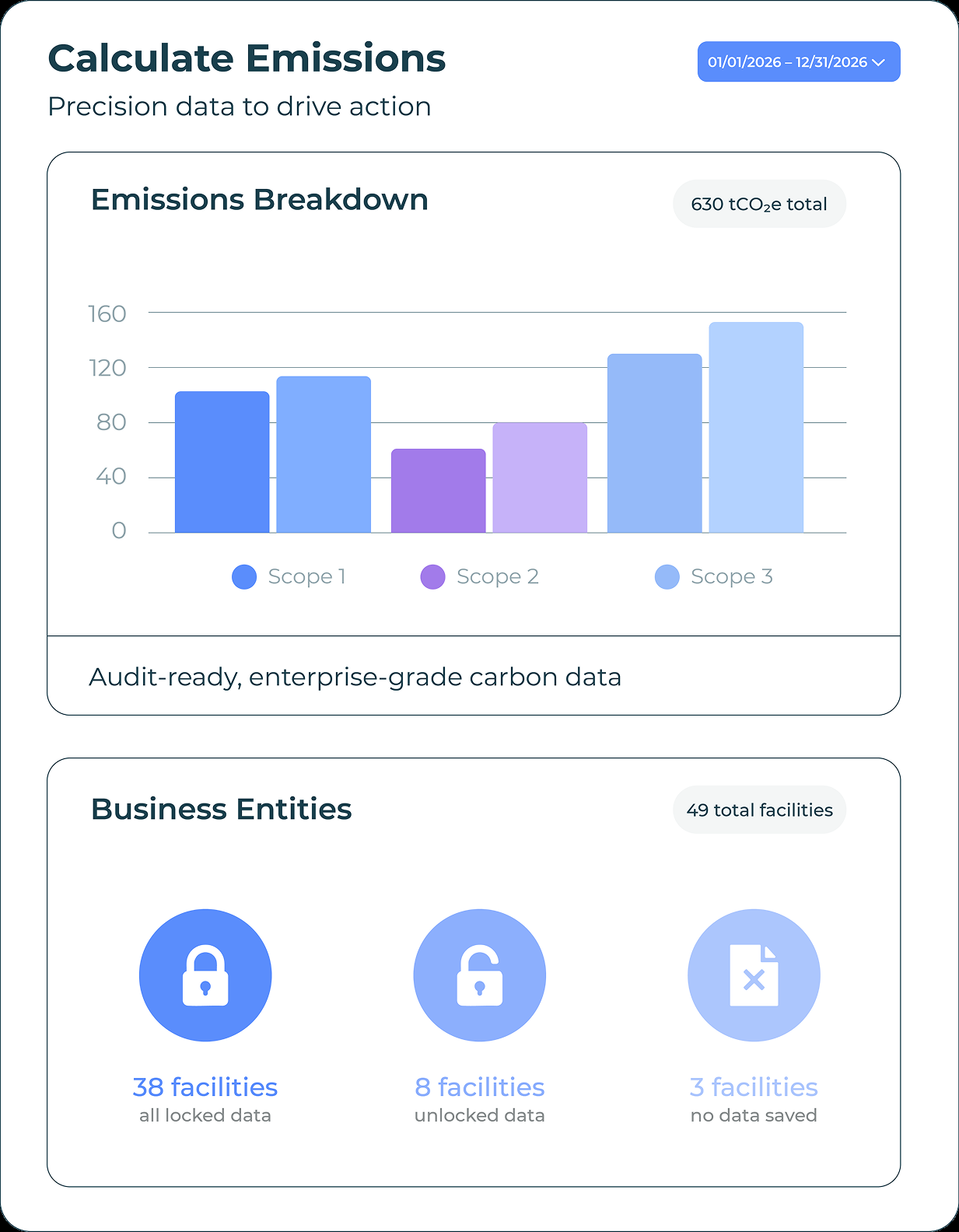
Persefoni splits its product into two tiers: a completely free Persefoni Pro plan for a single user, with unlimited assets and historical reporting years, and a quote-based Persefoni Advanced plan that adds multi-user roles, SSO/MFA, advanced analytics, and a dedicated customer success manager. Both tiers get ongoing methodology and emission-factor updates plus AI-powered automation features without additional add-on fees. In 2026, the company leaned further into AI automation for data ingestion, anomaly detection, and reporting — a push it says is meant to lower costs and improve turnaround for customers on both tiers.
Best for: teams that want to start measuring emissions immediately without a procurement cycle, then upgrade as needs grow.
Pros - Persefoni Pro is genuinely free with no seat limit on historical reporting years, unusual in a category dominated by quote-only pricing - No hidden add-on costs — methodology and emission-factor updates are included on both tiers - AI-powered automation features are available even on the free tier, not gated entirely behind Advanced - Straightforward two-tier structure is easier to understand than fully custom enterprise pricing
Cons - The free Pro tier is single-user, so any team collaboration requires upgrading to the quote-only Advanced plan - Advanced plan pricing is not published, so the cost of scaling beyond the free tier is unknown until you engage sales - SSO/MFA and advanced analytics — table stakes for many enterprise security reviews — sit behind the paid tier only - Heavier 2026 investment in AI automation means some newer features may still be maturing relative to established manual review processes elsewhere
4. Normative
Normative is one of the original science-based carbon accounting platforms, founded in Stockholm with offices in London and Copenhagen. It calculates Scope 1–3 emissions using a library of more than 300,000 emission factors independently evaluated by TÜV SÜD against ISO/IEC 25051 and the GHG Protocol, and automates data ingestion, emission-factor matching, and anomaly detection. In 2026 it launched a product carbon footprint (PCF) capability using AI-powered bill-of-materials ingestion, and every account is paired with a dedicated climate expert familiar with the customer's data and methodology. Its Carbon Network feature is built for supplier engagement and verified value-chain data collection.
Best for: enterprises with complex global supply chains where Scope 3 dominates the footprint and independent verification matters.
Pros - Emission-factor library independently evaluated by TÜV SÜD against ISO/IEC 25051 and the GHG Protocol - Every customer gets a dedicated climate expert, not just software access - Carbon Network feature is purpose-built for supplier engagement and Scope 3 data collection - 2026's AI-powered bill-of-materials ingestion extends the platform into product-level carbon footprints
Cons - No published pricing; the dedicated-climate-expert model suggests a higher-touch, higher-cost engagement than self-serve competitors - The white-glove, expert-paired approach can mean slower onboarding than a fully self-serve platform - Built primarily for enterprises with complex, global, Scope-3-heavy supply chains — likely more platform than a small company with a simple footprint needs - Nordic/European headquarters (Stockholm, London, Copenhagen) with less visible North American office presence than some US-headquartered competitors
5. Sinai Technologies
Sinai Technologies, founded in 2017, focuses on what it calls "decarbonization intelligence" for hard-to-abate industrial sectors — combining audit-grade Scope 1–3 accounting with internal carbon pricing and abatement-cost financial modeling in one platform, aimed at helping industrial clients quantify and prioritize decarbonization investments rather than just report emissions. The company was named a leader in Verdantix's Smart Innovators: Carbon Management Software report, and in February 2026 announced a partnership with Saudi Arabia's Regional Voluntary Carbon Market Company to launch what the companies describe as Saudi Arabia's first AI-enabled enterprise decarbonization platform.
Best for: industrial and hard-to-abate companies that need financial modeling for decarbonization investment decisions, not just emissions reporting.
Pros - Combines carbon accounting with internal-carbon-pricing and abatement-cost financial modeling, a narrower but genuinely differentiated capability - Named a leader in Verdantix's Smart Innovators: Carbon Management Software report - Track record specifically with industrial and hard-to-abate sector clients, where generalist platforms often lack depth - Recent government-scale partnership (Saudi Arabia's RVCMC, February 2026) signals credibility for large industrial and national-scale decarbonization programs
Cons - No published pricing; the platform's enterprise/government sales motion suggests a higher-touch, longer sales cycle than self-serve competitors - Narrower vertical focus (industrial, hard-to-abate) means less obvious fit for services, software, or retail companies with simpler footprints - Smaller brand recognition outside industrial sustainability circles compared to Watershed, Persefoni, or Sweep - Financial-modeling depth is a differentiator, but adds complexity for buyers who just need straightforward emissions reporting
6. Plan A
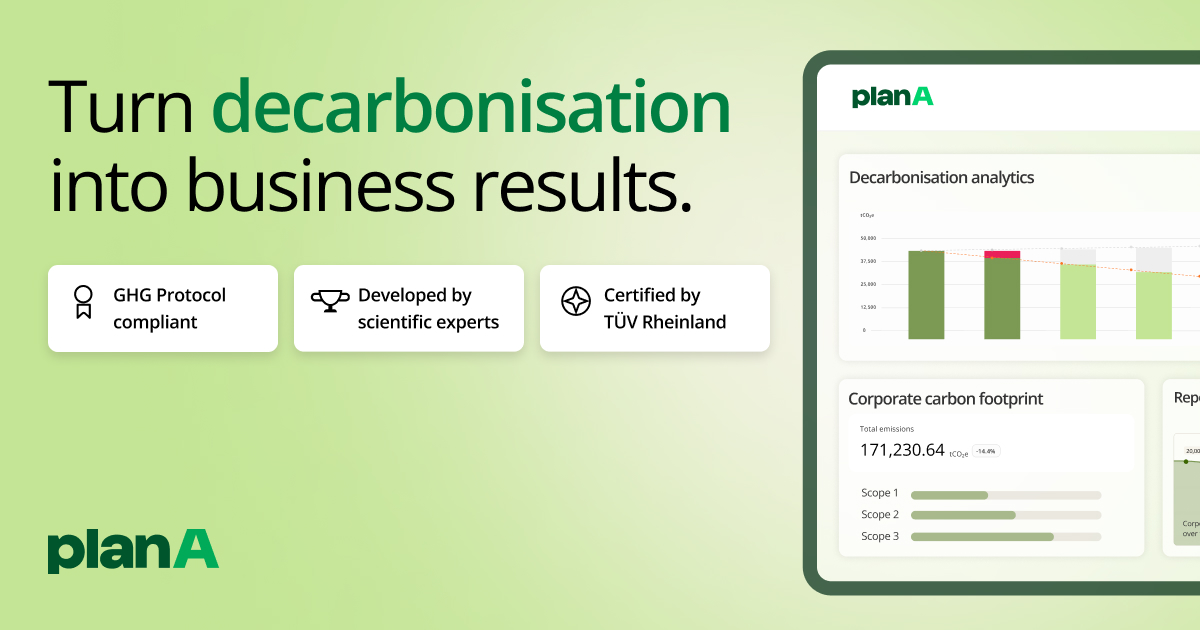
Plan A, founded in Berlin in 2017, combines carbon accounting with decarbonization planning — calculating both corporate and product carbon footprints, modeling reduction scenarios, and supporting compliance with German and EU regulations using TÜV-certified methodology. The platform has a strong European footprint with offices in Berlin, Munich, Paris, and London. On January 7, 2026, Plan A was acquired by Diginex, a broader ESG and sustainability technology company, folding Plan A's carbon-accounting engine into a larger platform.
Best for: European companies, especially in Germany, that want TÜV-certified methodology paired with actionable reduction roadmaps.
Pros - TÜV-certified methodology gives independent credibility to its emissions calculations - Focuses on reduction roadmaps and target-setting, not just disclosure, which some pure-accounting tools skip - Strong presence across Germany, France, and the UK, with regulatory support tailored to those markets - Combines corporate and product-level carbon footprint calculation in one platform
Cons - The January 2026 acquisition by Diginex introduces integration uncertainty — buyers should ask directly how Plan A's roadmap changes as part of a larger company - No published pricing - Primary strength and support depth is European (Germany, France, UK); North American buyers should confirm support coverage - As Plan A's product gets folded into Diginex's broader platform, its previously standalone feature set may shift over time
7. Greenly
Greenly, founded in Paris in 2019, targets SMBs and mid-market companies with Scope 1–3 emissions tracking, GHG assessment, life-cycle analysis, and broader ESG management, aiming for intuitive dashboards over deep enterprise configurability. Its EcoPilot AI copilot is built to walk non-expert sustainability managers through the full process — data collection, footprint calculation, reporting, and EcoVadis assessment submission — without requiring a dedicated climate-science hire. The company has also built CSRD-specific tooling for Wave 2 organizations under the EU's Directive (EU) 2026/470, ahead of first reporting in fiscal year 2027.
Best for: SMBs and mid-market companies doing carbon accounting for the first time without a dedicated sustainability team.
Pros - EcoPilot AI copilot is specifically designed for non-experts, lowering the skill bar to get started - Broad ESG coverage (GHG assessment, life-cycle analysis, ESG management) beyond carbon accounting alone - Purpose-built CSRD Wave 2 tooling ahead of FY2027 reporting deadlines - Positioned and priced for SMB/mid-market budgets rather than only large enterprise deals
Cons - No published pricing; buyers still need to request a quote despite the SMB-friendly positioning - Less depth for large multinational companies with complex, Scope-3-heavy global supply chains compared to Normative or Sinai - Heavier reliance on an AI copilot for non-experts may mean less of the audit-grade rigor that TÜV-verified competitors emphasize - Primarily European customer base and regulatory tooling (CSRD-specific features) may be less tailored for companies reporting under non-EU frameworks

How to choose
Large multinational enterprises with complex, multi-entity footprints and budget for a six-figure contract should start with Watershed or Sweep — both carry the strongest independent recognition, and Sweep additionally topped the 2026 IDC MarketScape outright. If you want to test the category before committing budget, Persefoni's free Pro tier is the only genuinely no-cost entry point among these seven. Companies with heavy Scope 3 exposure across global supply chains should prioritize Normative's TÜV-verified methodology and dedicated climate experts, while industrial and hard-to-abate sectors needing investment-grade financial modeling should look at Sinai Technologies. European companies, especially in Germany, get the most tailored regulatory fit from Plan A, though its recent acquisition by Diginex is worth asking about directly. SMBs and mid-market companies without a dedicated sustainability team will likely find Greenly's AI-guided workflow the fastest path to a first emissions inventory.
Frequently Asked Questions
What's the difference between carbon accounting and general ESG software?
Carbon accounting software specifically measures and reports greenhouse gas emissions across Scope 1, 2, and 3. General ESG software covers a broader set of environmental, social, and governance metrics. Several platforms here, including Watershed, Sweep, and Greenly, bundle carbon accounting into a wider ESG offering rather than selling it standalone.
Why don't any of these companies publish pricing?
Carbon accounting pricing typically depends on company size, number of entities, data source integrations, and level of advisory support — factors that vary enough per customer that most vendors quote deals individually rather than publishing a price list. Persefoni is the exception, with a genuinely free single-user tier.
What is Scope 3 emissions, and why does it matter for choosing software?
Scope 3 covers indirect emissions across a company's value chain — suppliers, product use, and disposal — and is typically the largest and hardest-to-measure share of a company's footprint. Platforms like Normative and Sinai Technologies are built with deeper supplier-engagement and industrial-modeling tools specifically for heavy Scope 3 exposure.
Does CSRD require using one of these specific platforms?
No. The EU's Corporate Sustainability Reporting Directive sets disclosure requirements but doesn't mandate specific software. Companies preparing for CSRD, including Wave 2 organizations reporting from FY2027 under Directive (EU) 2026/470, can use any platform capable of producing compliant data — Greenly and Sweep have both built CSRD-specific tooling.
Is a free tier like Persefoni Pro enough for a small company?
It can be, for a single user tracking Scope 1–2 emissions with straightforward reporting needs. Companies needing multi-user collaboration, SSO/MFA, or advanced analytics will need Persefoni's paid Advanced tier or a competitor built for team use from the start.
Editor's note — sources:
Company descriptions and figures were sourced from each platform's own site and blog (Watershed, Sweep, Persefoni, Normative, Sinai Technologies, Plan A, Greenly), plus Sweep's own newsroom coverage of its 2026 IDC MarketScape and Verdantix rankings, Tracxn's company profile on Plan A's January 2026 acquisition by Diginex, and third-party pricing-intelligence coverage (Vendr) for Watershed's estimated contract range, all current as of August 2026.