
Top 7 Data Observability Tools in 2026
The best data observability tools in 2026, compared on detection depth, deployment, and pricing: Monte Carlo, Anomalo, Acceldata, Soda, Bigeye, Sifflet, and Metaplane.


Top 7 Data Observability Tools in 2026
The leading data observability tools in 2026 are Monte Carlo, Anomalo, Acceldata, Soda, Bigeye, Sifflet, and Metaplane. Data observability is the practice of monitoring data pipelines and warehouses for freshness, volume, schema, and quality problems — catching broken or anomalous data before it reaches a dashboard or a model. These platforms use machine learning to detect anomalies, map lineage, and route incidents. Which one fits depends on your scale, your deployment constraints, and how much you value published pricing.
TL;DR
- Category leader: Monte Carlo — broadest adoption, now repositioned as "Data + AI observability" with a fleet of monitoring agents.
- Best for self-hosting: Anomalo and Acceldata both run fully in your own VPC or on-prem; most competitors are SaaS-only.
- Only one publishes a price: Soda, at $750/month for its Team tier, with an open-source engine (Soda Core). Every other vendor here is "pricing on request."
- Watch the ownership change: Metaplane was acquired by Datadog in April 2025, which adds reach but creates roadmap uncertainty.
How we picked these
We ranked tools on five criteria: detection depth (ML-based anomaly detection across freshness, volume, schema, and distribution), coverage and lineage, deployment flexibility including self-hosting, pricing transparency, and documented enterprise adoption. These are data-pipeline observability tools — distinct from application performance monitoring, which we cover in our observability and APM roundup, and from data catalogs and governance tools. Everything below is verified against each vendor's official site and pricing as of October 2026. We make no claim about sponsorship or paid placement.
Quick comparison
| Tool | Best for | Deployment | Pricing model |
|---|---|---|---|
| Monte Carlo | Broad enterprise coverage | SaaS (agentless) | Pricing on request |
| Anomalo | Self-hosted ML detection | SaaS or self-hosted VPC | Pricing on request |
| Acceldata | Hybrid / on-prem estates | SaaS, hybrid, on-prem | Pricing on request |
| Soda | Data contracts, open source | SaaS + open-source core | Free / $750 mo / enterprise |
| Bigeye | Metadata-driven monitoring | SaaS | Pricing on request |
| Sifflet | Catalog + observability | SaaS, hybrid, self-hosted (Ent.) | Pricing on request |
| Metaplane | dbt / warehouse-native teams | SaaS | Pricing on request |
1. Monte Carlo
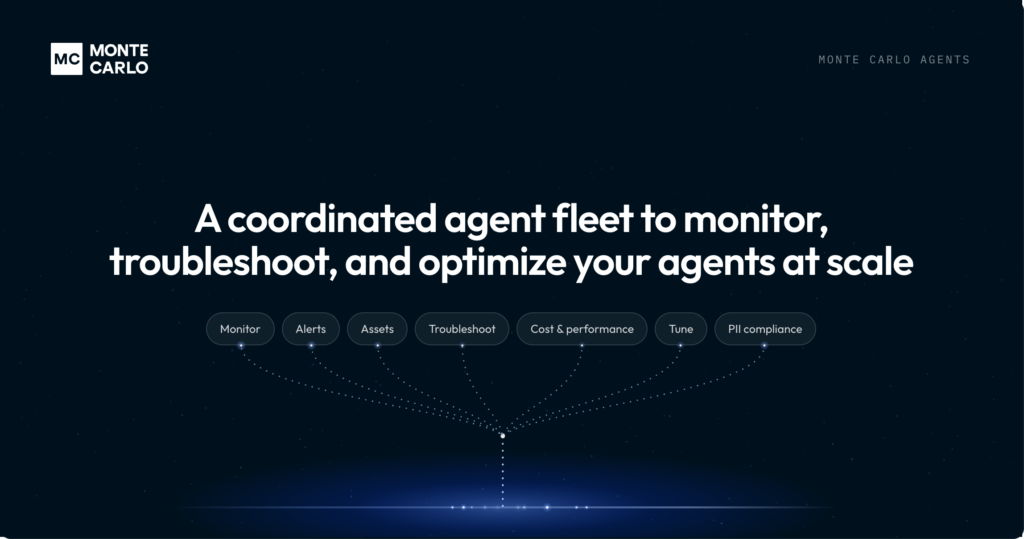
Monte Carlo is the most widely adopted data observability platform, using ML-based anomaly detection across freshness, volume, schema, and distribution, with end-to-end lineage. In 2026 it repositioned from "data observability" to "Data + AI observability," adding an Agent Fleet of named agents for monitoring, triage, troubleshooting, and remediation — including a PR agent that reviews schema and pipeline changes before merge and a remediation agent that can push fixes into a coding agent via MCP.
Best for: Large data and AI platform teams that want the broadest coverage in one tool.
Pros
- The Agent Fleet monitors both data pipelines and AI agents in a single platform.
- The PR agent reviews schema and pipeline changes pre-merge through a GitHub integration.
- Agentless connectors to warehouses, lakes, BI, and ETL; the company states customer data is never stored or used to train models.
Cons
- No pricing published anywhere — the dedicated page is literally titled "Request for Pricing."
- The heavy 2026 AI-agent rebrand makes direct comparison with pure data-observability competitors harder.
- Its headline performance numbers are self-reported and not independently audited.
2. Anomalo
Anomalo positions itself as an "autonomous data system," built around ML anomaly detection that needs little manual rule-writing. Its Agentic Suite spans table observability, data quality, data insights, conversational analytics, and documentation, with more agents on the roadmap. A data insights agent generates proactive root-cause narratives rather than pass/fail alerts.
Best for: Large enterprises that need deep ML detection and want data to stay inside their own environment.
Pros
- True VPC and self-hosted deployment — data never has to leave your environment, with a bring-your-own-model option.
- The data insights agent produces root-cause narratives, not just alerts.
- Named, detailed enterprise case studies (Equifax, Discover, Nationwide) with attributed executive quotes.
Cons
- No published pricing; everything is quote-based.
- Several agents in the Agentic Suite were still "coming soon" as of October 2026, not shipped.
- Customer results are vendor-curated testimonials, not independently verified.

3. Acceldata
Acceldata is an enterprise data and AI observability platform (ADOC) covering anomaly detection, profiling, freshness, schema drift, reconciliation, and lineage, alongside adjacent product lines for cost optimization and Hadoop modernization. It pitches a federated, hybrid compute model aimed at estates that span legacy on-prem systems and the cloud.
Best for: Large, regulated enterprises with hybrid or on-prem data estates.
Pros
- Genuine hybrid and on-prem deployment, with explicit Kubernetes support via its Open Data Platform.
- A single platform spans observability plus cost/FinOps plus legacy modernization — useful for mixed estates.
- Named, large-scale production customers such as PhonePe with specific reliability framing.
Cons
- Zero published pricing; two contact-sales tiers only.
- A very broad product surface across six-plus sub-products can mean less depth on core data-quality monitoring than point solutions.
- Case-study statistics are single-source and not independently audited.
4. Soda
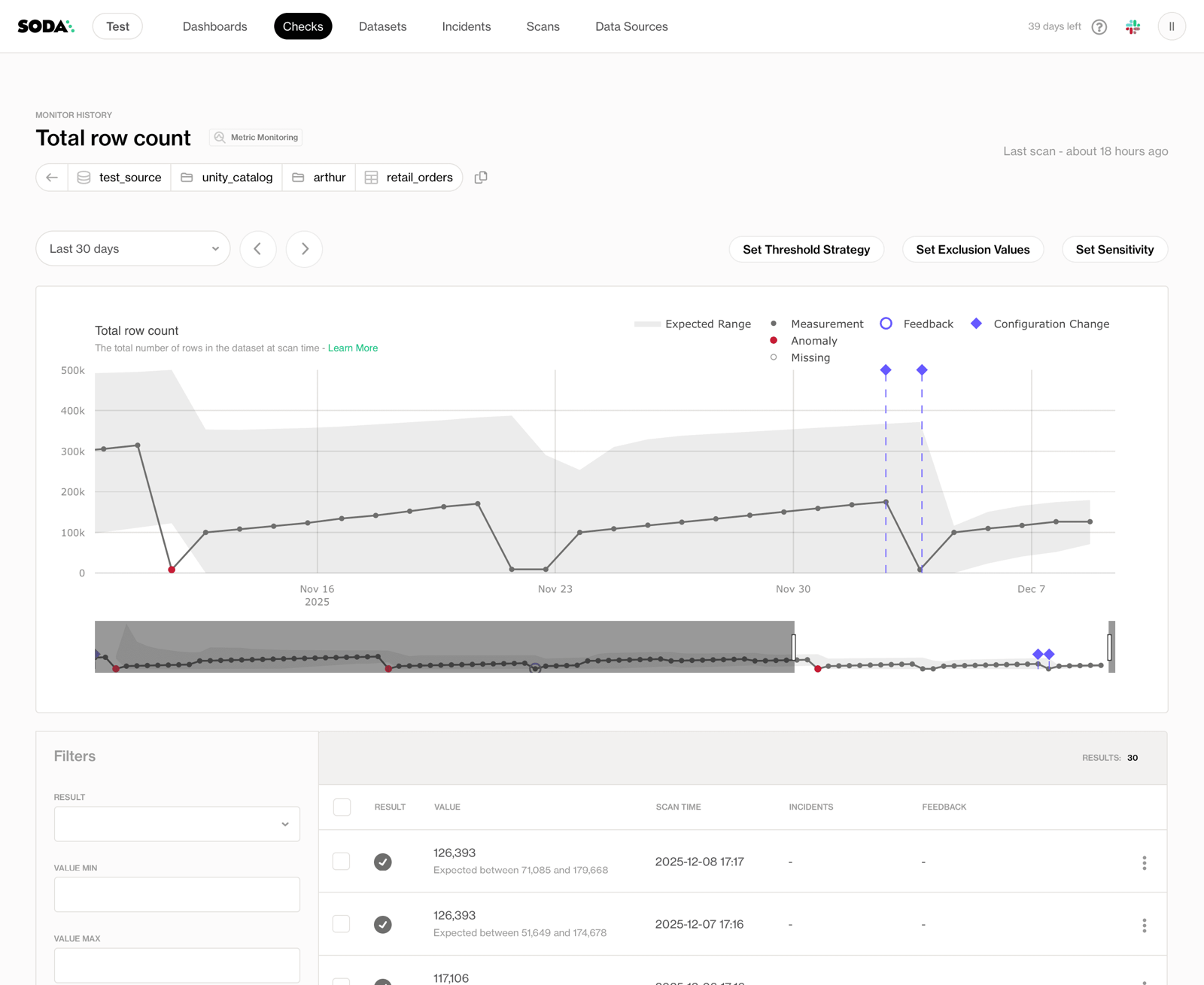
Soda splits into two layers: Soda Core, a free, open-source engine that runs YAML-based data-quality checks and contracts from a CLI or Python, and Soda Cloud, the paid SaaS layer that adds a UI, centralized management, and cloud anomaly detection. It leans into Git-based data contracts and stores failed records in your own warehouse for root-cause work.
Best for: Engineering teams that want data contracts, open-source tooling, and transparent pricing.
Pros
- The only vendor here with a published numeric price — Team at $750/month (observed October 2026), plus a free tier.
- Soda Core is genuinely open source, distributed via PyPI, not merely source-available.
- Root-cause diagnostics store failed records in your own warehouse rather than Soda's infrastructure.
Cons
- The headline AI-detection benchmark claims are self-reported with no independently verifiable link.
- The Enterprise tier is still custom-quote only.
- Record-level anomaly detection and AI-generated contracts are newer and less battle-tested than core metrics monitoring.
5. Bigeye
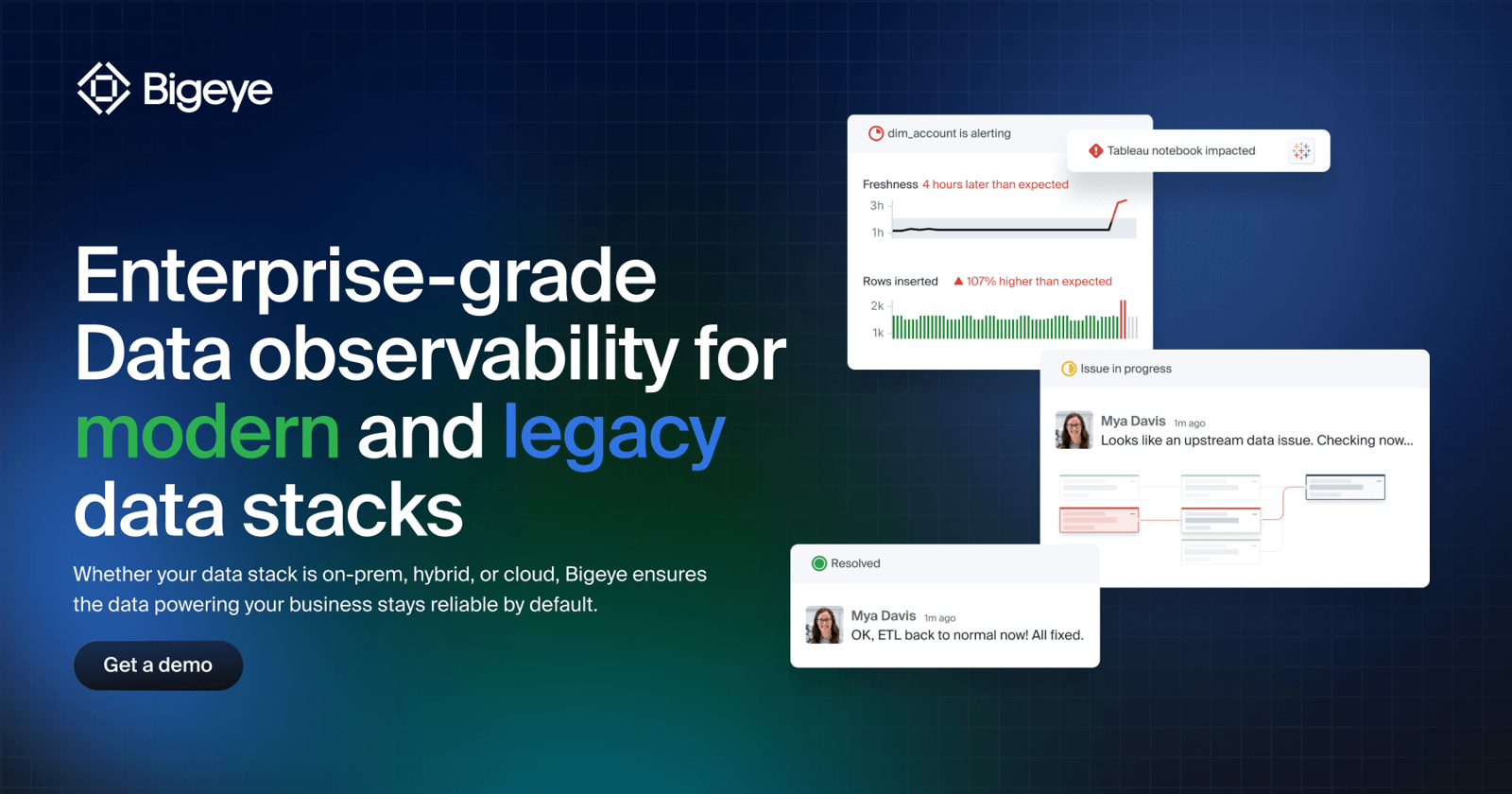
Bigeye is a metadata-driven data observability tool centered on autometrics — automatically generated quality checks — plus anomaly detection and lineage. Its distinctive "Deltas" feature compares data quality across table versions and environments, useful for validating changes before promotion.
Best for: Data engineering teams that want automated checks without hand-writing rules.
Pros
- Autometrics auto-generate standard quality checks, cutting manual rule-writing.
- "Deltas" environment comparison is a specific capability not every competitor offers.
- Documented case studies (Resident, JetBlue) report measurable detection-time reductions.
Cons
- No pricing published; treat it as quote-based.
- Reported improvements are single-source vendor case studies, not audited.
- Less third-party analyst coverage surfaced than Monte Carlo or Sifflet.
6. Sifflet
Sifflet bills itself as "the control plane for data and AI," combining a data catalog, quality monitoring, and lineage, with three AI agents: Sentinel for monitoring suggestions across all tiers, and Sage and Forge for diagnostics and fix suggestions in Enterprise early access. It has particular strength among European enterprises.
Best for: Mid-market and enterprise teams that want catalog and observability in one tool.
Pros
- Raised $18M in June 2025 (reported via wire service), a recent, independently dated funding signal.
- The Enterprise tier explicitly supports self-hosted and hybrid deployment, unlike many SaaS-only rivals.
- Combines catalog, lineage, and quality monitoring rather than splitting them across tools.
Cons
- The Sage and Forge AI agents are Enterprise-gated early access, not generally available.
- No numeric pricing published at any tier.
- Named customers are vendor-selected testimonials, not independently sourced.
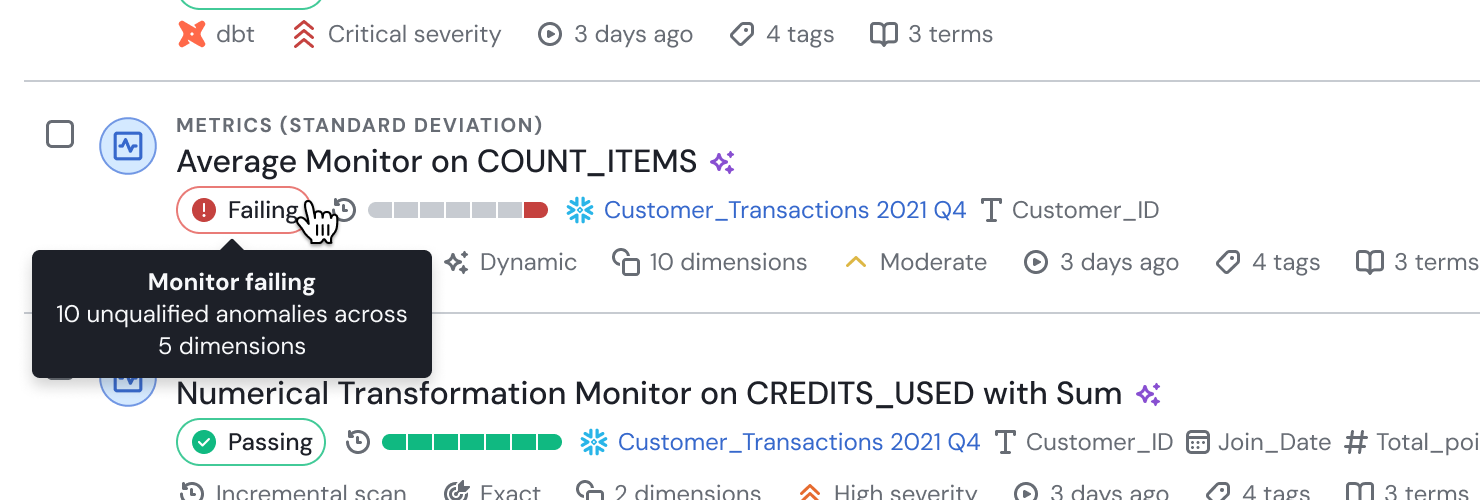
7. Metaplane
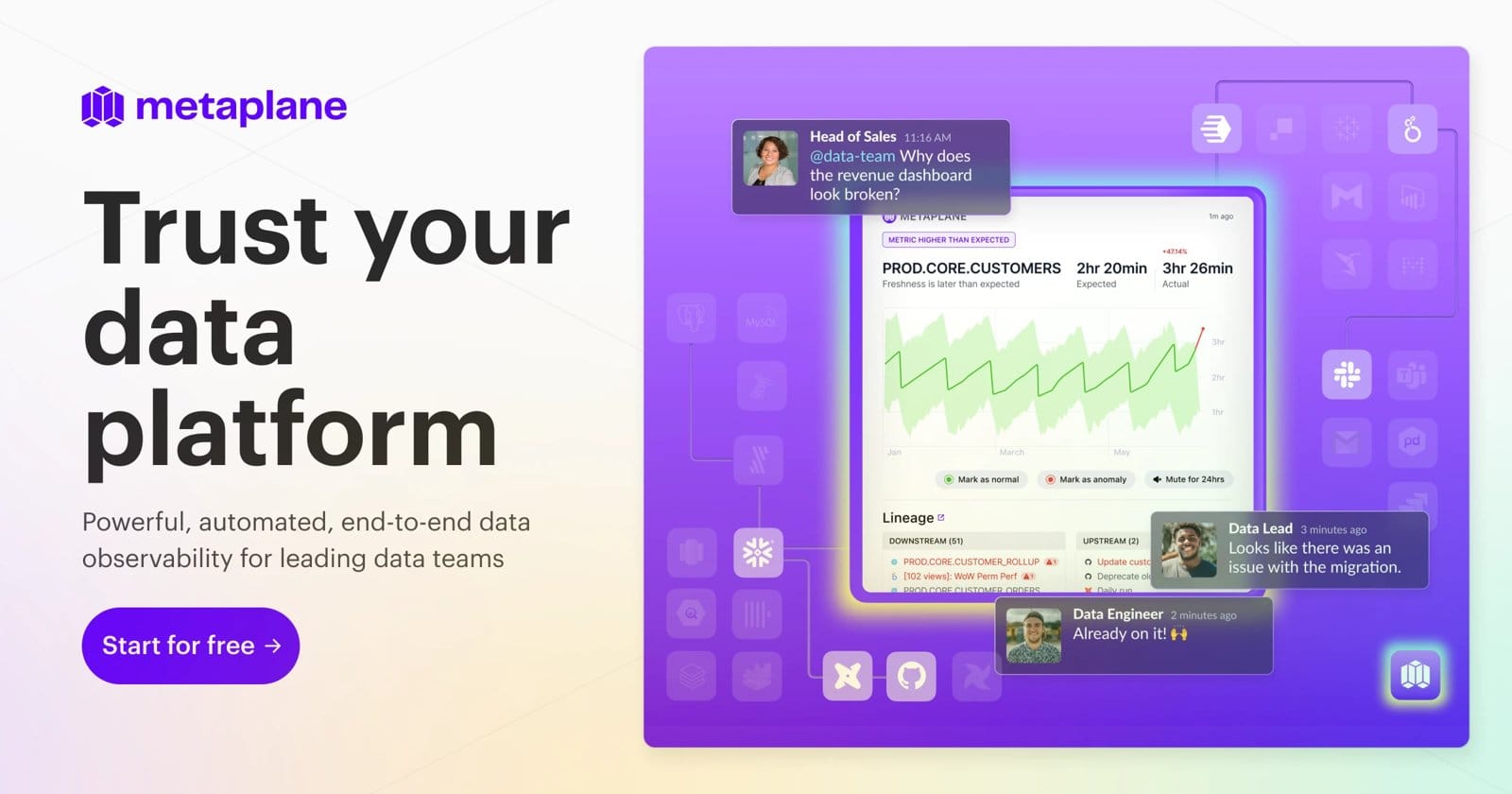
Metaplane is a data observability tool built for the modern data stack, with automated anomaly detection on freshness, volume, and schema, plus lineage and incident workflows. It is pitched for fast setup on Snowflake, BigQuery, and dbt-centric stacks, favoring quick time-to-value over heavyweight configuration.
Best for: Mid-market data teams on dbt and warehouse-native stacks that want fast setup.
Pros
- Lightweight, fast setup is a deliberate differentiator from heavier enterprise platforms.
- Narrow dbt and warehouse focus keeps the product simple for smaller teams.
- Now backed by Datadog's enterprise support and cross-sell into existing Datadog customers.
Cons
- Acquired by Datadog in April 2025, which creates roadmap and pricing uncertainty — whether it stays standalone or folds into Datadog's suite is unresolved.
- No independently verified current pricing.
- Smaller standalone market presence than Monte Carlo or Acceldata.
How to choose
Pick by deployment constraints and scale, then by how much pricing transparency matters to you.
- You want the broadest coverage and have budget for enterprise sales. Monte Carlo is the safe default, especially if you also need to monitor AI agents, not just pipelines.
- Your data cannot leave your environment. Anomalo and Acceldata both offer genuine self-hosted or on-prem deployment; Sifflet adds it at the Enterprise tier.
- You want to start free and see a real price. Soda is the only option with open-source tooling and published pricing.
- You're a lean team on dbt and Snowflake. Metaplane or Bigeye fit, though factor the Datadog acquisition into any long-term Metaplane bet.
- You want catalog plus observability in one. Sifflet combines them.
Data observability sits downstream of your pipelines, so pair it with solid ETL and data integration and data orchestration choices — observability catches what those layers break.
Frequently Asked Questions
What is data observability?
Data observability is the practice of continuously monitoring the health of data as it moves through pipelines and warehouses — tracking freshness, volume, schema, distribution, and lineage. It uses automated and ML-based detection to flag anomalies, like a table that stopped updating or a column whose values shifted, before bad data reaches dashboards, reports, or models.
What's the best data observability platform?
Monte Carlo is the most widely adopted and broadest platform, which makes it the common default for large enterprises. But "best" depends on constraints: Anomalo and Acceldata win if you need self-hosting, and Soda wins if you want open-source tooling and published pricing. Match the tool to your deployment and scale, not to brand size.
How do you implement data observability?
Start by connecting the tool to your warehouse and critical pipelines, then let it baseline normal behavior for freshness, volume, and schema. Add targeted quality checks or data contracts on your most important tables, wire alerts into Slack or your incident system, and use lineage to trace an anomaly back to its source before it spreads downstream.
Is data observability the same as data quality?
No. Data quality measures whether data meets defined rules — valid values, no nulls, correct formats. Data observability is broader: it monitors the overall health and behavior of data and pipelines over time, detecting anomalies you didn't write a rule for. Most modern tools, including Soda and Monte Carlo, combine both rule-based checks and ML anomaly detection.
Which data observability tool is best for dbt?
Metaplane and Bigeye are both strong for dbt and warehouse-native stacks, with fast setup on Snowflake and BigQuery. Soda integrates data contracts into Git-based dbt workflows. If your stack is dbt-centric and your team is lean, start with one of these rather than a heavier enterprise platform — but weigh Metaplane's Datadog acquisition for the long term.
Editor's note — sources: Deployment, pricing, and feature details were verified against each vendor's official site and documentation as of October 2026: Monte Carlo (montecarlo.ai), Anomalo, Acceldata, Soda, Bigeye, Sifflet, and Metaplane. The Datadog acquisition of Metaplane was announced April 23, 2025; Sifflet's $18M funding was reported June 19, 2025. All pricing is "as of October 2026" and subject to change; where a vendor publishes no price, we state "pricing on request" rather than estimate.