
Top 7 Cloud Cost Management Tools for FinOps in 2026
IBM Cloudability, CloudHealth, Flexera One, Vantage, CloudZero, Finout and Kubecost, ranked on cost allocation, verified FOCUS support and what they actually cost. Only one publishes real self-serve pricing, and CloudHealth is not dead.


TL;DR
- Only one vendor here publishes real self-serve prices: Vantage at $0 / $30 / $200 per month by tracked spend, plus 5% of savings on Autopilot.
- Best free option: Kubecost Foundations — unlimited clusters up to 250 cores, 15-day retention, self-hosted. Kubernetes only.
- Enterprise incumbents are now owned by two companies. IBM holds Cloudability and Kubecost; Broadcom holds CloudHealth; Flexera bought Spot by NetApp (closed 3 March 2025) and ProsperOps (announced 6 January 2026).
- CloudHealth is not dead. Despite persistent rumours, it shipped features through 31 August 2026 and there is no end-of-availability notice anywhere on Broadcom's domains.
Cloud cost management is the practice of measuring, allocating and reducing cloud spend so that every dollar maps to a team, product or customer. The leading tools in 2026 are IBM Cloudability and CloudHealth by Broadcom for large enterprises, Flexera One for hybrid estates that include on-prem and licensing, Vantage and CloudZero for engineering-led teams, Finout for multi-cloud plus SaaS, and Kubecost for Kubernetes.
The common failure is not visibility. It is allocation: the share of spend that no tag explains, that nobody owns, and that therefore nobody reduces. That is the problem worth comparing these tools on.
How we picked these
Selection criteria, weighted in this order:
- Allocation capability. Can it attribute 100% of spend — including shared and untagged cost — to a business owner? Tag-dependent tools stall at the first untagged resource group.
- Verified breadth. Which clouds, Kubernetes distributions, data platforms and AI providers are named on the vendor's own documentation, not implied by a logo wall.
- FOCUS support, verified on the vendor's own site. The FinOps Foundation's FOCUS billing spec is the only thing making multi-cloud cost data comparable. We only credit it where the vendor documents it.
- Pricing transparency. Vendors publishing real numbers ranked above vendors publishing a contact form. Most of this category does the latter.
- Current ownership and status as of October 2026, checked against press releases rather than assumed.
Every price and capability below was observed on vendor sites on 1 October 2026. Where a figure is a vendor marketing claim rather than a measured result, it is labelled as such.
Quick comparison
| Company | Best for | Deployment | Pricing model |
|---|---|---|---|
| IBM Cloudability | Enterprise FinOps with tag-independent allocation | SaaS (regional instances) | On request, three packages |
| CloudHealth by Broadcom | Widest cloud coverage and MSP/partner billing | SaaS | On request |
| Flexera One | Hybrid estates: cloud plus on-prem and licensing | SaaS | On request; ProsperOps charges share of realized savings |
| Vantage | Engineering teams wanting self-serve and AI spend | SaaS | Published: $0 / $30 / $200 per month, plus 5% of Autopilot savings |
| CloudZero | Unit economics and cost-per-customer | SaaS | On request |
| Finout | Multi-cloud plus Kubernetes plus SaaS in one bill | SaaS | Base on request; add-ons published |
| Kubecost | Kubernetes cost allocation and chargeback | Self-hosted or SaaS | Foundations free; Enterprise on request |
1. IBM Cloudability
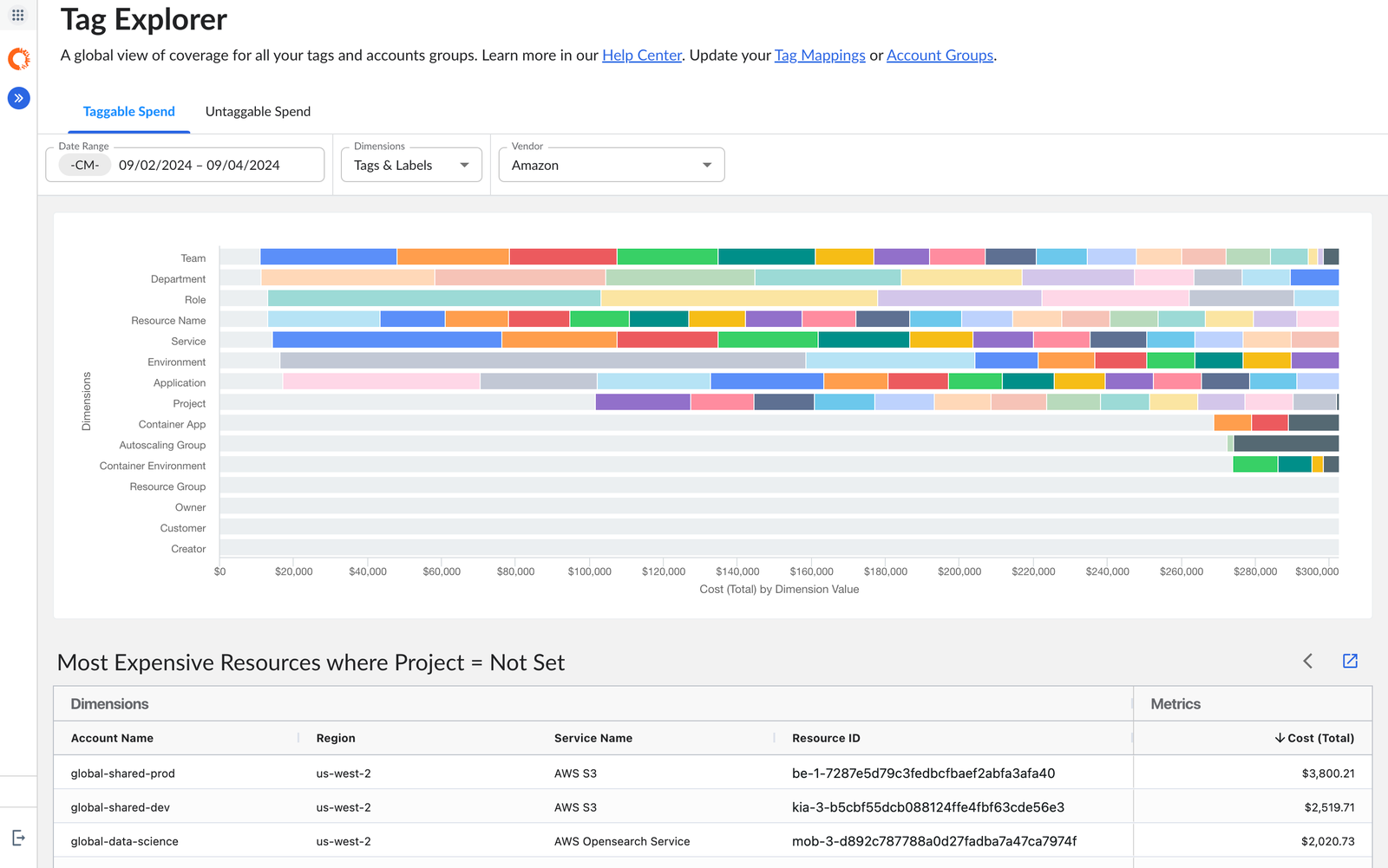
Apptio Cloudability is now branded IBM Cloudability — IBM completed the Apptio acquisition on 10 August 2023 for roughly $4.6B, and the product navigation has since dropped the Apptio prefix. It remains the reference enterprise cloud financial management platform: allocation, forecasting, commitment management and rightsizing.
The capability worth paying for is Business Mapping combined with Cost Sharing, which allocates 100% of both direct and shared multi-cloud cost without depending on resource tags. If you have ever tried to run chargeback against a half-tagged AWS estate, that distinction is the entire product. True Cost Explorer adds resource-level analytics, and AI spend is now broken out by model, token type and direction.
Cloudability documents FOCUS v1.0 and v1.1 ingest, with v1.1 generally available from October 2025, and carries a FinOps Certified Platform badge linking to its FinOps Foundation member page.
Best for: Large enterprises that need defensible chargeback across messy, partly-untagged multi-cloud estates.
Pros
- Tag-independent allocation via Business Mapping and Cost Sharing — the strongest answer here to unallocated spend.
- Documented FOCUS ingest for v1.0 and v1.1, plus AI-assisted mapping of third-party bills into the FOCUS schema.
- Kubernetes depth available from the same vendor through sibling product Kubecost, inside one IBM FinOps suite.
- Regional SaaS instances across Americas, EU and APAC for data-residency requirements, with integrations into Jira, Datadog and PagerDuty.
Cons
- No published pricing at any tier. Three packages are named — Essentials, Standard, Premium — with no numbers, so core capabilities sit behind undisclosed gates.
- Capabilities are split across separately marketed SKUs: Cloudability, Cloudability Savings Automation and Cloudability MSP, plus Kubecost. It is not one purchase.
- FOCUS support is ingest-side at v1.0/v1.1; we found no v1.2 claim, which CloudHealth does make.
- Brand and documentation churn: marketing lives on apptio.com while docs moved to ibm.com, and the product renamed mid-lifecycle.
2. CloudHealth by Broadcom
CloudHealth has been renamed four times in five years — CloudHealth by VMware, then VMware Aria Cost, then VMware Tanzu CloudHealth, now CloudHealth by Broadcom following Broadcom's completion of the VMware acquisition on 22 November 2023.
It is worth stating plainly, because the rumour persists: CloudHealth has not been discontinued. Its documentation was last updated 30 September 2026, product updates shipped monthly through 31 August 2026, and a search of the full 2018–2026 product-updates archive turns up no end-of-availability, end-of-life or sunset notice.
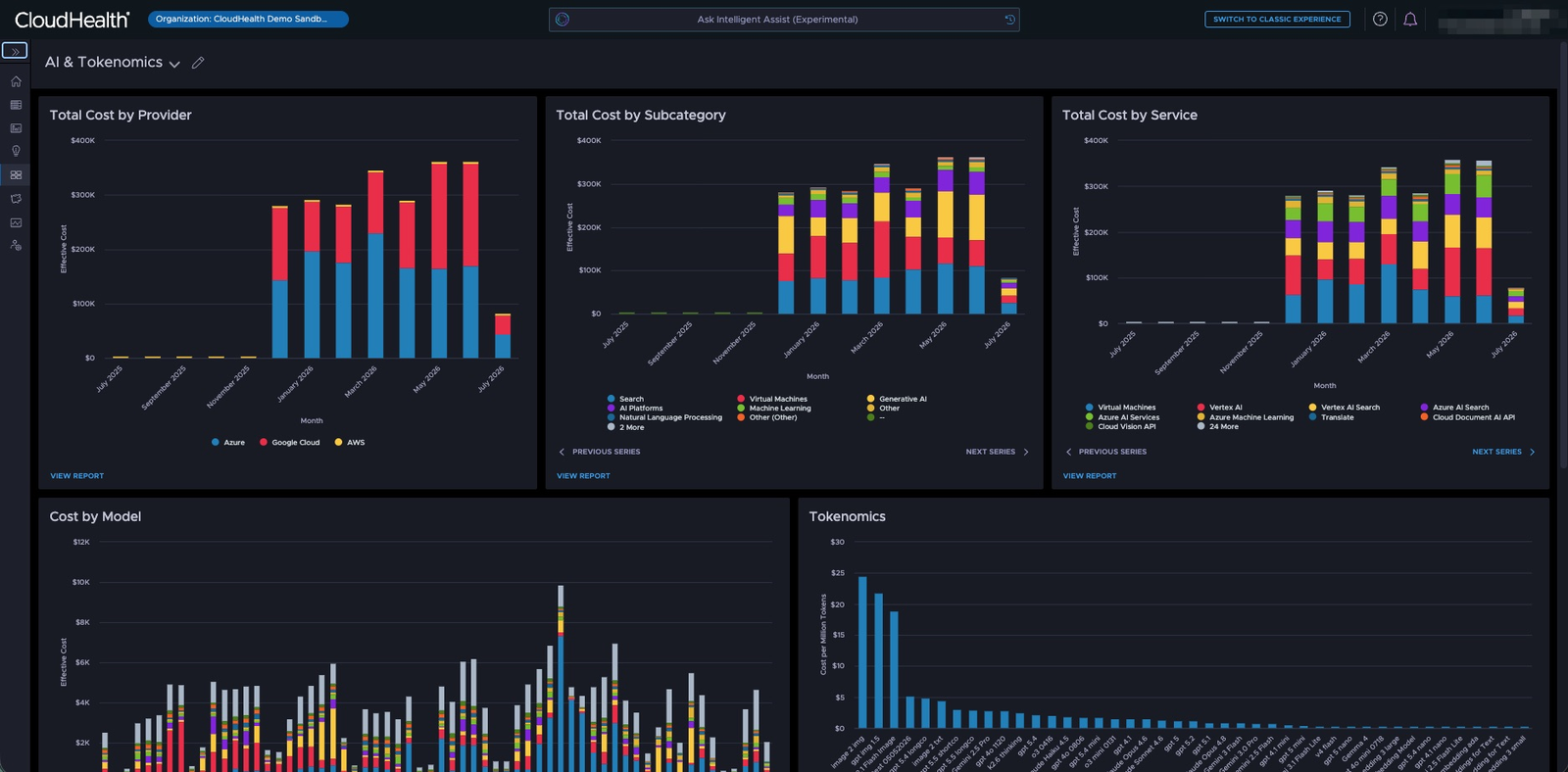
Technically it offers the broadest documented coverage in this roundup — AWS, Azure, GCP, Oracle Cloud, Alibaba Cloud, on-prem data centre, Kubernetes and bring-your-own-data. Allocation runs on Perspectives, dynamic business mapping rules, with FlexOrgs providing hierarchical org units and granular role-based access. It is also the most advanced FOCUS implementation verified here: CloudHealth acts as a FOCUS data generator with its own translation layer, and shipped a multi-cloud FOCUS v1.2 dataset and standard report on 29 May 2026.
Best for: Enterprises with genuinely heterogeneous estates, and managed service providers who need partner-generated billing.
Pros
- Widest verified platform coverage here, including Oracle Cloud, Alibaba Cloud and on-prem data centre alongside the big three.
- Generates FOCUS v1.2 itself rather than passing through provider exports — the most advanced FOCUS position we verified.
- Strongest MSP story: a dedicated Partner Platform with partner-generated billing across AWS, Azure and GCP.
- Demonstrably active roadmap, including a 2026 AI and Tokenomics dashboard tracking GPU spend and cost per million tokens.
Cons
- Four product names in about five years, with legacy URLs now returning 404s and stale
tanzu-cloudhealthslugs still embedded in current documentation paths. - Dual-platform migration burden. Release notes split features between "New Experience" and "Classic Experience" with uneven parity, which means real retraining and migration work.
- No public pricing; the only call to action is a Broadcom contact form.
- No FinOps Foundation product certification, despite prominent staff affiliations on the Governing Board and FOCUS working group that are easy to mistake for one.
3. Flexera One
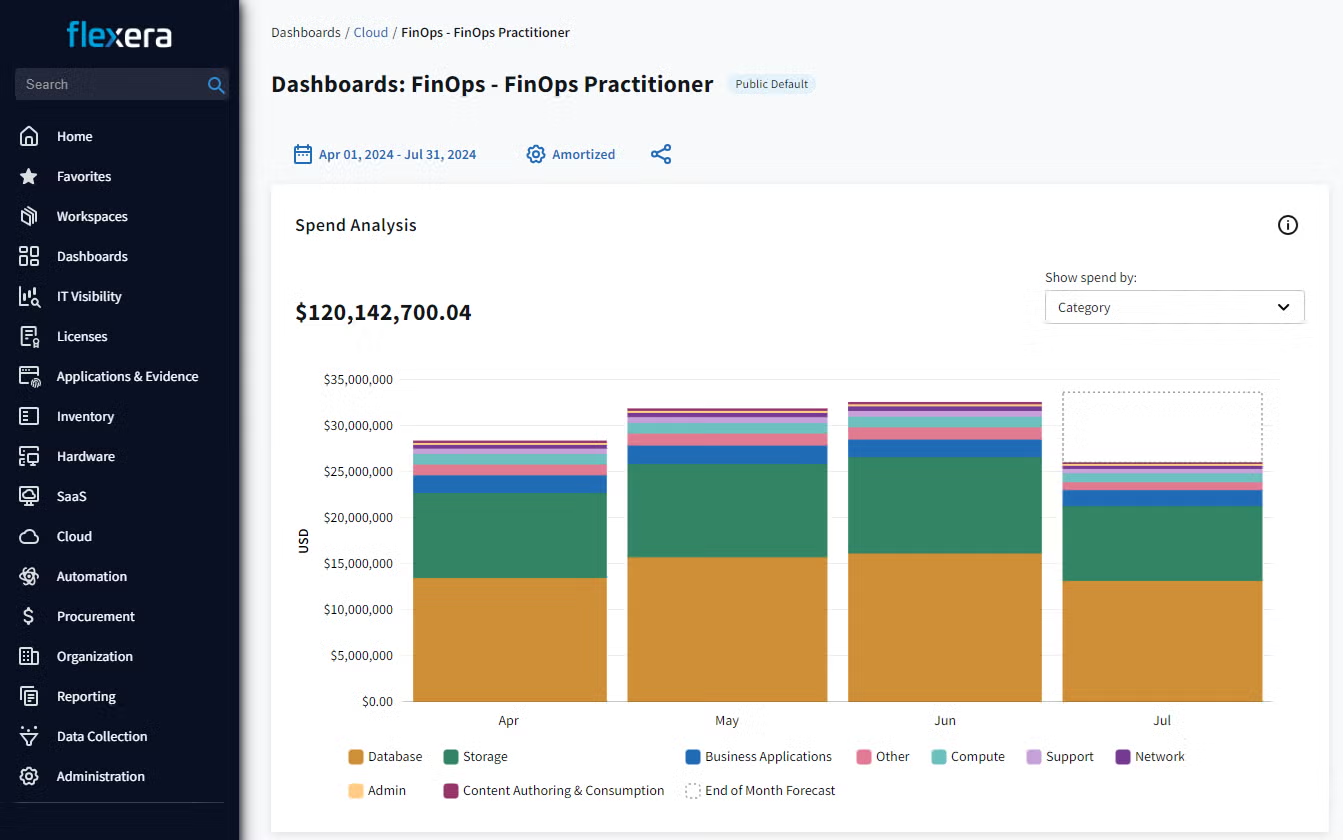
Flexera has assembled its FinOps position by acquisition, and the pace matters when you evaluate it. Snow Software completed 15 February 2024. Spot by NetApp — Spot Eco, Spot Ocean, Spot Elastigroup and CloudCheckr — was announced 15 January 2025 and completed 3 March 2025. ProsperOps and Chaos Genius were announced on 6 January 2026, with ProsperOps continuing as a standalone Flexera division under its own brand.
The distinctive capability is action rather than advice: Flexera ships 90+ out-of-the-box cost optimization policies that execute, including resource termination behind an approval workflow. The second is hybrid scope — via Technopedia, cloud cost is analysed alongside on-prem software, SaaS and licensing, which no pure cloud-bill tool here does.
ProsperOps brings commitment automation priced as a share of realized savings rather than a percentage of cloud spend. Flexera states ProsperOps is "growing more than 90%" with $6B of annual cloud usage under management — a vendor figure.
Best for: Enterprises whose cost problem spans cloud, on-prem software and SaaS licensing, not just cloud bills.
Pros
- Largest prebuilt automation library here: 90+ policies that take action, with approval workflows rather than recommendation-only output.
- Genuine hybrid TCO — cloud plus on-prem plus SaaS plus licensing in one view via Technopedia.
- ProsperOps commitment management is outcome-aligned: a share of realized savings, explicitly not a percentage of your bill, with a free savings analysis first.
- Broadest FinOps surface area post-acquisition, now covering rate optimization, workload optimization, containers, Snowflake and Databricks spend, SaaS and ITAM.
Cons
- Product sprawl from four acquisitions in roughly 25 months. Flexera's own site exposes five separate logins, and commitment management now exists in three lineages — native, Spot Eco and ProsperOps.
- Integration is unfinished by the vendor's own wording. ProsperOps says deep integrations will come "over time" and that it will maintain independent go-to-market during integration. Today you buy two products.
- No public pricing, and the ProsperOps savings-share percentage is not published anywhere.
- Its FinOps Certified Platform claim dates to a December 2021 press release, and we found no FOCUS spec support anywhere on flexera.com or prosperops.com.
- Oracle, Alibaba and IBM Cloud support is not stated on its own site — verify before assuming parity with CloudHealth.
4. Vantage
Vantage is the only vendor in this roundup you can buy without talking to anyone, and the only one publishing exact prices. Tiers gate on tracked cloud spend, not seats: Starter free up to $2,500 tracked spend with 3 users and 6 months retention; Pro $30/month up to $7,500 with 5 users; Business $200/month up to $20,000 with 10 users and 12 months retention; Enterprise custom with unlimited spend, users and retention.
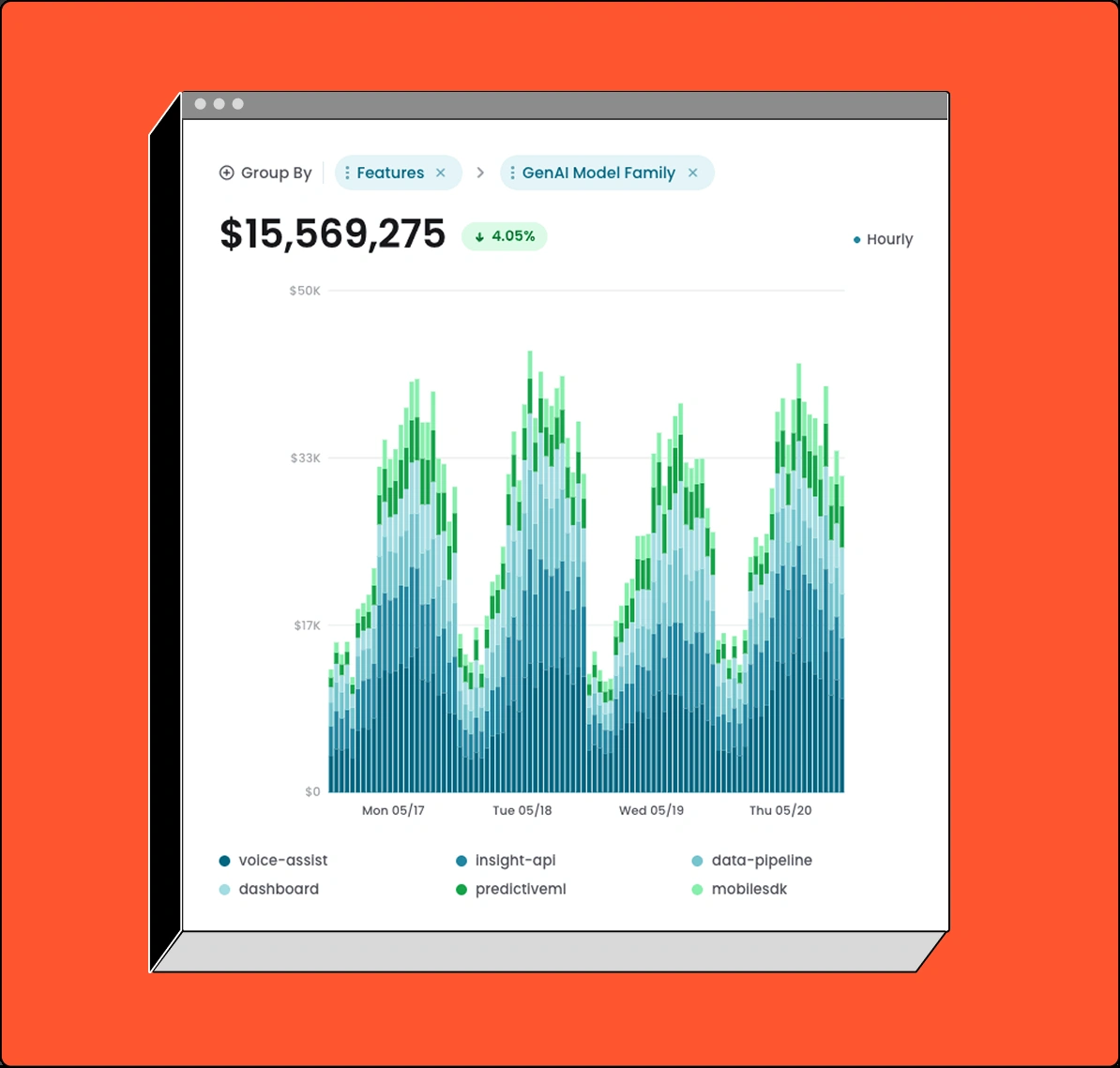
Two capabilities stand out. Virtual Tagging applies retroactive rule-based cost attribution without touching provider tags — the same untagged-spend problem Cloudability solves, available on a $30 plan. Autopilot for AWS Savings Plans profiles daily spend and buys commitments automatically or in approval mode, respecting existing reservations, and charges 5% of savings realized with no charge when there are no savings.
Coverage is unusually wide for the price: 30+ native providers including AWS, Azure, GCP, Oracle Cloud, Cloudflare, Kubernetes, Snowflake, Databricks, Datadog, and AI vendors including Anthropic, OpenAI, Cursor, Fireworks AI, Modal and Baseten. Vantage is a FinOps Certified Platform and a Premier Member, and supports FOCUS schema columns from v1.1 to v1.3.
Best for: Engineering-led teams that want cost visibility this afternoon, and anyone tracking AI provider spend.
Pros
- Fully public self-serve pricing with a real free tier — unique in this category.
- Widest verified AI-provider cost coverage here, with LLM token allocation alongside infrastructure spend.
- FinOps-as-code is real: a Terraform provider, a public API and an MCP server.
- Autopilot is risk-aligned at 5% of realized savings only, with an approval mode and respect for pre-existing commitments.
Cons
- The self-serve tiers are small. The top published tier caps at $20,000/month tracked spend, so most mid-market and all enterprise buyers land on quote-only Enterprise anyway.
- Retention is short on paid self-serve: 6 months on Pro, 12 on Business. Unlimited is Enterprise-only.
- RBAC, SOC 1 and SOC 2 compliance, the FinOps Agent and dedicated support are all Enterprise-gated — awkward for regulated teams that need access control on day one.
- SaaS-only with no self-hosted option and no open-source core.

5. CloudZero
CloudZero answers a narrower question than the platforms above: what does one customer, product or feature cost to serve? It raised a $56M Series C on 28 May 2025 led by BlueCrest Capital Management and Innovius Capital, with a strategic investment from MongoDB, and in May 2026 repositioned around AI cost as "the financial control plane for AI" — a positioning change, not a rename.
The technically interesting part is CostFormation: allocation logic authored in YAML or Python and version-controlled, rather than clicked together in a UI. CloudZero positions it explicitly as a way to avoid months of tagging cleanup, and for platform teams who already treat infrastructure as code it is a meaningfully different model. AnyCost with a Common Bill Format lets you write an adaptor in any language to convert any vendor's bill and POST it via REST, which is why its connector list runs to 33 named integrations including CoreWeave, Fastly, Temporal, Splunk and Kafka.
AWS access is read-only by design, established through a CloudFormation template, with SOC 1 Type 2 and SOC 2 Type 2 published on a public trust centre.
Best for: SaaS companies that need cost per customer or per feature to price and forecast, and teams that want allocation under version control.
Pros
- Allocation as code in YAML or Python, version-controlled and reviewable — genuinely unusual in this category.
- AnyCost means any bill is ingestible, not just the 33 native connectors.
- Explicitly read-only cloud access with documented IAM posture and a public trust centre carrying SOC 1 Type 2 and SOC 2 Type 2.
- Broad named connector coverage spanning infrastructure, data platforms, observability tools and AI providers.
Cons
- No published pricing at all — not even tier structure with numbers. The homepage FAQ mentions a tiered model with no overages; everything else is quote-only.
- No documented product-level FOCUS capability. CloudZero has a FOCUS maintainer on staff and an educational blog post, which is weaker than CloudHealth, Finout or Vantage.
- Its FinOps Foundation badges are Certified Partner and Premier Member — not Certified Platform, which is a different and lesser thing.
- The AI Data Plane that delivers real-time per-call AI telemetry is in preview, requires an account manager, and its docs say coverage is still expanding.
- SaaS-only, no self-hosted option, no open-source component.
6. Finout
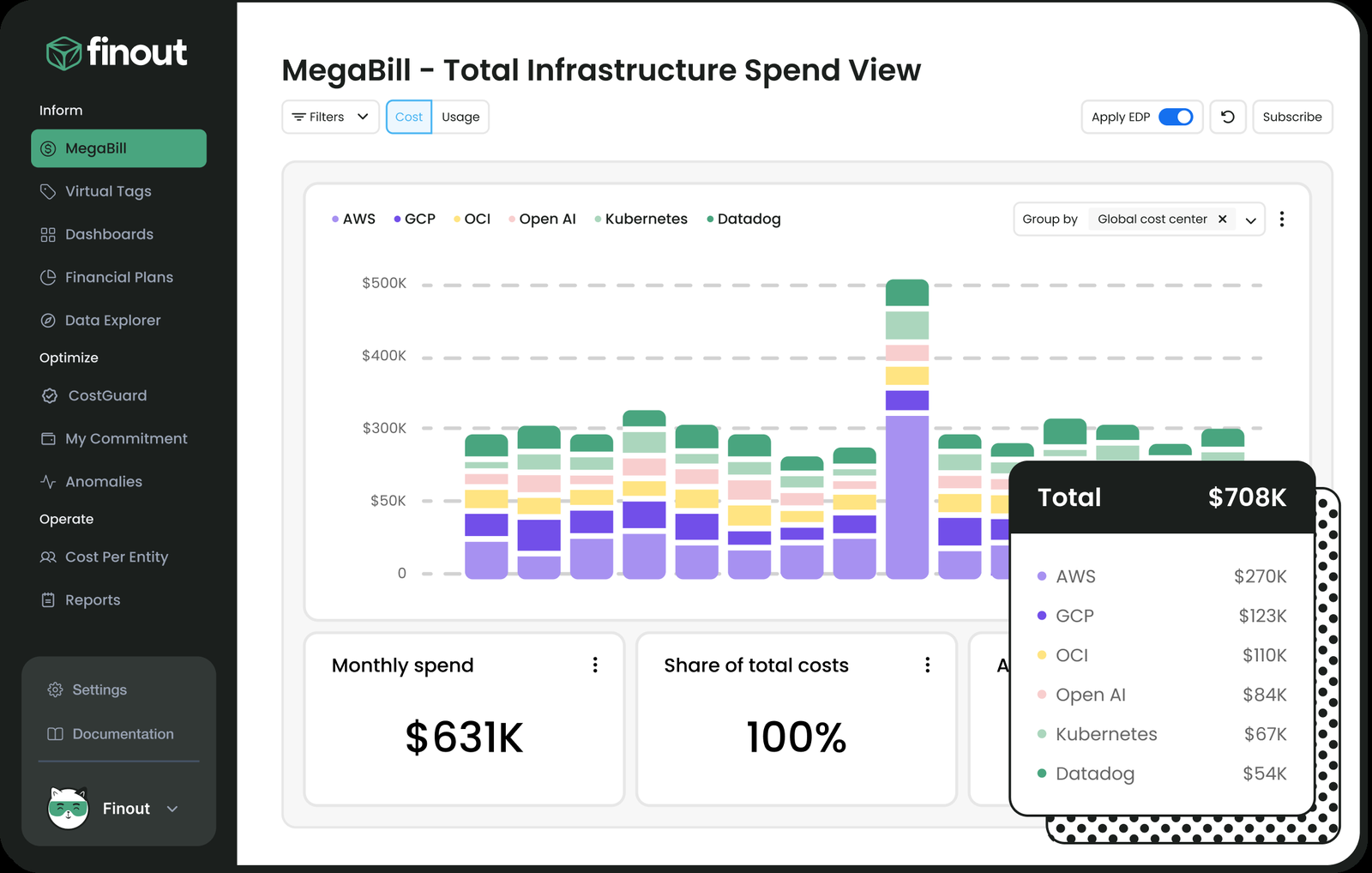
Finout unifies cloud, Kubernetes, SaaS and AI spend through MegaBill, which normalizes every connected provider bill into one consolidated bill that then becomes the allocation substrate. Virtual Tags apply rules that group and relabel cost retroactively across technologies without touching provider tags.
Of the two independents here, Finout has the clearest documented FOCUS support: custom FOCUS CSV upload, a native default FOCUS table, and FOCUS virtual tags, with docs stating it supports any FOCUS file as a custom cost centre. It names 23 integrations including AWS, GCP, Azure, Oracle, Alibaba, Kubernetes, Snowflake, Databricks, Anthropic, OpenAI and GitHub Copilot, and supports EKS, GKE, AKS plus OpenShift ROSA and ARO.
Kubernetes can run two ways: an in-cluster Helm agent, or agentless — a scheduled read-only CronJob querying your existing Prometheus and exporting to your own S3 bucket. If your platform team will not accept another in-cluster agent, that option is rare.
Pricing is a flat annual fee tied to committed cloud and AI spend — explicitly not per-seat and not a percentage of your bill. The base fee is quote-only, but the add-on deltas are published: Cost Per Customer costs +$250 on Business and +$500 on Pro, and the Kubernetes add-on is +25% on both, included only on Enterprise.
Best for: Teams consolidating cloud, Kubernetes, SaaS and AI spend into one allocation model, especially where an in-cluster agent is off the table.
Pros
- Clearest documented FOCUS support among the independents, with three distinct ingest and modelling paths.
- Pricing structure is unusually transparent for a quote-only vendor: flat annual fee, published add-on deltas, and a machine-readable pricing file.
- Kubernetes can run agentless via a read-only Prometheus CronJob to your own S3, with OpenShift ROSA and ARO supported.
- Security posture published on its own site: SOC 2 Type II, ISO 27001, GDPR and CCPA, with EU and US data residency and a read-only, audit-logged AI assistant.
Cons
- Base price is still unpublished — only add-on deltas are. All three tiers require a quote, with yearly contracts only and no self-serve checkout.
- Restrictive low-end gating: Business allows 2 cost centres and Pro allows 3, and Kubernetes costs 25% extra unless you are on Enterprise. SAML is Enterprise-only.
- No corporate news published on its own site — no newsroom, no dated funding round, only a cumulative $85M figure.
- No self-hosted option, fewer named connectors than CloudZero at 23 versus 33, and its "40+ vendors" claim is not itemized.
- No FinOps Foundation certification or membership published on its own site.
7. Kubecost
Kubecost is the narrowest tool here and the only free, self-hostable one. IBM announced the acquisition on 17 September 2024 and it is now branded IBM Kubecost, sitting beside Cloudability in the same FinOps suite.
It does real-time Kubernetes cost monitoring, allocation and optimization, and the capability that matters is reconciliation against the cloud provider's actual bill. Most Kubernetes cost tools estimate from list pricing; Kubecost reconciles with AWS, Azure and GCP billing APIs so your showback numbers survive a finance review. It also converts request-sizing and namespace-turndown recommendations into automated actions.
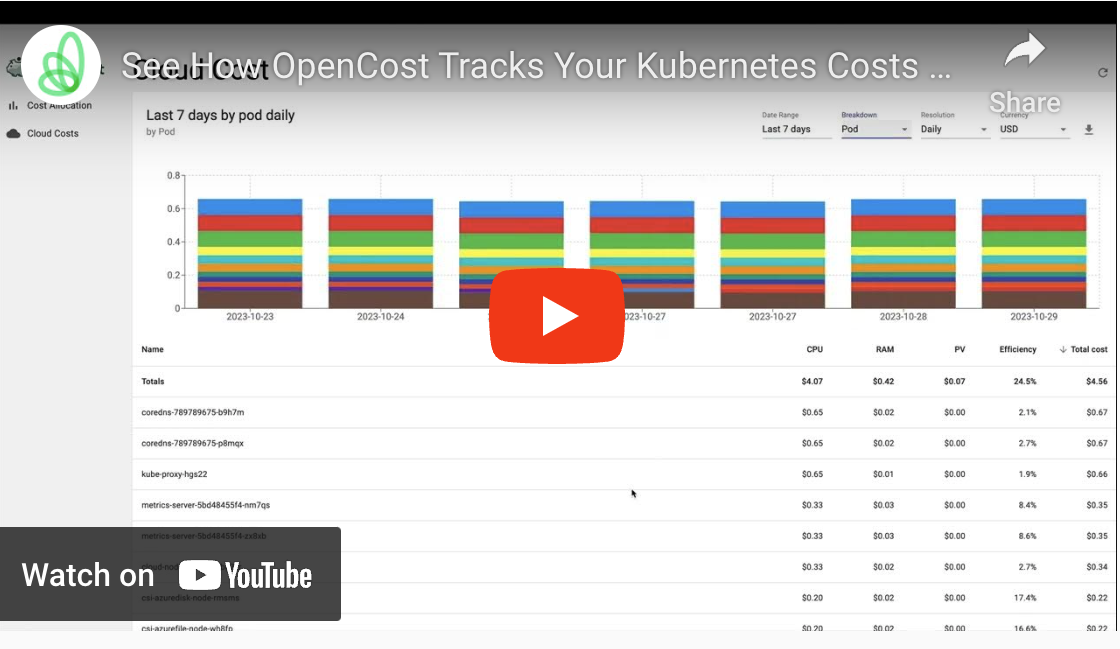
Kubecost originally developed and open sourced OpenCost, which is Apache-2.0 licensed and a CNCF Incubating project — accepted June 2022, moved to Incubating in October 2024, with contributors from AWS, Adobe, Google, Microsoft and SUSE. Note it is Incubating, not Graduated.
The free Foundations tier is genuinely useful: unlimited clusters up to 250 cores, unlimited users, EKS/AKS/GKE/on-prem, bill reconciliation and cost optimization insights, with 15-day metric retention.
Best for: Kubernetes-heavy platform teams that need defensible chargeback, and anyone who must self-host.
Pros
- Free at a genuinely useful size — unlimited clusters up to 250 cores with unlimited users, self-hosted.
- Reconciles in-cluster allocation against the actual provider bill, so chargeback survives finance scrutiny.
- Credible open-source lineage: it created OpenCost, now an Apache-2.0, CNCF Incubating project with multi-vendor contributors.
- Three deployment models including fully self-hosted, meeting data-residency requirements the SaaS-only vendors cannot.
Cons
- Kubernetes-only. It is not a multi-cloud FinOps platform; whole-estate allocation, forecasting and commitment management mean pairing it with Cloudability, a separate SKU.
- The free tier is deliberately thin for production: 15-day metric retention and no unified multi-cluster view, so trending and fleet rollups require paying.
- RBAC, custom pricing, unlimited retention and enhanced GPU optimization are Enterprise-gated — awkward for regulated teams needing access control immediately.
- No published Enterprise pricing, and no Kubecost-specific FOCUS or FinOps certification claim. Do not assume Cloudability's certifications carry over.
How to choose cloud cost management tools
Pick on your allocation problem and your contract tolerance, not the feature grid.
- You need defensible chargeback across a large, partly-untagged multi-cloud estate. IBM Cloudability. Business Mapping plus Cost Sharing is the strongest tag-independent allocation here. Budget for multiple SKUs.
- Your estate includes Oracle, Alibaba or on-prem data centre, or you are an MSP. CloudHealth by Broadcom. Broadest verified coverage and the only partner-billing platform here. Factor in the Classic-to-New migration.
- Your cost problem is bigger than cloud — on-prem software, SaaS and licensing too. Flexera One. Accept that you are buying a portfolio mid-integration.
- You want cost visibility today without a sales call. Vantage. Real published pricing, a free tier, and the best AI spend coverage. Check whether $20,000/month tracked spend covers you before assuming self-serve applies.
- You need cost per customer or per feature to price your product. CloudZero. Allocation as version-controlled code, if you can accept quote-only pricing.
- You want cloud, Kubernetes, SaaS and AI in one bill, and no new in-cluster agent. Finout. The agentless Prometheus path is the differentiator. Price the Kubernetes add-on into your comparison — it is 25% extra below Enterprise.
- Your spend is mostly Kubernetes, or you must self-host. Kubecost. Start free; the 15-day retention limit is what will eventually push you to Enterprise.
Two warnings that apply across the category. First, cloud cost optimization is not a tool purchase. Every platform here will surface rightsizing and commitment recommendations within a week; whether anyone acts on them is an organizational question, and the tools that automate action — Flexera's policies, ProsperOps and Vantage Autopilot — are priced accordingly. Second, treat vendor savings percentages as marketing. Claims like "30%+ unit cost reduction" or "30–50% Kubernetes savings" appear on these sites without methodology.
If you are also sizing the spend itself rather than just measuring it, our roundups of GPU cloud providers, cloud data warehouse platforms and infrastructure as code tools cover the layers where most of the bill originates. For the monitoring side of the same stack, see observability and APM tools — and Datadog vs Splunk if observability itself has become one of your larger line items.
Frequently Asked Questions
What is cloud cost management?
Cloud cost management is the practice of measuring, allocating, forecasting and reducing cloud spend. It covers ingesting billing data from each provider, attributing every cost to an owning team, product or customer, forecasting future spend, and acting on rightsizing and commitment opportunities. Tools automate the ingestion and allocation; the acting remains human.
What is FinOps?
FinOps is the operating discipline for variable cloud spend, defined by the FinOps Foundation around three phases: Inform, Optimize and Operate. It puts engineering, finance and business teams on shared cost data so the people who provision resources also see their cost. Cloud cost management tools are the tooling layer underneath that practice.
What are cloud cost management tools?
They are platforms that ingest cloud, Kubernetes, SaaS and AI billing data, normalize it, allocate it to owners, and recommend or automate savings. Core features are cost allocation and showback, anomaly detection, forecasting, rightsizing recommendations and commitment management. Examples include IBM Cloudability, CloudHealth, Flexera One, Vantage, CloudZero, Finout and Kubecost.
Why is cloud cost management so difficult?
Because cloud bills are enormous, hourly and inconsistently labelled. A single provider's bill can run to hundreds of millions of line items, tagging is usually incomplete, and shared resources like Kubernetes clusters, load balancers and data transfer resist clean attribution. Multi-cloud makes it worse, since each provider names and structures cost differently — which is why the FOCUS spec exists.
How do you manage cloud costs across multiple clouds?
Normalize first. Use a tool that ingests every provider into one schema — ideally FOCUS-conformant — then apply allocation rules that work without relying on provider tags, such as Cloudability Business Mapping, Finout Virtual Tags or Vantage Virtual Tagging. Only then compare spend across clouds, because raw provider exports are not comparable.
Editor's note — sources: IBM Cloudability, Cloudability FOCUS ingress documentation, IBM completes Apptio acquisition, CloudHealth by Broadcom, CloudHealth documentation, CloudHealth product updates, Flexera One cloud cost optimization, Flexera ProsperOps and Chaos Genius announcement, Flexera completes Spot acquisition, ProsperOps pricing, Vantage pricing, Vantage Autopilot, Vantage FinOps Certified Platform, CloudZero pricing, CloudZero Series C, Finout pricing, FOCUS in Finout, IBM Kubecost, OpenCost CNCF incubation. Pricing and feature claims observed 1 October 2026 and subject to change.