
Top 7 Lidar Sensor Companies in 2026
For engineers and buyers specifying lidar sensors for vehicles, robots or infrastructure. The shakeout finished this year: Luminar was liquidated in April 2026, and the volume leaders are now profitable, Chinese, and barred from US defence procurement.


For engineers and buyers specifying lidar sensors for vehicles, robots or infrastructure. The shakeout finished this year: Luminar was liquidated in April 2026, and the volume leaders are now profitable, Chinese, and barred from US defence procurement.
Lidar sensors measure distance by timing laser pulses, building a live 3D point cloud of the world around a vehicle or robot. The companies that matter in 2026 are Hesai and RoboSense, which together ship well over a million units a quarter, followed by Ouster, Valeo, Seyond, Aeva and Innoviz. The technology argument is largely settled — 905nm time-of-flight won on cost — but the commercial picture split in two: Chinese suppliers have the volume and the margins, Western suppliers have the federal market and the balance-sheet problems.
How we picked these
Four criteria, weighted in this order:
- Verified shipment volume and financial disclosure. Published earnings only. A company that reports unit counts every quarter is judged on those numbers; one that discloses nothing is marked down for it.
- Named, publicly confirmed design wins. Either the supplier or the carmaker has to have said it. Unnamed "top-10 global OEM" claims do not count.
- Production maturity. Automotive-grade qualification and units actually on the road, not sample programmes.
- Technical differentiation that a buyer can act on — range, field of view, resolution, solid-state versus mechanical, and whether the sensor is legal for your market.
Three corrections to the sector's reputation, because stale information is everywhere on this topic.
Luminar no longer exists. It filed Chapter 11 on 15 December 2025, sold its semiconductor arm to Quantum Computing Inc. and its lidar business to MicroVision in February 2026, and the bankruptcy court confirmed a plan of liquidation effective 6 April 2026. Equity was cancelled with zero recovery. Any 2026 list that still includes Luminar was not checked.
Velodyne and Cepton are gone as independent companies too. Velodyne merged into Ouster in February 2023. Cepton's acquisition by Koito completed on 7 January 2025 and it delisted from Nasdaq.
The US restrictions are narrower than most coverage suggests. FY2025 NDAA Section 164, in force from 30 June 2026, bars the Department of Defense from procuring or using lidar from China, Russia, Iran or North Korea, and names Hesai expressly. Both Hesai and RoboSense sit on the Section 1260H Chinese Military Companies list, RoboSense added in June 2026. But the 2025 Commerce connected-vehicle rule bans Chinese connectivity hardware — lidar and other AV sensors are not prohibited under it. The Connected Vehicle Security Act of 2026 cleared Senate Commerce on 22 July 2026 and is not yet law. Federal procurement is closed to the Chinese suppliers; the US commercial car market currently is not.
All figures below are as of September 2026.
Quick comparison
| Company | Best for | Sensor technology | Status |
|---|---|---|---|
| Hesai | High-volume ADAS OEM programmes | 905nm ToF, hybrid solid-state | Nasdaq HSAI + HKEX 2525.HK |
| RoboSense | Robotics and AMR builders | 905nm ToF, in-house SPAD-SoC | HKEX 2498.HK |
| Ouster | US government and smart-city work | Digital ToF, spinning multi-beam | Nasdaq OUST |
| Valeo | OEMs needing certified Level 3 | ToF scanning, Tier-1 integrated | Euronext Paris |
| Seyond | Long-range highway ADAS | 1550nm ToF | HKEX 02665.HK |
| Aeva | L4 trucking needing velocity data | FMCW 4D, silicon photonics | Nasdaq AEVA |
| Innoviz | L3/L4 shuttles and defence | MEMS ToF | Nasdaq INVZ |
1. Hesai
Hesai is the only lidar pure-play making money. For the quarter ended June 2026 it reported net revenue of RMB 860.8 million (US$126.9 million), up 21.9%, with GAAP net income of RMB 70.6 million — up 60% year over year — on a 40.0% gross margin. It shipped 628,275 units in the quarter, roughly 80% more than a year earlier, split between 485,000-plus ADAS units and 142,000-plus for robotics.
The products are 905nm time-of-flight. The AT128 uses a rotating-mirror hybrid solid-state design with a 120° × 25.4° field of view, 210m range at 10% reflectivity and 1,536,000 points per second. The compact ATX reaches 200m at 10% using 128 multi-junction VCSEL arrays. Hesai states mass-production design wins with 24 OEMs, and 40 OEMs across more than 160 vehicle models.
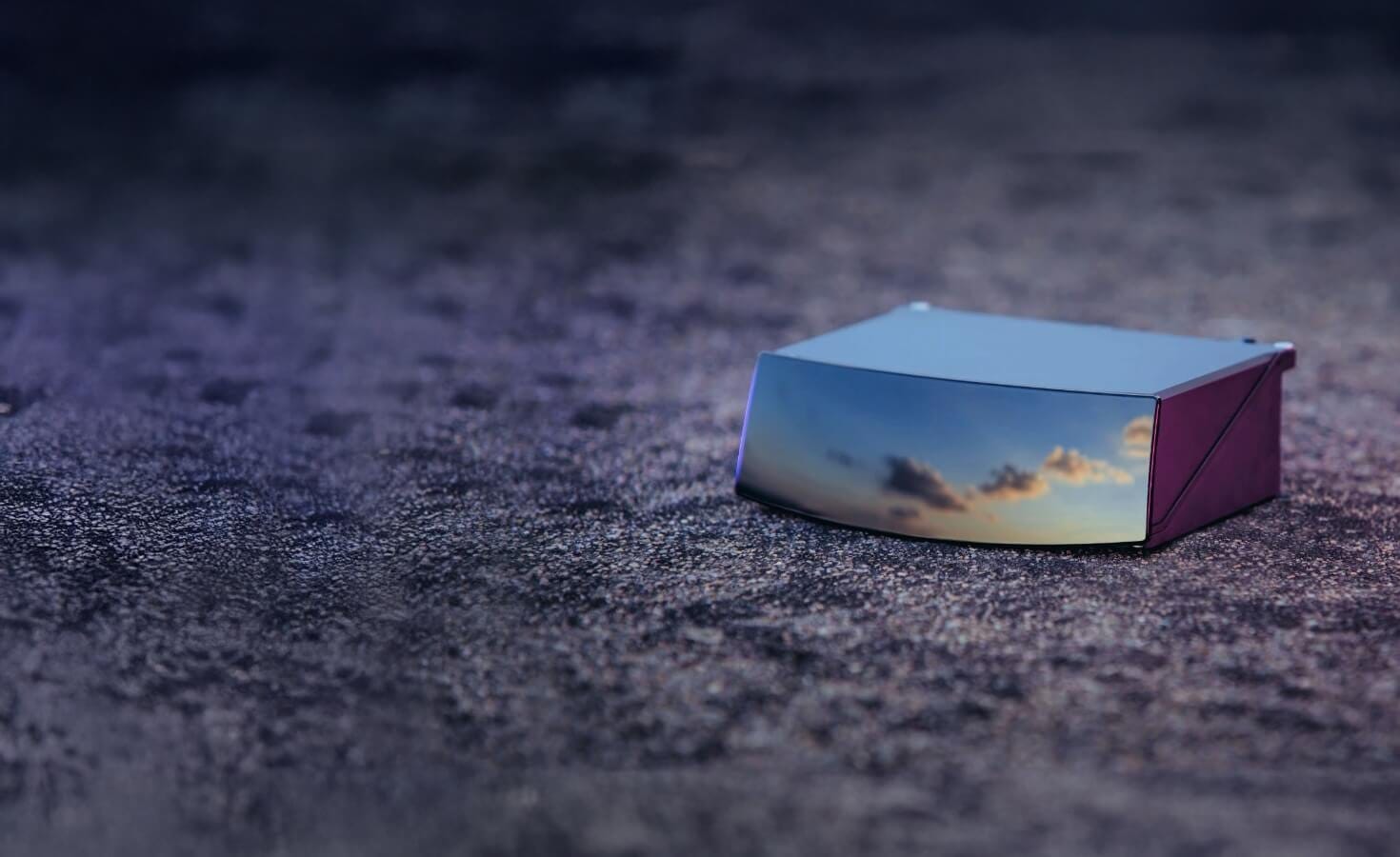
Best for: High-volume ADAS OEM programmes where proven mass-production economics matter more than US federal eligibility.
Pros
- The only lidar pure-play with sustained GAAP profitability
- Highest verified unit volume in the industry by a wide margin — 628,275 units in a single quarter
- 40% gross margin at scale, roughly double most of this field
- Broadest verified OEM footprint, including a publicly announced Toyota design win
Cons
- Barred from US defence procurement. Hesai is on the Section 1260H list and named expressly in NDAA Section 164, in force since 30 June 2026.
- Gross margin is compressing — 42.5% a year ago, 40.0% now, as cheap high-volume ADAS units dominate the mix.
- Heavy revenue concentration among Chinese carmakers leaves it exposed to the domestic EV price war and to any widening of US or EU rules.
- A US government laboratory began probing Chinese-made lidar for security vulnerabilities in August 2026, which is a live regulatory and headline risk regardless of what it finds.
- Pricing is quote-only; Hesai publishes no unit prices.
2. RoboSense
RoboSense is the volume runner-up and the clear leader in robotics. It shipped 719,200 units in the first half of 2026, up 169.6%, of which 282,600 went to robotics — a 510.4% increase. Revenue was RMB 1,019.7 million, up 30.2%.
Its architecture bet is in-house silicon: an EOCENE SPAD-SoC design with Phoenix and Peacock chipsets, now in mass production rather than on a roadmap. The EM4 is the only mass-producible lidar it lists with more than 500 beams, configurable from 520 up to 2,160. The E1R is fully solid-state with a 120° × 90° field of view, 75m maximum range, 260,000 points per second and no moving parts, rated IP67 and IP6K9K across −40°C to +85°C.
It is also the rare lidar company that publishes a price. The E1R is listed at US$999 with a direct store link. Automotive SKUs remain quote-only.
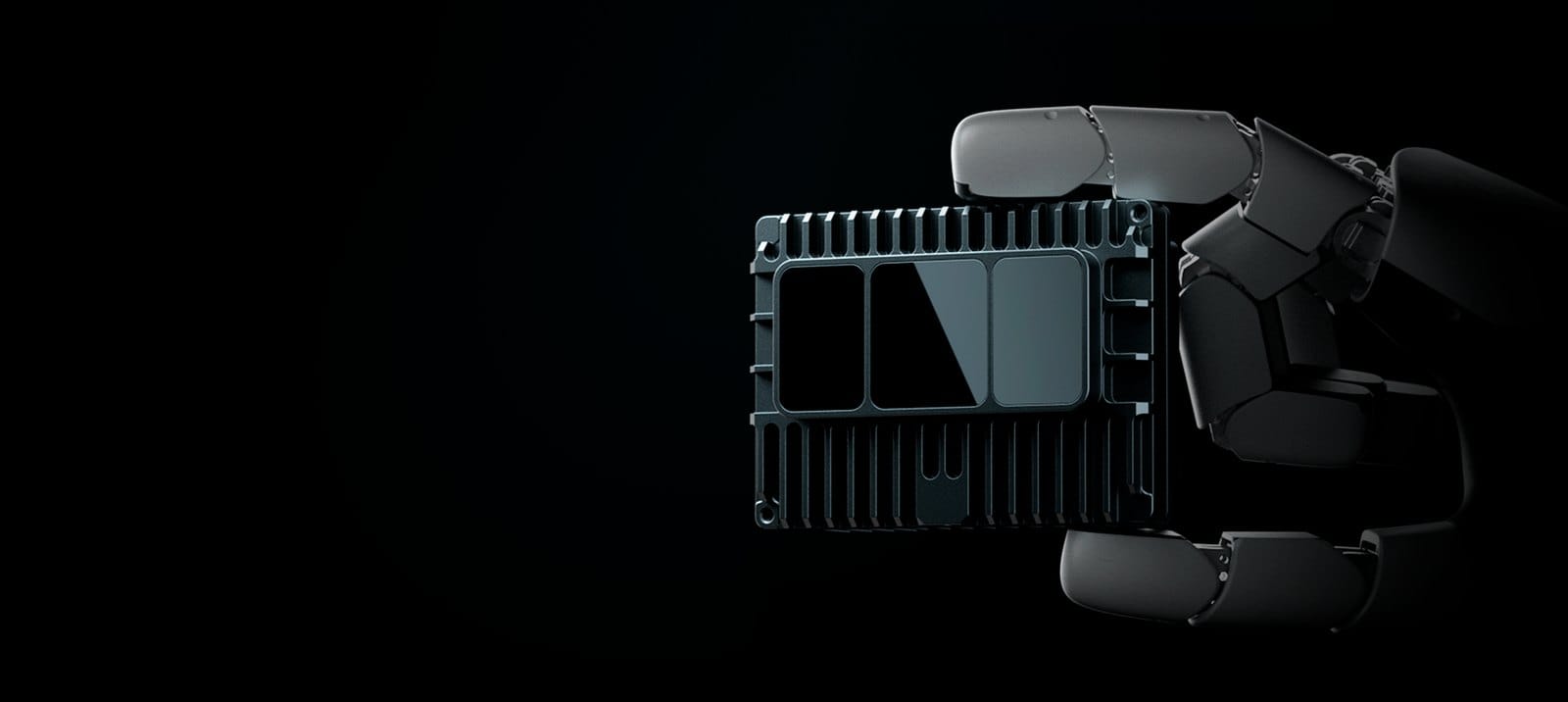
Best for: Robotics and AMR builders who want an automotive-grade solid-state sensor at a published, budgetable unit price.
Pros
- Published list pricing and a working web store for robotics sensors, which almost nobody else in this sector offers
- Genuine in-house silicon in mass production, not a roadmap claim
- Fastest robotics growth of any verified player, at 510% half-on-half shipment growth
- Second-broadest automotive base — 36 automakers and Tier 1 suppliers across 186 vehicle models as of 30 June 2026
Cons
- Still loss-making, and the loss widened — RMB 159.9 million in H1 2026, up 7.6% year over year.
- Gross margin fell to 21.8% from 25.9%, roughly half Hesai's, on lower selling prices and higher material costs. Pricing power is weak.
- Added to the Section 1260H list in June 2026, so NDAA Section 164 applies to it as well.
- Strategic churn: it is repositioning from lidar toward broader robotics components, which carries execution risk for a company not yet profitable.
3. Ouster
Ouster took the opposite route to the Chinese volume leaders and does not chase automotive series production. It sells digital lidar into smart infrastructure, security, industrial automation and robotics, and it is the credible NDAA-compliant and Buy America(n) certified supplier now that Hesai and RoboSense are locked out of DoD work. The OS1 is approved for unmanned aircraft and secure government operations.
One architecture spans the line. The OS1 offers 90m range at 10% reflectivity, a 45° vertical field of view, 128 channels and up to 10.4 million points per second; the OSDome gives a 180° hemispherical view. The Rev8 generation adds native colour. Software — Gemini and BlueCity — is in-house, and the StereoLabs acquisition on 4 February 2026 (about $35 million cash plus 1.8 million shares) added stereo cameras and embedded compute.
Q2 2026 revenue was $55 million, up 56%, its fourteenth consecutive quarter of growth, with GAAP gross margin of 49% — the best among Western suppliers here — on more than 17,000 sensors shipped.
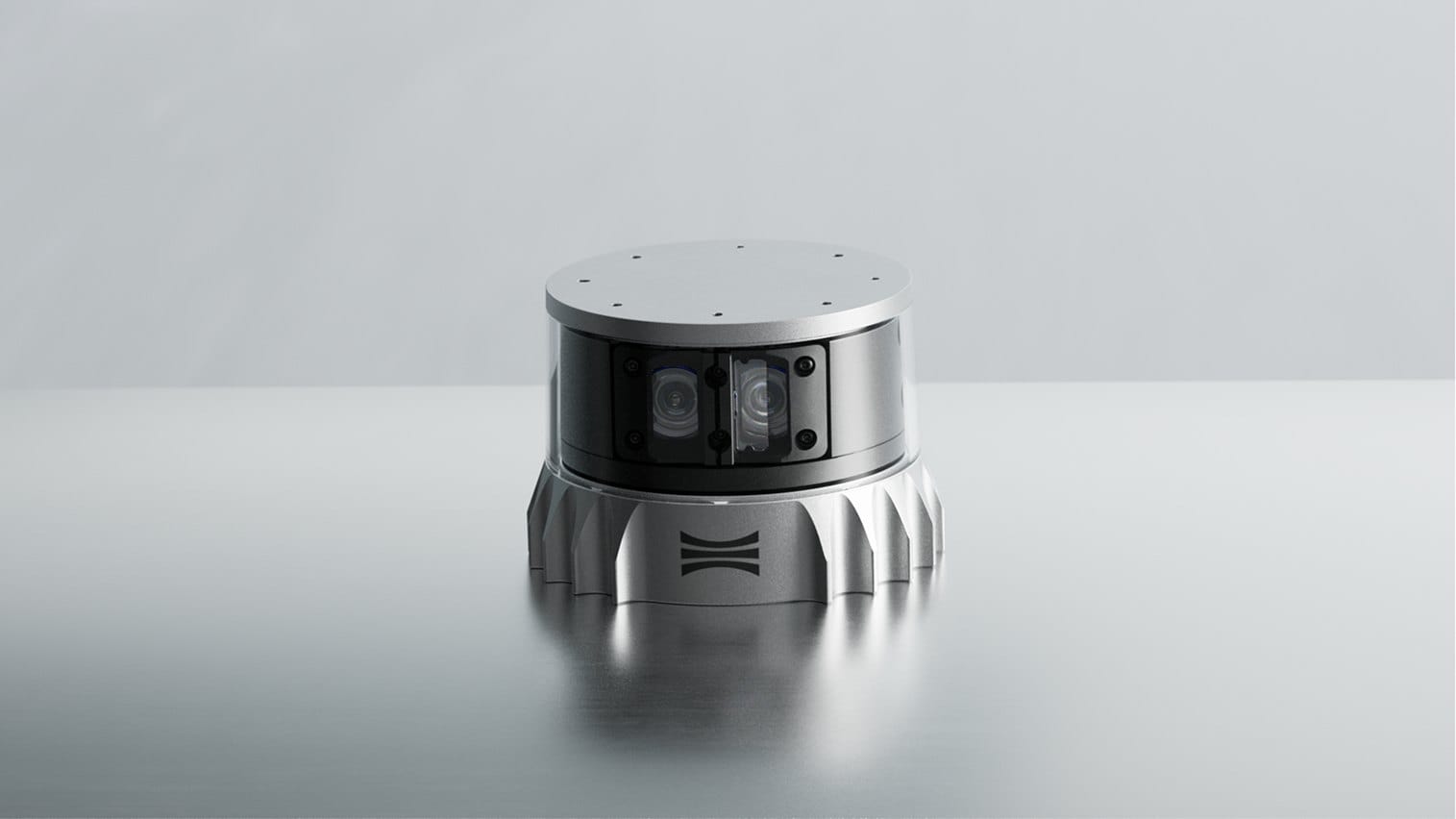
Best for: US government, defence, smart-city and security deployments where NDAA compliance is a hard requirement.
Pros
- NDAA-compliant and Buy America(n) certified, which is now a structural advantage in federal work
- 49% GAAP gross margin, up 400 basis points year over year
- Fourteen straight quarters of revenue growth, the most consistent record in the sector
- One unified architecture across OS0, OS1, OS2 and OSDome, plus owned perception software
Cons
- Still unprofitable — an $18.11 million net loss on $55 million of quarterly revenue.
- No verifiable automotive OEM series-production design win. Neither Ouster nor any carmaker has publicly named one. It has effectively ceded automotive volume.
- Unit volumes are two orders of magnitude below the leaders — roughly 17,000 a quarter against Hesai's 628,000 — so it has no route to automotive-scale unit cost.
- Integration risk from StereoLabs, and a broadening "physical AI" story that widens focus for a company this size.
- Pricing is quote-only; the legacy published price list has been removed.
4. Valeo
Valeo is the only supplier here with a certified Level 3 system in production. SCALA Gen 2 is the lidar in Mercedes-Benz DRIVE PILOT, the first mass-produced SAE Level 3 system. More than 220,000 SCALA units are on the road — the deepest automotive field history of anyone on this list.
SCALA Gen 3 offers 200m range at 10% reflectivity, a 120° × 26° field of view, 0.05° resolution in both axes and 12.5 million points per second at 10fps, with a selectable 10–20fps frame rate. What distinguishes it is the integration work point suppliers skip: built-in sensor heating and a cleaning system, plus an in-house perception stack. Stellantis selected it for STLA AutoDrive Level 3, alongside three other global OEMs, and Valeo reports more than €1 billion in SCALA 3 orders.
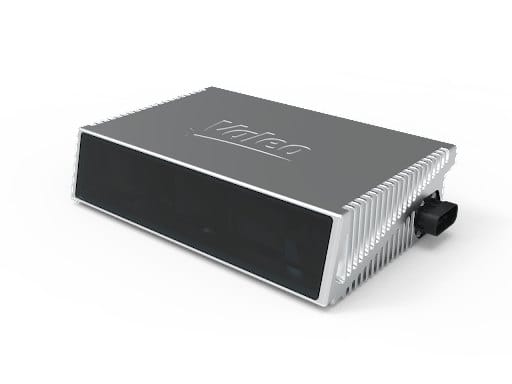
Best for: OEMs that need a certified, field-proven Level 3 lidar from an established Tier 1.
Pros
- The only verified, shipping, certified Level 3 production programme in this group
- Around 220,000 units already in the field
- More than €1 billion in orders for the current generation, across Stellantis and three further global OEMs
- Solves integration problems others leave to the carmaker — heating, cleaning and perception software included
Cons
- No lidar financial disclosure at all. Valeo does not break out lidar revenue, shipments or margin, so unit economics cannot be audited.
- Narrow product line — automotive only, with no robotics, industrial or infrastructure business to diversify into.
- Lidar sits inside a Tier 1 running a €500 million divestment programme. There is no evidence lidar is a candidate, and the opposite is being signalled, but line-level strategic risk exists.
- The flagship confirmed Level 3 win launches at around 37 mph, so real-world capability remains modest.
- Pricing is contract-only, as with all Tier 1 business.
5. Seyond
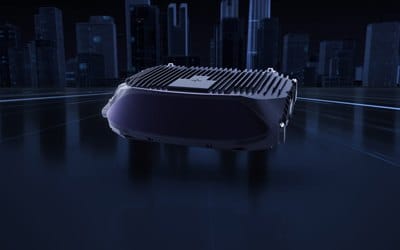
Seyond, formerly Innovusion, is the surviving 1550nm long-range specialist after Luminar's liquidation. The Falcon K detects from 1.5m to 500m, reaching 250m at 10% reflectivity with a 120° × 25° field of view and resolution to 0.06° × 0.06° — the longest verified range in this set. The line also includes the wide-field Robin W, the 300m Robin E1X, and the Hummingbird D1, a fully solid-state flash sensor with a 140° × 100° field of view.
Growth is the fastest here. First-half 2026 shipments hit roughly 450,900 units, up 364.8%, exceeding all of FY2025 in six months, on revenue of about US$140.2 million, up 127.9%. The loss narrowed 23.2%. The company passed one million cumulative lidar deliveries in April 2026 and listed on the Hong Kong exchange on 10 December 2025.
Best for: Long-range highway ADAS and smart-highway infrastructure where 250m at 10% reflectivity is the binding requirement.
Pros
- Longest verified range in this group, and the last 1550nm player operating at scale
- Fastest shipment growth of any company here, at 364.8% year over year
- Losses are genuinely narrowing, with operating expense down 26.3 percentage points as a share of revenue
- Three commercialised platforms — ultra-long-range, mid-range and solid-state flash — with over a million cumulative units delivered
Cons
- Severe single-customer dependence on NIO — 91.6% of revenue in 2024, still 82.0% in 2025. Improving, but NIO's own financial health transmits straight through.
- Gross margin of 11.2% is the weakest here, roughly a quarter of Hesai's. The 1550nm fibre-laser bill of materials is structurally expensive.
- Newly listed via de-SPAC in December 2025, so there is only one full interim reporting period to judge it on.
- Chinese manufacturing base leaves it exposed to the same policy trajectory as Hesai and RoboSense, though we found no evidence it is currently on the 1260H list.
6. Aeva
Aeva is the genuine technical outlier. Where everyone else measures time of flight, Aeva uses frequency modulated continuous wave sensing on a silicon-photonics chip, which returns instant per-point velocity alongside range. That makes it immune to sunlight and to interference from other lidars, including other Aeva units, and lets it derive six-degree-of-freedom ego-motion without an IMU or GPS.
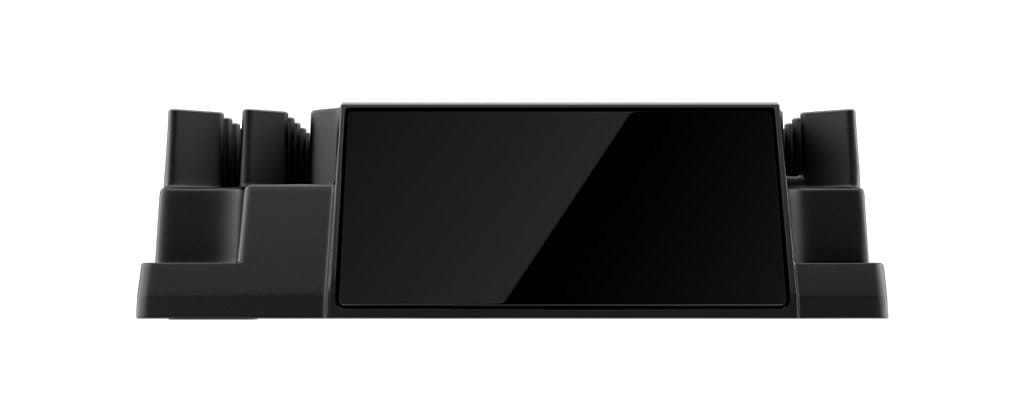
The Atlas reaches 250m at 10% reflectivity across a 120° × 30° field of view, carries ISO 26262 ASIL-B(D) functional safety and is 70% smaller than the previous generation, built on the Aeva X1 system-on-chip. It has two named exclusive wins: Daimler Truck North America and Torc, for autonomous Freightliner Cascadia Class 8 trucks, and an unnamed European passenger OEM for a Level 3 programme.
Then the numbers. Q2 2026 revenue was $6.1 million against a GAAP net loss of $79.6 million.
Best for: Level 4 trucking and applications where instant per-point velocity justifies a pre-production bet.
Pros
- The only FMCW player at this stage of development; per-point Doppler velocity is a real capability gap, not marketing
- Best-funded Western supplier here, with $302.9 million total liquidity at 30 June 2026
- Two named exclusive design wins, in Class 8 trucking and European Level 3
- Deepest silicon vertical integration, with an automotive-grade FMCW lidar SoC certified to ISO 26262 and ISO 21434
Cons
- Revenue is negligible against the burn — $6.1 million of quarterly revenue against a $79.6 million net loss, roughly a 13× ratio, by far the worst here.
- No volume production anywhere. The European OEM programme does not reach production until 2028, and Daimler is still at C-sample. Everything shipping today is prototype and engineering work.
- Cash consumption of about $28 million a quarter means even $302.9 million of liquidity requires either accelerating revenue or another raise.
- Launching an optical connectivity business for data centres in 2026 splits the focus of a small company and suggests lidar alone is not delivering.
- Pricing is quote-only.
7. Innoviz
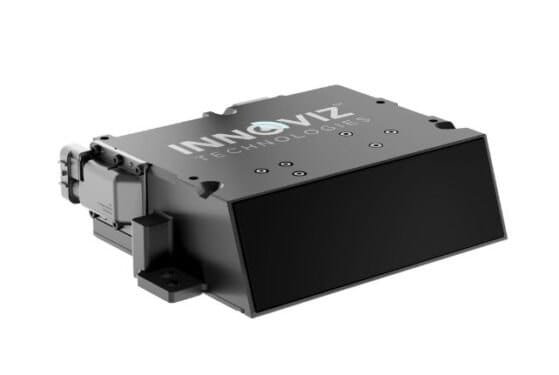
Innoviz builds MEMS-based time-of-flight sensors and has the production heritage to prove the engineering works. InnovizOne powered the BMW i7 Level 3 system launched in Germany in March 2024 — though that product is no longer for sale. The current InnovizTwo Long-Range covers 0.5m to 300m with a 120° × 43° maximum field of view, 0.05° × 0.05° angular resolution and a 10 or 20fps frame rate.
Its clearest live win is Volkswagen ADMT, which uses InnovizTwo on the ID. Buzz AD shuttle at three long-range plus six short-to-mid-range sensors per vehicle — unusually high sensor content. Q2 2026 revenue reached a record $18.1 million, nearly double the year-ago quarter, and the company is pushing hard into defence and homeland security, which it expects to reach 20–30% of revenue by 2027.
Best for: Level 3 and Level 4 shuttle programmes, and defence perception work requiring a non-Chinese supplier.
Pros
- Revenue nearly doubled year over year, the fastest growth rate among the Western pure-plays
- A named, verifiable OEM platform win at Volkswagen ADMT, with nine sensors per vehicle
- Genuine production heritage through the BMW i7, validating ISO 26262, IATF 16949 and ASPICE capability end to end
- Credible diversification: roughly half its 2026 defence target is already booked
Cons
- Weakest balance sheet here — $48.5 million of liquidity at 30 June 2026, requiring a roughly $30 million dilutive raise that closed on 29 July 2026.
- Revenue quality is poor. The record $18.1 million is a mix of non-recurring engineering services and unit sales, and NRE flatters the growth rate.
- Guidance is heavily back-end loaded — FY2026 of $67–73 million depends on the bulk of the second half landing in Q4, on customer milestones Innoviz does not control.
- Its newest OEM engagement is explicitly a development programme, not a series-production award, and the BMW product it is best known for is discontinued.
- Pricing is quote-only.
How to choose
You are a carmaker doing high-volume ADAS and you sell outside the US federal market. Hesai or RoboSense. They have the volume, the cost base and the design-win breadth, and nothing else is close on unit economics.
You need NDAA compliance or Buy America(n). Ouster, and effectively only Ouster at volume. Innoviz is the alternative if you need automotive-grade qualification and can accept its balance sheet.
You are launching a certified Level 3 programme. Valeo. It is the only supplier with one already on the road, and the integrated heating, cleaning and perception stack removes work you would otherwise own.
You are building robots, AMRs or drones. RoboSense, starting with the E1R at a published $999. Ouster if you need longer range or a US-origin supply chain.
You need long-range highway sensing above 200m. Seyond's Falcon K, with the caveat that you are buying from a company that earns 82% of its revenue from one customer.
You are doing Level 4 trucking and velocity data changes your perception stack. Aeva — but treat it as a 2028 production timeline and a technology partnership, not a procurement decision you can ship on next year.
Frequently Asked Questions
What is a lidar sensor?
A lidar sensor emits laser pulses and measures how long they take to return, converting those timings into precise distance measurements. Thousands to millions of measurements per second build a 3D point cloud of the surroundings. It gives direct depth data that cameras must infer and radar measures at far lower resolution.
What are lidar sensors used for?
Automotive driver assistance and autonomous driving are the largest market, followed by robotaxis and autonomous trucking. Beyond vehicles, lidar is used in warehouse robots and AMRs, drones, smart-city traffic monitoring, security and crowd analytics, ports, mining, agriculture, construction surveying and rail.
How do lidar sensors work?
A laser emitter fires pulses at a scene, typically at 905nm or 1550nm. Returning light hits a photodetector, often a SPAD array, and the sensor times the round trip to calculate distance. Scanning — mechanical, MEMS mirror or fully electronic — sweeps the beam across the field of view. FMCW designs instead measure frequency shift, which also yields velocity.
Does Tesla use lidar?
No. Tesla's production driver-assistance systems use a camera-based vision approach and do not include lidar, a position the company has held publicly for years. Most other automakers pursuing Level 3 autonomy — Mercedes-Benz, BMW, Stellantis, NIO and others — do fit lidar, which is why the suppliers on this list exist.
What is lidar technology's main limitation?
Cost and weather. Lidar remains more expensive per unit than cameras or radar, which is why cheap 905nm time-of-flight designs won on volume. Performance also degrades in heavy rain, fog and snow, and sensors need heating and cleaning to stay usable — one reason Valeo builds both into SCALA.
Editor's note — sources: Specifications and product claims come from each company's own product pages and datasheets, accessed 30 September 2026. Financial figures come from published results and filings: Hesai Q2 2026, RoboSense H1 2026 interim, Ouster Q2 2026, Seyond H1 2026 interim, Aeva Q2 2026 and Innoviz Q2 2026. Corporate status was verified against SEC filings and exchange announcements, including Luminar's Chapter 11 filing and confirmed plan of liquidation, the Ouster–Velodyne merger and the Koito–Cepton completion. US policy positions were checked against the FY2025 NDAA, the Section 1260H list as updated in June 2026, and the 2025 Commerce connected-vehicle rule. Where a design win or customer is unnamed by the supplier, it is described as unnamed rather than guessed.