
Top 7 Digital Twin Software Platforms for 2026
The 7 best digital twin software platforms for 2026: Siemens, NVIDIA Omniverse, Dassault, Ansys, Bentley, Azure, ThingWorx — features and pricing.

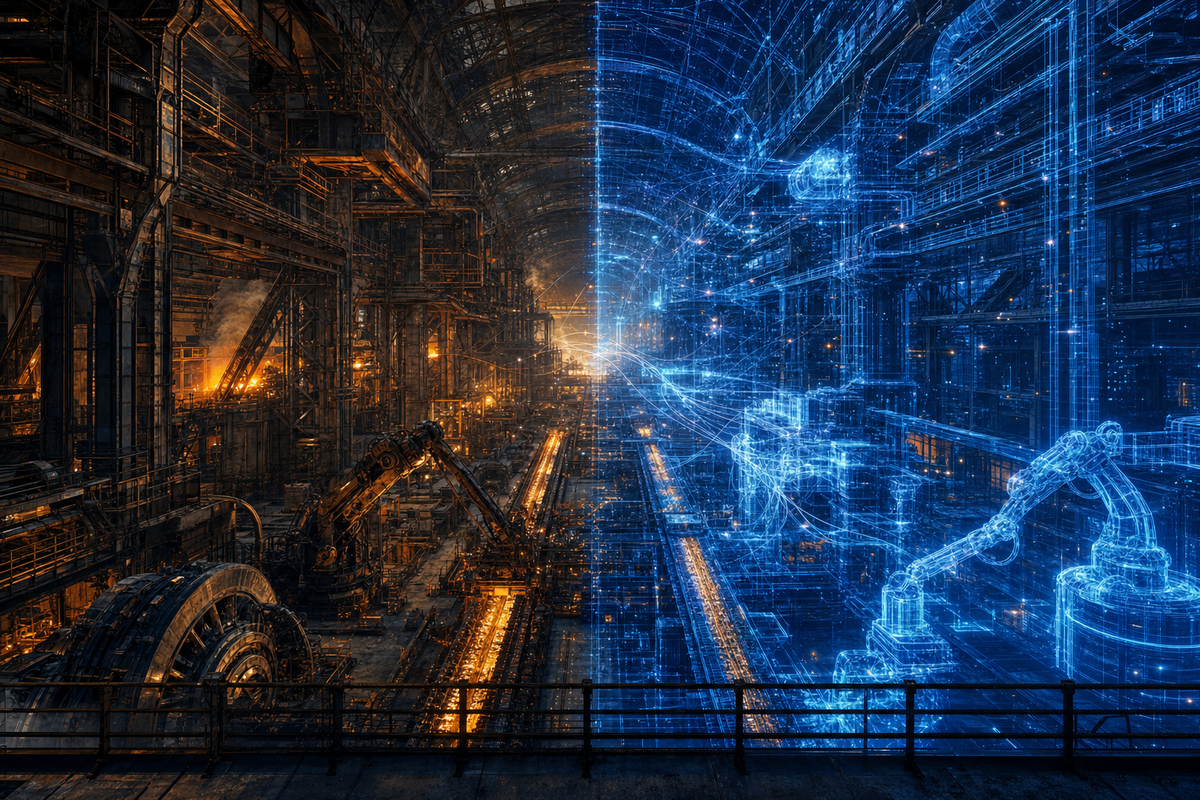
The leading digital twin software platforms in 2026 are Siemens, NVIDIA Omniverse, Dassault Systèmes, Ansys (now part of Synopsys), Bentley iTwin, Microsoft Azure Digital Twins, and ThingWorx (now owned by Velotic). A digital twin is a live, data-connected virtual model of a physical product, machine, building, or process. These platforms differ sharply — some simulate physics, others bind real-time IoT telemetry, and one has just changed hands.
TL;DR
- Siemens offers the broadest end-to-end industrial twin (design to operations); NVIDIA Omniverse is the fast-rising OpenUSD visualization and simulation layer the others plug into.
- Ansys was acquired by Synopsys (closed July 17, 2025); ThingWorx and Kepware were sold by PTC to TPG and spun into a new company, Velotic (March 2026).
- Most of these are quote-based enterprise platforms. Azure Digital Twins is the exception — consumption-priced, pay-as-you-go.
- Pick by industry: Siemens/Ansys/NVIDIA for manufacturing, Bentley iTwin for infrastructure, Azure for cloud-native IoT operations twins.
Digital twin software creates a virtual replica of a physical asset or system, kept in sync with real-world data so you can simulate, monitor, and predict behavior. The 2026 market splits into three types: physics-and-engineering twins (Siemens, Ansys, Dassault), real-time operations and IoT twins (ThingWorx/Velotic, Azure Digital Twins) that often sit on top of the IoT platforms feeding them telemetry, and the visualization-and-simulation layer that ties them together (NVIDIA Omniverse, Bentley iTwin for infrastructure). This guide ranks the seven platforms that matter, with deployment models, honest limitations, and two ownership changes you need to know before you buy.
How we picked these
We ranked on industrial maturity, breadth of the "digital thread" (design through operations), simulation fidelity, open-standards support, and verifiable adoption. Incumbents with deep multiphysics and large reference deployments rank above narrower or newer tools. We checked ownership explicitly — two of these platforms changed hands in the last 18 months — and weighted real cons equally: suite lock-in, opaque enterprise pricing, steep learning curves, and narrow industry fit. Pricing and ownership facts are as of November 2026; most vendors quote by project, which we state plainly rather than guessing numbers.
Quick comparison
| Platform | Best for | Deployment | Pricing model |
|---|---|---|---|
| Siemens | Full design-to-operations manufacturing twin | On-prem, private cloud, SaaS | Quote-based |
| NVIDIA Omniverse | Photoreal factory/robotics simulation (OpenUSD) | SDK on RTX GPUs; on-prem or cloud | Quote-based (Enterprise) |
| Dassault Systèmes | Aerospace/defense and life-sciences twins | 3DEXPERIENCE cloud + on-prem | Quote-based (role licensing) |
| Ansys (Synopsys) | Physics-grounded predictive twins | Desktop authoring; cloud/edge runtime | Quote-based |
| Bentley iTwin | Infrastructure and AEC twins | Cloud platform + open SDK | Quote-based; API tiers |
| Azure Digital Twins | Cloud-native IoT operations twins | Azure PaaS (cloud-only) | Consumption-based |
| ThingWorx (Velotic) | Real-time plant-floor IIoT monitoring | On-prem and cloud | Quote-based |
1. Siemens
Siemens Digital Twin, delivered through the Siemens Xcelerator platform, spans product, production, and performance in one environment. It ties multiphysics simulation (Simcenter), PLM and the digital thread (Teamcenter), CAD (NX, Solid Edge), and manufacturing operations into a single source of truth. The distinction is breadth: few vendors connect design, manufacturing, and operations this completely, and Siemens is layering industrial AI and an industrial-metaverse tie-in through its NVIDIA Omniverse partnership.
Best for: Large manufacturers wanting one vendor across the full digital thread.
Pros
- The broadest end-to-end digital thread — CAD, CAE, PLM, and manufacturing operations under one roof.
- Best-in-class multiphysics simulation through Simcenter.
- Open Xcelerator ecosystem with an Omniverse/OpenUSD visualization tie-in.
Cons
- Suite lock-in: full value requires multiple Siemens modules.
- Opaque, quote-based enterprise pricing and high total cost.
- Steep learning curve and heavy implementation effort.
2. NVIDIA Omniverse
NVIDIA Omniverse is a platform of APIs and reference "Blueprints" for building physically accurate, real-time industrial twins on OpenUSD, which NVIDIA positions as the interchange layer connecting tools from Siemens, Rockwell, Dassault, and Ansys. Its strengths are RTX real-time path-traced rendering, built on the same AI chips NVIDIA sells for training, and tight coupling to AI and physics simulation for robotics and factory planning. Omniverse usually acts as the visualization and simulation layer inside a partner's workflow rather than a standalone operations twin, and NVIDIA publicizes deployments at BMW, Foxconn, and Mercedes-Benz.
Best for: Photoreal, real-time factory and robotics simulation and vendor-neutral twin assembly.
Pros
- OpenUSD-native aggregation lets you assemble twins from many vendors' tools.
- Unmatched real-time photoreal rendering plus physics and robotics simulation.
- Ships as the visual and simulation layer inside Siemens, Rockwell, and Dassault workflows.
Cons
- Heavy infrastructure: it requires significant NVIDIA RTX/GPU investment.
- Not a turnkey operations twin — you integrate and build on it, which is developer-heavy.
- No native IoT telemetry or PLM layer; it depends on partners for the data and operations side.
3. Dassault Systèmes
Dassault Systèmes brands its approach the "Virtual Twin Experience," a real-time replica spanning the full lifecycle on the 3DEXPERIENCE platform, with NETVIBES adding AI and data science. Dassault deliberately uses "virtual twin" to signal a broader lifecycle scope than an operations dashboard. Its standout is unified modeling and simulation (MODSIM) plus uniquely strong positions in aerospace-and-defense systems engineering and life-sciences twins, including its widely publicized "Living Heart" healthcare program. In 2026 it is moving toward an AI-native platform with agentic "Virtual Companions."
Best for: Aerospace and defense systems engineering and regulated life-sciences twins.
Pros
- Unified modeling and simulation (MODSIM) on one platform.
- Uniquely strong in life-sciences/healthcare twins and A&D systems engineering.
- True full-lifecycle "experience" scope, not just a monitoring dashboard.
Cons
- Highly proprietary and platform-locked, with thinner open-standards (OpenUSD/FMI) support than peers.
- Complex, costly role-based licensing and a steep adoption curve.
- "Virtual twin" terminology and platform breadth can obscure which modules you actually need.
4. Ansys (part of Synopsys)
Ansys Twin Builder assembles multidomain system models from FMI-compatible components and reduced-order models (ROMs) generated from Ansys 3D structural, fluid, and electromagnetic simulation. Its "hybrid analytics" calibrates models against sensor data, and Twin Deployer pushes the twin to cloud, edge, or offline runtimes. The distinction is physics-grounded fidelity: these twins are built from simulation, not purely from data, which matters where sensor data is sparse. Synopsys completed its acquisition of Ansys on July 17, 2025, folding the simulation leader into the semiconductor EDA giant; the product is now branded "Ansys, part of Synopsys."
Best for: High-fidelity, physics-based predictive twins where sensor data is limited.
Pros
- Physics- and simulation-grounded ROMs produce high-fidelity twins without dense sensor data.
- Strong FMI and multiphysics interoperability.
- Twin Deployer enables true edge and offline runtime deployment.
Cons
- Requires the upstream Ansys simulation suite (Mechanical, Fluent, HFSS) to generate ROMs — not standalone.
- Opaque, expensive enterprise licensing.
- The ownership transition to Synopsys adds roadmap and branding uncertainty; weaker on broad IoT fleet operations.
5. Bentley iTwin
Bentley Systems built iTwin specifically for infrastructure. The iTwin Platform aggregates engineering and BIM data, reality models from point clouds and drone photogrammetry, and IoT feeds into a web-visualizable 4D twin, now part of the Bentley Infrastructure Cloud. Its purpose-built fit for civil and AEC assets — roads, rail, bridges, water, grid, and plants — sets it apart, and its open-source iTwin.js SDK makes it more developer-friendly and less proprietary than most peers. Bentley's annual Going Digital Awards showcase hundreds of named infrastructure-twin projects.
Best for: Infrastructure owner-operators in rail, roads, water, grid, and plants.
Pros
- The deepest infrastructure and AEC fit, with reality-modeling (drone and point-cloud) fusion.
- Open-source iTwin.js SDK reduces lock-in relative to peers.
- A strong design-to-construction-to-operations lifecycle story for civil assets.
Cons
- Narrow industry fit — built for infrastructure, not discrete manufacturing or product twins.
- Best value needs other Bentley apps (OpenRoads, ProjectWise), creating suite gravity.
- Quote-based enterprise pricing, and building a full twin is integration-heavy.
6. Microsoft Azure Digital Twins
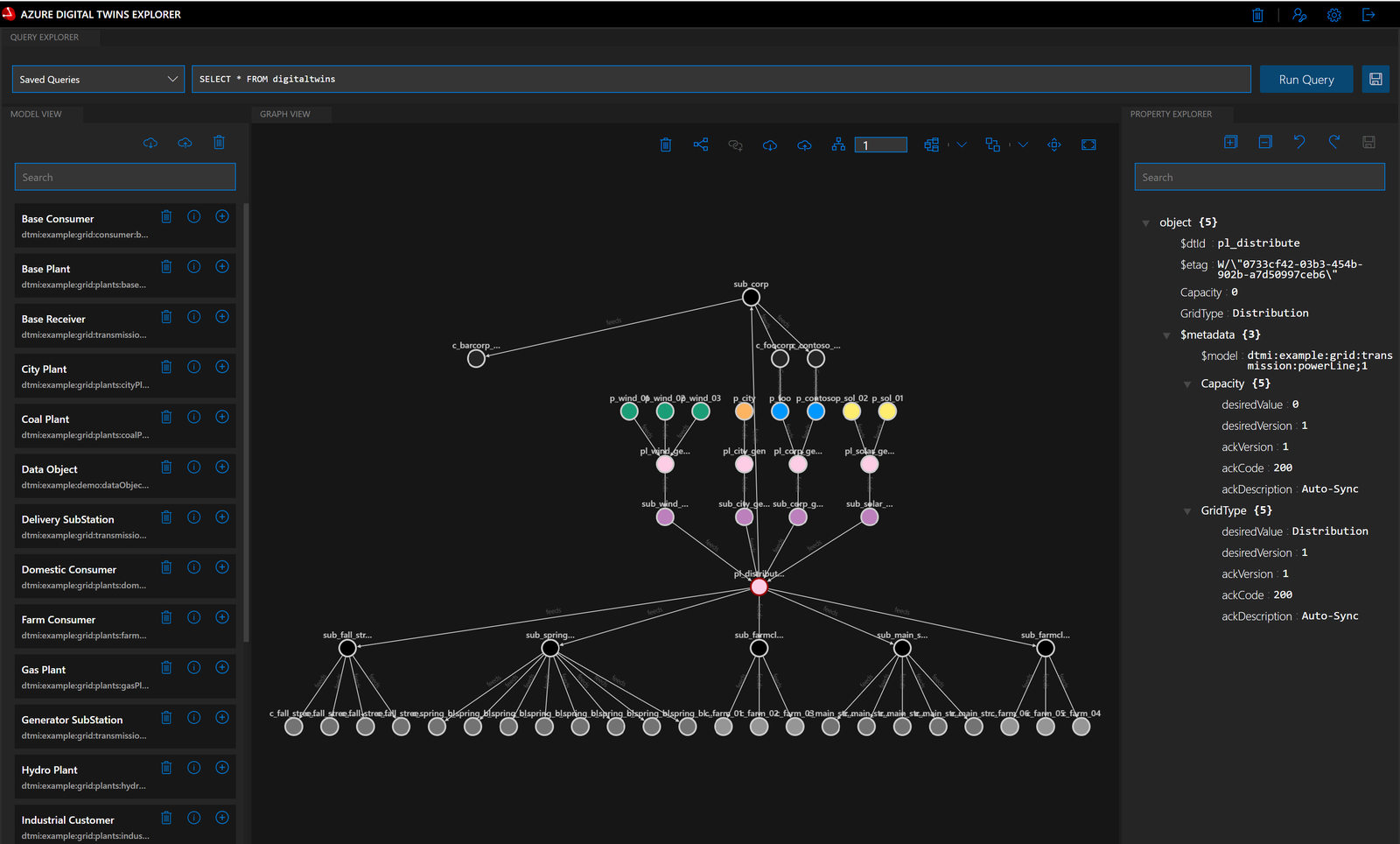
Azure Digital Twins is a platform-as-a-service for building a live "twin graph" of an environment — a building, factory, farm, or energy network — from models written in the open DTDL language. It ingests live data through IoT Hub, queries the graph, drives 3D visualization, and routes events to downstream Azure analytics and AI. The distinction is a standards-based graph model plus the deepest cloud and IoT ecosystem integration. Unlike its rivals, it is genuinely consumption-priced: pay-as-you-go across operations, messages, and query units, with no seat licensing.
Best for: Cloud-native teams building custom smart-building or IoT operations twins on Azure.
Pros
- Open DTDL modeling with prebuilt industry ontologies — a standards-based graph.
- The deepest cloud, IoT, and analytics integration (IoT Hub, Event Grid, Fabric, Power BI).
- Consumption pricing with no seat lock-in and a low entry cost.
Cons
- Azure lock-in and cloud-only — no on-prem or air-gapped option.
- A toolkit, not a turnkey app: you build the twin and its visualization yourself.
- No native physics simulation, and overlapping Microsoft twin products can confuse buyers.
7. ThingWorx (now Velotic)
ThingWorx is an industrial IoT application platform that connects machines through Kepware's protocol-agnostic connectivity, binds live telemetry to digital-twin "Things," and drives real-time dashboards and low-code apps. ThingWorx 10 added an AI-ready foundation and agents. Its strength is real-time IoT data binding and the breadth of Kepware's OPC and industrial-protocol support — an operations and monitoring twin, not a physics simulator. The major change: PTC sold ThingWorx and Kepware to private-equity firm TPG, which launched them as an independent company, Velotic, in March 2026. ThingWorx is no longer a PTC product.
Best for: Real-time plant-floor IIoT monitoring and predictive-maintenance twins.
Pros
- Best-in-class industrial connectivity (Kepware) with real-time telemetry binding.
- Low-code app and dashboard building for operations twins.
- Deployment flexibility across on-prem and cloud, suiting air-gapped plants.
Cons
- Ownership upheaval — just spun out to a PE-owned entity (Velotic), so roadmap, support, and brand are in transition.
- An operations-monitoring twin only; no native physics simulation or 3D CAE.
- Full value depends on Kepware and now Proficy within the new Velotic stack.
How to choose
Start with your industry. Discrete manufacturing and product engineering point to Siemens for breadth or Ansys for physics fidelity; add NVIDIA Omniverse when you need photoreal factory or robotics simulation. Aerospace, defense, or life sciences favor Dassault's systems-engineering and healthcare twins. Infrastructure and AEC — rail, water, grid, plants — are Bentley iTwin's lane, and nothing else fits as well. If you want a cloud-native, pay-as-you-go operations twin you build yourself on standard models, Azure Digital Twins has no seat lock-in and the lowest entry cost. For real-time plant-floor IoT monitoring, ThingWorx still has the connectivity edge — just weigh the Velotic ownership transition before committing. Two practical notes: budget for professional services, since most of these are integration-heavy, and confirm current branding and roadmaps directly, because Ansys and ThingWorx both changed owners in the past 18 months.
Frequently Asked Questions
What is a digital twin?
A digital twin is a virtual model of a physical object, system, or process that stays synchronized with real-world data. It mirrors the real asset's state so engineers can simulate scenarios, monitor performance, and predict failures. Twins range from physics-based engineering models to real-time IoT operations dashboards, depending on the platform and use case.
What is the best digital twin software?
Siemens offers the broadest industrial platform, from design through operations, while NVIDIA Omniverse leads real-time visualization and simulation. For physics-grounded engineering twins, Ansys is the benchmark; for infrastructure, Bentley iTwin; and for cloud-native IoT operations twins, Azure Digital Twins. The best choice depends on your industry and whether you need simulation or monitoring.
How much does digital twin software cost?
Most industrial digital twin platforms — Siemens, Ansys, Dassault, Bentley, and NVIDIA Omniverse Enterprise — are quote-based, with pricing set by project scope and modules. Azure Digital Twins is the exception, using consumption pricing across operations, messages, and query units. Expect significant implementation and integration costs on top of licensing for enterprise deployments.
What industries use digital twins?
Manufacturing, automotive, and aerospace use twins for design, simulation, and production planning. Infrastructure and construction use them for buildings, rail, and utilities. Energy, process industries, and smart cities use them for monitoring and predictive maintenance, and healthcare uses patient and device twins. The common thread is pairing a physical asset with a live, data-connected model.
Is a digital twin the same as a simulation?
No. A simulation runs a model of a system, often offline and for a specific study. A digital twin is continuously connected to its real-world counterpart through live data, so it reflects the asset's actual current state over its lifetime. Many digital twins incorporate simulation, but the live data link is what makes a twin a twin.
Editor’s note — sources: Product, deployment and pricing details were taken from each vendor’s own site and documentation as of November 2026. Two ownership changes were verified against primary sources: Synopsys’ completion of the Ansys acquisition (July 17, 2025), and PTC’s divestiture of ThingWorx and Kepware to TPG, relaunched as Velotic (March 2026), reported across multiple outlets. Most of these are enterprise, quote-based platforms; Azure Digital Twins is consumption-priced via the Azure pricing calculator. Market-size and revenue figures were omitted where they could not be traced to a primary source.