
Top 7 Edge AI Platforms and Chips in 2026
For engineers choosing silicon for robots, cameras, drones and industrial systems in 2026 - a year when edge accelerators stopped being vision-only parts and started running language models locally.


For engineers choosing silicon for robots, cameras, drones and industrial systems in 2026 — a year when edge accelerators stopped being vision-only parts and started running language models locally.
Edge AI platforms run inference on the device instead of in a data center, which matters when latency, bandwidth, privacy or connectivity rule out a round trip to the cloud. The category is now split between full compute modules you drop into a product (NVIDIA Jetson, Qualcomm Dragonwing, Ambarella, SiMa.ai), bolt-on accelerators that add AI to an existing host (Hailo, Axelera AI), and NPU designs licensed to chipmakers (Arm). The defining change this year: parts in the 2.5W–10W range now run local LLMs and vision-language models, not just object detection.
How we picked these
Shipping now, not sampling. Every platform here is in production and buyable, through distributors, devkits or IP licensing.
Software maturity. Silicon is the easy part. Compiler quality, model-zoo coverage and framework support decide whether a part is usable in six weeks or six months.
Verifiable specifications. Performance figures below come from each vendor's own product pages. Where a number is a vendor benchmark or marketing claim rather than a specification, it is labeled as such — there is no independent, audited benchmark covering all seven.
Deployment breadth. How many form factors, thermal envelopes and industrial or automotive temperature grades the platform actually covers.
Ranking reflects production maturity, software ecosystem and breadth of supply — not raw TOPS. TOPS numbers across vendors are not comparable anyway, since they depend on the numeric precision quoted, a point Hailo itself makes in its own technical writing. All specifications are as of September 2026.
Quick comparison
| Company | Best for | Form factor | Headline performance |
|---|---|---|---|
| NVIDIA Jetson | Robotics and physical AI needing maximum headroom | Compute modules and devkits | Up to 2,070 FP4 TFLOPS (Thor) |
| Qualcomm Dragonwing | Long-lifecycle industrial and IoT products | SoCs via ODM partners | 20–700 TOPS across the IQ series |
| Hailo | Adding efficient AI to an existing host board | M.2, mPCIe, PCIe cards, vision SoCs | 40/20 TOPS (INT4/INT8) at 2.5W |
| Ambarella | Camera and automotive vision with local GenAI | SoCs | Multimodal LLMs up to 34B parameters under 50W |
| Arm Ethos | Chipmakers building their own AI silicon | Licensable NPU IP | Up to 4 TOPS at 1 GHz (Ethos-U85) |
| Axelera AI | High-throughput multi-camera vision | M.2, PCIe, embedded systems | Up to 214 TOPS INT8, 15 TOPS/W |
| SiMa.ai | Jetson-compatible upgrades, multimodal edge | SoM, PCIe card, devkit | 50 TOPS multimodal under 10W, from $449 |
1. NVIDIA Jetson
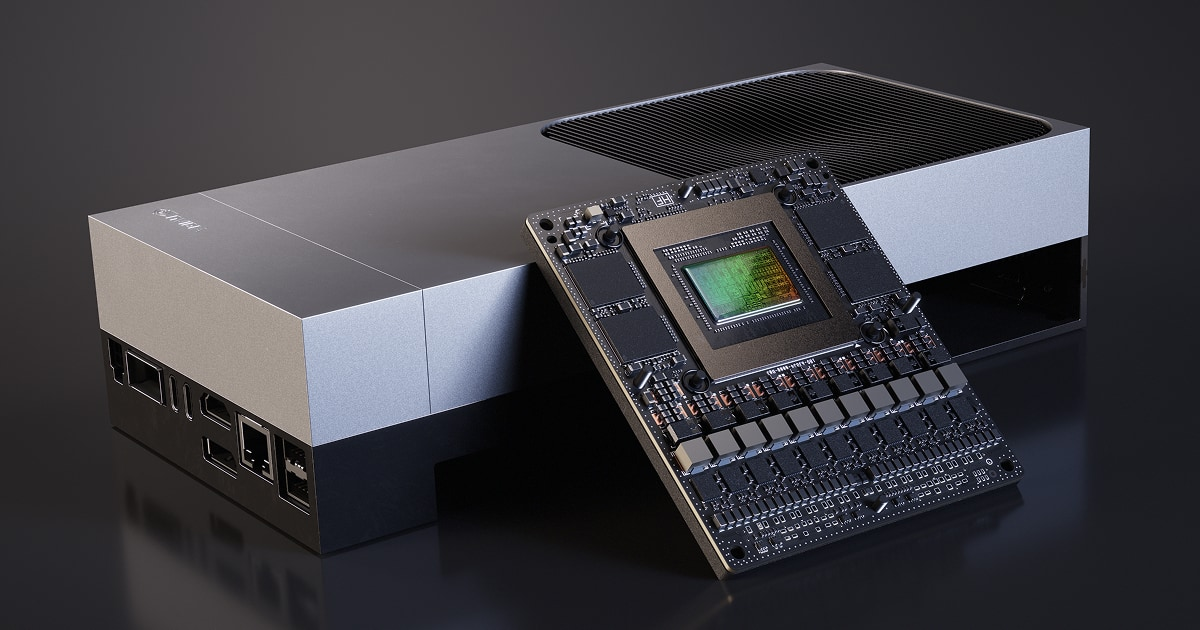
NVIDIA Jetson remains the default, mostly because of software. The Jetson family shares one architecture and one SDK — JetPack, with CUDA underneath — so a model developed on a workstation moves to an embedded module without a separate toolchain. The current top end is Jetson Thor, built on Blackwell, which NVIDIA specifies at up to 2,070 FP4 TFLOPS of AI compute with 128GB of 256-bit LPDDR5X at 273 GB/s, power configurable between 40W and 130W. NVIDIA states Thor delivers over 7.5x the AI compute of Jetson AGX Orin with 3.5x better energy efficiency. Below it, Jetson AGX Orin reaches up to 275 TOPS, Orin NX up to 157 TOPS, and Orin Nano Super sits at 67 TOPS for compact generative AI work.
Best for: robotics and physical AI where compute headroom and toolchain maturity matter more than power draw.
Pros - One SDK and CUDA runtime across the whole family, so porting between tiers is straightforward - Thor's 40W–130W configurable envelope lets one module serve several thermal designs - Deep third-party ecosystem: carrier boards, camera partners, ROS support and pretrained models - Clear performance ladder from 67 TOPS up to Thor, so you can scale a product line without changing stacks
Cons - Power and cost sit well above the accelerator-class parts here — 40W minimum on Thor rules out battery and fanless designs - Performance quoted in FP4 TFLOPS rather than INT8 TOPS makes direct comparison with rivals awkward - CUDA dependence is real lock-in: models and kernels tuned for Jetson don't move to other silicon cheaply - Historically constrained supply and long lead times on newly launched modules
2. Qualcomm Dragonwing
Qualcomm consolidated its industrial and IoT silicon under the Dragonwing brand, and it is now the broadest edge portfolio by workload range: Qualcomm describes the Dragonwing IQ series as spanning 20 to 700 TOPS across IQ8, IQ9, IQ10 and IQ-X families. The IQ-X series pairs up to 45 TOPS of on-device AI acceleration with 8- or 12-core Oryon CPUs reaching 3.4 GHz single-thread. In September 2026, ahead of IFA, Qualcomm added the Dragonwing Q-2390 for commercial and consumer IoT and the IQ-2390, the first part in a new industrial IQ2 series. The commercially decisive detail is lifecycle: Qualcomm commits to product longevity support through 2036 or later, which is what industrial customers designing a ten-year product actually need. Qualcomm also acquired Edge Impulse in March 2025, announced at Embedded World in Nuremberg, bringing an established model-development workflow in-house; terms were not disclosed.
Best for: industrial and IoT products with long service lives and tight power budgets.
Pros - Longevity support committed through 2036 or later, which few competitors match - Range from 20 to 700 TOPS lets one vendor relationship cover sensors through edge servers - Owning Edge Impulse gives Qualcomm a real developer-facing training and deployment workflow - Strong ODM channel — Innodisk and SECO both ship Dragonwing-based modules and carrier systems
Cons - You mostly buy Dragonwing through partners rather than directly, adding an integrator to the supply chain - Qualcomm's product web pages render dynamically and are thin on plain specifications, so evaluation means requesting documentation - Frequent renaming — Snapdragon to Dragonwing, plus overlapping IQ, IQ-X and now IQ2 lines — makes the portfolio hard to navigate - No public unit pricing at any tier
No product image is included for Qualcomm: its Dragonwing product pages are rendered client-side and no image could be retrieved from Qualcomm's own properties.
3. Hailo
Hailo built its business on doing one thing efficiently: dropping an accelerator onto a board that already has a host CPU. The Hailo-10H is its second-generation part, specified at 40 TOPS INT4 or 20 TOPS INT8 with 2.5W typical consumption, supporting LPDDR4/4X and — the meaningful addition — a direct DDR interface so it can scale to LLMs and VLMs rather than just vision models. Hailo offers industrial (-40°C to 85°C) and automotive (-40°C to 105°C) grades. The earlier Hailo-8 delivers 26 TOPS and remains widely deployed, alongside the entry-level 8L, the 8R mPCIe module, the Hailo-8 Century PCIe card, and the Hailo-15L and 15H vision processors. The software suite includes a Dataflow Compiler, the HailoRT runtime and a Model Zoo, supporting TensorFlow, TensorFlow Lite, Keras, PyTorch and ONNX across x86 and Arm hosts on Linux, Windows and Android. Distribution is unusually accessible for this category — Avnet/EBV, Farnell, WPG and J Squared all stock it, and the Hailo-10H is the accelerator inside the Raspberry Pi AI HAT+ 2.
Best for: adding capable, low-power AI to a design that already has a host processor.
Pros - 2.5W typical power at 20 TOPS INT8 is among the best efficiency figures published in this list - Buyable in small quantities from mainstream distributors, no design-win negotiation required - Both industrial and automotive temperature grades from the same part family - Raspberry Pi design win means a large hobbyist and prototyping community, which speeds up early development
Cons - Headline "40 TOPS" is INT4; the INT8 figure is 20 TOPS, so quoted performance halves at the precision most vision models still use - It is an accelerator, not a system-on-chip — you still need to select and support a host processor - Absolute ceiling is far below Jetson Thor or Axelera Metis, so large multi-stream workloads need multiple modules - The website gates product briefs and the Developer Zone behind registration, slowing evaluation
No product image is included for Hailo: its media files sit behind bot protection that blocked retrieval from hailo.ai.
4. Ambarella
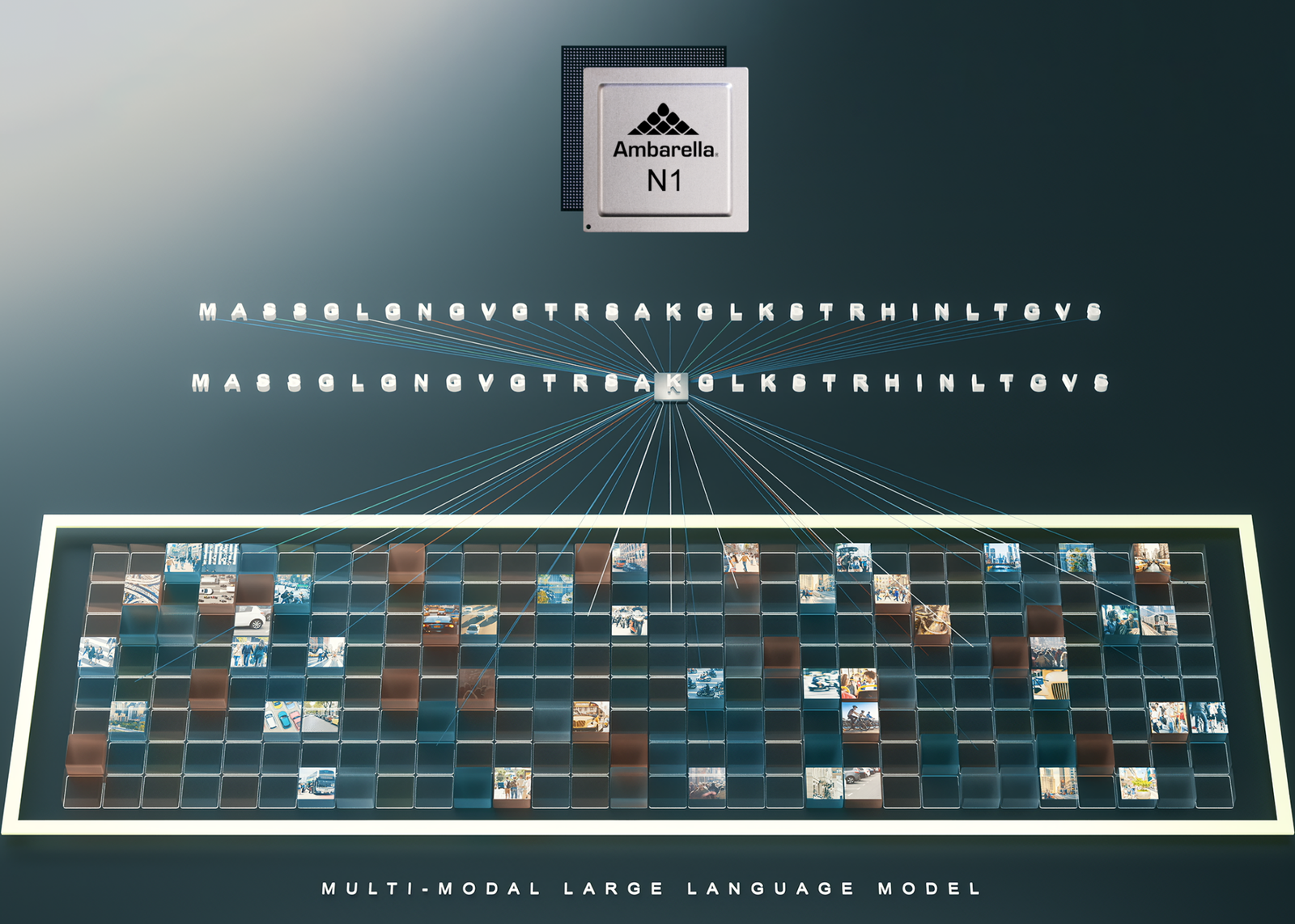
Ambarella spent two decades building video-processing silicon for cameras and cars, and its N1 series applies that lineage to generative AI. Ambarella specifies the N1 at 5nm with what it describes as server-grade performance under 50W, supporting multimodal LLMs up to 34 billion parameters. The architecture is notably more than an NPU: neural network compute alongside a general vector processor, an advanced image processor, a dense stereo and optical flow engine, 16 Arm Cortex-A78AE CPUs and a GPU. That combination suits systems where the AI is one stage in a real sensor pipeline. The N1-655 targets smart cities, industrial automation, robotics, healthcare and on-premise AI hubs, and Ambarella has since extended the family with a part aimed at on-premise multi-channel VLM and neural network processing under 20W. Ambarella is publicly traded, which makes its financials and risk disclosures unusually transparent for this list.
Best for: camera, automotive and robotics systems that need image signal processing and local generative AI on one chip.
Pros - Full sensor pipeline on-chip — image processing, stereo depth and optical flow, not just matrix math - Cortex-A78AE CPUs are automotive safety-oriented cores, relevant for functional-safety programs - Public company reporting gives buyers visibility into financial stability and supply risk - Multi-channel VLM processing under 20W addresses on-premise video analytics directly
Cons - Ambarella does not publish TOPS figures for the N1 series, making comparison with rivals difficult - Its business runs on design wins, so small-volume buyers are poorly served - Under-50W positioning is high for battery-powered or fanless enclosures - Tooling is oriented to camera and automotive OEMs rather than general-purpose AI developers
5. Arm Ethos
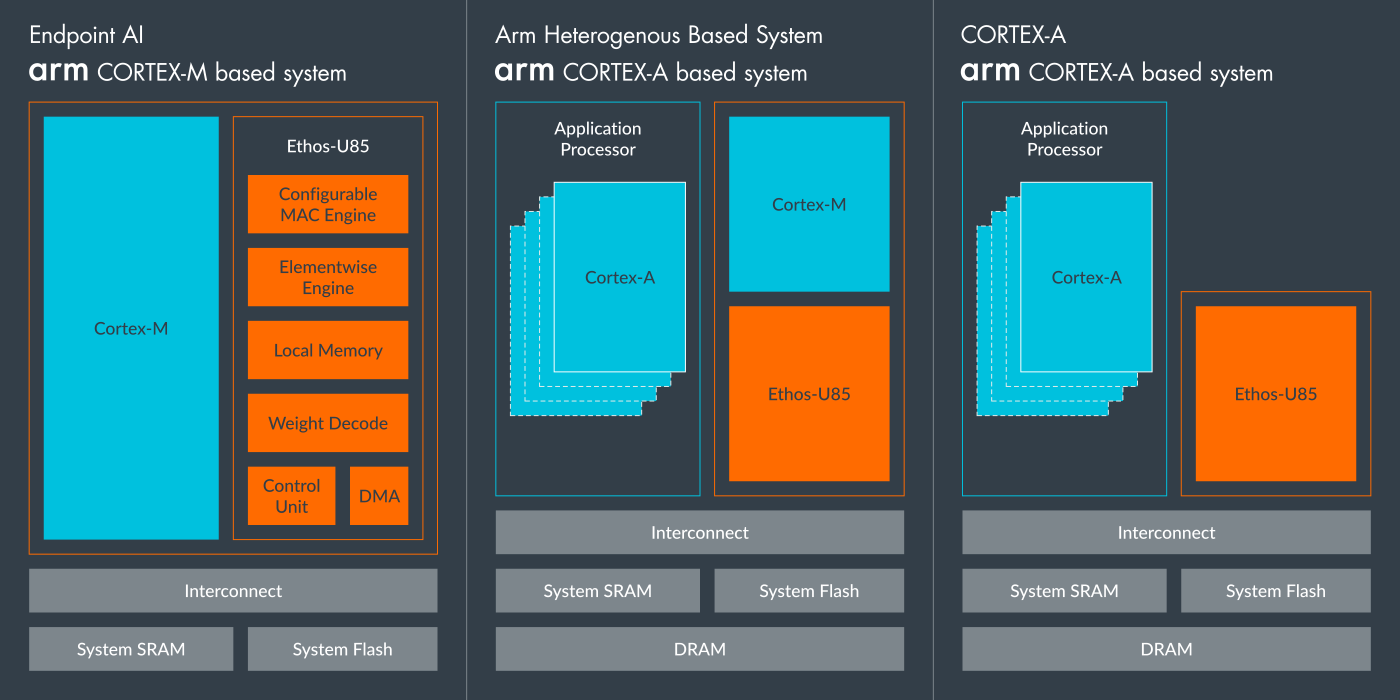
Arm does not sell chips. It licenses NPU designs that other companies build into their silicon, which is why Ethos ends up in far more devices than any part on this list while being invisible to the people using them. Ethos-U85 is the current microcontroller-class design: it scales from 128 to 2,048 MACs and delivers up to 4 TOPS at 1 GHz, and Arm states it is 20% more energy efficient than the earlier Ethos-U55 and U65. It adds native support for transformer networks and for the Tensor Operator Set Architecture (TOSA) as a standard interface. Ethos-U85 pairs with either Cortex-M microcontrollers for endpoint AI or Cortex-A application processors in heterogeneous systems, sharing system SRAM, flash and DRAM. If you are a product company rather than a chip company, Ethos matters as the thing inside the microcontroller you selected — not as a purchase decision.
Best for: semiconductor companies and large OEMs designing their own AI-capable silicon.
Pros - Configurable from 128 to 2,048 MACs, so licensees tune area and power to the target product - TOSA support gives a standard operator interface rather than a proprietary compiler path - Native transformer support in a microcontroller-class NPU, which was rare until recently - Enormous ecosystem — Arm toolchains, CMSIS-NN and vendor SDKs are already familiar to embedded teams
Cons - Not purchasable as a product; realizing it requires a silicon program with licensing costs and multi-year timelines - 4 TOPS is orders of magnitude below the accelerator parts here — it targets keyword spotting and sensor analytics, not video LLMs - Your actual performance depends on the licensee's implementation, memory system and clock, not on Arm's figures - Licensing terms and pricing are private, negotiated per customer
6. Axelera AI
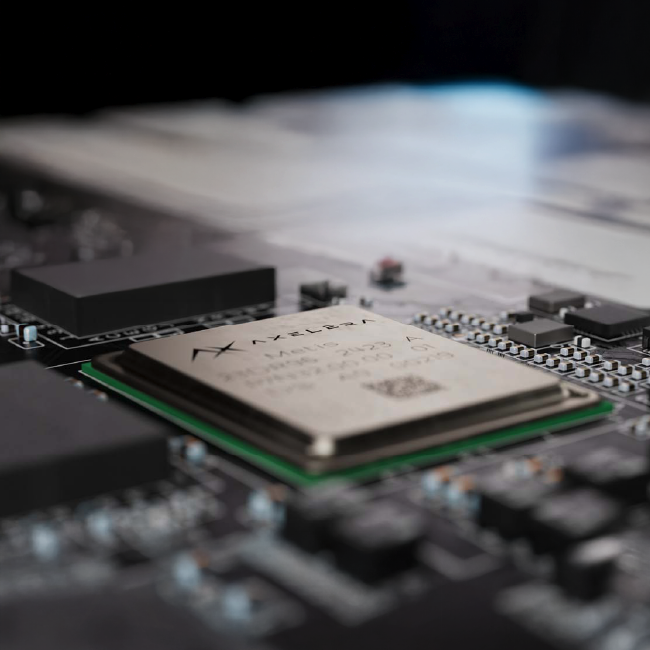
Axelera AI, headquartered in Eindhoven, built the Metis AI processing unit around in-memory computing, and its published figures are aggressive: up to 214 TOPS INT8 from a single Metis unit, up to 3,200 frames per second on ResNet-50, and 15 TOPS per watt. Axelera also cites 16.4 frames per second per dollar on ResNet-50 for the Metis PCIe system — a cost-per-throughput framing rather than a raw performance one, and its own benchmark rather than an independent result. The product line spans M.2 modules, PCIe cards, an embedded system and a mini PC, with a next-generation part named Europa announced. The Voyager SDK, Voyager Wingman and a model zoo make up the software side, and Axelera lists Dell, Advantech, Lenovo, Aetina, SECO and Arduino as partner system suppliers — meaningful validation for a company this young.
Best for: multi-camera vision workloads where throughput per watt and per dollar decide the design.
Pros - 15 TOPS/W and 214 TOPS INT8 from one unit put it at the top of the published efficiency figures here - Range from M.2 up to mini PC covers prototype through deployment without changing vendors - Partner systems from Dell, Lenovo and Advantech reduce integration risk considerably - European supply chain, which increasingly matters for public-sector and defense-adjacent procurement
Cons - The fps/$ and fps figures are Axelera's own benchmarks, and ResNet-50 is a dated proxy for current workloads - Youngest software stack in this list — Voyager has far less field history than JetPack or Hailo's compiler - A recent product renaming across the Metis and Europa lines adds confusion to documentation and part numbers - No public unit pricing, and the company's long-term independence is unproven relative to the incumbents
7. SiMa.ai
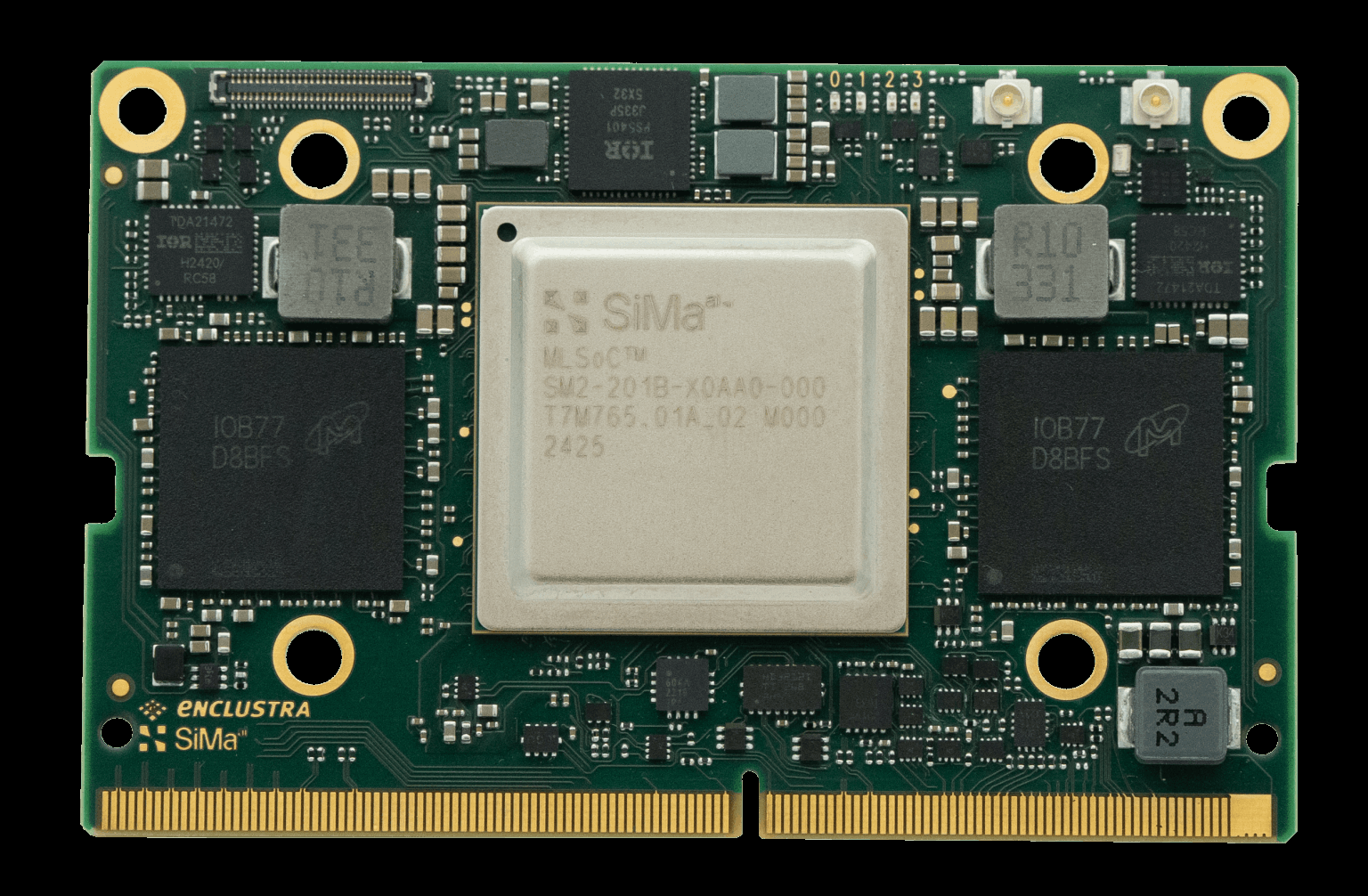
SiMa.ai targets what it calls physical AI, and its second-generation Modalix MLSoC is built on TSMC's N6 process. SiMa specifies 50 TOPS of multimodal AI at sub-10W, with BF16, INT8 and INT16 precision, MIPI, USB, PCIe Gen5 RC and SPI interfaces, TrustZone with encryption and eKeys for security, and support for CNNs, vision transformers, LLMs and large multimodal models. The most practical decision SiMa made is compatibility: the Modalix system-on-module is pin-compatible with NVIDIA Jetson Orin NX and Orin Nano, so it drops into existing carrier boards as an upgrade path. It also publishes a price — from $449 — which almost nobody else in this category does. A half-height half-length PCIe card and devkits round out the line, with the Palette SDK on the software side. In April 2026 SiMa.ai announced a strategic investment from Micron.
Best for: teams already on Jetson Orin carrier boards who want more efficiency without redesigning hardware.
Pros - Pin-compatible with Jetson Orin NX and Nano, a genuinely unusual migration path in embedded silicon - Publishes a starting price of $449, so budgeting doesn't require a sales call - 50 TOPS multimodal under 10W covers CNNs, ViTs and LLMs on one part - Hardware security built in — TrustZone, encryption and eKeys — relevant for government and defense work
Cons - 50 TOPS is well below Axelera's 214 TOPS INT8 and far below Jetson Thor, limiting high-stream-count designs - Smallest ecosystem here: Palette and the model browser have limited third-party tooling around them - Least established supply track record, and the Micron investment signals it is still scaling manufacturing - Its Jetson pin compatibility is also a dependency — it competes inside a form factor NVIDIA defines
How to choose
Start with the power budget, not the TOPS number. A 2.5W Hailo-10H and a 130W Jetson Thor are not competing for the same socket. Fix your thermal envelope first and the list shortens immediately.
If you need maximum compute and fast development, Jetson Thor and the JetPack stack are still the shortest path — as long as 40W minimum and CUDA lock-in are acceptable.
If you are adding AI to an existing board, Hailo and Axelera are the direct answers, with Hailo winning on power and distributor availability and Axelera on raw throughput.
If your product must ship for a decade, Qualcomm's support commitment through 2036 or later is the differentiator, and no one else states it as plainly.
If the workload is cameras, Ambarella's on-chip image pipeline removes components you would otherwise add around a bare NPU.
If you are already on Jetson Orin hardware, SiMa.ai's pin-compatible module is worth benchmarking purely because switching costs are close to zero.
If you are designing your own chip, Arm Ethos is the question, and it is a completely different timeline and budget from everything above.
One caution on specifications: compare at the same numeric precision. Hailo's 40 TOPS is INT4 and 20 TOPS INT8; NVIDIA quotes Thor in FP4 TFLOPS; Axelera quotes INT8. Vendors pick the flattering unit, which is why Hailo's own engineering blog argues TOPS alone is misleading. Benchmark your model, on your data, at your power ceiling. The same discipline applies whether you are picking edge silicon or datacenter training and inference chips, and it is the reason robotics programs usually run their own bring-up before committing.
Frequently Asked Questions
What is edge AI?
Edge AI runs machine learning inference on the device that captures the data — a camera, robot, vehicle or sensor — instead of sending it to a cloud data center. This reduces latency, cuts bandwidth costs, keeps data local for privacy or regulation, and lets systems keep working without network connectivity.
What is the difference between an edge AI chip and an accelerator?
A system-on-chip like Ambarella's N1 or SiMa.ai's Modalix includes CPUs, memory interfaces and often image processing, so it can run a product on its own. An accelerator such as Hailo-10H or Axelera Metis only handles inference and plugs into a host board that already provides a processor.
Are TOPS figures comparable between vendors?
No. TOPS depends on numeric precision, so a part quoting 40 TOPS at INT4 may deliver 20 TOPS at INT8. Vendors also quote peak theoretical throughput rather than sustained performance on real models. Compare at identical precision and benchmark your own workload before deciding.
Can edge devices run large language models locally?
Yes, within limits. Hailo-10H adds a direct DDR interface specifically to scale to LLMs and VLMs at 2.5W. Ambarella's N1 supports multimodal models up to 34 billion parameters under 50W. Expect modest token rates and quantized models rather than frontier-scale performance.
How much do edge AI platforms cost?
Only some vendors publish prices. SiMa.ai lists Modalix modules from $449. Hailo modules sell through distributors including Avnet and Farnell in small quantities. NVIDIA Jetson devkits are publicly priced. Qualcomm, Ambarella, Axelera and Arm all quote privately, so budget for a procurement process.
Editor's note — sources: NVIDIA Jetson modules and Jetson Thor; Hailo-10H product page; Ambarella N1 announcement and N1 family expansion; Arm Ethos-U85; Axelera Metis AIPU; SiMa.ai MLSoC family, Modalix in production and Micron investment; Qualcomm Dragonwing IQ series details via Qualcomm's Dragonwing announcement coverage and Edge Impulse acquisition. Performance claims and benchmark figures are vendor-published and attributed as such. Specifications verified September 2026. Analysis is Edgewisely's own.
On the software side of edge inference, our Ollama vs llama.cpp comparison covers which runtime reaches which silicon, including the Vulkan, SYCL and OpenCL backends that matter off the CUDA path.