
Top 7 Reverse Proxy Servers in 2026
A skeptical, sourced comparison of the 7 best reverse proxy servers in 2026 — NGINX, HAProxy, Envoy, Traefik, Caddy, Apache HTTP Server and Varnish — with pros, cons, licenses and pricing for load balancing and TLS.


TL;DR
- The best reverse proxy servers in 2026 are NGINX, HAProxy, and Envoy. NGINX is the versatile default (30% of all websites per W3Techs), HAProxy is the load-balancing specialist, and Envoy is the cloud-native, CNCF-graduated standard.
- All seven are free and open source. Paid editions (NGINX Plus, HAProxy Enterprise, Traefik Hub, Varnish Enterprise) add support and advanced features and are priced on request.
- For containers and Kubernetes, Traefik and Caddy win on ease: automatic service discovery and automatic HTTPS out of the box.
- Watch the governance story: NGINX is an F5 product, with the independent freenginx fork (started 2024) still shipping releases in 2026.
A reverse proxy server sits in front of your backend applications and handles incoming traffic — routing requests, terminating TLS, balancing load, and caching responses — so clients never talk to your origin servers directly. In 2026 the three to evaluate first are NGINX (the versatile, battle-tested default), HAProxy (the dedicated load balancer), and Envoy (the programmable, cloud-native proxy behind most service meshes). The other four each own a niche: Traefik and Caddy for container-native simplicity, Apache HTTP Server for traditional hosting, and Varnish for high-speed HTTP caching. All seven are open source, so the real question is fit, not price.
How we picked these
We ranked on real-world adoption, versatility (web server, load balancer, cache, TLS), maturity, and support for modern features like HTTP/3, dynamic configuration, and automatic TLS. We verified each project's license, latest stable release, and governance as of November 2026, including commercial ownership where it affects the roadmap. Adoption figures come from W3Techs (as of Nov 2026), which counts origin web servers — so HAProxy, Envoy, and Varnish are undercounted because they usually run as load balancers or caches, not as the detected origin. We did not rank on throughput benchmarks, which depend too heavily on configuration and hardware to compare fairly.
Quick comparison
| Server | Best for | Deployment | License / pricing |
|---|---|---|---|
| NGINX | Versatile all-purpose proxy | Self-hosted | BSD-2-Clause; free, NGINX Plus on request |
| HAProxy | High-performance load balancing | Self-hosted | GPLv2/LGPL; free, Enterprise on request |
| Envoy | Service meshes, API gateways | Self-hosted | Apache-2.0; free |
| Traefik | Kubernetes / container routing | Self-hosted | MIT; free, Hub/Enterprise on request |
| Caddy | Simplest automatic HTTPS | Self-hosted | Apache-2.0; free |
| Apache HTTP Server | Traditional LAMP/PHP hosting | Self-hosted | Apache-2.0; free |
| Varnish | HTTP caching accelerator | Self-hosted | BSD-2-Clause; free, Enterprise on request |
1. NGINX

NGINX is the most versatile and most widely deployed reverse proxy, which makes it the default choice for most workloads. One event-driven binary serves static content, reverse-proxies, load-balances at L4 and L7, and caches — with very low memory per connection. HTTP/3 over QUIC is stable in recent releases. Configuration is a declarative directive file (nginx.conf); the open-source edition has no built-in dynamic reconfiguration or service discovery, so changes need a reload. NGINX has been an F5 product since 2019. In 2024, core developer Maxim Dounin forked it as freenginx over governance disputes; both remain active in 2026 (NGINX stable 1.30.6, October 2026). The commercial NGINX Plus adds live reconfiguration, active health checks, and support, priced on request.
Best for: a fast, versatile all-purpose reverse proxy and web server for almost any workload.
Pros
- Proven at massive scale, with very low memory use per connection.
- Huge module ecosystem and ubiquitous documentation.
- Handles web serving, reverse proxy, L4/L7 load balancing, and caching in one binary.
Cons
- The open-source edition lacks dynamic config and service discovery — config changes need a reload.
- Advanced load balancing (active health checks, the live reconfig API) is gated behind paid NGINX Plus.
- The config syntax has sharp edges, such as
locationand regex ordering.
2. HAProxy

HAProxy is the gold-standard dedicated load balancer, and the pick when traffic control matters more than serving files. It is an event-driven, multi-threaded proxy with deep L4 and L7 features — rich load-balancing algorithms, health checks, ACLs, stick-tables, rate limiting, and strong observability through a stats page, a Runtime API, and Prometheus metrics. HTTP/3 over QUIC is supported. Its Data Plane API adds dynamic configuration on top of the structured frontend/backend config file. The project is led by Willy Tarreau; HAProxy Technologies sells HAProxy Enterprise, the ALOHA appliance, and the Fusion control plane (priced on request). The current line is 3.4 LTS (2026). HAProxy is not a general web server — it won't serve static sites.
Best for: high-performance, feature-rich L4/L7 load balancing.
Pros
- Exceptional throughput and connection efficiency, matured over roughly 20 years.
- Deep traffic control — ACLs, stick-tables, rate limiting, retries.
- Excellent runtime observability, plus a Runtime API for live changes without a full reload.
Cons
- Not a web server — it cannot serve static content like NGINX, Caddy, or Apache.
- The config language is powerful but steep (ACLs, maps, stick-tables).
- WAF, bot management, and long-term support are gated behind HAProxy Enterprise.
3. Envoy

Envoy is the modern cloud-native standard, and the right choice when you need a programmable proxy at fleet scale. Built in C++ at Lyft in 2016, it is driven by xDS APIs — a gRPC/REST control plane that hot-updates configuration with no restarts — and it offers best-in-class observability (tracing, detailed stats, access logs) and strong HTTP/2, HTTP/3, and gRPC support. It is the data plane inside Istio and many API gateways. Envoy is a CNCF graduated project (graduated November 2018), which means vendor-neutral governance rather than a single corporate owner. The latest release is v1.39.1 (August 2026). There is no "Envoy Enterprise"; commercial value comes from third-party products built on it, such as Istio distributions and Gloo.
Best for: service meshes and programmable, control-plane-driven API gateways at fleet scale.
Pros
- Dynamic xDS configuration — programmable and hot-reconfigurable across a fleet.
- Best-in-class observability, with tracing, detailed stats, and gRPC support.
- Vendor-neutral CNCF governance and the de-facto standard for service meshes.
Cons
- A steep learning curve and verbose config; it is rarely used standalone without a control plane.
- A heavier resource footprint, and overkill for simple reverse-proxy needs.
- Not a web server — it won't serve static content.
4. Traefik
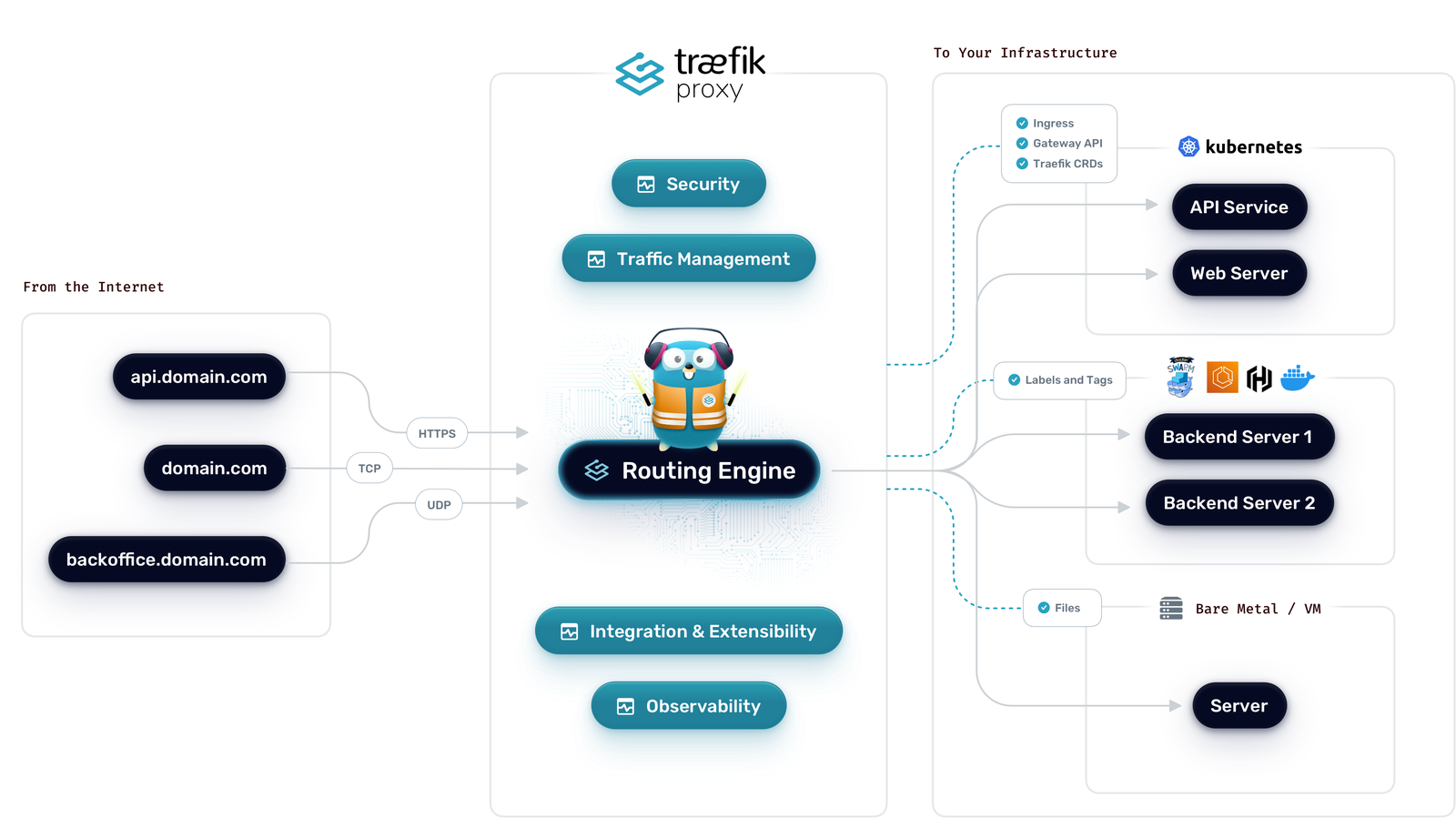
Traefik is the best developer experience for containers and Kubernetes, because it configures itself. Written in Go, it watches providers — Docker, Kubernetes, Consul — and reconfigures routes live with zero reloads, and it obtains and renews TLS certificates automatically through Let's Encrypt/ACME. It is primarily an L7 router (with some TCP/UDP), supports HTTP/3, and ships a web dashboard, metrics, and first-class Kubernetes CRDs and Gateway API support. It is MIT-licensed. The company Traefik Labs (formerly Containous) sells Traefik Hub (API management) and Traefik Enterprise (clustered HA control plane), priced on request. The latest release is v3.7.16 (October 2026). The trade-off is overhead and config churn: the v1→v2→v3 migrations have been painful.
Best for: Kubernetes and container environments that need auto-discovery plus automatic TLS.
Pros
- True dynamic config and service discovery — no reloads, ideal for ephemeral containers.
- Automatic HTTPS through ACME, out of the box.
- First-class Kubernetes support (CRDs, Gateway API), plus a built-in dashboard and metrics.
Cons
- Higher memory and overhead than C-based NGINX or HAProxy; lower raw performance.
- Frequent config-format changes across major versions make upgrades disruptive.
- Advanced API-gateway and HA control-plane features are gated behind Hub/Enterprise.
5. Caddy
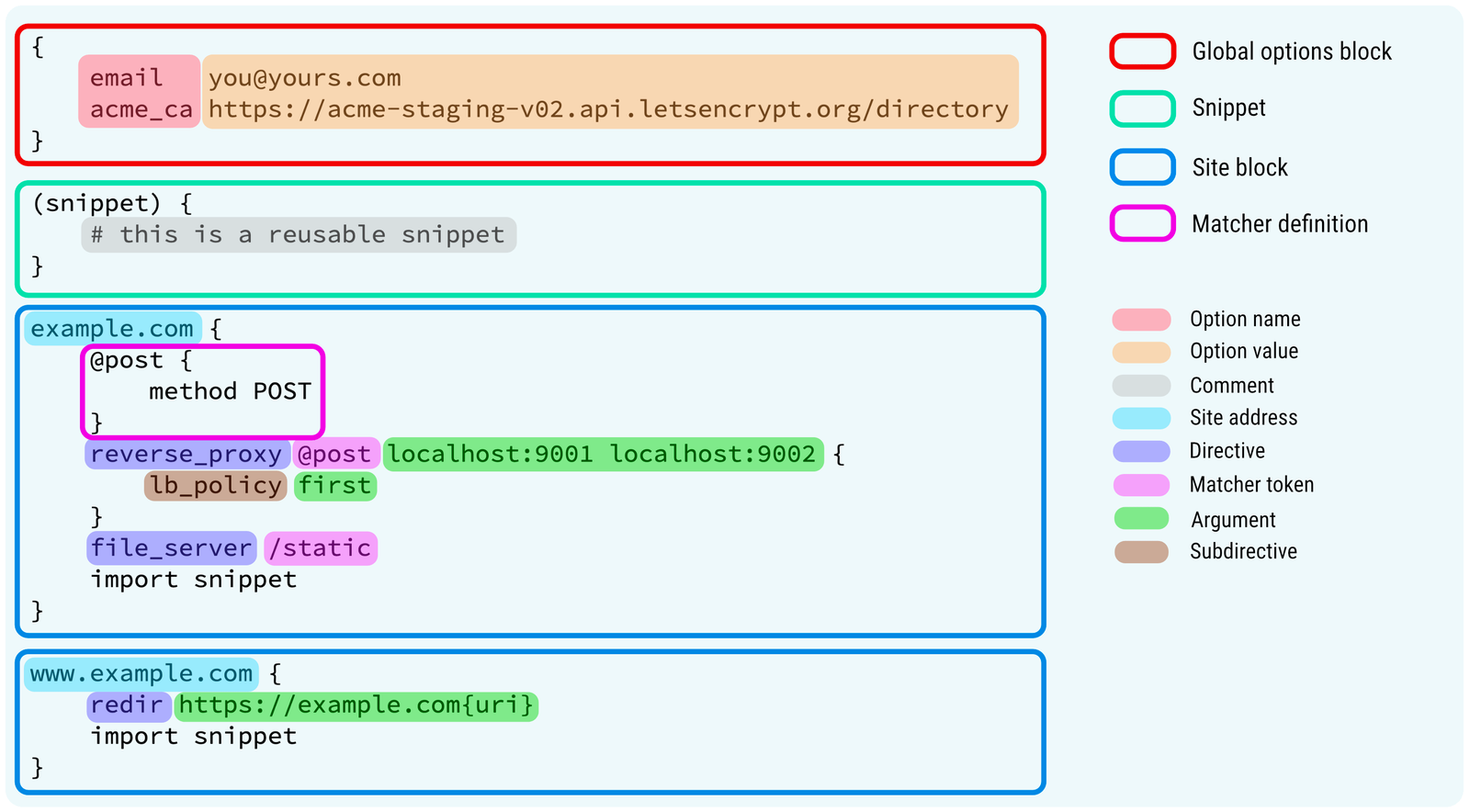
Caddy is the simplest server to get HTTPS working, which makes it ideal for small and mid-sized deployments. Written in Go, it obtains and renews TLS certificates automatically via ACME with zero configuration, and HTTP/3 is on by default. Configuration is either the human-friendly Caddyfile or a JSON config with an admin API for live changes, and it extends through Go modules via xcaddy. It is Apache-2.0 licensed and has the highest GitHub star count of any proxy here. Notably, there is no paid edition of Caddy — the project is funded through sponsorships, not a commercial upsell. The latest release is v2.11.7 (October 2026). W3Techs puts it at about 1.2% of all websites.
Best for: the simplest possible automatic-HTTPS reverse proxy and web server.
Pros
- Fully automatic HTTPS, including renewal — the simplest TLS story of any server here.
- Extremely concise Caddyfile config, with HTTP/3 on by default.
- A single static binary, memory-safe Go, and an admin API for live config.
Cons
- The Go runtime brings higher memory and GC overhead than NGINX or HAProxy at extreme scale.
- A smaller ecosystem and fewer very large, battle-tested deployments.
- Extending it with plugins requires recompiling via
xcaddy; there is no runtime plugin loading.
6. Apache HTTP Server

Apache HTTP Server is the choice for traditional hosting, where its module ecosystem and per-directory config still pay off. The original ubiquitous web server also works as a reverse proxy (mod_proxy), load balancer (mod_proxy_balancer), and TLS terminator (mod_ssl). It uses a pluggable process/thread model (the prefork, worker, and modern event MPMs) and supports HTTP/2 via mod_http2, but it has no native HTTP/3 in core. Its .htaccess per-directory configuration remains unmatched for shared hosting and LAMP/PHP stacks. It is an Apache Software Foundation project — community-governed, with no official commercial edition — and the latest stable is 2.4.69 (October 2026). W3Techs still puts it at about 21% of all websites.
Best for: traditional LAMP/PHP hosting and .htaccess-driven per-directory config.
Pros
- Unmatched longevity and stability, with a vast module ecosystem.
- A flexible MPM model, plus
mod_proxyfor reverse proxy and load balancing. - ASF vendor-neutral governance and extremely thorough documentation.
Cons
- The process/thread roots scale worse under high concurrency than event-driven proxies.
- No native HTTP/3.
- Its reverse-proxy and load-balancing features are less capable than purpose-built proxies.
7. Varnish
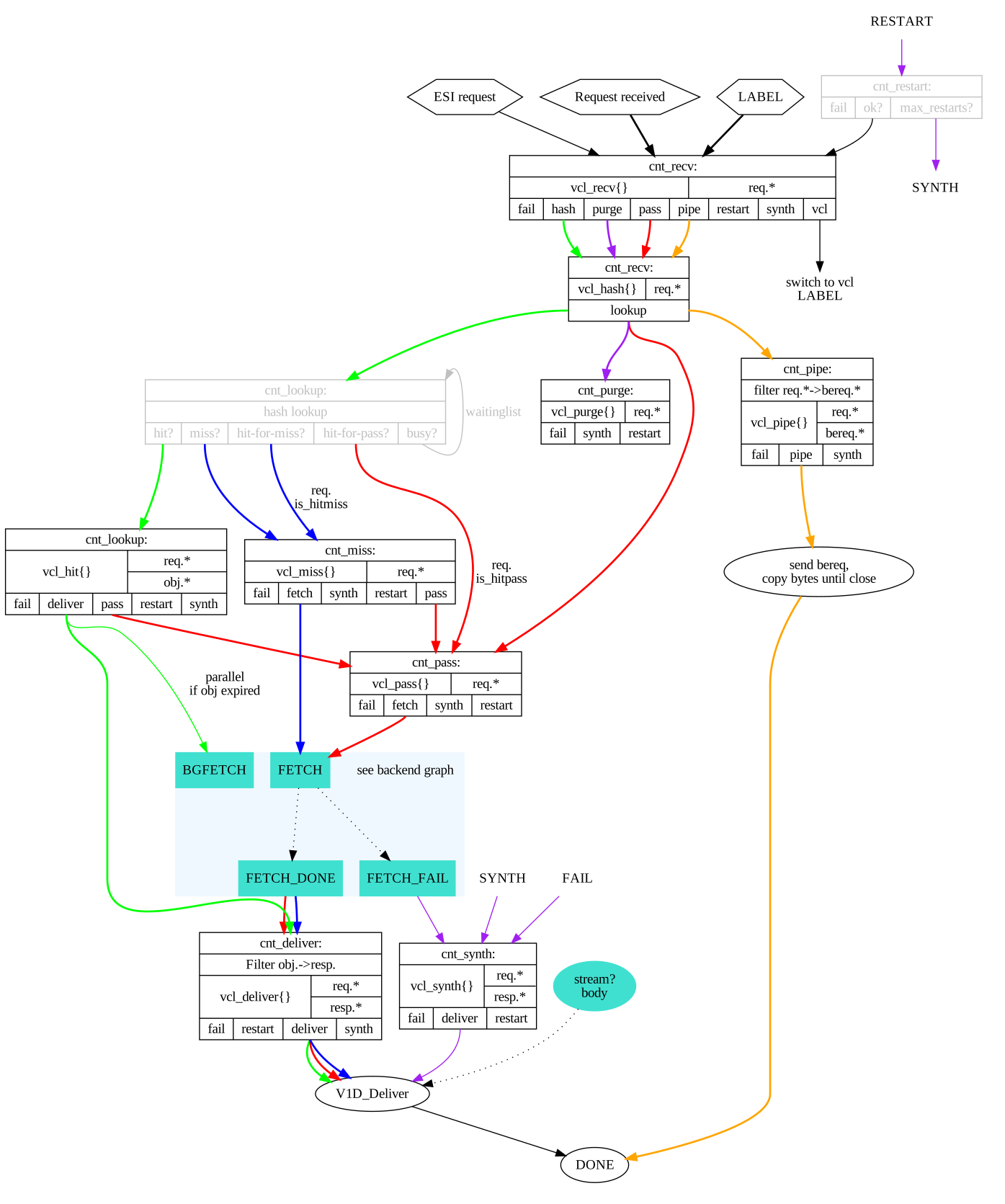
Varnish is an HTTP caching reverse proxy — an accelerator you put in front of origins to serve content at very high speed. Its distinctive feature is VCL (Varnish Configuration Language), a C-compiled DSL that gives programmable control over request, response, and cache logic that config-file proxies can't match. It handles HTTP/1.1 and HTTP/2, with strong cache-invalidation and edge-side-includes support, but no HTTP/3 in the community edition and no native TLS termination — you pair it with a TLS front end. It is BSD-2-Clause licensed; Varnish Software sells Varnish Enterprise (native TLS, persistent storage, support), priced on request. The latest community release is Varnish 9.1.0 LTS (September 2026).
Best for: a fast, programmable HTTP cache in front of busy origins.
Pros
- Extremely fast in-memory HTTP caching, proven on major high-traffic sites.
- VCL gives fine-grained, programmable cache and routing logic.
- Strong cache-invalidation and edge-side-includes (ESI) support.
Cons
- No native TLS termination in the community edition — you need a separate TLS front end.
- Narrow scope: it is a cache, not a general load balancer or web server.
- VCL is a specialized language with a real learning curve, and there is no HTTP/3.
How to choose
Pick by the job in front of you.
- General-purpose proxy or web server: NGINX. It does the most jobs well and has the deepest documentation.
- Serious load balancing: HAProxy for the richest L4/L7 traffic control, or NGINX Plus if you want one vendor for serving and balancing.
- Kubernetes and containers: Traefik for auto-discovery and dashboards, or Caddy if you mainly want effortless HTTPS.
- Service mesh or programmable API gateway: Envoy, almost always via a control plane like Istio.
- Traditional LAMP/PHP hosting: Apache HTTP Server, especially where
.htaccessmatters. - Caching in front of busy origins: Varnish, paired with a TLS terminator.
Reverse proxies overlap with neighboring tools: an API management platform adds developer portals and rate plans on top, a service mesh handles east-west traffic between services, and a web application firewall adds request inspection. For global edge delivery, compare these with a CDN provider, and for container platforms, see our guide to managed Kubernetes.
Frequently Asked Questions
What is a reverse proxy?
A reverse proxy is a server that sits in front of one or more backend servers and forwards client requests to them, then returns the response. Clients talk only to the proxy, which can terminate TLS, balance load, cache content, and route by hostname or path. NGINX, HAProxy, and Envoy are common examples.
What is the difference between a proxy and a reverse proxy?
A forward proxy sits in front of clients and sends their requests out to the internet on their behalf — it hides the client. A reverse proxy sits in front of servers and receives requests on their behalf — it hides the origin. In short, a forward proxy protects and represents users; a reverse proxy protects and represents servers.
How does a reverse proxy work?
A reverse proxy listens for incoming requests on a public address, then decides which backend should handle each one based on rules — hostname, URL path, or load-balancing algorithm. It opens a connection to that backend, forwards the request, receives the response, and relays it to the client. Along the way it can terminate TLS, cache, and add headers.
Is a reverse proxy the same as a load balancer?
Not quite — they overlap. A load balancer distributes traffic across multiple backends for scale and availability, which is one feature of most reverse proxies. A reverse proxy does more: TLS termination, caching, request routing, and header rewriting. HAProxy is a load balancer first; NGINX and Envoy are reverse proxies that also balance load.
What is a reverse proxy used for?
Common uses are TLS/SSL termination, load balancing across backend servers, caching to reduce origin load, routing requests to different services by hostname or path, hiding internal infrastructure, and adding a central point for security controls, rate limiting, and logging. In Kubernetes, an ingress controller like Traefik or NGINX plays this role.
Editor's note — sources: NGINX (nginx.org) and the freenginx fork; HAProxy (haproxy.org); Envoy (envoyproxy.io) and its CNCF graduation; Traefik (traefik.io); Caddy (caddyserver.com); Apache HTTP Server (httpd.apache.org); Varnish (varnish-cache.org). Adoption figures are W3Techs as of November 2026 and undercount load balancers and caches; licenses, versions, and pricing observed November 2026.