
Top 7 Satellite Internet Providers in 2026
The best satellite internet providers in 2026, ranked: Starlink, Viasat, SES, Eutelsat OneWeb, HughesNet, Amazon Leo and Telesat. Real pricing, orbits, and honest pros and cons for every provider.


TL;DR
- The leaders in 2026 are Starlink, Viasat, SES, Eutelsat OneWeb, HughesNet, Amazon Leo, and Telesat — spanning low-earth-orbit (LEO), medium-earth-orbit (MEO), and geostationary (GEO) constellations.
- Starlink is the only at-scale consumer+enterprise LEO network, with over 8,000 operational satellites and residential plans from $55/month (hardware $349, as of October 2026).
- Big changes since 2025: Amazon renamed Project Kuiper to Amazon Leo (November 2025), SES closed its Intelsat acquisition (July 2025), and EchoStar sold spectrum to SpaceX and AT&T while hinting it may wind down HughesNet home service.
- For a home in a rural area, your real choice today is Starlink or HughesNet. For aviation, maritime, or government, it's Viasat or SES. Everything else is enterprise or still deploying.
Satellite internet delivers broadband from orbit to a dish or terminal, reaching places fiber and cable never will. The best satellite internet providers in 2026 are Starlink, Viasat, SES, Eutelsat OneWeb, HughesNet, Amazon Leo, and Telesat. Starlink leads on availability and low latency; Viasat and SES own aviation, maritime, and government; HughesNet still serves rural US homes; Amazon Leo and Telesat are the deploying challengers. This guide ranks all seven on what they actually deliver today, with real pricing and honest limitations.
How we picked these
We ranked providers on the breadth and maturity of operational service in 2026 — not announced plans. The criteria:
- Operational scale: satellites in orbit and delivering service now, not on a roadmap.
- Availability: who can actually buy and use it, and where.
- Latency and performance: LEO (~20–50 ms) versus MEO (~150 ms) versus GEO (~600+ ms) changes what the link is good for.
- Who it serves: consumer, enterprise, government, aviation, or maritime.
- Pricing transparency: published consumer rates versus contact-sales-only.
We make no claim about independence or paid placement. No provider paid to appear here, and ranking reflects operational reality as of October 2026.
Quick comparison
| Provider | Best for | Orbit | Pricing model |
|---|---|---|---|
| Starlink | Anyone needing broadband anywhere now | LEO (~550 km) | Published consumer + enterprise |
| Viasat | Aviation, maritime, government mobility | GEO | Enterprise / contact sales |
| SES | Low-latency enterprise and government reach | MEO + GEO | Enterprise / contact sales |
| Eutelsat OneWeb | Non-US global LEO for enterprise/gov | LEO + GEO | Via distribution partners |
| HughesNet | Rural US homes with no fiber or LEO | GEO | Published consumer |
| Amazon Leo | Future AWS-integrated enterprise | LEO (~600 km) | Not yet announced |
| Telesat Lightspeed | Telco and defense backhaul (from ~2027) | LEO | Wholesale / contact sales |
1. Starlink
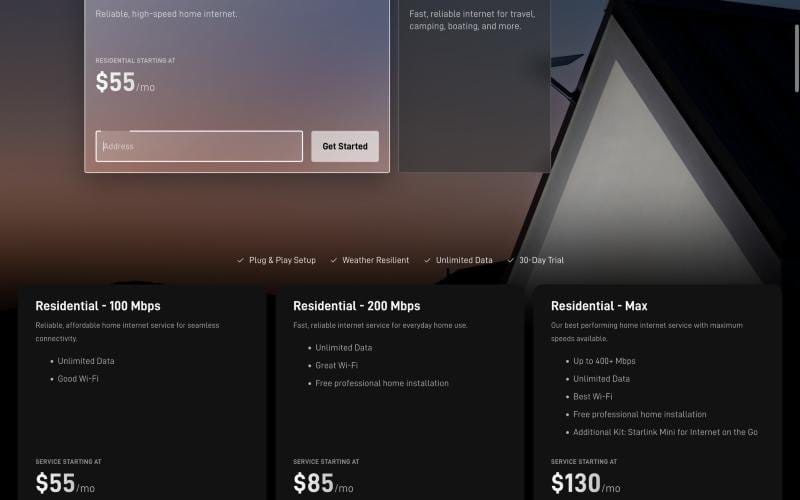
Starlink, operated by SpaceX, is the dominant satellite internet provider in 2026 and the only one offering at-scale, low-latency broadband to consumers worldwide. It runs the largest constellation ever built — more than 8,000 operational satellites in low-earth orbit at roughly 550 km — which keeps round-trip latency in the 20–50 ms range, close to fixed wireless and far below traditional GEO satellite. Service covers 100+ countries across consumer, enterprise, maritime, aviation, and mobility segments, with direct-to-cell service rolling out through carrier partners. SpaceX reported surpassing 8 million customers in mid-2026.
Best for: anyone who needs proven, available, low-latency broadband almost anywhere today.
Pros - Largest and most mature network, available in 100+ countries with self-serve ordering. - Low LEO latency (~20–50 ms) suitable for video calls and gaming, unlike GEO rivals. - Published, unlimited-data residential plans from $55/month (100 Mbps), $85 (200 Mbps), and $130 for MAX (up to 400 Mbps); Standard kit $349 (as of October 2026, per SatelliteInternet.com).
Cons - Upfront hardware cost ($349) is higher than leased GEO equipment. - Congestion in dense areas can trigger a one-time "congestion charge" ($100–$1,500 in some regions) and slower peak-hour speeds. - A single operator controls pricing and policy, and residential rates have shifted repeatedly.
2. Viasat

Viasat (NASDAQ: VSAT) is the largest operator focused on aviation, maritime, government, and enterprise mobility, built on geostationary high-throughput satellites and the L-band and Ka-band networks it gained by acquiring Inmarsat in 2023. Its ViaSat-3 class satellites are among the highest-capacity GEO birds ever launched. Because the fleet sits in geostationary orbit (~35,786 km), latency runs 600+ ms — fine for streaming and in-flight connectivity, poor for real-time applications. Viasat leads in-flight connectivity on thousands of commercial aircraft.
Best for: aviation, maritime, and government mobility at global scale.
Pros - Dominant in-flight connectivity franchise and deep government and defense relationships. - Near-global multi-band GEO coverage after the Inmarsat combination. - Mature, revenue-generating operator with decades of service continuity.
Cons - GEO latency (~600+ ms) rules it out for latency-sensitive workloads. - The first ViaSat-3 satellite (F1) suffered an antenna deployment anomaly in 2023 that cut its usable capacity well below design. - Consumer broadband is uncompetitive against LEO on both speed and latency.
3. SES
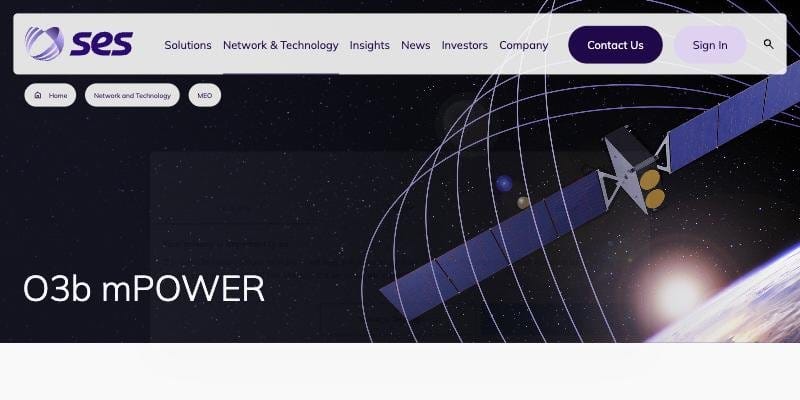
SES runs the only operational medium-earth-orbit broadband system, O3b mPOWER, alongside a large GEO fleet. At roughly 8,000 km, MEO delivers latency around 150 ms — far better than GEO, if not as low as LEO — with software-defined, steerable Ka-band beams. Commercial mPOWER service began in April 2024; 10 of 13 satellites are launched, with the latest pair entering service in March 2026. SES completed its acquisition of Intelsat in July 2025, making it one of the largest satellite operators by fleet. It targets governments, telcos, cruise lines, maritime, and aviation — not retail consumers.
Best for: enterprises and governments wanting GEO-like reach with much lower latency.
Pros - Only operational MEO constellation: global reach with ~150 ms latency, a genuine middle ground. - Strong government, telco-backhaul, and cruise franchises. - The Intelsat acquisition adds fleet scale and spectrum.
Cons - No consumer product; sold as managed enterprise capacity only. - Early mPOWER satellites hit a power-module anomaly that delayed the ramp (SES addressed it with replacement satellites). - Capital-intensive and competing hard with LEO for enterprise budgets.
4. Eutelsat OneWeb

Eutelsat OneWeb is the only operational global LEO network outside the United States, positioned as a sovereign European alternative to Starlink. The OneWeb constellation — roughly 630+ first-generation satellites at ~1,200 km, flying pole-to-pole — serves enterprise, government, maritime, aviation, and cellular backhaul through distribution partners rather than direct consumer sales. Eutelsat and OneWeb completed their merger in 2023, and in August 2025 the company ordered 340 second-generation satellites from Airbus. The French state increased its stake in 2025.
Best for: enterprise and government backhaul needing a non-US global LEO option.
Pros - Only operational non-US global LEO network, with true pole-to-pole coverage. - Multi-orbit (LEO + GEO) resilience for enterprise and government buyers. - Backed as a strategic "sovereign" European option, with committed Gen2 investment.
Cons - No consumer or retail self-serve; everything runs through partners. - First-generation capacity is constrained relative to Starlink. - Heavy capital requirements and thin margins have kept funding under pressure.
5. HughesNet

HughesNet, part of EchoStar (NASDAQ: SATS), is the established geostationary provider for rural US homes and small businesses, using Ka-band JUPITER satellites. Its "Fusion" plans combine satellite with fixed wireless to cut latency on interactive traffic. Published satellite plans run Lite at $39.99/month (25 Mbps), Select at $49.99 (50 Mbps), and Elite at $64.99 (100 Mbps), with Fusion at $94.99 — all 12-month promotional rates, plus equipment lease ($9.99–$19.99/month) or purchase ($100–$449.99), as of October 2026 per SatelliteInternet.com. EchoStar spent 2025 selling wireless spectrum to SpaceX and AT&T and shifting strategy.
Best for: rural US households with no fiber or LEO option.
Pros - Available across rural US today, with no dish-purchase requirement if you lease. - Fusion hybrid plans lower latency versus pure GEO for interactive use. - 12-month price locks and a long service track record.
Cons - GEO latency and data prioritization throttle heavy users after a soft cap. - Losing subscribers steadily to LEO competitors. - A 2026 SEC filing reportedly suggests EchoStar may wind down HughesNet home internet and refer customers to Starlink; the company has not confirmed this, so treat it as unconfirmed.
6. Amazon Leo
Amazon Leo — the service renamed from Project Kuiper in November 2025 — is Amazon's low-earth-orbit constellation and the best-capitalized challenger to Starlink. It launched roughly 400 satellites by October 2026 (up from 153 at the rebrand) toward a planned fleet of more than 3,000 at ~590–630 km. Amazon has announced three Ka-band terminals: Leo Nano (up to 100 Mbps), Leo Pro (up to 400 Mbps), and Leo Ultra (up to 1 Gbps). An enterprise preview began in late 2025, with AWS integration pitched as the differentiator. It is not yet commercially available, and no pricing has been announced.
Best for: future AWS-integrated enterprise connectivity, once the service goes live.
Pros - Amazon and AWS backing provide deep capital and a built-in enterprise channel. - A three-tier terminal lineup, including a 1 Gbps Ultra option, is ambitious on paper. - Credible #2 LEO contender deploying at a fast launch cadence.
Cons - Not commercially available; no public pricing and no subscribers yet. - Far behind Starlink on satellites in orbit. - Must meet FCC deployment deadlines to keep its spectrum.
7. Telesat Lightspeed
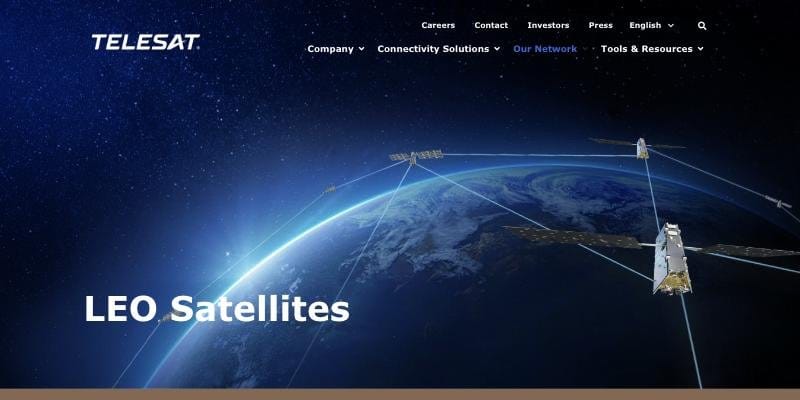
Telesat (NASDAQ/TSX: TSAT), a long-established Canadian operator, is building Lightspeed, a 198-satellite LEO constellation aimed squarely at telco backhaul, government, defense, maritime, and aviation — a business-to-business network, not a consumer dish. MDA Space is the prime manufacturer, and the build is fully funded through Canadian federal and Quebec commitments plus equity. Lightspeed uses optical inter-satellite links and carrier-grade MEF 3.0 Ethernet. First operational launches are targeted for 2026 on SpaceX Falcon 9, with global service around 2027.
Best for: telcos and defense customers planning future carrier-grade LEO backhaul.
Pros - Fully funded with committed launch contracts and a named prime manufacturer. - Carrier-grade and defense-focused design (MEF 3.0, military Ka-band) differentiates it from consumer LEO. - A sovereign Canadian LEO option for government buyers.
Cons - Not yet operational — service is targeted for ~2027, and dates in this industry slip. - No revenue or subscribers yet. - Enters a crowded LEO market late, behind Starlink, OneWeb, and Amazon Leo.
Honorable mention: AST SpaceMobile
AST SpaceMobile (NASDAQ: ASTS) belongs in the conversation but in a different category: direct-to-device, beaming broadband to unmodified smartphones rather than to a dish. Its BlueBird satellites carry large phased-array antennas, and the company has FCC authorization for US commercial direct-to-device service and roughly 60 mobile-operator partnerships. It remains pre-commercial in 2026, scaling toward a usable constellation. If your interest is phone connectivity in dead zones rather than fixed broadband, this is the company to watch.
How to choose
Match the orbit to the job.
- Rural home, want it working this week: Starlink if you can afford the kit and want low latency; HughesNet if you want a lower monthly bill and leased hardware and can tolerate GEO latency.
- Video calls, gaming, remote work: LEO only — Starlink today, Amazon Leo later.
- Aviation, maritime, or government mobility: Viasat or SES, depending on whether you need maximum coverage (Viasat) or lower latency (SES MEO).
- Enterprise or telco backhaul outside the US: Eutelsat OneWeb now, Telesat Lightspeed from ~2027.
- Connectivity to ordinary phones in dead zones: watch AST SpaceMobile.
The honest summary: for most individual buyers in 2026, the decision is Starlink versus HughesNet, and it comes down to budget and whether you need low latency. Everything else on this list is enterprise capacity or still getting off the launch pad.
Frequently Asked Questions
What is satellite internet?
Satellite internet is broadband delivered from orbiting satellites to a dish or terminal at your location, instead of through ground cables. It reaches rural and remote places fiber and cable don't. Providers operate in low, medium, or geostationary orbit, which determines the connection's speed and latency.
How does satellite internet work?
A ground terminal sends and receives radio signals to satellites overhead, which relay traffic to gateway stations connected to the internet backbone. Low-earth-orbit networks like Starlink use thousands of satellites close to Earth for low latency; geostationary systems use a few distant satellites covering wide areas with higher latency.
How much does satellite internet cost?
In 2026, US consumer plans range from about $40 to $130 per month. HughesNet starts near $40/month and Starlink residential starts around $55/month, plus hardware — a $349 Starlink kit or a HughesNet equipment lease. Enterprise, aviation, and government services from Viasat, SES, OneWeb, and Telesat are priced on request.
Is satellite internet good?
For rural and remote users without fiber or cable, yes — modern LEO service like Starlink delivers 100+ Mbps with latency low enough for video calls. GEO services such as HughesNet work for browsing and streaming but struggle with real-time applications. It remains more expensive and more weather-sensitive than wired broadband.
Which satellite internet provider is best?
For most individuals in 2026, Starlink is the best overall for availability, speed, and latency. HughesNet is the cheaper entry point for rural homes that can tolerate higher latency. For aviation, maritime, or government, Viasat and SES lead. Amazon Leo and Telesat are promising but not yet commercially available.
Editor's note — sources: Starlink (starlink.com, pricing via SatelliteInternet.com); Viasat (viasat.com); SES O3b mPOWER (ses.com); Eutelsat OneWeb (eutelsat.com); HughesNet/EchoStar (hughesnet.com, pricing via SatelliteInternet.com); Amazon Leo (aboutamazon.com); Telesat Lightspeed (telesat.com); AST SpaceMobile (ast-science.com). Satellite counts, ownership changes, and pricing verified as of October 2026; consumer prices vary by region and change frequently — confirm on each provider's site.