
Top 7 RPA Tools for Enterprise Automation in 2026
RPA software automates repetitive, rules-based work. We rank the seven best RPA tools for 2026 — UiPath, Power Automate, Automation Anywhere, Pega, Appian, Blue Prism and IBM — on capability, deployment and real published pricing.


TL;DR
- RPA (robotic process automation) uses software bots to run repetitive, rules-based computer tasks the way a person would. The strongest 2026 platforms are UiPath, Microsoft Power Automate, and Automation Anywhere, with Pega, Appian, SS&C Blue Prism, and IBM rounding out the enterprise field.
- Pricing spans a wide range: Power Automate lists unattended "Process" bots at $150/bot/month, UiPath's entry "Basic" tier starts from $25/month, and IBM's agentic watsonx Orchestrate starts at $530/month (Essentials). Most enterprise deals from the pure-plays are quote-only.
- The whole category rebranded around AI agents in 2025–2026 — UiPath Maestro, Automation Anywhere's Agentic Process Automation, and Pega's Agentic Process Fabric (launched June 2, 2025). Gartner retired the standalone RPA Magic Quadrant; the space now sits under "Business Orchestration and Automation Technologies."
- Pick for fit: UiPath for breadth, Power Automate for Microsoft shops on a budget, Automation Anywhere for cloud-native regulated workloads, Pega/Appian when RPA is one piece of a larger process platform.
The best RPA tools in 2026 are UiPath, Microsoft Power Automate, and Automation Anywhere, with Pega, Appian, SS&C Blue Prism, and IBM completing a strong enterprise seven. RPA software automates repetitive, rules-based work — moving data between systems, filling forms, reconciling records — by driving the user interface or APIs the same way a human operator would. What separates these seven is how far each has moved beyond deterministic bots into AI-driven "agentic" automation, how they deploy, and how honestly their pricing is published. This guide ranks them on maturity, breadth, deployment flexibility, and real-world fit.
How we picked these
We weighted four things: capability and maturity (how complete and battle-tested the automation stack is), adoption (install base, ecosystem, and talent availability), deployment flexibility (SaaS, on-prem, hybrid, and governance controls), and fit for a defined job (back-office scale vs. Microsoft-native vs. process-heavy enterprise). We verified pricing against each vendor's own pages and noted where figures are quote-only. We did not rank alphabetically, and we make no claim about sponsorship or paid placement — every tool was assessed on the same criteria.
Quick comparison
| Company | Best for | Deployment | Pricing model |
|---|---|---|---|
| UiPath | Full-stack, enterprise-scale automation | SaaS, self-hosted, hybrid | Free tier; from $25/mo; enterprise quote |
| Microsoft Power Automate | Microsoft-centric orgs on a budget | SaaS + on-prem gateway | Per-user and per-bot (published) |
| Automation Anywhere | Cloud-native, regulated enterprises | SaaS, customer VPC, on-prem | Quote only |
| Pega | Complex, decision-heavy processes | Pega Cloud, hybrid, on-prem | Quote only |
| Appian | RPA inside a broader low-code platform | Appian Cloud, self-managed | Quote only |
| SS&C Blue Prism | Governed, unattended bots in regulated sectors | On-prem, SaaS, hybrid | Quote only |
| IBM | IBM-stack enterprises moving to agentic | SaaS | IBM RPA quote; Orchestrate from $530/mo |
1. UiPath
UiPath is the most complete pure-play automation platform and the default choice for enterprises that want everything — RPA, process mining, document understanding, and AI agents — from one vendor. Its stack runs from Studio (low-code bot development) to Orchestrator (fleet management), with both selector-based automation and Computer Vision for virtual and Citrix desktops. The 2025–2026 push is agentic: the Maestro orchestration family, Agent Builder, and Autopilot layer LLM-driven agents on top of the deterministic bot core. UiPath is public (NYSE: PATH); co-founder Daniel Dines returned as sole CEO in 2024 after a roughly 10% workforce restructuring.
Best for: Enterprises wanting a single, full-stack RPA-to-agentic platform at scale.
Pros
- Widest capability set in the market — RPA, process/task mining, document processing, and agents in one platform.
- Largest community, marketplace, and talent pool, which eases hiring and reuse.
- Genuine hybrid and on-prem option (Automation Suite) for regulated workloads, not SaaS-only.
Cons
- Enterprise pricing is opaque and historically expensive once you add robots and platform fees.
- The product lineup (five Maestro sub-brands) creates real buyer confusion.
- Agentic features are new and still maturing relative to the hardened RPA core.
2. Microsoft Power Automate
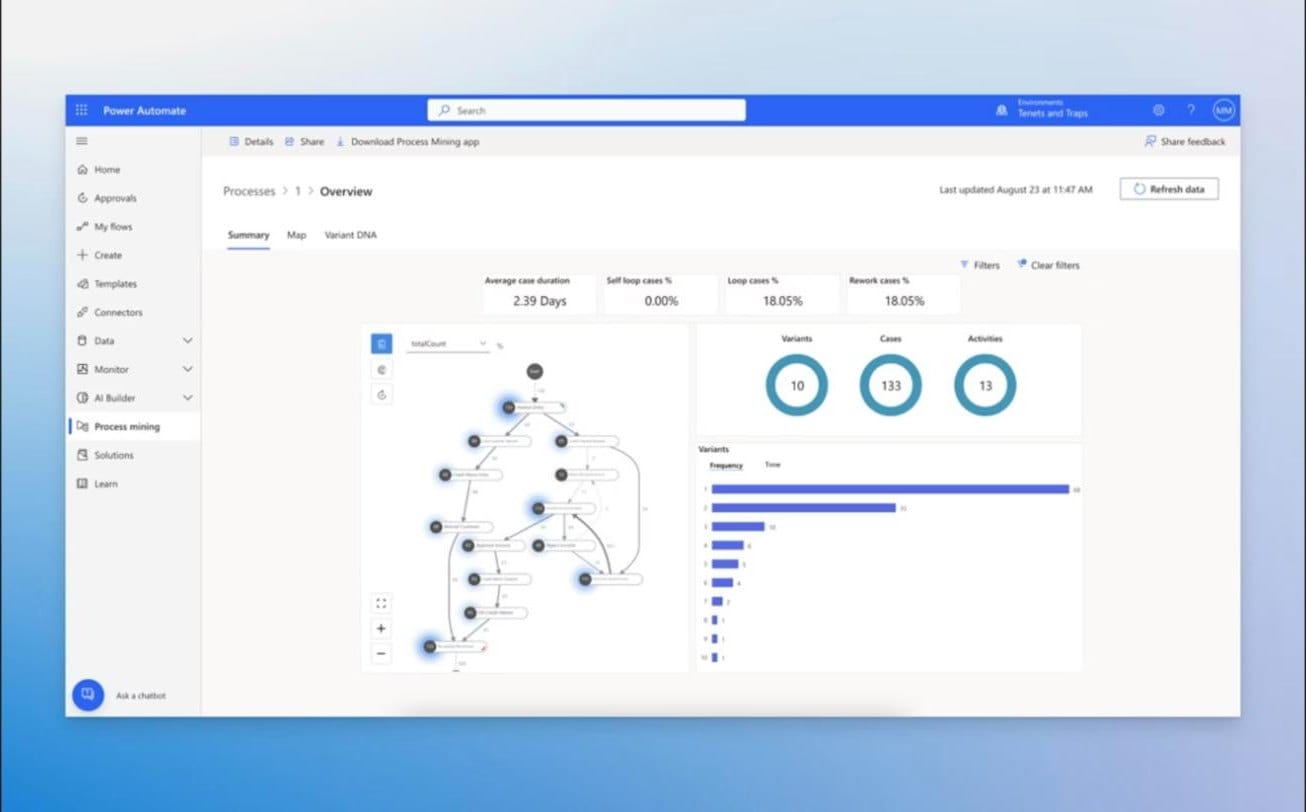
Microsoft Power Automate wins on ubiquity and price for anyone already in Microsoft 365. It splits into cloud flows (connector-based workflow automation) and desktop flows — the actual RPA, via Power Automate Desktop, supporting attended and unattended bots with both selector- and image-based automation. Copilot adds natural-language flow building, and the platform ties directly into Teams, Dynamics, and Azure. As of October 2026, Microsoft publishes its pricing openly: Premium at $15/user/month (annual) including attended desktop RPA, unattended "Process" bots at $150/bot/month, Hosted Process at $215/bot/month, and a Process Mining add-on at $5,000/tenant/month.
Best for: Microsoft-centric organizations wanting cheap, broad workflow automation with RPA as an add-on.
Pros
- Lowest entry cost in this list and native integration across M365, Teams, and Dynamics.
- Over 1,000 connectors make API-first automation fast to assemble.
- Copilot-driven, natural-language flow building lowers the skill barrier for citizen developers.
Cons
- Per-bot unattended licensing and the $5,000/month mining add-on get expensive at scale.
- Desktop RPA is less robust and governed than UiPath or Automation Anywhere for complex, high-volume unattended work.
- The per-user vs. per-flow vs. per-bot licensing model is genuinely confusing.
3. Automation Anywhere
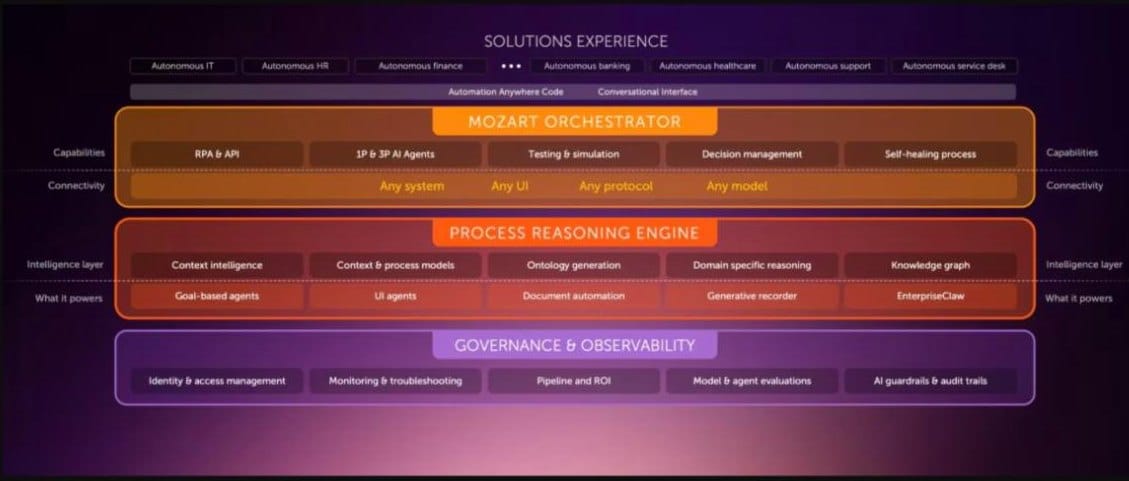
Automation Anywhere is the other pure-play leader, and the most cloud-native of the group. Its Automation 360 platform is now marketed as an Agentic Process Automation system: goal-based AI agents, RPA bots, APIs, and human-in-the-loop steps orchestrated together, with AI Agent Studio for low-code agent building and strong document automation. Because it was architected for the web rather than the desktop, it deploys cleanly in a customer's own VPC — a reason it shows up across banking, healthcare, and BPO. It remains private; its last primary venture valuation was roughly $6.8B in a 2019 SoftBank-led round, and an IPO has been rumored for years.
Best for: Large regulated enterprises wanting cloud-native RPA plus document and agentic automation.
Pros
- Fully cloud-native, web-based architecture simplifies deployment and updates.
- Strong document processing and agentic tooling (AI Agent Studio) in one platform.
- VPC deployment and compliance certifications (SOC 2 Type II, ISO 27001) suit regulated industries.
Cons
- Enterprise pricing is entirely quote-only — no public list prices.
- Still private with a long-delayed IPO, which raises procurement and longevity questions.
- The "agentic" rebrand is recent; real-world agentic maturity is still being proven.
4. Pega (Pegasystems)
Pega treats RPA as a tactical layer on top of a far deeper platform: BPM, case management, and a decisioning/rules engine (Pega Infinity). For organizations whose problem is complex, stateful processes rather than simple screen-scraping, that depth is the point. Pega GenAI Blueprint assists app design, and the Agentic Process Fabric, launched June 2, 2025, orchestrates AI agents, people, and systems under governed rules. Pega is public (NASDAQ: PEGA); private equity firm Clayton, Dubilier & Rice made a roughly $1B convertible investment announced in late 2022.
Best for: Large, complex, decision-heavy enterprises in banking, insurance, telco, and government.
Pros
- Best-in-class rules, decisioning, and case management for genuinely complex processes.
- Strong governance framing for agentic AI through the Agentic Process Fabric.
- Deep vertical templates for regulated industries.
Cons
- Steep learning curve and heavyweight implementation that needs specialized Pega developers.
- Opaque, high enterprise pricing with no public figures.
- RPA is secondary to BPM, so it is thinner than the pure-plays for high-volume bot work.
5. Appian
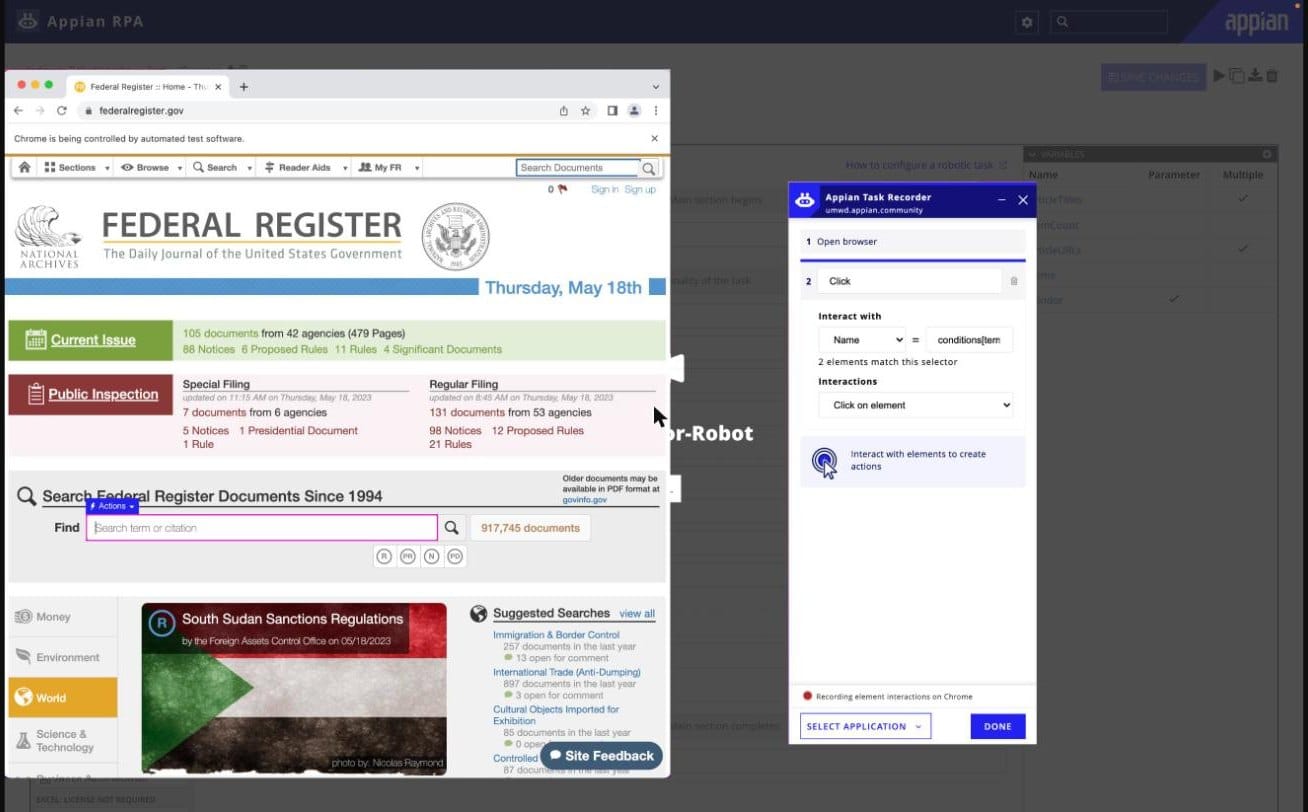
Appian folds RPA into a unified low-code platform alongside BPM, process mining, a data fabric, and AI. The pitch is "complete the automation loop" — use bots to fill gaps where APIs do not exist, inside a broader application. It entered RPA through its 2020 acquisition of Novayre Solutions (Jidoka), and today bundles a drag-and-drop bot recorder and bot pools into the same environment where you build the surrounding app. Appian is public (NASDAQ: APPN) and markets an "unlimited bots" model within its platform, which can change the cost math for high-bot-count scenarios — confirm current packaging before you commit.
Best for: Teams building process-centric enterprise apps where RPA is one component of a larger workflow.
Pros
- RPA, BPM, process mining, and data fabric are genuinely unified, reducing integration seams.
- A low-code recorder makes bot-building accessible to non-developers.
- The "unlimited bots" model can be economical versus per-bot licensing at high volumes.
Cons
- RPA is less deep and standalone than the pure-plays — best used inside the Appian platform.
- Pricing is quote-only and platform licensing can be costly.
- Smaller dedicated RPA ecosystem and talent pool than UiPath or Automation Anywhere.
6. SS&C Blue Prism
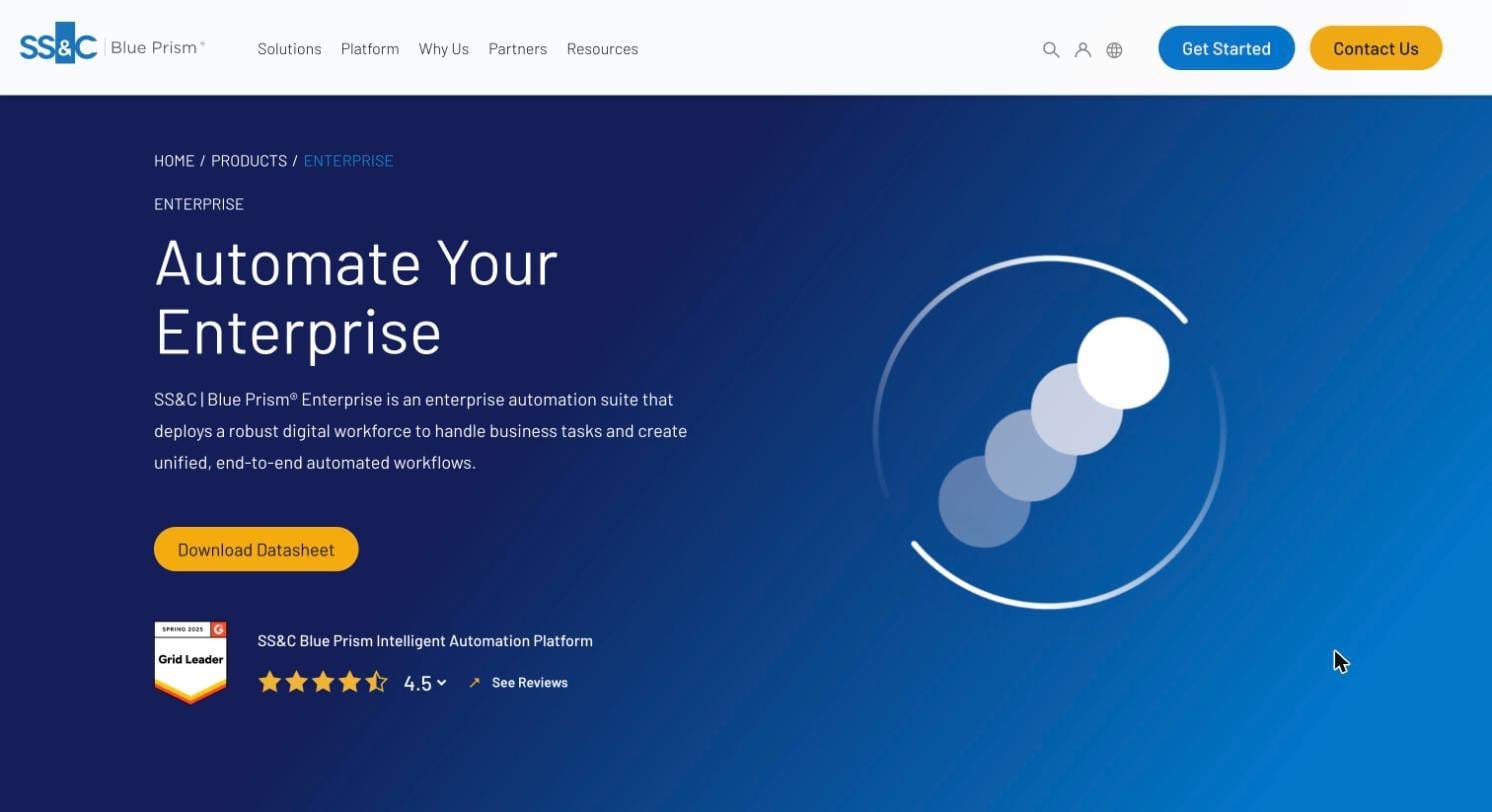
SS&C Blue Prism built its reputation on governed, unattended "digital workers" — centrally managed, auditable bots with no attended desktop model historically. That control-first design keeps it trusted in banking, insurance, and government. The portfolio spans Blue Prism Enterprise, the fully managed Blue Prism Cloud, plus Chorus (BPM) and document automation. SS&C Technologies (NASDAQ: SSNC) acquired Blue Prism in March 2022 for about $1.6B and delisted it; the company shipped next-generation automation tooling in July 2025, though its momentum is widely seen as having slowed versus cloud-native rivals.
Best for: Regulated enterprises prioritizing control, auditability, and unattended scale.
Pros
- Strong security, governance, and auditability — long trusted in regulated sectors.
- Robust unattended, centrally orchestrated digital workforce at scale.
- Backing of a large, profitable public parent (SS&C) lowers vendor-failure risk.
Cons
- Historically weak attended automation and a steeper, more developer-oriented build model.
- Perceived innovation slowdown and reduced visibility since the acquisition.
- Quote-only pricing and heavier on-prem infrastructure overhead than SaaS-native tools.
7. IBM
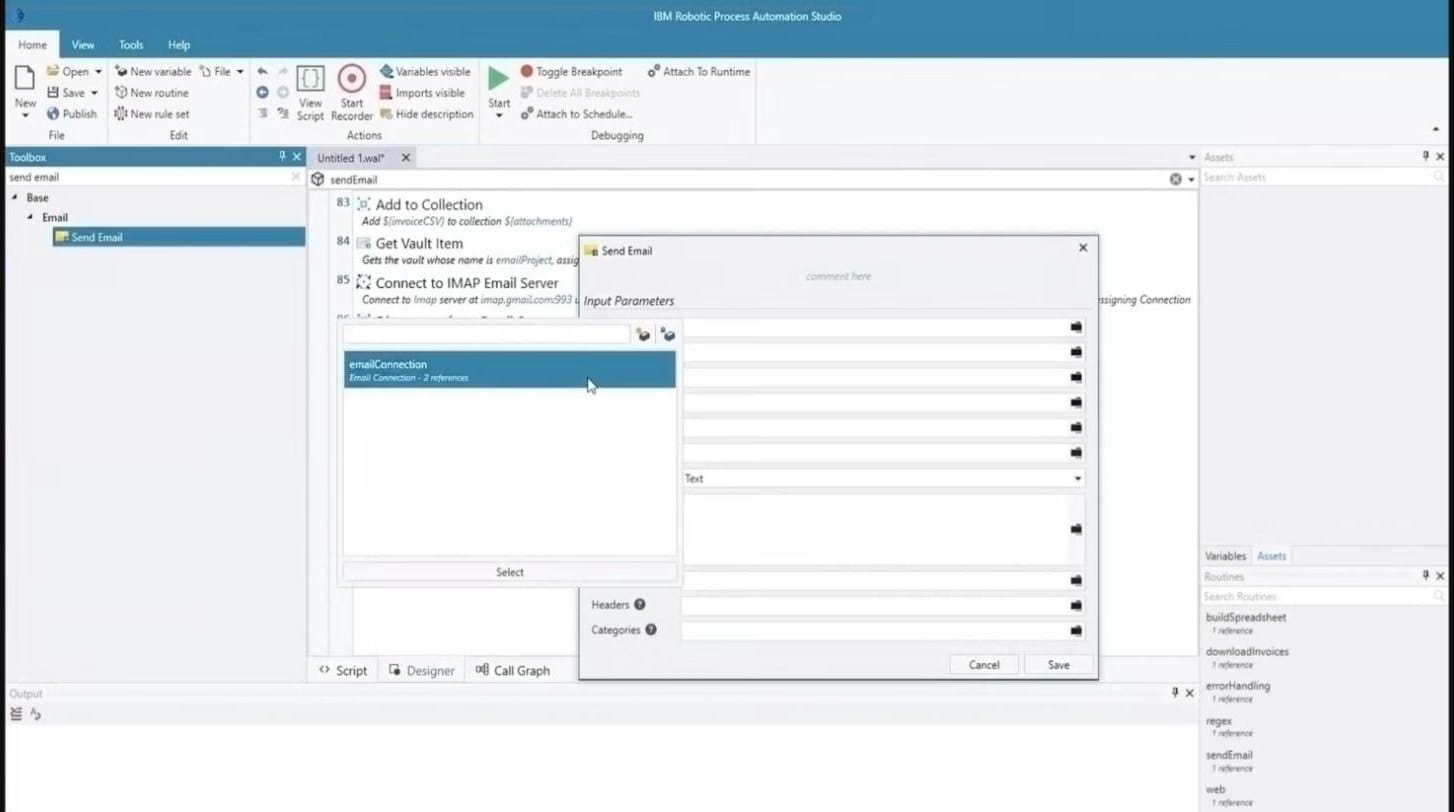
IBM still ships IBM Robotic Process Automation — SaaS software bots with AI-assisted bot building, chatbot integration, and metric tracking — but its clear strategic direction is watsonx Orchestrate, its agentic automation platform. For cross-industry enterprises already standardized on IBM, that combination plus IBM Process Mining and watsonx AI is the draw. watsonx Orchestrate publishes pricing: Essentials from $530/month and Standard from $6,360/month as of September 2026, with a Premium tier (including a HIPAA-ready option) on request. IBM RPA itself is quote-based with a free trial. IBM is public (NYSE: IBM).
Best for: IBM-stack, cross-industry enterprises wanting governed bots plus a path to agentic automation.
Pros
- Backed by IBM's cross-industry reach and integration with Process Mining and watsonx AI.
- A clear agentic path via watsonx Orchestrate, with transparent published pricing.
- SaaS bots with AI-assisted building and built-in metric tracking.
Cons
- Classic IBM RPA is de-emphasized next to the watsonx Orchestrate push — two overlapping products to navigate.
- watsonx Orchestrate is priced for enterprises ($530–$6,360+/month) and is agentic workflow, not pure screen-scraping RPA.
- Smaller dedicated RPA community and ecosystem than UiPath or Automation Anywhere.
How to choose
Start from your stack and your problem, not the brand.
- If you're already a Microsoft 365 shop: start with Microsoft Power Automate. The attended RPA is bundled cheaply; only add unattended bots when a specific process justifies the $150/bot/month.
- If you want one vendor for everything and you're automating at scale: UiPath has the broadest, most mature stack and the deepest talent pool.
- If you're regulated and cloud-native matters: Automation Anywhere's VPC deployment and compliance posture, or SS&C Blue Prism's governance pedigree, fit best.
- If RPA is a small part of a bigger process or app: Pega (for deep decisioning) or Appian (for unified low-code) make more sense than a pure-play bot tool.
- If you're standardized on IBM: IBM RPA plus watsonx Orchestrate keeps you in one ecosystem with a clear agentic roadmap.
One caveat for 2026: nearly every vendor now sells "agents." Pilot the agentic features on a real process before you buy on them — the deterministic RPA core is mature, but LLM-driven agents vary widely in reliability. If you're evaluating agent platforms more broadly, see our guides to AI agent platforms and AI agent frameworks for production. Teams whose RPA work is mostly document-heavy should also weigh dedicated intelligent document processing platforms, and those orchestrating bots alongside data pipelines may want a look at workflow orchestration platforms.
Frequently Asked Questions
What is RPA?
RPA, or robotic process automation, is software that automates repetitive, rules-based digital tasks by mimicking how a human interacts with applications — clicking, typing, copying data between systems, and filling forms. Bots can be attended (triggered by a person) or unattended (running on their own). RPA suits high-volume, structured work with stable interfaces.
What does RPA stand for?
RPA stands for robotic process automation. The "robotic" refers to software robots, or bots — not physical machines. These bots execute defined sequences of steps across applications and user interfaces, automating back-office processes such as data entry, reconciliation, and report generation without changing the underlying systems they operate on.
How does RPA work?
RPA bots are configured in a development studio to follow a defined workflow, then deployed and managed centrally. They interact with software either through the user interface — using screen elements, selectors, or computer vision — or through APIs where available. An orchestrator schedules bots, handles queues, logs activity, and scales unattended bots across machines.
Is RPA the same as AI?
No. Traditional RPA is deterministic: it follows explicit, pre-defined rules and does not learn. AI adds perception and judgment — reading unstructured documents, classifying intent, or deciding next steps. In 2026, vendors increasingly combine the two, embedding AI and LLM-driven "agents" into RPA platforms, but the rules-based bot core and AI remain distinct capabilities.
Which is the best RPA tool?
There is no single best RPA tool — it depends on your stack. UiPath offers the broadest, most mature platform; Microsoft Power Automate is the cheapest entry for Microsoft shops; Automation Anywhere suits cloud-native regulated enterprises; and Pega or Appian fit when RPA is one part of a larger process platform. Match the tool to your environment and the processes you need to automate.
Editor's note — sources: UiPath pricing and product pages (uipath.com); Microsoft Power Automate pricing (microsoft.com), observed October 2026; Automation Anywhere product pages (automationanywhere.com); Pegasystems product pages and Agentic Process Fabric announcement (pega.com, June 2025); Appian product pages (appian.com); SS&C Technologies acquisition release and Blue Prism product pages (ssctech.com, blueprism.com); IBM Robotic Process Automation and watsonx Orchestrate pricing (ibm.com), observed September–October 2026. Pricing and feature claims are current as of October 2026 and may change.