
Best OCR Model 2026: Benchmarks & Verdict
PaddleOCR-VL tops the OmniDocBench v1.6 leaderboard at 94.18, ahead of Gemini 3 Pro and GPT-5.2. A current, benchmark-charted comparison of the best open-weight and API OCR models, with real accuracy numbers, licenses, and per-page prices, and a verdict by use case.

The best OCR model overall right now is PaddleOCR-VL, Baidu's 0.9B open-weight document parser, which tops the neutral OmniDocBench v1.6 leaderboard at 94.18 (higher is better). For a closed API, Gemini 3 Pro leads. For a permissive license, dots.ocr (MIT) is the strongest pick. All three beat GPT-5.2 at document OCR. Here's the full comparison, with real benchmark numbers and prices.
TL;DR
- Best overall: PaddleOCR-VL (Baidu, 0.9B, Apache-2.0) scores 94.18 on the OmniDocBench v1.6 full-page leaderboard — the top result as of November 2026, and it's open-weight and self-hostable.
- Best closed API: Gemini 3 Pro at 92.91, ahead of GPT-5.2 (86.59) and the Mistral OCR entry (85.66).
- Best permissive open license: dots.ocr (MIT, 90.77) or DeepSeek-OCR-2 (90.25). On the separate OlmOCR-Bench, Ai2's olmOCR 2 (Apache-2.0) leads at 82.3.
- Price reality: open-weight models cost $0 to license (you pay only for compute). Mistral OCR 3 is $2 per 1,000 pages, or $1 batched.
- What changed in 2026: sub-1.5B vision-language models now beat 235B general models and frontier chat models (GPT-5.2) at document parsing. Small and specialized won.
What is the best OCR model right now?
PaddleOCR-VL. Baidu's document-parsing VLM sits at the top of the OmniDocBench v1.6 leaderboard with an Overall score of 94.18, ahead of MinerU-2.5 (93.04) and Google's Gemini 3 Pro (92.91).
It does this at 0.9B parameters — small enough to run on a single consumer GPU. The model pairs a dynamic-resolution vision encoder with Baidu's ERNIE-4.5-0.3B language model, per the model card and paper (released 2025-10-16). License: Apache-2.0.
"Best" depends on your constraint. If you need a hosted API with no GPU to manage, Gemini 3 Pro is the accuracy leader. If you need a permissive license you can ship in a commercial product, dots.ocr (MIT) is the pick. The table below shows the trade-offs.
Best OCR model comparison (as of November 2026)
| Model | Maker | Open / API | Size | License | OmniDocBench v1.6 Overall ↑ | Price | Best for |
|---|---|---|---|---|---|---|---|
| PaddleOCR-VL | Baidu | Open-weight | 0.9B | Apache-2.0 | 94.18 | $0 license + compute | Best overall; cheap to self-host |
| MinerU-2.5 | OpenDataLab | Open-weight | 1.2B | AGPL-3.0 | 93.04 | $0 license + compute | Full PDF-to-Markdown pipelines |
| Gemini 3 Pro | API | Not disclosed | Proprietary | 92.91 | Token-based | Best hosted API, no GPU | |
| Gemini 3 Flash | API | Not disclosed | Proprietary | 92.62 | Token-based (cheaper) | High-volume hosted OCR | |
| dots.ocr | rednote / Xiaohongshu | Open-weight | 3B (1.7B LLM) | MIT | 90.77 | $0 license + compute | Commercial products needing MIT |
| DeepSeek-OCR-2 | DeepSeek | Open-weight | Not disclosed | MIT (v1) | 90.25 | $0 license + compute | Token-efficient batch OCR |
| Qwen3-VL-235B | Alibaba | Open-weight | 235B (MoE) | Apache-2.0 | 89.78 | $0 license + heavy compute | General VLM that also OCRs |
| GPT-5.2 | OpenAI | API | Not disclosed | Proprietary | 86.59 | Token-based | Already in an OpenAI stack |
| olmOCR 2 | Ai2 | Open-weight | 8B | Apache-2.0 | 85.74 | $0 license + compute | Fully open, reproducible pipeline |
| Mistral OCR | Mistral | API | Not disclosed | Proprietary | 85.66 | $2 / 1,000 pages ($1 batch) | Simple pay-per-page API |
Scores are the OmniDocBench v1.6 full-page end-to-end "Overall" composite (higher is better), from the opendatalab/OmniDocBench README, read November 2026. Sizes and licenses are from each model's official card. "Not disclosed" means the vendor does not publish it.
How accurate are OCR models, and what does OmniDocBench measure?
Modern OCR accuracy is measured on OmniDocBench, the standard public document-parsing benchmark from OpenDataLab. It scores a model on a full page — text, formulas, tables, and reading order — not just isolated characters.
Read the direction carefully, because sources mix two conventions. The headline Overall score (used in our table and chart) is a composite where higher is better, maxing near 100. But OmniDocBench also reports edit-distance metrics (TextEdit, Read-Order Edit) where lower is better, with 0 being perfect. A blog quoting "0.040" and one quoting "94.18" can describe the same model — one is text edit distance, the other the overall composite.
The chart below ranks the current field by OmniDocBench v1.6 Overall score.
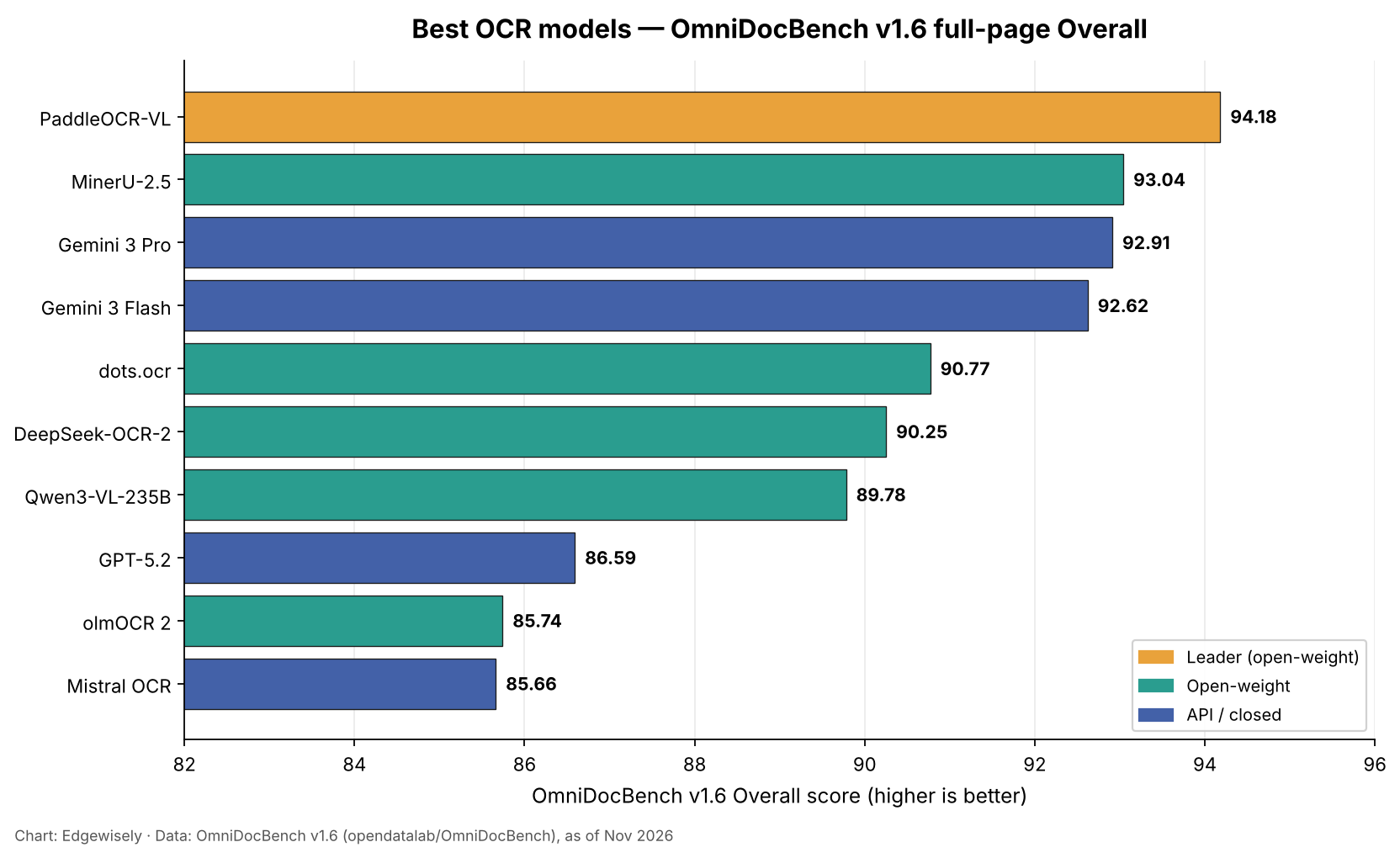
The spread is tight at the top. Six models score above 90, and the gap between first-place PaddleOCR-VL (94.18) and sixth-place DeepSeek-OCR-2 (90.25) is under four points. The real story is lower down: GPT-5.2 (86.59) and the Mistral OCR entry (85.66) trail every leading specialist model. General frontier vision beats a specialist at document OCR only in your demo, not on the benchmark.
As a cross-check, Ai2's OlmOCR-Bench (higher is better) tells a consistent story for the models it covers: olmOCR 2 leads at 82.3, dots.ocr at 79.1, DeepSeek-OCR at 75.7, and MinerU2.5 at 75.2, per each model card. Two independent benchmarks agreeing on the ordering is the signal you want.
Best open-source OCR model?
PaddleOCR-VL, with MinerU-2.5 a close second for full-pipeline work. Both are open-weight, both score above 93, and both run on modest hardware.
Pick by license and job:
- PaddleOCR-VL (Apache-2.0, 0.9B) — highest score, most permissive of the two, smallest to run. The default choice.
- MinerU-2.5 (AGPL-3.0, 1.2B) — a full PDF-to-Markdown toolchain, not just a model. Strong at 93.04, but AGPL-3.0 is a copyleft license that can be a problem for closed-source SaaS; check with legal before shipping.
- dots.ocr (MIT, 3B) — slightly lower at 90.77, but MIT is the most business-friendly license here, and it comes from the rednote/Xiaohongshu team.
- DeepSeek-OCR-2 (open-weight) — DeepSeek's follow-up to its October 2025 model, released 2026-01-27. Known for extreme vision-token efficiency, which cuts inference cost on high-volume batch jobs; if you're already weighing DeepSeek, our DeepSeek safety analysis covers the app-vs-self-host distinction that matters here.
- olmOCR 2 (Apache-2.0, 8B) — from the Allen Institute for AI, built on Qwen2.5-VL-7B. The most transparent option: open weights, open data, open training recipe. It leads OlmOCR-Bench at 82.3 even if it sits mid-pack on OmniDocBench.
The headline: the best open-source OCR model outscores the best closed API. That was not true a year ago.
Which closed OCR API is best?
Gemini 3 Pro leads the hosted field at 92.91, with Gemini 3 Flash right behind at 92.62 and cheaper to call. Both beat GPT-5.2 (86.59) at document parsing by a wide margin.
Mistral OCR is the purpose-built API option. Mistral OCR 3 (model mistral-ocr-2512) shipped 2025-12-17 and prices per page rather than per token, which makes cost predictable for document workloads. A newer Mistral OCR 4 has since shipped; OCR 3 remains available for existing integrations. On OmniDocBench the tested Mistral OCR entry scores 85.66 — behind the Gemini 3 models and the leading open-weight specialists. Mistral's wider frontier lineup is covered in our Mistral vs Claude breakdown.
If you already run on OpenAI or Google, their vision models are "good enough" for clean documents. For messy, high-volume, or accuracy-critical document work, a specialist model — open or Mistral — is the better tool.
What does OCR cost?
Two pricing models, and the cheaper one is also near the top of the benchmark.
- Open-weight models: $0 license, your compute. PaddleOCR-VL, MinerU, dots.ocr, DeepSeek-OCR-2, and olmOCR 2 are free to download and run. Your only cost is GPU time, and a 0.9B–1.2B model runs on a single mid-range GPU.
- Mistral OCR 3: $2 per 1,000 pages standard, $1 per 1,000 pages via the batch API, and $3 per 1,000 annotated pages, per Mistral's announcement.
- Gemini, GPT-5.2: token-based. Cost scales with image resolution and output length, which makes per-page cost harder to forecast for large documents. If raw API cost is your main lever, our cheapest AI API comparison breaks down per-token pricing across vendors.
For a million pages a month, a self-hosted PaddleOCR-VL instance is almost always cheaper than any token-billed API — once you've absorbed the ops cost of running it. Below roughly 50,000 pages a month, a pay-per-page API like Mistral's usually wins on total cost of ownership.
Open-weight vs API OCR: which should you use?
Use open-weight when you have GPUs or an ML platform, high volume, data-privacy requirements, or a need to fine-tune. Use an API when you want zero infrastructure, spiky or low volume, and don't want to manage a model.
The accuracy argument for APIs is gone. The best open-weight model (94.18) now outscores the best closed API (92.91). You're choosing on operations and cost, not quality.
- Self-host if: >50k pages/month, sensitive data, existing GPU capacity, or you need to tune on your document types.
- Use an API if: low or unpredictable volume, no ML ops, clean documents, or you need results this afternoon.
OCR output usually feeds a downstream retrieval pipeline, so pair your choice with a strong retriever — see our best embedding model guide for the RAG half of that stack.
Our take
Our thesis: in late 2026, OCR is a solved problem for clean documents and an open-weight one. The decision has moved from "which model is accurate enough" to "what's my license, my volume, and my ops budget." Six models clear 90 on OmniDocBench, four of them open-weight, and the top one runs at 0.9B parameters. Accuracy is no longer the differentiator at the top of the table.
The most important fact in this whole comparison is the one that's easy to miss: a 0.9B specialist beats a 235B general model and every frontier chat model at reading documents. PaddleOCR-VL (0.9B) outscores Qwen3-VL-235B, GPT-5.2, and the Mistral OCR entry. If you're reaching for GPT-5.2 vision to OCR an invoice, you're using a worse and more expensive tool than a model you can run yourself for free. That's our strongest opinion here, and the benchmark backs it.
Now the caveat, because a benchmark is not reality. OmniDocBench measures structured document parsing — academic papers, reports, tables, formulas, reading order — largely on reasonably clean scans. It is an excellent proxy for "can this model turn a PDF into clean Markdown for a RAG pipeline." It is a weaker proxy for the cases that actually break OCR in production: crumpled receipts, phone photos at an angle, carbon-copy forms, non-Latin and mixed scripts, dense handwriting, and low-light captures. Baidu's own PaddleOCR-VL-1.5 paper makes this point implicitly by introducing a separate "Real5" benchmark for physically distorted documents — and scores on that benchmark are several points lower across the board. Our read: trust the OmniDocBench ordering for clean docs; run your own eval on your ugliest real inputs before you commit.
The second thing OmniDocBench doesn't score is hallucination risk. VLM-based OCR doesn't "fail to read" the way old OCR did — it can invent plausible text, complete a number it couldn't see, or silently drop a table row. For a RAG index, a rare hallucination is noise. For an accounts-payable pipeline reading dollar amounts, it's a liability. This is an opinion, not a benchmarked fact: for money-critical extraction, we'd still run two models and flag disagreements, regardless of which one "wins" OmniDocBench.
On the open-vs-API economics, our judgement is unambiguous at the extremes and genuinely close in the middle. High volume with GPUs: self-host PaddleOCR-VL or MinerU, full stop — the quality is top-tier and the marginal cost per page approaches your electricity bill. Low or spiky volume with no ML ops: pay Mistral $1–2 per 1,000 pages and spend your engineering time elsewhere. The messy middle is 20k–100k pages a month, where the answer depends on whether you already have inference infrastructure. If standing up a GPU is a project, the API wins even though the sticker price is higher; the total cost of ownership includes your team's time.
Where each model actually fits, in our words:
- PaddleOCR-VL — default for most builders. Best score, tiny, Apache-2.0. Avoid if you can't run a GPU at all.
- MinerU-2.5 — best when you want a batteries-included PDF pipeline, not just a model. Avoid if AGPL-3.0 can't ship in your product.
- dots.ocr — best when you need a permissive MIT license in a commercial product and can trade ~3 points of accuracy for it.
- Gemini 3 Pro / Flash — best hosted accuracy with zero ops. Avoid if token-based pricing on large documents blows your budget.
- Mistral OCR 3 — best predictable per-page API pricing. Avoid if you need the absolute top of the accuracy table.
- olmOCR 2 — best when reproducibility and fully open data matter more than the last two benchmark points.
- DeepSeek-OCR-2 — best for token-efficient, high-volume batch jobs where inference cost dominates.
- GPT-5.2 vision — use only because it's already in your stack. It is not the best tool for OCR, and the benchmark says so.
Our one-line verdict: start with PaddleOCR-VL if you can self-host, Mistral OCR 3 if you can't, and don't reach for a frontier chat model to do a specialist's job.
Frequently Asked Questions
What is the best OCR model?
The best OCR model overall as of November 2026 is PaddleOCR-VL, Baidu's 0.9B open-weight model, which leads the OmniDocBench v1.6 leaderboard at 94.18 (higher is better). It's Apache-2.0 licensed, self-hostable, and outscores closed APIs including Gemini 3 Pro and GPT-5.2 at document parsing.
Which OCR model is the best for my use case?
It depends on your constraint. For best overall accuracy and self-hosting, choose PaddleOCR-VL. For a hosted API with no GPU to manage, choose Gemini 3 Pro. For a permissive MIT license in a commercial product, choose dots.ocr. For predictable per-page pricing, choose Mistral OCR 3 at $1–2 per 1,000 pages.
Which AI model is best for OCR?
For document OCR specifically, a specialist vision-language model beats a general chat model. PaddleOCR-VL (94.18 on OmniDocBench v1.6) and Gemini 3 Pro (92.91) both outperform GPT-5.2 (86.59). Use a purpose-built OCR model rather than a frontier chat model, which is less accurate and more expensive for this task.
What are the best OCR tools or models available?
The strongest current options are PaddleOCR-VL, MinerU-2.5, and dots.ocr among open-weight models; Gemini 3 Pro and Gemini 3 Flash among APIs; and Mistral OCR 3 as a per-page API. Ai2's olmOCR 2 leads the separate OlmOCR-Bench at 82.3 and is fully open.
Is open-source OCR as accurate as paid APIs?
Yes, and it's now more accurate. The top open-weight model, PaddleOCR-VL, scores 94.18 on OmniDocBench v1.6, above the best closed API, Gemini 3 Pro, at 92.91. Open models like MinerU-2.5 and dots.ocr also beat GPT-5.2 and the tested Mistral OCR entry. You choose on ops and cost, not accuracy.
Editor's note — sources: All benchmark scores are from the OmniDocBench v1.6 leaderboard (opendatalab/OmniDocBench) and OlmOCR-Bench, read November 2026. Model sizes, licenses, and release dates are from each model's official Hugging Face card, GitHub repo, or arXiv paper; pricing is from vendors' live pages (Mistral). Scores change as leaderboards update — verify the current number before you standardize on a model. Sources: OmniDocBench leaderboard, PaddleOCR-VL card, PaddleOCR-VL paper, dots.ocr card, olmOCR 2 card, Mistral OCR 3.