
Mistral vs Claude: Which AI Wins in 2026?
Claude leads on raw capability (Index 59 vs 26); Mistral wins on price (10x cheaper output), open weights and EU data sovereignty. A current, sourced head-to-head with real November 2026 benchmark and pricing numbers, and who should pick which.


Mistral vs Claude comes down to one trade-off: Claude wins raw capability, Mistral wins price, openness and European data sovereignty. As of November 2026, Anthropic's Claude Opus 5.5 scores 59 on the Artificial Analysis Intelligence Index v5.0.1; Mistral's flagship Mistral Large 4 scores 26. Pick Claude for hard agentic work, Mistral for cheap, open-weight, EU-resident deployment.
TL;DR
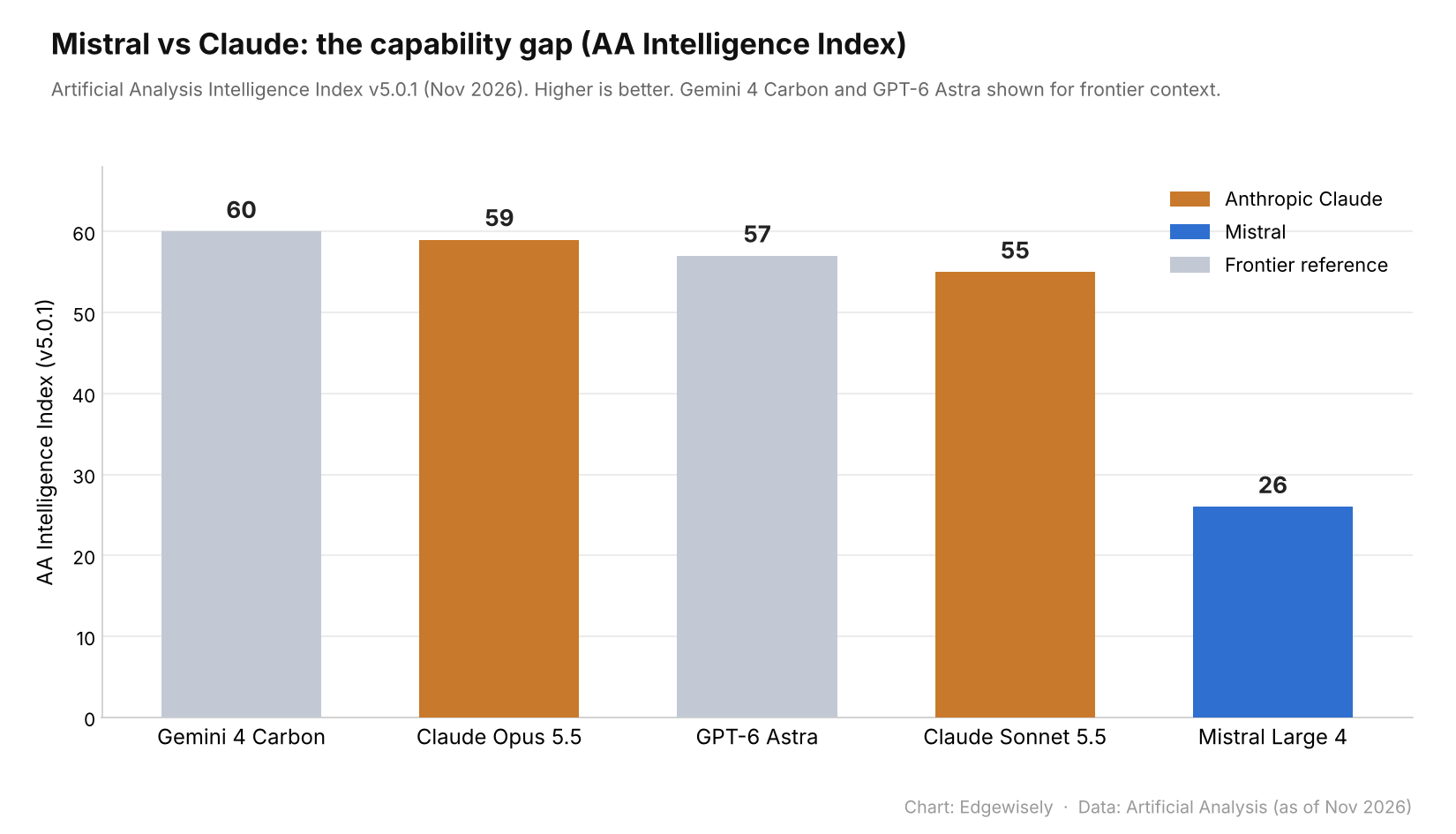
- Capability: Claude leads clearly. Claude Opus 5.5 = 59 and Sonnet 5.5 = 55 on the AA Intelligence Index v5.0.1; Mistral Large 4 = 26 (as of November 2026).
- Price: Mistral is far cheaper at the top end. Mistral Large 4 runs $0.70 in / $2.10 out per 1M tokens vs Claude Opus 5.5 at $4 / $20 — roughly 10x cheaper output. But Claude Haiku 5.5 ($0.10 / $0.50) undercuts every Mistral large model.
- Openness: Mistral ships open weights you can self-host; Claude is closed, API-only. Mistral Large 4 is under the Mistral Ecosystem Open-Weight License; Mistral Large 3 is Apache 2.0.
- Sovereignty: Mistral (France) offers EU data residency and on-prem/VPC deployment. Claude does not ship weights.
- Who picks which: Claude for agentic coding and long-horizon reasoning; Mistral for budget, open-weight/on-prem, and EU-regulated workloads.
Mistral vs Claude: which is better?
Claude is the better model on raw intelligence, and it is not close on the headline number. On the Artificial Analysis Intelligence Index v5.0.1, Claude Opus 5.5 scores 59 and Sonnet 5.5 scores 55. Mistral's current flagship, Mistral Large 4, scores 26.
That gap is real. The index blends reasoning, coding and knowledge benchmarks, and Claude sits near the frontier (Google's Gemini 4 Carbon leads at 60, GPT-6 Astra at 57).
But "better" depends on the job. Mistral Large 4 is a 1.1-trillion-parameter mixture-of-experts (52B active) with open weights and a 1M-token context. You can download it, run it on your own hardware, and pay a fraction of Claude's token price.
So the honest answer to claude vs mistral: Claude if you need the smartest possible output per call. Mistral if price, control, or EU residency outweigh the last 30 points of index score.
Is Mistral cheaper than Claude?
Yes — dramatically, at the frontier tier, and that is Mistral's strongest card. Here is the current lineup side by side.
| Model | Maker | AA Index (v5.0.1) | Input $/1M | Output $/1M | Open weights? (license) | Best for |
|---|---|---|---|---|---|---|
| Mistral Large 4 | Mistral (FR) | 26 | $0.70 | $2.10 | Yes — Mistral Ecosystem Open-Weight | Cheap frontier-ish, self-host, EU |
| Mistral Large 3 | Mistral (FR) | N/A | $0.50 | $1.50 | Yes — Apache 2.0 | Clean-license open-weight general use |
| Claude Opus 5.5 | Anthropic (US) | 59 | $4.00 | $20.00 | No (API only) | Hardest reasoning + agentic tasks |
| Claude Sonnet 5.5 | Anthropic (US) | 55 | $2.00 | $10.00 | No (API only) | Best all-round coding value |
| Claude Haiku 5.5 | Anthropic (US) | N/A | $0.10 | $0.50 | No (API only) | High-volume cheap tasks |
All figures as of November 2026. Index: Artificial Analysis v5.0.1. Prices: vendor APIs. "N/A" = no v5.0.1 index score published.
Read the nuance. Mistral Large 4 output is ~10x cheaper than Claude Opus 5.5 and ~5x cheaper than Sonnet 5.5. For high-volume generation, that compounds fast.
But Claude has a cheap tier too. Claude Haiku 5.5 at $0.10 / $0.50 is cheaper than any Mistral large model. If your task is simple and you just want low cost on a managed API, Haiku beats Mistral Large 4 on price.
The clean framing: Mistral wins the capable-but-cheap middle; Claude wins both the top (Opus) and the rock-bottom (Haiku).
Is Mistral as smart as Claude?
No, not on current benchmarks. The mistral large 3 vs claude and Large 4 vs Claude comparisons both land the same way: Claude's models sit 25-35 index points higher.
Mistral Large 3 (December 2025) never received a v5.0.1 index score and is now marked deprecated on Artificial Analysis. Mistral Large 4 replaced it and scores 26 — above DeepSeek V4 Pro (23) and in the range of mid-tier open models, but well below the Claude line. Mistral is one of several open challengers chasing Claude on price; the same open-versus-closed trade-off runs through Qwen vs Claude and GLM vs Claude.
Where does that gap bite? Multi-step reasoning, tool use over long horizons, and tasks where one wrong step derails the whole run. Claude is simply more reliable there.
Where does it not bite? Classification, extraction, summarization, retrieval-augmented generation, and structured output. On those, a 26-index model and a 59-index model often produce indistinguishable results — and you paid 10x less.
Mistral's full lineup beyond Large 4
Mistral vs Claude is rarely a one-model decision, because Mistral fields a wider, cheaper stack. Here is what sits beneath the flagship, with prices as listed by Artificial Analysis (November 2026).
Mistral Medium 3 is the cost-efficient workhorse, at a blended $0.56 per 1M tokens (AA figure). It targets the bulk of production traffic — the extraction, summarization and RAG tasks where frontier intelligence is overkill. The newer Medium 3.5 carries a low v5.0.1 index (5), so lean on your own evals rather than the headline score here.
Magistral is Mistral's reasoning line. Magistral Small 1.2 is listed at $0.60 per 1M tokens (AA). It is the open, cheap answer to chain-of-thought workloads, though it trails Claude on the hard reasoning the index rewards.
Ministral 3 covers the edge: dense 3B, 8B and 14B models priced from roughly $0.037 to $0.074 per 1M tokens (AA). These run on modest hardware or on-device — a tier Claude has no equivalent for, since Anthropic ships no small, local models.
Codestral (code completion) and Devstral 2 (agentic coding, open weights) round out the developer stack. Both self-host, which is the point: private-repo coding that never leaves your network. Claude is stronger at agentic coding, but it cannot run inside an air-gapped environment the way open Devstral can.
The takeaway: Mistral gives you a full price/size ladder you can self-host; Claude gives you three managed tiers (Opus, Sonnet, Haiku) you rent.
Can Mistral replace Claude for coding?
Partly, and only if you accept lower reliability for much lower cost. Coding is where Claude's lead is most concrete.
On Terminal-Bench 4.0, the agentic-coding benchmark the field now uses, Claude Sonnet 5.5 scores 70.6% and Opus 5.5 scores 66.4%. Mistral reports Mistral Large 4 at 41% on the same test (Mistral's own figure, up 13 points from a self-reported preview).
That is a wide, same-benchmark gap. For autonomous, long-running coding agents, Claude finishes more tasks without a human babysitting it.
Mistral's answer is specialization and openness. Codestral and open-weight Devstral 2 target developer workflows and self-host. For an in-house code assistant on private repos that must never leave your network, open-weight Devstral is a real option Claude cannot match on deployment.
Verdict: Claude for frontier agentic coding; Mistral for cheap, self-hosted, privacy-bound coding where you tolerate more retries.
Mistral vs Claude for data privacy and EU sovereignty
This is where mistral ai vs claude stops being about benchmarks. Mistral wins decisively on deployment control.
Mistral is French, and it ships open weights. You can run Mistral Large 4 or Large 3 on your own infrastructure, in your own EU region, with no US-vendor dependency. The Mistral Ecosystem Open-Weight License permits commercial self-hosting; running it as a resold model-as-a-service needs a separate commercial license. Mistral Large 3's weights are released under Apache 2.0, which is as permissive as it gets.
Claude is closed. You consume it through Anthropic's API (or hyperscaler resellers like AWS Bedrock and Google Vertex). There are no weights to download, no air-gapped deployment, no "the model runs inside our VPC and nothing leaves."
For a regulated European organization, that difference is often the whole decision. Open weights plus EU-region self-hosting gives a concrete answer to the one question compliance teams keep asking: where does our data physically go? With a self-hosted Mistral model, the answer is "nowhere it isn't already" — inference happens on infrastructure you control, inside the jurisdiction you choose.
That matters under the EU AI Act and GDPR-driven data-residency rules. A bank, a hospital, or a public-sector body can place an open-weight model in an on-prem or private-cloud (VPC) deployment, keep personal and regulated data inside the EU, and avoid transferring it to a US vendor's systems entirely. No cross-border transfer, no reliance on a foreign provider's processing terms, full control of logging and retention.
Claude cannot offer that shape. Anthropic provides strong security and enterprise controls, but your prompts and data still reach a US company's (or a reseller's) infrastructure. If "no US-vendor dependency" or "data never leaves our walls" is a hard requirement, Mistral wins before the benchmark conversation starts.
Le Chat vs Claude: the consumer apps
For the chat apps, the le chat vs claude call tracks the model gap but narrows on price and features.
Mistral's Le Chat has a free tier, Le Chat Pro at $14.99/month, and Team at $24.99/user/month, per Mistral's pricing page. It bundles web search, document analysis, image generation and a code interpreter.
Claude's app is Claude Pro at $17-20/month and Max at $100/month, per Anthropic's published pricing. It is powered by the stronger Opus/Sonnet models.
Le Chat is cheaper and genuinely fast. Claude gives better answers on hard reasoning and longer, more complex documents. For everyday drafting and search, most people won't feel the gap; for demanding analysis or coding help, Claude's lead shows.
How we compared them
A note on the numbers, because methodology changes what they mean.
The Artificial Analysis Intelligence Index v5.0.1 is a single blended score built from reasoning, coding and knowledge benchmarks (its components include Terminal-Bench 4.0 among others). It is a good proxy for peak capability and a poor proxy for "will this do my specific task." Use it to rank, not to predict your eval results.
Scores are not comparable across index versions. A v5.0.1 figure can't be read against an older v5.0 or v4.0 number — the composition differs. Every index figure here is v5.0.1, dated November 2026.
Watch who ran each benchmark. The coding figures are not all independent. Mistral Large 4's 41% on Terminal-Bench 4.0 is Mistral-cited, and the preview number it improved on was self-reported. Claude's 70.6% (Sonnet 5.5) and 66.4% (Opus 5.5) are Anthropic self-run. Treat same-vendor benchmarks as directional, and lean on the neutral AA Index plus your own evaluation before committing.
Our take
Our thesis: the 59-vs-26 index gap is real, but it is the wrong number to anchor a buying decision on for most production workloads — and the market keeps anchoring on it anyway.
The Artificial Analysis Intelligence Index measures frontier reasoning, hard coding and knowledge. It is an excellent proxy for "how smart is this model at its hardest." It is a poor proxy for "will this model do my actual job." Most deployed LLM work is not frontier reasoning. It is extraction, classification, summarization, routing, RAG answers, and structured generation — tasks where a mid-index open model and a frontier closed model land in the same place, and the only thing that differs is the invoice.
On that invoice, Mistral is serious. Mistral Large 4 at $2.10 output per 1M tokens is roughly a tenth of Claude Opus 5.5's $20. Over millions of calls, that is the difference between a feature that ships and one that gets cut for cost. If your evals show Mistral Large 4 clears your quality bar — and for a large slice of workloads it will — paying 10x for Claude is a luxury, not a requirement.
Then there is the part the thin comparison blogs ignore: sovereignty is a capability. Open weights plus EU hosting is not a nice-to-have for a European regulated enterprise; it is often the only legally clean path. Claude is a better model that some organizations simply cannot deploy the way their compliance team needs. Mistral's open-weight releases — Large 4, Large 3 under Apache 2.0, Devstral for coding — turn "which is smarter" into "which can we actually run," and on that question Mistral wins outright for the on-prem and data-residency crowd. The self-host economics help too: at sustained high volume, running open weights on your own GPUs can beat per-token API pricing from either vendor.
Where we won't stretch the argument: Claude is genuinely ahead where it counts most, and we think that lead is worth paying for in specific cases. Agentic coding is the clearest. Claude Sonnet 5.5's 70.6% on Terminal-Bench 4.0 vs Mistral Large 4's reported 41% is not a rounding difference — it is the gap between an agent that finishes and one that stalls. For autonomous coding, long-horizon tool use, and tasks where a single bad step is expensive, Claude's reliability earns its price. That is an opinion, but it is the consistent pattern across the agentic benchmarks.
Our cost/quality judgement: default to Mistral and let Claude earn its premium on the hard 20%. Run your real workload through Mistral Large 4 (or Medium for cheaper, or Haiku if you want a managed cheap API). Measure. Route only the tasks that fail to Claude Sonnet, and reserve Opus for the genuinely hard agentic work. That tiered setup usually beats standardizing on either vendor.
Best for / avoid:
- Startup on a budget: Mistral Large 4 or Claude Haiku 5.5. Avoid defaulting to Opus — you're overpaying.
- EU-regulated enterprise: Mistral, for open weights + residency. Avoid Claude as your only option if on-prem is mandatory.
- Agentic-coding team: Claude Sonnet 5.5 (Opus for the hardest agents). Avoid Mistral Large 4 as your primary coding agent unless cost forces it.
- Privacy/on-prem shop: Mistral (self-host Large 4 or Devstral). Avoid Claude — there are no weights to run.
Frequently Asked Questions
Is Mistral better than Claude?
Not on raw capability. As of November 2026, Claude Opus 5.5 scores 59 on the Artificial Analysis Intelligence Index v5.0.1 versus 26 for Mistral Large 4. Mistral is "better" only when price, open weights, self-hosting or EU data residency matter more than peak intelligence — which for many production workloads, they do.
Is Mistral cheaper than Claude?
At the frontier tier, yes, by a wide margin. Mistral Large 4 costs $0.70 input / $2.10 output per 1M tokens versus $4 / $20 for Claude Opus 5.5 — roughly 10x cheaper output. The exception: Claude Haiku 5.5 ($0.10 / $0.50) is cheaper than any Mistral large model for simple, high-volume tasks.
Can Mistral replace Claude for coding?
For cheap or self-hosted coding, partly. For frontier agentic coding, no. Claude Sonnet 5.5 scores 70.6% on Terminal-Bench 4.0 and Opus 5.5 66.4%, versus Mistral Large 4's self-reported 41%. Mistral's open-weight Devstral and Codestral win where you need private, on-prem coding assistance over absolute reliability.
Is Mistral's Le Chat as good as Claude?
For everyday chat, close. For hard reasoning, no. Le Chat Pro ($14.99/month) is cheaper than Claude Pro ($17-20/month) and fast, with search, documents and image generation. Claude runs stronger underlying models (Opus/Sonnet), so it pulls ahead on complex analysis, long documents and coding help.
Which is better for data privacy, Mistral or Claude?
Mistral, if you need control. It ships open weights you can self-host in your own EU region with no US-vendor dependency, which suits AI Act and data-residency requirements. Claude is closed and API-only — strong security, but your data goes to Anthropic's (or a reseller's) infrastructure, with no on-prem option.
Editor's note — sources: All benchmarks and prices are as of November 2026. Intelligence Index scores come from Artificial Analysis (v5.0.1); prices from Mistral's and Anthropic's own pricing pages and Artificial Analysis. Terminal-Bench 4.0 coding figures are vendor-reported (Mistral-cited for Large 4; Anthropic self-run for Claude) and should be read as directional. Artificial Analysis Intelligence Index scores are not comparable across index versions.