
Grok vs Gemini: Which AI Model Wins in 2026?
Gemini 4 wins on intelligence (v5.0 index 50-59 vs Grok 4.7's 34), but Grok is about half the price and taps live X data. A current two-way comparison with verified Oct 2026 benchmarks, a pricing table, and a clear pick-Grok-if / pick-Gemini-if verdict.
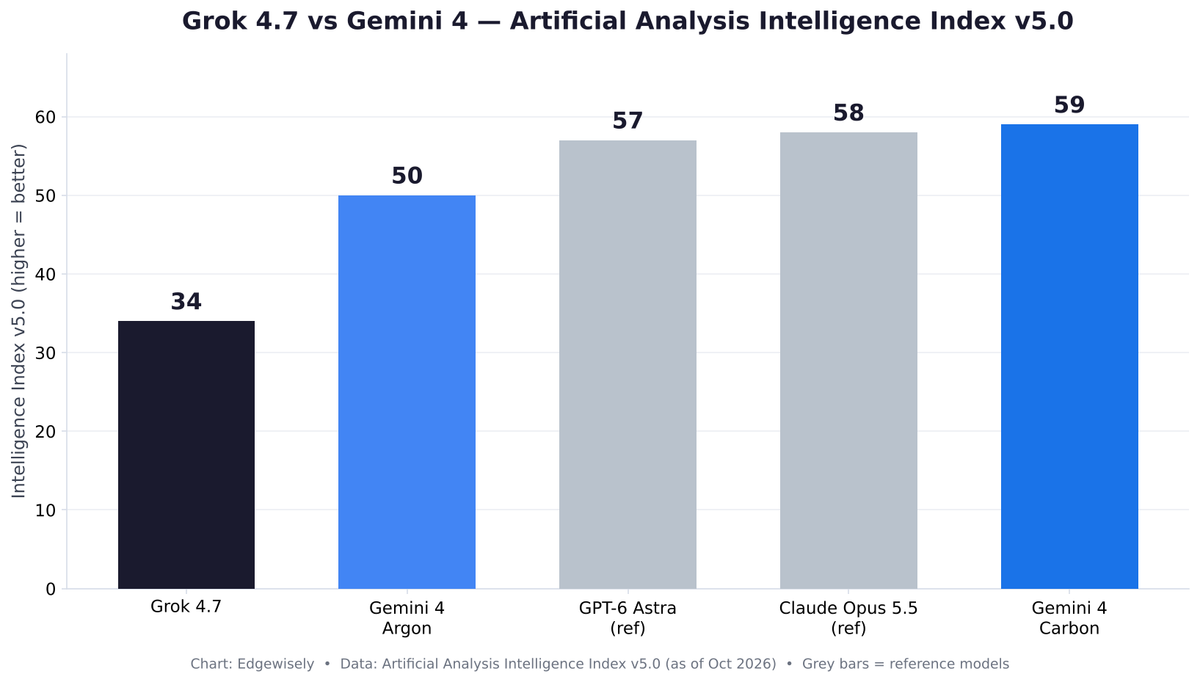
Pick Gemini for raw intelligence, Grok for price and real-time data. On Artificial Analysis's v5.0 Intelligence Index (as of Oct 2026), Gemini 4 scores 50 (Argon) to 59 (Carbon) against Grok 4.7's 34 — but Grok costs roughly half as much and taps live X data. For grok vs gemini, that trade-off is the whole decision.
TL;DR
- Intelligence: Gemini wins clearly. Gemini 4 Carbon (59) is the current #1 on the Artificial Analysis Intelligence Index v5.0; Gemini 4 Argon scores 50; Grok 4.7 scores 34 (all v5.0, as of Oct 2026).
- Price: Grok wins. Grok 4.7 is $2 in / $6 out per 1M tokens. Gemini 4 standard is $4 / $20 (Argon runs a promo of $2 / $10 through Nov 30, 2026). Grok's blended cost is roughly half Gemini's.
- Context: Gemini wins. 1M tokens (both Gemini 4 tiers) vs 500k for Grok 4.7.
- Coding: Mixed. Gemini 4 Argon leads agentic coding (Terminal-Bench 4.0 57% vs Grok's 26%); the two are near-even on FrontierCode 2.0 (Grok 29%, Gemini 26%).
- Verdict: Pick Gemini when answer quality, long context, or multimodal input matters. Pick Grok when you want the cheapest competent reasoning model or live X/𝕏 data.
What's the difference between Grok and Gemini?
Short version: Gemini is the smarter, pricier, longer-context family; Grok is the cheaper model wired to real-time X data. Gemini 4 comes from Google in two tiers — Argon (generally available) and Carbon (the new top-ranked model, rolling out to selected users). Grok 4.7 is xAI's current flagship, a reasoning model with configurable effort.
The gap shows up on one consistent yardstick. The Artificial Analysis Intelligence Index v5.0 aggregates nine evaluations into a single score. As of Oct 2026, Gemini 4 Carbon sits at 59, Gemini 4 Argon at 50, and Grok 4.7 at 34 (source: Artificial Analysis's Grok 4.7 page).
One caution on numbers you'll see elsewhere: older Grok "46" figures come from the retired v4.3.2 index and are not comparable to v5.0. We only use v5.0 here, so every head-to-head number is apples to apples.
Three models, side by side
| Model | Maker | Released | Context window | Price (in / out per 1M) | AA Intelligence Index v5.0 | Input modalities | Best for |
|---|---|---|---|---|---|---|---|
| Grok 4.7 | xAI | Sep 21, 2026 | 500k | $2 / $6 (75% cache discount) | 34 | Text, image | Cheap reasoning, real-time X data |
| Gemini 4 Argon | Sep 2026 | 1M | $4 / $20 standard; $2 / $10 promo through Nov 30, 2026 | 50 | Text, image | Everyday high-quality work, long context | |
| Gemini 4 Carbon | Oct 2026 | 1M | $4 / $20 (50% launch discount, no end date) | 59 | Text, image, video, speech | Hardest reasoning, multimodal, frontier quality |
All figures as of Oct 2026. Sources: Artificial Analysis model and comparison pages; x.ai docs; Google's Gemini API pricing. Cached input for both Gemini tiers is $0.20 / 1M at standard pricing.
Note on availability: Gemini 4 Carbon is not yet publicly available — as of Oct 28, 2026 it is limited to selected users (source: Artificial Analysis's Gemini 4 Carbon writeup). If you need something you can call in the API today, the real fight is Grok 4.7 vs Gemini 4 Argon.
Is Grok better than Gemini?
No — not on measured intelligence. On the Artificial Analysis Intelligence Index v5.0, Gemini 4 beats Grok 4.7 by a wide margin: 50 and 59 vs 34 (as of Oct 2026). That is not a rounding-error gap; it is the difference between a frontier model and a solid mid-tier one.
Grok is "better" only on axes the index doesn't weigh heavily: price, output speed, and live data. Grok is roughly half the cost, runs at a comparable ~88 output tokens/sec, and is tied to real-time X/𝕏 content that Gemini doesn't natively carry.
So the honest framing isn't "which is better" — it's "which trade-off fits your job." Gemini buys you answer quality and context. Grok buys you margin and freshness.
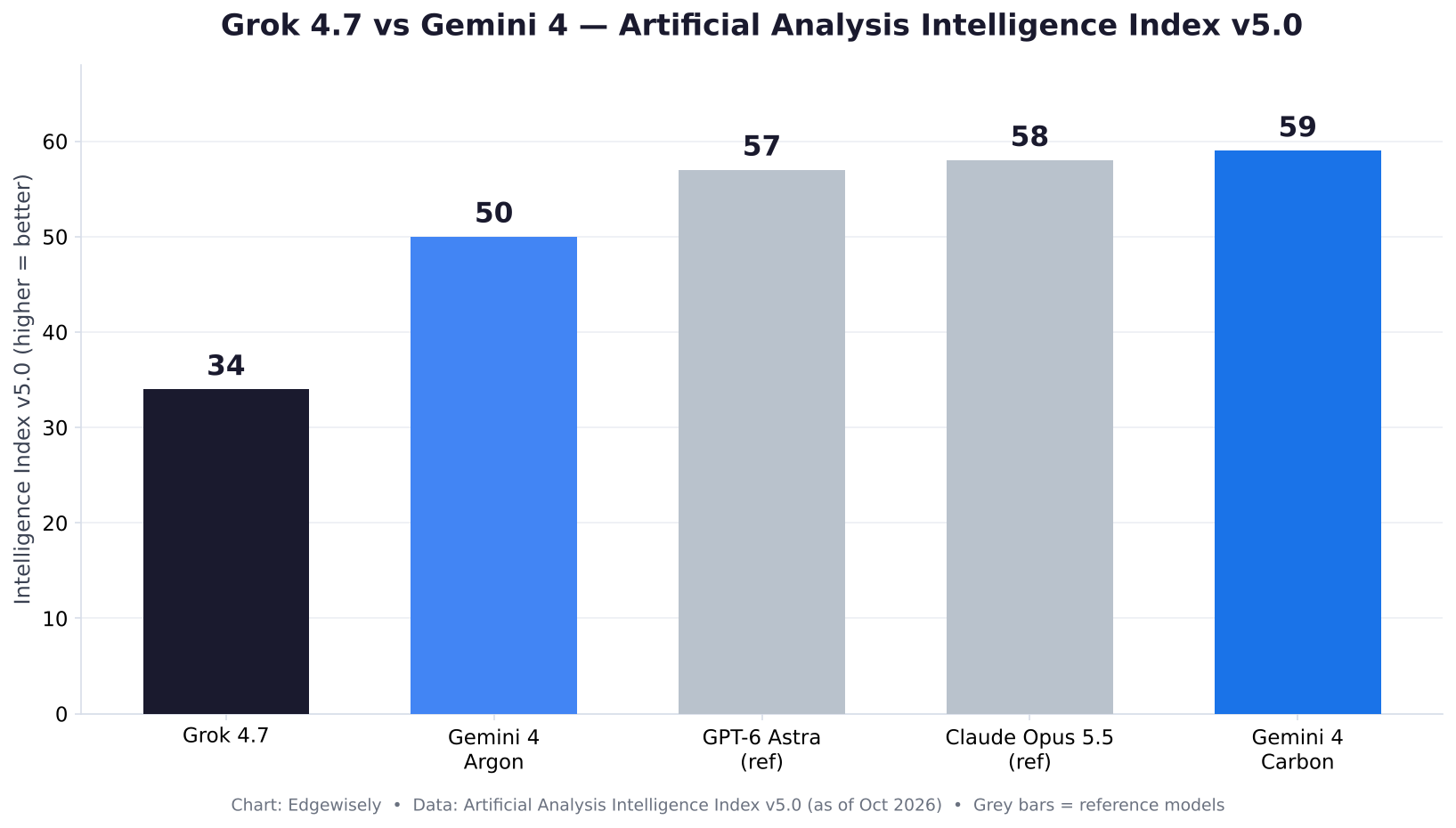
For context on that chart: on the same v5.0 index, Claude Opus 5.5 = 58 and GPT-6 Astra = 57 (as of Oct 2026, Artificial Analysis). Gemini 4 Carbon's 59 edges both to take #1; Gemini 4 Argon's 50 is competitive mid-frontier; Grok 4.7's 34 sits below that pack, closer to models like DeepSeek V4.1 Flash (32).
Where Grok actually leads
One benchmark flips the script. On AA-Briefcase v1.1 — an Artificial Analysis-run Elo for knowledge-work tasks — Grok 4.7 scores ~1638, ahead of both Gemini 4 Argon (~1483) and Gemini 4 Carbon (~1609) (as of Oct 2026, Artificial Analysis). That's an independent, same-source result, and it's a real point in Grok's favor for business/analyst workloads.
Read that carefully, though: AA-Briefcase measures a specific kind of task. The broader v5.0 index — reasoning, science, long-horizon agentic work — still favors Gemini by a lot. Grok wins a round, not the fight.
Grok vs Gemini: which is better at coding?
For agentic coding, Gemini 4 Argon leads clearly; for short, self-contained code tasks the two are closer. On independent, same-source benchmarks (Artificial Analysis, as of Oct 2026):
| Coding benchmark | Grok 4.7 | Gemini 4 Argon |
|---|---|---|
| Terminal-Bench 4.0 (agentic coding) | 26% | 57% |
| FrontierCode 2.0 (agentic software engineering) | 29% | 26% |
Terminal-Bench 4.0 rewards multi-step, tool-using agent workflows — the kind of "give it a repo and a task" coding that matters for real engineering. Gemini roughly doubles Grok there. On FrontierCode 2.0 the gap closes and Grok is marginally ahead, which suggests Grok holds its own on tighter, more contained problems.
xAI markets Grok 4.7 as its flagship for code, and has cited a DeepSWE result in its own materials — but we could not verify that number on Artificial Analysis, so treat any vendor DeepSWE figure as xAI's self-reported claim, not an independent result.
For the broader frontier picture: Gemini 4 Carbon ranks second on Artificial Analysis's Coding Agent Index (59, three points behind Claude Opus 5.5 at 62, as of Oct 2026). Grok does not lead that board. If a coding agent is your main use case, our deeper Grok vs Claude comparison is worth a read alongside this one.
What does each cost?
Grok is the cheaper model, full stop. Grok 4.7 is $2 input / $6 output per 1M tokens, with a 75% cache discount (source: x.ai docs, as of Oct 2026). Gemini 4 standard pricing is $4 / $20 for both Argon and Carbon (source: Artificial Analysis).
The catch is Google's temporary discounting:
- Gemini 4 Argon runs a promo of $2 input / $10 output through Nov 30, 2026, reverting to $4 / $20 on Dec 1, 2026 (source: Google's Gemini API pricing, as of Oct 2026). Cached input is $0.10 during the promo, $0.20 after.
- Gemini 4 Carbon carries a 50% launch discount with no confirmed end date (source: Artificial Analysis).
Even on promo, Gemini's output tokens cost more. On Artificial Analysis's blended pricing (a 7:2:1 input/output/cache mix), Grok 4.7 blends to ~$1.35 / 1M versus Gemini 4 Argon at ~$2.94 / 1M (as of Oct 2026) — Grok is a little over half the cost.
Output token price is where this bites hardest. Reasoning models emit a lot of output (thinking tokens count), so Gemini's $20 output rate — 3.3x Grok's $6 — dominates the bill on verbose, high-reasoning workloads. If cost per token is your main concern, see our cheapest AI API comparison for where both models sit against the budget field.
Which has the bigger context window?
Gemini, by 2x. Both Gemini 4 tiers offer a 1M-token context window; Grok 4.7 offers 500k (sources: Artificial Analysis, x.ai docs, as of Oct 2026).
500k is already large — enough for big codebases, long documents, or multi-file analysis. But if you routinely stuff entire repositories, long transcripts, or large document sets into a single prompt, Gemini's 1M gives you real headroom Grok can't match.
Gemini also wins on input modalities. Grok 4.7 takes text and image. Gemini 4 Argon matches that; Gemini 4 Carbon adds video and speech input. If your pipeline ingests audio or video, Carbon is the only one of the three that handles it natively.
Who should use Grok? Who should use Gemini?
Short answer: cost-and-freshness teams pick Grok; quality-and-context teams pick Gemini. Here's the segmented read.
Pick Grok 4.7 if:
- You're cost-sensitive and running high volume — Grok's ~half-price economics compound fast.
- You need real-time X/𝕏 data in the loop (social monitoring, trend detection, live sentiment).
- Your tasks are knowledge-work / analyst-style, where Grok's AA-Briefcase strength shows up.
- 500k context and text+image input are enough.
Pick Gemini 4 (Argon) if:
- You want frontier-adjacent answer quality at a still-reasonable price, generally available today.
- You need the 1M context window for big documents or codebases.
- You're doing agentic coding — Argon roughly doubles Grok on Terminal-Bench 4.0.
Pick Gemini 4 (Carbon) if:
- You need the single best measured reasoning available (v5.0 = 59, #1 as of Oct 2026).
- You ingest video or speech, not just text and images.
- You can access it — Carbon is still limited to selected users, so confirm availability before you design around it.
What the Artificial Analysis numbers do and don't capture
The v5.0 Intelligence Index is the cleanest single comparison available, and it's why this verdict is confident. But it's an aggregate. It does not weigh your latency tolerance, your data-residency needs, your existing cloud contracts, or whether you need live social data. It also can't tell you how a model feels on your prompts — the only test that fully counts is your own eval on your own traffic.
Two same-source caveats worth holding: Grok's AA-Briefcase lead is real and specific to knowledge work, and Gemini's hallucination profile is a genuine edge (Argon and Carbon post the two lowest hallucination rates Artificial Analysis measured, though Carbon's 11% is up from Argon's 4%, per the Oct 28, 2026 article). Neither fact is captured by a single headline index number.
Our take
Here's our thesis: for most builders shipping production features, Gemini 4 Argon is the better default — but Grok 4.7 is the smarter money more often than its index score suggests. That's an opinion grounded in the verified numbers; we'll flag where it's judgment.
Start with what's not debatable. On the Artificial Analysis v5.0 index, Gemini 4 outscores Grok 4.7 by 16 to 25 points (50–59 vs 34, as of Oct 2026). That is a large, consistent, independently measured gap. Anyone telling you Grok matches Gemini on raw intelligence is selling something. If your product lives or dies on answer quality — legal reasoning, hard math, multi-step science, high-stakes agentic work — you buy the intelligence. Full stop. Gemini.
But intelligence isn't the only thing you're buying, and here's where we part from the "just use the top of the leaderboard" crowd. Grok 4.7 is roughly half the blended cost (~$1.35 vs ~$2.94 per 1M on AA's blend) and its output tokens are 3.3x cheaper ($6 vs $20). For a huge class of real workloads — classification, extraction, summarization, routing, first-draft generation, high-volume chat — a v5.0 score of 34 is plenty, and the quality delta you're paying double for simply doesn't show up in the output your users see. Opinion: for those jobs, paying Gemini prices for Gemini intelligence is over-buying. Grok wins on unit economics, and unit economics is what kills or saves a margin at scale.
The real-time X data is the other underrated card. This isn't a benchmark line; it's a capability Gemini doesn't natively have. If your product touches live social signal — brand monitoring, market sentiment, breaking-news summarization, trend surfacing — Grok isn't just cheaper, it's doing something Gemini structurally can't. Opinion: that moat is narrow but, where it applies, decisive.
Now the part the leaderboard hides. Grok's AA-Briefcase Elo of ~1638 beats both Gemini tiers (same source, same date). AA-Briefcase proxies knowledge-work tasks — the analyst, ops, and business-document grind that a lot of "AI at work" actually is. So the picture isn't "Gemini smart, Grok cheap." It's "Gemini wins deep reasoning and agentic coding; Grok wins cost and a specific, common category of office work." If your workload looks like Briefcase, Grok may be both cheaper and better for you. That's the asymmetry the single index number flattens.
Where does Grok clearly lose? Agentic coding (26% vs 57% on Terminal-Bench 4.0) and anything needing 1M context or video/speech input. If you're building coding agents, Gemini — or Claude Opus 5.5 on the Coding Agent Index — is the serious choice, and the price premium is worth it because a bad code diff costs more than a few dollars of tokens.
On the price promos: don't architect around them. Gemini 4 Argon's $2 / $10 rate expires Nov 30, 2026, snapping back to $4 / $20. Carbon's 50% discount has no confirmed end. Model your real cost at standard pricing ($4 / $20), because that's what you'll pay in Q1 2027. Under that lens, Grok's price advantage is permanent and Gemini's is a launch sale. Opinion: that tilts the long-run cost case further toward Grok than today's promo-period math implies.
So the verdict, stated plainly:
- Pick Gemini if answer quality is the product, you need 1M context, you're building coding agents, or you ingest video/speech. Use Argon today; move to Carbon when it's generally available and you need the extra 9 points.
- Pick Grok if you're running high volume on bounded tasks, you need live X data, your work resembles knowledge-work/analyst tasks, or margin is the constraint. You're trading ~16+ index points for ~2x cost efficiency — and for a lot of products, that's a trade worth making.
Run both on your own eval before you commit. The index picks the winner in general; only your traffic picks the winner for you.
Frequently Asked Questions
Is Grok better than Gemini?
No, not on measured intelligence. On Artificial Analysis's v5.0 index (as of Oct 2026), Gemini 4 scores 50 (Argon) to 59 (Carbon) versus Grok 4.7's 34. Grok "wins" only on price, speed, and real-time X data — and on the AA-Briefcase knowledge-work benchmark, where it leads both Gemini tiers.
Is Grok or Gemini cheaper?
Grok is cheaper. Grok 4.7 costs $2 input / $6 output per 1M tokens; Gemini 4 standard is $4 / $20 (as of Oct 2026). Gemini 4 Argon runs a promo of $2 / $10 through Nov 30, 2026, but reverts afterward. On a blended basis, Grok is roughly half Gemini's cost per million tokens.
Which is better for coding, Grok or Gemini?
Gemini, for agentic coding. Gemini 4 Argon scores 57% on Terminal-Bench 4.0 versus Grok 4.7's 26% (Artificial Analysis, as of Oct 2026). The two are near-even on FrontierCode 2.0 (Grok 29%, Gemini 26%). For repo-level agent work, pick Gemini; for cheap, bounded code generation, Grok is defensible.
Does Grok or Gemini have the bigger context window?
Gemini, by 2x. Both Gemini 4 tiers offer a 1M-token context window; Grok 4.7 offers 500k (as of Oct 2026). Gemini also accepts more input types — Argon handles text and image, Carbon adds video and speech, while Grok 4.7 takes text and image.
Is Gemini or Grok better for everyday use?
It depends on your priority. For the best general answer quality, Gemini 4 Argon wins. For the cheapest competent model or anything needing live X/𝕏 data, Grok 4.7 wins — and for analyst-style knowledge work, Grok's AA-Briefcase lead makes it a genuinely strong everyday choice at lower cost.
Editor's note — sources: All figures are as of Oct 2026 and sourced to Artificial Analysis model/comparison pages and vendor docs (x.ai, Google Gemini API pricing). We used the Artificial Analysis Intelligence Index v5.0 exclusively for head-to-head intelligence scores; older Grok figures near "46" come from the retired v4.3.2 index and are not comparable. Vendor-reported benchmarks (e.g. xAI's DeepSWE claim) are labeled as such and were not independently verified. Gemini 4 Carbon was limited to selected users at publication. Prices and promos change — verify current rates before committing.