
CrowdStrike vs SentinelOne: 2026 Pricing and Verdict
CrowdStrike Falcon Enterprise is $184.99/device/year; SentinelOne Singularity Complete is $179.99. A neutral comparison on pricing, MITRE results and agentic AI.

TL;DR
- List prices are nearly identical at the EDR tier. CrowdStrike Falcon Enterprise is $184.99 per device per year; SentinelOne Singularity Complete is $179.99 per endpoint per year. A $5 gap. Price is not the deciding factor — packaging is.
- CrowdStrike has a current independent detection result. SentinelOne does not. CrowdStrike posted 100% detection, 100% protection, zero false positives in the 2025 MITRE ATT&CK Enterprise Evaluations. SentinelOne declined to take part in that round.
- Both meter agentic AI separately. SentinelOne introduced Singularity Credits in June 2026; CrowdStrike sells Charlotte AI through modules and Falcon Flex. Budget for it either way.
- Verdict: CrowdStrike for enterprises consolidating onto one platform with a staffed SOC. SentinelOne for cheaper entry to full EDR, partner-led buying, or a deliberate second source.
The CrowdStrike vs SentinelOne decision in 2026 comes down to platform breadth versus purchasing flexibility, not detection quality. CrowdStrike wins on independently verified detection, module depth and a single-console architecture. SentinelOne wins on cheaper full-EDR entry, partner-led pricing and autonomous on-agent response. At comparable tiers, list prices differ by about $5 a year.
One disclosure first. The two pages that rank highest for this query after a 2023 Reddit thread are SentinelOne's page about CrowdStrike and CrowdStrike's page about SentinelOne. Both are marketing documents written by a party with a commercial stake in your answer. So are several of the results below them. Edgewisely sells neither product and takes no vendor money. Every figure here comes from a vendor pricing page, press release or earnings report, checked on 29 September 2026.
What does CrowdStrike vs SentinelOne pricing actually cost?
Published list prices, annual billing, taken from each vendor's own pricing page.
| Tier | Annual list, per device | EDR included? | Log retention | Notes |
|---|---|---|---|---|
| CrowdStrike Falcon Go | $59.99 | No | — | Capped at 100 devices |
| CrowdStrike Falcon Pro | $99.99 | No | — | Adds firewall management |
| CrowdStrike Falcon Enterprise | $184.99 | Yes | — | Adds threat intel and hunting |
| CrowdStrike Falcon Complete MDR | Quote only | Yes | — | Managed detection and response |
| SentinelOne Singularity Complete | $179.99 | Yes | 14 days | Adds cloud workload protection |
| SentinelOne Singularity Commercial | $229.99 | Yes | 90 days | Adds ITDR and managed hunting |
| SentinelOne Singularity Enterprise | Quote only | Yes | 90 days | Adds agentic AI SOC analyst |
Four things matter more than the headline numbers.
CrowdStrike's cheap tiers have no EDR. Falcon Go at $59.99 and Falcon Pro at $99.99 are next-generation antivirus with device and firewall control. CrowdStrike's pricing page lists endpoint detection and response as unavailable until Falcon Enterprise. If you are comparing "cheapest CrowdStrike" against Singularity Complete, you are not comparing EDR to EDR.
SentinelOne's list price is a starting point, not a quote. Its pricing page states that purchases go through an authorised third-party partner and that partner pricing controls. The published figures are also scoped to 5–100 workstations. Enterprise buyers negotiate from here.
CrowdStrike publishes monthly billing. SentinelOne does not. Falcon Go, Pro and Enterprise are also sold at $7.99, $14.99 and $19.99 per device per month. SentinelOne's packages page quotes annual only.
Retention is the hidden line item. Singularity Complete includes 14 days. Reaching 90 days means Singularity Commercial at $229.99 — a 28% step up — or buying data retention separately.
Which one actually detects more?
CrowdStrike is the only one of the two with a 2025 independent result, and it is a perfect one.
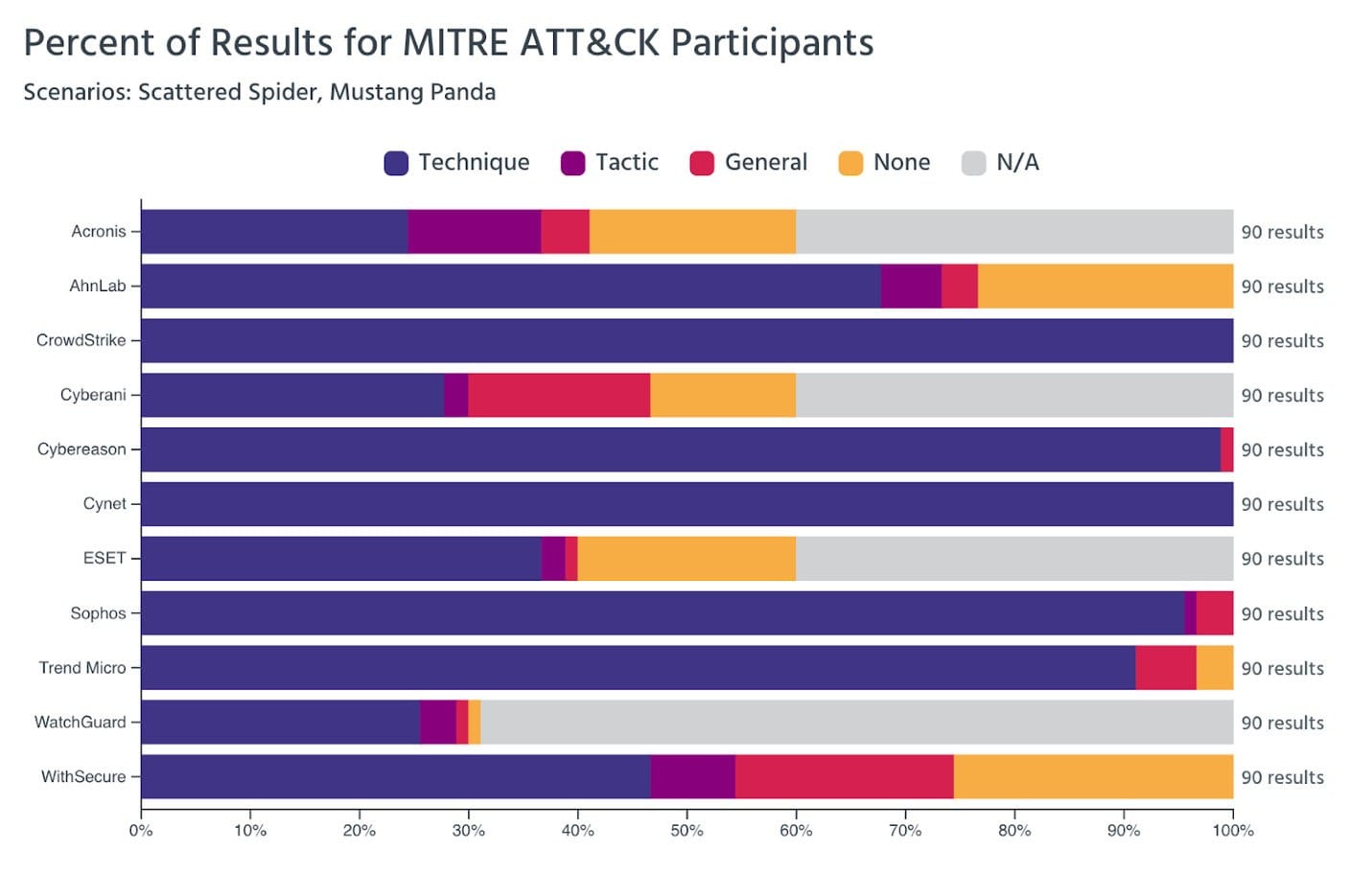
In the 2025 MITRE ATT&CK Enterprise Evaluations, CrowdStrike reported 100% detection, 100% protection and zero false positives. That round was harder than its predecessors. It added cloud control-plane tradecraft for the first time and introduced the Reconnaissance tactic, emulating SCATTERED SPIDER and MUSTANG PANDA across endpoint, identity and cloud.
SentinelOne was not in it. In a post dated 12 September 2025, the company confirmed it had decided not to participate in the 2025 Enterprise evaluation, saying it wanted to prioritise engineering resources on customer-focused work.
Read that fairly. SentinelOne was not alone — only eleven vendors took part, and several large ones sat out. Non-participation is not evidence of weak detection, and SentinelOne's result in the 2024 round was strong.
But it means something concrete for you. As of September 2026 there is no independent head-to-head test of these two products newer than 2024. Any page claiming to compare their current detection rates is setting one vendor's 2025 result against another vendor's two-year-old one. Treat both vendors' charts accordingly, including the one below.
Falcon vs Singularity: the agentic AI difference
This is where the two platforms genuinely diverge in 2026, and where most ranking pages are a year out of date.
SentinelOne shipped autonomous investigation first, and meters it. On 17 June 2026 the company opened Purple AI Agentic Investigation to all customers — investigations that trigger themselves when a threat crosses a threshold, reach a verdict and respond. It runs on a multi-model stack combining Anthropic's Claude, OpenAI's GPT and SentinelOne's own models.
The same announcement introduced Singularity Credits, a consumption currency for AI work. The trial is free; after that you buy credits. The Agentic AI SOC Analyst is an add-on at the Complete and Commercial tiers and is only bundled at Enterprise.
CrowdStrike went multi-agent. At Fal.Con on 2 September 2026, CrowdStrike announced coordinated multi-agent investigations — Charlotte AI dispatching domain agents in parallel across endpoint, identity, SaaS, cloud and network on a shared context layer, so what one agent learns the others know. Charlotte AI AgentWorks builds no-code agents from plain English, and bidirectional MCP connects third-party agents in and CrowdStrike agents out.
The practical read: SentinelOne's autonomy goes deeper on a single investigation and is cheaper to trial. CrowdStrike's reaches wider across domains and suits a real SOC with governance requirements. Both add cost you will not find on the pricing page.
Does the July 2024 CrowdStrike outage still matter?
Less than it did, and the fix is specific enough to audit.
On 19 July 2024 a Rapid Response Content update crashed Windows hosts running sensor 7.11 and above. CrowdStrike reverted it 78 minutes later. Mac and Linux were unaffected. The company's preliminary post-incident review traced it to a content validation bug that let a malformed template instance through.
The part that matters for a buyer is what customers could and could not control. Sensor releases already had N, N-1 and N-2 staging through Sensor Update Policies. Rapid Response Content did not. CrowdStrike committed to canary and staggered rollout for that content class and to giving customers granular control over when and where it deploys.
Treat this as a due-diligence question rather than a disqualifier. Ask to see the Rapid Response Content deployment controls in the console, and ask SentinelOne the same question about its agent update rings. Neither vendor is immune to a bad content push.
For the wider picture of how endpoint tooling now overlaps with cloud and network controls, see our comparison of Zscaler and Netskope and our rundown of CNAPP platforms.
What this means for you
If you run a small company with no SOC. Falcon Go at $59.99 is the cheapest credible entry point, but you are buying antivirus, not EDR, and it caps at 100 devices. If you need real EDR at this size, Singularity Complete at $179.99 is better value than Falcon Enterprise at $184.99, because it includes cloud workload protection.
If you run a platform team consolidating tools. CrowdStrike. Falcon Flex — a pre-negotiated draw-down you spend across modules and reallocate annually — is the strongest commercial mechanism either vendor offers for consolidation. Its ending ARR passed $2.29 billion in Q2 FY2027, growing 101% year over year. This is not a pilot programme.
If you run a staffed SOC and care about analyst throughput. Trial both agentic layers before signing. SentinelOne's free credit allowance makes that cheap. Measure time-to-verdict on your own alerts, not on the vendor's demo. If you are also choosing where those alerts land, our SIEM tools comparison covers the downstream half of that decision.
If you are regulated and need long retention. Price SentinelOne at Commercial ($229.99), not Complete. A 14-day default will not survive an audit.
If vendor concentration is a board-level concern. SentinelOne is the credible second source. At $1.218 billion ARR against CrowdStrike's $5.84 billion — both for the quarter ended 31 July 2026 — it is roughly one-fifth the size but growing at a similar rate, 22% against 25%.
Frequently Asked Questions
Is SentinelOne better than CrowdStrike?
No, and not worse either. They are close. SentinelOne offers cheaper full EDR entry at $179.99 and strong on-agent autonomous response. CrowdStrike has broader modules, a single-console architecture and the only current independent detection result. Pick SentinelOne for value and second-sourcing, CrowdStrike for consolidation and SOC depth.
Which is cheaper, CrowdStrike or SentinelOne?
SentinelOne, marginally, at the EDR tier: $179.99 for Singularity Complete against $184.99 for Falcon Enterprise. CrowdStrike is cheaper below that, but Falcon Go and Pro exclude EDR entirely. Above those tiers both vendors quote only, and SentinelOne list prices assume 5–100 workstations bought through a partner.
Does SentinelOne or CrowdStrike need a separate antivirus?
No. Both replace traditional antivirus rather than supplement it, and each ships its own prevention engine. Running a third antivirus product alongside either one causes file-scanning conflicts and degraded performance. On Windows workstations the CrowdStrike sensor registers with Windows Security Center and disables Microsoft Defender automatically.
Can CrowdStrike and SentinelOne run on the same machine?
Not as a steady state. Neither vendor documents supported coexistence with the other, and two kernel-level agents competing for the same file and process events cause performance problems and duplicate alerts. A short overlap during migration is common practice, but it needs mutual path exclusions and a firm cutover date.
Editor's note — sources: CrowdStrike list pricing and tier contents from CrowdStrike's pricing page; SentinelOne list pricing, retention tiers and partner-pricing terms from SentinelOne's platform packages page. 2025 MITRE ATT&CK Enterprise results from CrowdStrike's results blog and SentinelOne's own statement on non-participation. Agentic AI features from SentinelOne's Purple AI Agentic Investigation announcement (17 June 2026) and CrowdStrike's agentic SOC announcement (2 September 2026). Financial figures for the quarter ended 31 July 2026 are from each company's Q2 FY2027 results: CrowdStrike total ARR $5.84bn (+25%), net new ARR $333m, Falcon Flex ending ARR above $2.29bn (+101%); SentinelOne ARR $1,218m (+22%), revenue $292m (+21%). July 2024 outage timeline from CrowdStrike's preliminary post-incident review. All figures checked 29 September 2026.