
Kilo Code vs Cline: Which to Pick in 2026
Cline has 5.48M VS Code installs to Kilo Code's 1.58M. But the bigger story is that Kilo is no longer a Cline fork at all, and Roo Code is archived.


TL;DR
- Cline leads on adoption: 5.48 million VS Code installs against Kilo Code's 1.58 million (Marketplace API, 29 September 2026). Cline is Apache-2.0, Kilo Code is MIT.
- Kilo Code is no longer a Cline derivative. It started as a Roo Code fork, but the extension shipping today was rebuilt on OpenCode — its licence file now credits OpenCode, not Cline.
- Roo Code is dead. The repo was archived on 15 May 2026 at v3.54.0, with no commits since. Kilo Code was acquired by Anaconda in July 2026; Cline remains independent.
- Verdict: Cline for most VS Code developers. Kilo Code if you need JetBrains, inline autocomplete, or a self-serve team plan.
For kilo code vs cline in 2026: Cline is the safer default for most developers, with 5.48 million VS Code installs, an Apache-2.0 licence and an independent company behind it. Kilo Code wins on free native JetBrains support, inline autocomplete and a $15-per-user team tier. The correction most comparisons miss: Kilo is no longer a Cline-lineage codebase.
Kilo Code vs Cline: the numbers that matter
All figures pulled on 29 September 2026 from the GitHub API and the VS Code Marketplace gallery API. Roo Code is in the table because it is the shared ancestor, it appears in the same user question, and it is now frozen.
| Cline | Roo Code | Kilo Code | |
|---|---|---|---|
| Repository | cline/cline |
RooCodeInc/Roo-Code |
Kilo-Org/kilocode |
| Status | Active | Archived | Active |
| Licence | Apache-2.0 | Apache-2.0 | MIT |
| GitHub stars | 69,518 | 24,291 | 27,434 |
| VS Code installs | 5,476,251 | 2,041,278 (frozen) | 1,581,043 |
| Latest extension | 4.1.21 (24 Sep 2026) | 3.54.0 (15 May 2026) | 7.8.1 (25 Sep 2026) |
| Owner | Cline Bot Inc (independent) | Roo Code Inc | Anaconda (acquired Jul 2026) |
| Underlying codebase | Original | Cline fork | OpenCode rebuild |
Two things stand out. Cline has roughly 3.5x Kilo's install base. And Kilo's commit volume this quarter runs several times Cline's — that is a rebuild in progress, not a steady-state project.
Is Kilo Code a fork of Cline or Roo Code?
Both, historically. Neither, in the code you install today.
The chain runs Cline to Roo Code to Kilo Code. Cline came first. Roo Code forked it in late 2024 — the evidence is still visible in Roo's Marketplace identifier, RooVeterinaryInc.roo-cline, and Roo's own repository names Cline as the project it originated from. Kilo then forked Roo in 2025.
Then the lineage broke.
Kilo rebuilt its VS Code extension on OpenCode, a separate MIT-licensed agent. That is not a marketing claim, it is visible in the repository. Kilo's repo contains an .opencode-version file, an .opencode/ directory and a packages/opencode workspace. Its licence file reads "Copyright (c) 2026 Kilo Code / Copyright (c) 2025 opencode." No Cline or Roo copyright line remains, and the licence changed from Apache-2.0 to MIT.
So the common framing — Kilo as "Cline plus extra features" — is out of date. Only Kilo's legacy v5.x extension still runs Roo-derived code. The shipping v7.x line does not.
What happened to Roo Code?
Roo Code shut down. Its README states the extension was shut down on 15 May, pointing users to Cline or to a community fork.
The repository is archived. Last release: v3.54.0 on 15 May 2026. The final commits removed the web app and redirected the domain. There have been no commits since.
This matters for anyone searching kilo code vs roo code: that comparison is now historical. Roo's 2.04 million installs are frozen, and bring-your-own-key setups keep working, but nothing is being patched. If you are still on Roo, plan a move.
What does each one cost?
Both extensions are free and open source. You pay for inference either way.
Cline charges nothing for the extension. You bring your own keys, or use Cline's pay-as-you-go usage billing. ClinePass costs $9.99 per month and offers several times the usage of standard API rates on a curated set of open coding models. Enterprise is contact-sales, with no self-serve tier in between.
Kilo Code is free for individuals. Kilo's pricing page lists Teams at $15 per user per month and custom Enterprise. Inference runs through free models, local models, your own keys, or Kilo Gateway at provider rates with no markup. Note two extras: a 5% processing fee on credit purchases, and cloud compute billed separately by the hour.
The practical split: Cline is cheaper if you just want an agent and your own keys. Kilo is cheaper for a small team, because Cline has nothing between free and enterprise sales.
How do modes, subagents and MCP compare?
Both support MCP, both ship a server marketplace, both run subagents. The differences are in shape.
Cline uses a two-mode toggle. Plan mode reads and searches but cannot modify files or run commands. Act mode executes, carrying the planning context over. Subagents are enabled by default and still marked experimental. Cline also ships Skills, Hooks, Checkpoints, Memory Bank and multi-root workspaces, across VS Code, a CLI, a desktop app and an SDK.
Kilo Code uses agent personas instead: code, ask, plan, debug, plus custom agents. Its plan agent is documented as the successor to the legacy Architect mode. Orchestrator mode is deprecated and slated for removal, because full-tool agents now handle subagents natively. Kilo adds inline autocomplete, automatic model routing and an agent manager built on git worktrees.
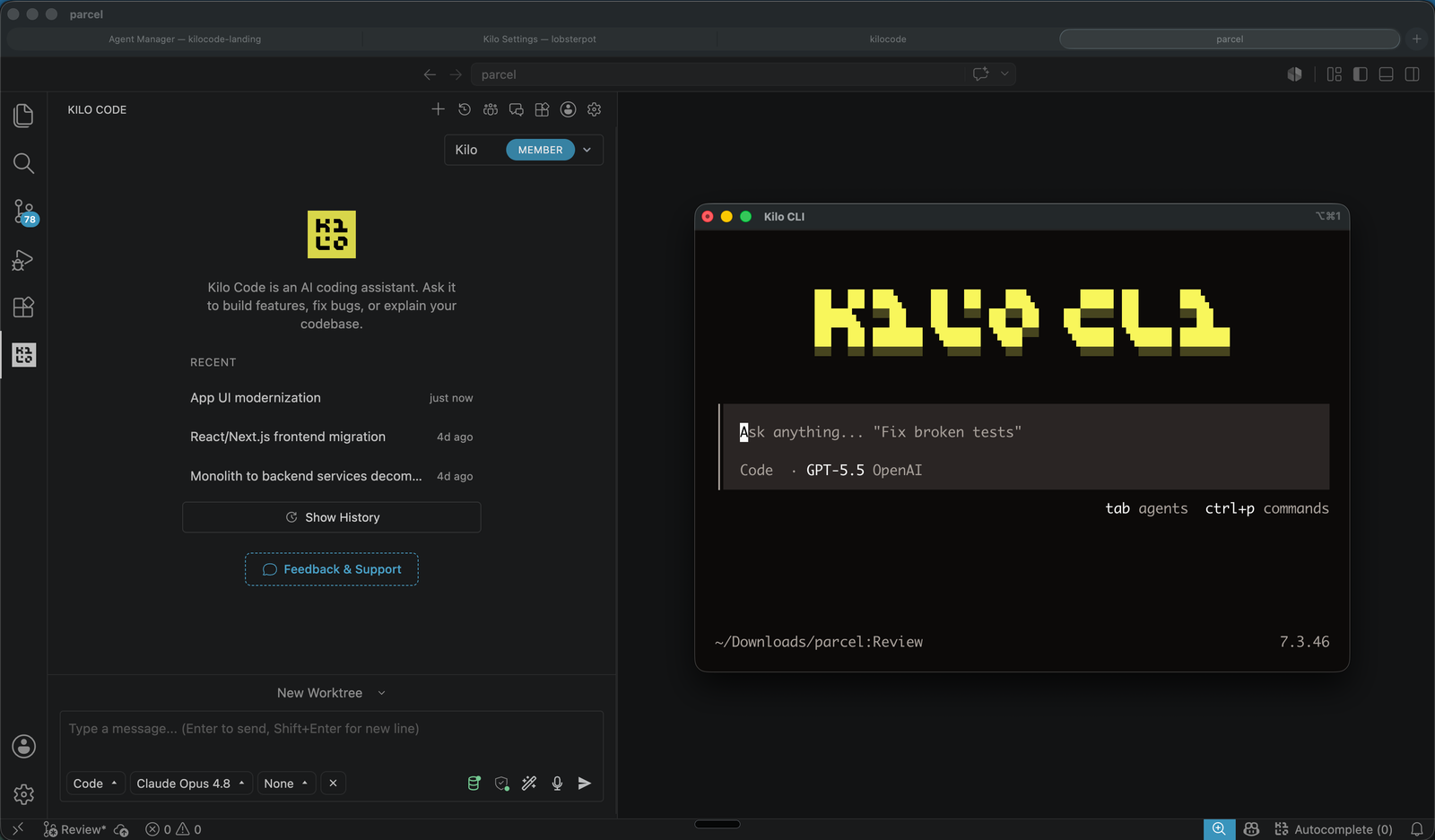
One concrete gap: Kilo ships a free native JetBrains plugin. Cline reaches JetBrains through the Agent Client Protocol, but lists its native JetBrains extension under Enterprise.
If you are weighing these against the commercial agents, our comparisons of Aider and Claude Code and Claude Code and GitHub Copilot cover that side of the field.
Who should use which?
If you are a solo developer on VS Code. Cline. Bigger install base, Apache-2.0, a mature v4 line and no per-seat pricing to think about. Add ClinePass at $9.99 a month if you lean on open models.
If you work in JetBrains. Kilo Code. The free native plugin decides it, and Cline's protocol-based path is a looser integration.
If you are a team of three to twenty. Kilo's $15-per-user Teams tier with shared keys and usage analytics is the only self-serve option of the two. Cline routes you to sales.
If you are migrating off Roo Code. Kilo has the published migration path and a file-mapping wizard. Check first that you do not depend on Orchestrator mode, which is deprecated.
If you need stability above all. Cline. Kilo's commit velocity reflects an active platform rebuild, which cuts both ways. For a terminal-first alternative in the same spirit, see Warp vs Cursor.
Frequently Asked Questions
Is Kilo Code better than Cline?
Not generally. Cline has roughly 3.5 times the VS Code installs and a longer stable track record. Kilo Code is better if you need JetBrains support without an enterprise contract, inline autocomplete, or a self-serve team plan at $15 per user. For plain VS Code agentic coding, Cline remains the safer pick.
Is Kilo Code free?
Yes. The Kilo Code extension is free and MIT-licensed for individuals, and you can run it with your own API keys or local models at no platform cost. You pay only for inference. Team plans cost $15 per user per month, and Kilo adds a 5% processing fee on credit purchases.
Is Kilo Code a fork of Cline or Roo Code?
Originally Roo Code, which was itself a Cline fork. But the extension Kilo ships today was rebuilt on OpenCode in 2026. Its licence changed from Apache-2.0 to MIT and now credits OpenCode, not Cline. Only the legacy v5.x extension still runs the Roo-derived code.
Can you use the same API key with Kilo Code and Cline?
Yes. Both are bring-your-own-key and accept the same provider credentials, including Anthropic, OpenAI, Google, OpenRouter and AWS Bedrock. One key works in both. Keys are stored per extension, so you enter them twice, and each tool bills your provider account independently.
Who owns Cline and Kilo Code?
Cline is built by Cline Bot Inc, an independent company. Kilo Code was acquired by Anaconda in July 2026, which cited more than three million developers across VS Code, JetBrains, web and CLI. Both projects remain open source under their existing licences.
Editor's note — sources: Star counts, licences, archive status and repository contents from the GitHub repositories for Cline, Kilo Code and Roo Code, read via the GitHub API on 29 September 2026. Install counts and extension versions come from the VS Code Marketplace gallery API for saoudrizwan.claude-dev, RooVeterinaryInc.roo-cline and kilocode.Kilo-Code — a primary API endpoint rather than a citable page. Pricing from Kilo's pricing page and the ClinePass documentation. Ownership from Anaconda's acquisition announcement. Kilo's OpenCode lineage is evidenced by its LICENSE copyright lines, its .opencode-version file and its packages/opencode workspace, all in the repository linked above.