
Grok vs DeepSeek: Which AI Model Wins in 2026?
Grok 4.7 is the smarter, closed, hosted model; DeepSeek is the open-weight, far cheaper one you can self-host. Grok leads the Artificial Analysis Intelligence Index 35 to 33, but DeepSeek V4.1 Flash costs 5-10x less and ships MIT weights. Full benchmark table, pricing math and a verdict.


TL;DR
- Verdict: Choose Grok 4.7 for the highest hosted intelligence with zero infrastructure; choose DeepSeek for open weights, data control and the lowest bill by a wide margin.
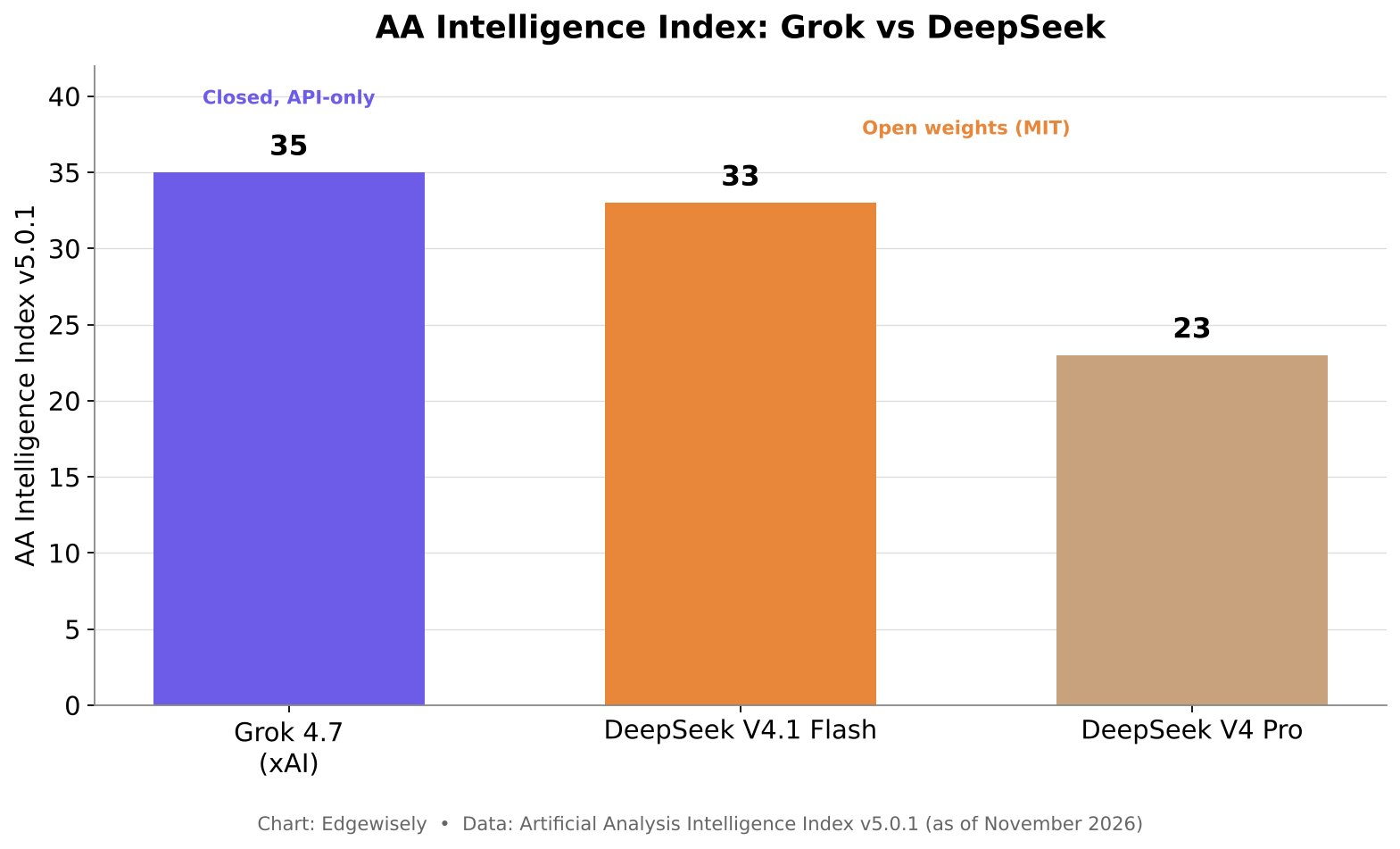
- Intelligence gap is small: Grok 4.7 scores 35, DeepSeek V4.1 Flash 33, DeepSeek V4 Pro 23 on the Artificial Analysis Intelligence Index v5.0.1 (as of November 2026).
- Price gap is huge: DeepSeek V4.1 Flash runs $0.30 / $1.20 per 1M tokens against Grok's $2 / $6 — and DeepSeek halves its rate off-peak.
- Open vs closed: DeepSeek ships MIT-licensed weights you can download and self-host; Grok is closed, API-only, hosted by xAI.
- Who it's for: Grok if you want near-frontier reasoning you don't have to run; DeepSeek if cost, privacy and no vendor lock-in matter more than the last two index points.
Grok vs DeepSeek comes down to one trade-off. Grok 4.7 is the smarter, closed, hosted model; DeepSeek is the open-weight, far cheaper one you can run yourself. Grok leads on raw intelligence — 35 vs 33 on the Artificial Analysis index — but DeepSeek wins decisively on price and control. Pick by which you value more.
Grok vs DeepSeek: which is better in 2026?
Grok is better if you define "better" as the top intelligence score from a hosted API. DeepSeek is better if you define it as capability per dollar, data control, or the freedom to self-host.
Here is the honest framing most comparison pages miss: the two models are not really competing on the same axis. Grok 4.7 is a proprietary frontier model you rent. DeepSeek V4 Pro and V4.1 Flash are open-weight models you can rent or own.
So "is Grok better than DeepSeek" has a boring-but-true answer — slightly, on intelligence; no, on almost everything else that touches your budget or your compliance team.
One caveat on Grok's crown. Even xAI's own flagship sits behind the very top of the field. Decrypt called Grok 4.7 "late to the AI frontier party", noting the benchmarks put it "still in second place" behind the leading OpenAI and Anthropic models. You are buying a strong hosted model, not the single best model in existence.
How do Grok and DeepSeek compare on benchmarks?
On the Artificial Analysis Intelligence Index v5.0.1 — nine evaluations, same generation for every model — Grok leads, but the cheap DeepSeek model is right behind it, and it beats the big DeepSeek model.
| Model | Maker | Architecture / params | Context | Price (in / out per 1M) | AA Intelligence Index v5.0.1 | License | Best for |
|---|---|---|---|---|---|---|---|
| Grok 4.7 | xAI | Proprietary, closed; params not officially disclosed (reported ~2.1T) | 500K | $2 / $6 (≤200K prompt) | 35 (xHigh) | Closed, API-only | Hosted near-frontier reasoning |
| DeepSeek V4.1 Flash | DeepSeek | MoE, ~552B / ~16B active, text + image | 1M | $0.30 / $1.20 | 33 (Max) | MIT (open weight) | Cheap, high-intelligence, self-hostable |
| DeepSeek V4 Pro | DeepSeek | MoE, ~1.6T / ~49B active | 1M | $1.32 / $3.96 (half off-peak) | 23 (Max) | MIT (open weight) | Largest open model, agentic workloads |
All figures as of November 2026. DeepSeek API prices are RMB-converted, so treat them as approximate.
Two things stand out.
First, the Grok-vs-DeepSeek intelligence gap is two points (35 vs 33) against the Flash model — not the wide chasm the "frontier proprietary vs open" label implies. Grok 4.7's 35 is confirmed on its Artificial Analysis model page; DeepSeek V4.1 Flash's 33 on its page.
Second, DeepSeek's bigger model scores lower. V4 Pro lands at just 23 on the same v5.0.1 index despite 1.6T parameters, because V4.1 Flash is newer and more aggressively reasoning-tuned. If you only skimmed the spec sheet you'd pick the wrong DeepSeek model.
Grok vs DeepSeek pricing
DeepSeek is far cheaper — not by a little, by multiples. This is the clearest win on the board.
Grok 4.7 costs $2 per 1M input tokens and $6 per 1M output, per the x.ai model docs, for prompts up to 200K tokens; above that it doubles to $4 / $12. (Our Grok API pricing breakdown has the full per-token cost picture.)
DeepSeek V4.1 Flash costs $0.30 / $1.20, and V4 Pro $1.32 / $3.96, per the DeepSeek API pricing page — and DeepSeek applies a 50% off-peak discount (most hours outside 01:00–10:00 UTC on weekdays), plus heavy cache-hit discounts.
Run the math on a typical 70/30 input/output mix:
- Grok 4.7: ~$3.20 per 1M blended tokens.
- DeepSeek V4.1 Flash (peak): ~$0.57 — roughly 5–6x cheaper.
- DeepSeek V4.1 Flash (off-peak): ~$0.29 — close to 10x cheaper.
And that is before self-hosting, which removes per-token API cost entirely. If raw cost drives your choice, see our cheapest AI API breakdown — DeepSeek sits near the top of it.
Open weights vs closed: what DeepSeek gives you that Grok can't
DeepSeek gives you the weights. Grok never will. This is the structural difference no price cut or benchmark can erase.
Both DeepSeek models are released under the MIT license with downloadable weights — V4 Pro on Hugging Face (1.6T / 49B active, FP4+FP8) and V4.1 Flash (552B backbone, ~16B active, text + image). That buys you four things:
- Self-hosting. Run it on your own hardware or a private cloud; no data leaves your perimeter.
- Data control. Nothing is sent to a vendor. For regulated stacks, that is often the whole game — see is DeepSeek safe for the nuance between the hosted API and self-hosted weights.
- No vendor lock-in. MIT means fork it, fine-tune it, ship it in a product. No rug-pull on pricing or access.
- Permanence. A model you've downloaded can't be deprecated out from under you.
Grok is the opposite by design. It's API-only, hosted entirely by xAI, with parameter counts the company doesn't officially publish. You get convenience and xAI's real-time X integration; you give up the weights, and you send your prompts to xAI's servers. If that data posture matters for your use case, read is Grok safe to use first.
Closed isn't automatically worse. Hosted means no GPUs to manage, no ops burden, instant updates. But "DeepSeek vs Grok" on openness is not a close call — only one of them hands you the model.
Grok vs DeepSeek for coding
For coding, it's closer than the intelligence index suggests — near-parity on independent tests, with a price gap that tilts the practical choice toward DeepSeek.
On Artificial Analysis's independent Terminal-Bench 4.0, Grok 4.7 and DeepSeek V4.1 Flash land within a point of each other — roughly 26% vs 27% on the AA comparison page. On an independent harness, there is no meaningful coding edge for Grok.
xAI tells a rosier story: VentureBeat reports xAI's own Terminal-Bench 4.0 figure for Grok 4.7 at 38%. Treat that as a vendor claim under xAI's own setup; the independent number is lower.
Our read for "Grok vs DeepSeek for coding": if you want hosted autocomplete and agentic coding without managing infra, Grok 4.7 is competent. If you want the same ballpark capability at a fifth of the cost — or on your own hardware — DeepSeek V4.1 Flash is the better engineering decision. Grok's higher token consumption also inflates real-world coding bills faster than its sticker price implies.
Which should you choose?
Pick by role, not by the leaderboard.
- Choose Grok 4.7 if you want the highest hosted intelligence score, you're already in the X/xAI ecosystem, and you'd rather pay a premium than run infrastructure. Best for teams who value convenience over cost and don't need the weights.
- Choose DeepSeek V4.1 Flash if you want ~94% of Grok's intelligence at a fraction of the price, with open MIT weights. This is the default for most engineers and founders. Best for cost-sensitive, privacy-sensitive, or high-volume workloads.
- Choose DeepSeek V4 Pro if you specifically need the largest open model for agentic or long-horizon tasks and can tolerate a lower index score for more raw capacity.
- Avoid Grok if data control, self-hosting or budget are hard constraints. Avoid DeepSeek's hosted API if your policy forbids sending data to its servers — then self-host the same weights instead.
Our take
The "frontier proprietary vs leading open-weight" framing sets up a David-and-Goliath story that the numbers quietly refuse to tell. Grok 4.7 wins the intelligence index. It wins by two points over a model that costs a sixth as much. That is the single most important fact in this comparison, and it inverts the usual assumption that closed frontier models buy you a commanding capability lead.
Our thesis: for the large majority of engineers, founders and technical operators, DeepSeek V4.1 Flash is the correct default, and Grok 4.7 is a situational upgrade — not the other way around.
Start with what the index does and doesn't capture. A score of 35 vs 33 means Grok is marginally more capable across a basket of nine evaluations. It does not mean Grok is 6% "better" for your task, and it certainly doesn't justify a 5–10x price difference. Worse for Grok's case, Grok 4.7 isn't even the field leader — by Decrypt's reading it's in second place behind the top OpenAI and Anthropic models. So you're not paying a premium for the best model; you're paying a premium for a good hosted model that happens to beat DeepSeek by a hair. When the premium model isn't the frontier and the cheap model is this close, the economic argument collapses.
Then there's the part the benchmark can't score: ownership. DeepSeek's MIT weights are a different category of product. You can download V4.1 Flash or V4 Pro, run them inside your own VPC, fine-tune them, and keep them forever. For anyone handling regulated data, that's not a nice-to-have — it's frequently the only acceptable architecture. Grok cannot offer it at any price, because the business model depends on you not having the weights. "No vendor lock-in" sounds abstract until xAI changes its pricing or deprecates a model; with DeepSeek, the copy on your disk doesn't care.
The real cost picture widens the gap further. Grok's $2/$6 is already multiples of DeepSeek's $0.30/$1.20, but DeepSeek's off-peak discount and aggressive cache pricing push the effective rate toward 10x cheaper, and self-hosting removes per-token cost entirely. Grok's documented high token consumption on agentic work means the gap is often worse than the headline rates in production. If you're running serious volume, the DeepSeek bill is a rounding error against Grok's.
Coding is where we'd expect a premium model to pull away, and it doesn't. Independent Terminal-Bench numbers are effectively tied (~26–27%). xAI's own 38% figure may be real under its harness, but we weight independent evals over vendor claims, and on those the two trade blows. There is no coding reason to pay Grok's premium.
Where does that leave Grok? It's genuinely good, genuinely convenient, and genuinely the top hosted score here. If you want frontier-ish reasoning with zero ops, you're deep in the X ecosystem, or you need Grok's real-time social data, it earns its place — and you should still read up on its closed data posture before you send it anything sensitive. (Opinion, grounded in the figures above: for a cost-conscious team, that's a narrow set of reasons to pay 5–10x.)
Best for Grok 4.7: hosted-only shops that prize convenience and want the highest hosted intelligence score, budget permitting. Avoid if: you need weights, data control, or a defensible cloud bill.
Best for DeepSeek: almost everyone else — cost, privacy, self-hosting, scale. Avoid if: your policy bans its hosted API and you can't self-host; or you need a specific proprietary integration only Grok offers.
If we had to run one in production tomorrow on our own money, it'd be DeepSeek V4.1 Flash, with Grok on standby for the jobs that specifically need it.
Frequently Asked Questions
Is Grok better than DeepSeek?
Only marginally, and only on raw intelligence. Grok 4.7 scores 35 on the Artificial Analysis Intelligence Index v5.0.1 versus DeepSeek V4.1 Flash's 33 (November 2026). On price, openness, data control and self-hosting, DeepSeek wins clearly. For most teams, the two-point gap doesn't justify Grok's higher cost.
Is DeepSeek cheaper than Grok?
Yes, by a wide margin. DeepSeek V4.1 Flash costs $0.30 / $1.20 per 1M input/output tokens against Grok 4.7's $2 / $6 — roughly five to six times cheaper, and nearly ten times cheaper off-peak. DeepSeek's open weights also let you self-host and remove per-token API cost entirely.
Which is better for coding, Grok or DeepSeek?
They're near-tied. On Artificial Analysis's independent Terminal-Bench 4.0, Grok 4.7 and DeepSeek V4.1 Flash score about 26% and 27% (November 2026). xAI self-reports a higher 38% under its own setup. Given the price gap, DeepSeek is usually the better practical coding choice unless you need hosted convenience.
Can you self-host Grok or DeepSeek?
You can self-host DeepSeek, not Grok. Both DeepSeek V4 Pro and V4.1 Flash ship under the MIT license with downloadable weights on Hugging Face, so you can run them on your own hardware. Grok 4.7 is closed and API-only — xAI does not release its weights, so self-hosting is impossible.
Is Grok or DeepSeek better for reasoning?
Grok 4.7 edges it on the reasoning-weighted intelligence index (35 vs DeepSeek V4.1 Flash's 33, v5.0.1, November 2026). But DeepSeek's reasoning mode closes most of the gap at a fraction of the cost, and its bigger V4 Pro model actually scores lower (23), so pick the Flash model, not the largest one.
Editor's note — sources: x.ai model docs, x.ai release notes, DeepSeek API pricing, Hugging Face: DeepSeek V4 Pro, Hugging Face: DeepSeek V4.1 Flash, Artificial Analysis: Grok 4.7, Artificial Analysis: DeepSeek V4 Pro, Artificial Analysis: DeepSeek V4.1 Flash, Artificial Analysis comparison, VentureBeat, Decrypt. All benchmarks and prices verified November 2026 against the Artificial Analysis Intelligence Index v5.0.1. Vendor-reported figures are attributed as such.