
Claude API Pricing 2026: Cost Per Token Explained
What does the Claude API cost in 2026? Current per-token prices for Haiku, Sonnet, Opus and Fable, how prompt caching and the Batch API cut your bill, worked dollar scenarios, and how Claude stacks up against GPT, Gemini and DeepSeek.


TL;DR
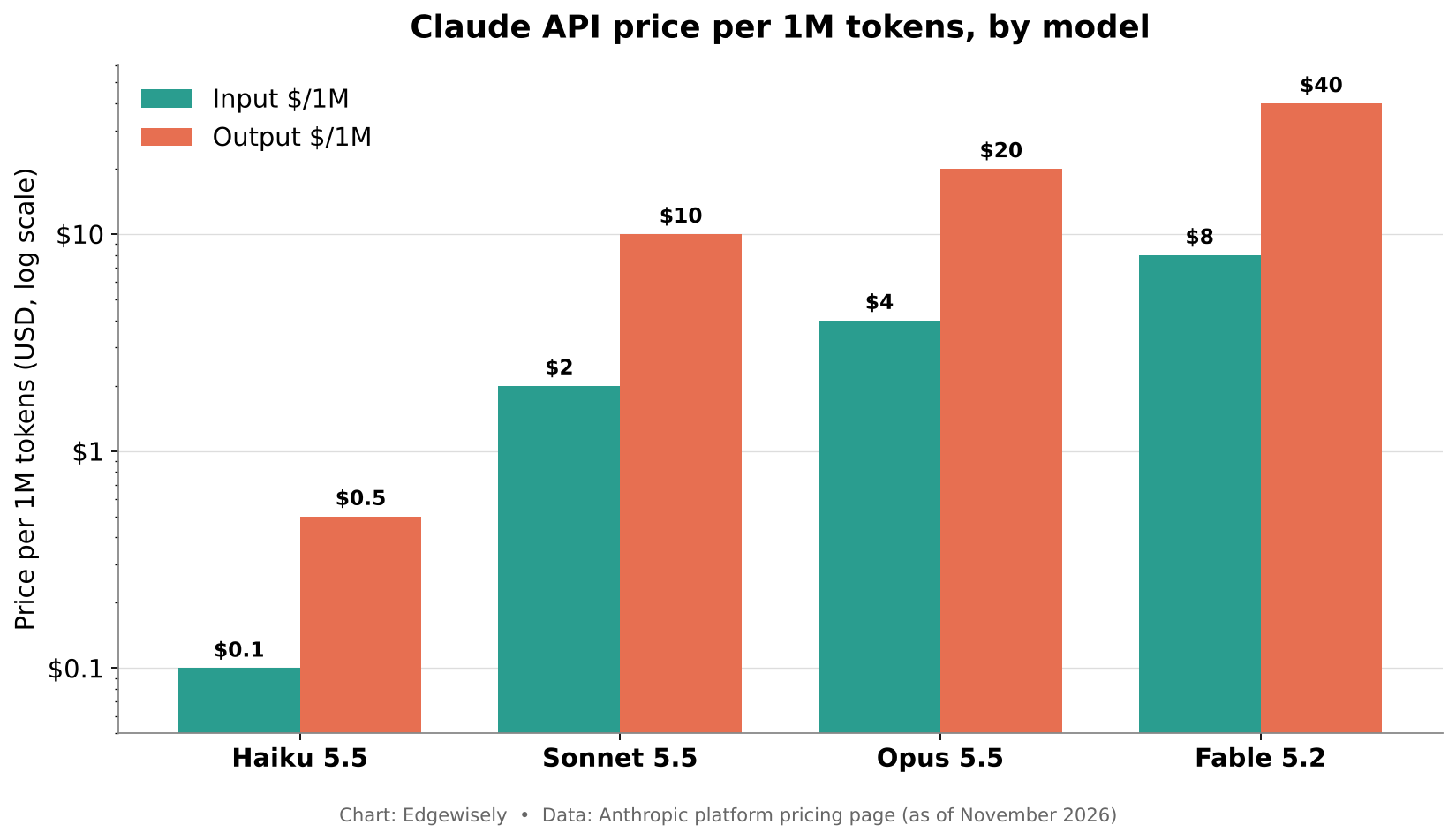
- As of November 2026, Anthropic's API is usage-based per token: Claude Haiku 5.5 $0.10 / $0.50, Sonnet 5.5 $2 / $10, Opus 5.5 $4 / $20, and the frontier Fable 5.2 $8 / $40 per million input / output tokens.
- Cheapest vs most capable: Haiku 5.5 is roughly 80x cheaper on output than Fable 5.2. Most teams never need Fable.
- Caching and batch cut real bills hard: prompt-cache reads drop repeat context to as low as $0.10/1M on Sonnet (and $0.01/1M on Haiku); the Batch API takes 50% off input and output.
- Cross-vendor: Sonnet 5.5 matches GPT-6.2 Sol ($2/$10), Opus 5.5 undercuts the $8/$40 flagships, and Haiku 5.5 now trades blows with the cheapest budget models. DeepSeek is still the raw-price floor.
Claude API pricing is pay-as-you-go per token, with no subscription required. As of November 2026 Anthropic lists Claude Sonnet 5.5 at $2 input / $10 output per million tokens, Opus 5.5 at $4 / $20, Haiku 5.5 at $0.10 / $0.50, and the top-end Fable 5.2 at $8 / $40. The verdict: mid-pack on sticker price, strong on coding and agent value once caching is on.
What does the Claude API cost in 2026?
Claude is billed per token, split into cheaper input (what you send) and pricier output (what the model writes). Output runs about 5x the input rate across the lineup.
Here are the current headline rates, straight from Anthropic's platform pricing page, per million tokens (MTok):
- Claude Haiku 5.5 — $0.10 in / $0.50 out
- Claude Sonnet 5.5 — $2 in / $10 out
- Claude Opus 5.5 — $4 in / $20 out
- Claude Fable 5.2 — $8 in / $40 out
Fable 5.2 is the newest, highest-intelligence model and sits at the top of Artificial Analysis's Intelligence Index at 65, ahead of Opus 5.5 at 59, Sonnet 5.5 at 55 and Haiku 5.5 at 36. Note the quirk: Opus 5.5 is the premium workhorse at $4/$20, while Fable is the pay-extra frontier tier.
For most production work, Sonnet 5.5 is the model you'll actually reach for.
How does Claude API pricing work?
Claude API pricing works on metered token usage through a Console account, separate from the Claude Pro and Max chat subscriptions. You pay for exactly what you call.
A few rules shape the real number:
Input vs output. You're charged separately for both. Long prompts (big system prompts, retrieved documents, chat history) hit the input line; generations hit the output line.
Context windows are now generous and flat. Per Anthropic's context-windows documentation, Fable 5.2, Opus 5.5, Sonnet 5.5 and Haiku 5.5 all carry a 1M-token context window, billed at standard pricing with no beta header. The old Sonnet "1M context beta" surcharge is gone. The one exception: Haiku 5.5 prompts over 100,000 tokens jump to $0.50 / $2.50.
Regional add-on. Routing to US-only inference adds a 1.1x multiplier on all token types for current models.
Subscriptions are a different product. Claude Pro is about $20/month (or $17 billed annually) and Max starts at $100/month. Those cover the chat apps and Claude Code seats, not raw API calls. Claude is also resold through Microsoft Foundry, AWS and Google Cloud, where per-token prices can differ from Anthropic's direct rates.
Claude model pricing compared
The table below is the decision tool. All figures per million tokens, as of November 2026, from Anthropic's pricing page.
| Model | Context window | Input $/1M | Output $/1M | Cache write (5m / 1h) · read | Batch | Best for |
|---|---|---|---|---|---|---|
| Fable 5.2 | 1M | $8 | $40 | $10 / $16 · $0.20 | 50% off | Hardest frontier reasoning; top AA Intelligence (65) |
| Opus 5.5 | 1M | $4 | $20 | $5 / $8 · $0.20 | 50% off | Complex agents, long multi-step coding tasks |
| Sonnet 5.5 | 1M | $2 | $10 | $2.50 / $4 · $0.10 | 50% off | Default production workhorse; best all-round value |
| Haiku 5.5 | 1M (≤100K prompt) | $0.10 | $0.50 | $0.125 / $0.20 · $0.01 | 50% off | High-volume classification, extraction, cheap chat |
| Haiku 5.5 (>100K prompt) | — | $0.50 | $2.50 | $0.625 / $1 · $0.05 | 50% off | Large-context Haiku jobs |
"Cache read" is what you pay to reuse a cached prompt prefix on the next call. Note how steep the drop is: Sonnet reuse costs $0.10/1M versus its $2 fresh input rate.
How much do prompt caching and the Batch API save?
A lot, if your traffic is cacheable or asynchronous. These are the two biggest levers on your bill.
Prompt caching lets you store a stable prefix (system prompt, tool definitions, a long document) and pay a one-time write, then a tiny read on every reuse. On Sonnet 5.5 that read is $0.10/1M against $2/1M fresh — a 20x cut on the cached portion. On Haiku the read is $0.01/1M. The write costs a premium (Sonnet 5m write is $2.50/1M), so caching pays off when a prefix is reused several times before it expires.
The Batch API gives a flat 50% discount on both input and output for any workload you can run asynchronously (results typically returned within 24 hours). Anthropic lists it on the same pricing page. Fast mode is not available with batch.
Stack both where you can: a cached, batched Sonnet job can land well under half its naive sticker cost.
Claude API pricing vs GPT, Gemini and DeepSeek
Claude is mid-market, not premium, once you compare like tiers. Here's the cheapest-comparable picture across vendors, each from the vendor's own pricing page, as of November 2026.
| Model (vendor) | Input $/1M | Output $/1M | Source |
|---|---|---|---|
| Claude Fable 5.2 (Anthropic) | $8 | $40 | Anthropic |
| GPT-6.2 Astra (OpenAI) | $8 | $40 | OpenAI |
| Claude Opus 5.5 (Anthropic) | $4 | $20 | Anthropic |
| Claude Sonnet 5.5 (Anthropic) | $2 | $10 | Anthropic |
| GPT-6.2 Sol (OpenAI) | $2 | $10 | OpenAI |
| Gemini 3.5 Flash (Google) | $1.50 | $9 | |
| GPT-6.1 Terra (OpenAI) | $1 | $5 | OpenAI |
| DeepSeek V4.1 Flash (peak) | $0.30 | $1.20 | DeepSeek |
| Claude Haiku 5.5 (Anthropic) | $0.10 | $0.50 | Anthropic |
| GPT-6 Luna (OpenAI) | $0.10 | $0.50 | OpenAI |
| Gemini 2.5 Flash-Lite (Google) | $0.10 | $0.40 |
The read-outs:
- At the top, Anthropic and OpenAI line up exactly: Fable 5.2 and GPT-6.2 Astra are both $8/$40.
- Opus 5.5 ($4/$20) is a value flagship — half the price of the $8/$40 tier for near-frontier quality.
- Sonnet 5.5 ties GPT-6.2 Sol dollar-for-dollar at $2/$10.
- At the floor, Haiku 5.5 now matches GPT-6 Luna and sits beside Gemini 2.5 Flash-Lite, and it undercuts DeepSeek V4.1 Flash's peak rate. DeepSeek is still cheapest off-peak ($0.15/$0.60) but ranks well below Claude's frontier on intelligence benchmarks — our cheapest AI API breakdown has the full floor-price picture, and DeepSeek vs Claude weighs the open-vs-closed trade directly.
How much will the Claude API actually cost you?
Below are three worked examples using the verified per-token rates above. These are our calculations from the cited prices, so you can reproduce them.
1) Support chatbot on Sonnet 5.5. Say 2,000 input + 500 output tokens per message, 5,000 messages/day. - Input: 2,000 × 5,000 = 10M/day → 10 × $2 = $20/day - Output: 500 × 5,000 = 2.5M/day → 2.5 × $10 = $25/day - ~$45/day ≈ $1,350/month. Cache the ~1,500-token system prompt (read at $0.10/1M) and input falls to ~$5.75/day, cutting the total to roughly $925/month — about 30% off.
2) Coding agent task on Opus 5.5. A complex task reading files and running tools: ~300K input + 50K output tokens. - Input: 0.3M × $4 = $1.20; Output: 0.05M × $20 = $1.00 → $2.20/task. - Run the same task on Sonnet 5.5: 0.3M × $2 + 0.05M × $10 = $1.10 — half the cost.
3) Bulk classification on Haiku 5.5. One million documents, ~500 input + 50 output tokens each. - Input: 500M × $0.10 = $50; Output: 50M × $0.50 = $25 → $75. - Via the Batch API (50% off): $37.50 for the whole million.
Who should use the Claude API?
- Build on Sonnet 5.5 if you want the best single default: strong coding, $2/$10, 1M context. This is the right call for most teams, and it tops our best AI model for coding picks.
- Reach for Opus 5.5 for long autonomous agents and gnarly multi-file coding, where its reliability saves more in retries than it costs in tokens.
- Use Haiku 5.5 for high-volume, low-complexity work — classification, extraction, routing, cheap chat — especially batched.
- Only pay for Fable 5.2 when you've proven a task genuinely needs frontier intelligence Opus can't deliver.
- Look elsewhere if raw token price is the only axis that matters and quality is negotiable: DeepSeek and Gemini Flash-Lite win on pure cost. For a single-vendor cost deep-dive on the other side, see our Grok API pricing breakdown.
Our take
Claude's pricing in late 2026 tells a clearer story than the "Claude is the expensive one" reputation suggests. The premium is real only at the very top, and it is increasingly justified by where Claude actually earns its keep: coding and long-running agents.
Start with the structure. Anthropic has built a genuine four-rung ladder — Haiku 5.5, Sonnet 5.5, Opus 5.5, Fable 5.2 — and the gaps between rungs are wide enough that choosing wrong is the single biggest cost mistake you can make. Output tokens span from $0.50 to $40 per million, an 80x range. Most teams reaching for Opus or Fable "to be safe" are overpaying by 2-10x for quality the task never uses. Our rule: prototype on Sonnet, profile which calls actually fail on quality, and promote only those to Opus. Everything cheap and repetitive goes to Haiku.
On the premium question, our thesis is that Opus 5.5 is the most underrated price in the lineup. At $4/$20 it delivers near-frontier capability for half the cost of the $8/$40 flagship tier that Fable 5.2 and GPT-6.2 Astra occupy. If you were about to default to a $40-output model for an agent, Opus is very likely the smarter buy, and Fable should be reserved for the specific reasoning tasks where you can measure a difference. Paying frontier rates "just in case" is how API bills quietly triple.
Caching and batching change the math more than the sticker prices do, and this is where Claude's economics get genuinely competitive. A chatbot with a fat, stable system prompt is mostly paying to re-send the same tokens; cache them and Sonnet's input drops 20x on the cached portion. Any workload that doesn't need a synchronous answer should run through the Batch API for a flat 50% cut. Teams that ignore these two levers are comparing Claude's naive price against a competitor's naive price and drawing the wrong conclusion. The honest comparison is cached-and-batched Claude versus cached-and-batched everyone else.
Where does Claude lose? On pure price-per-token at the frontier, it doesn't lead — it ties OpenAI and sits above Gemini Flash and DeepSeek. If your use case is bulk summarization or classification where a 90%-as-good answer is fine, DeepSeek V4.1 Flash (off-peak $0.15/$0.60) and Gemini 2.5 Flash-Lite ($0.10/$0.40) are cheaper, and we'd use them without hesitation. The surprise of 2026 is that Claude no longer loses at the bottom: Haiku 5.5 at $0.10/$0.50 is now priced to compete directly with budget models, which it wasn't a year ago.
Where Claude wins is reliability on agentic and coding workloads — the tasks where a model that finishes correctly on the first try is cheaper than a cheaper model that needs three attempts and human cleanup. That's an opinion, grounded in the token math: at Opus's rates, a single avoided retry on a 350K-token task saves more than the price gap to a budget model. For engineering teams, token price is rarely the real cost; wasted developer time is.
Verdict. Best for: teams shipping coding tools, agents, and production assistants that value correctness — build on Sonnet 5.5, escalate to Opus 5.5, batch to Haiku 5.5. Avoid if: your workload is price-sensitive bulk text where quality is fungible — DeepSeek and Gemini Flash-Lite will cost you less. Turn on prompt caching and the Batch API before you benchmark anyone on price.
Frequently Asked Questions
What is Claude API pricing?
Claude API pricing is Anthropic's pay-as-you-go, per-token rate for calling Claude models programmatically. As of November 2026 it runs from Haiku 5.5 at $0.10/$0.50 per million input/output tokens up to Fable 5.2 at $8/$40, with Sonnet 5.5 ($2/$10) and Opus 5.5 ($4/$20) between them.
How does Claude API pricing work?
You're billed per token through a Console account, separate from the Pro and Max chat subscriptions. Input (what you send) and output (what Claude writes) are priced separately, with output about 5x input. Prompt caching and the Batch API reduce the effective rate, and the 1M context is included at standard pricing.
Is the Claude API cheaper than the Claude Pro or Max subscription?
It depends on usage. Pro is roughly $20/month and Max starts at $100/month for the chat apps. The API is metered, so light programmatic use can cost cents, while heavy automated traffic easily exceeds a subscription. Use subscriptions for interactive work, the API for products and automation.
How much does it cost to run Claude Opus per million tokens?
Anthropic lists Claude Opus 5.5 at $4 per million input tokens and $20 per million output tokens as of November 2026. Prompt-cache reads cost $0.20/1M and the Batch API halves both rates. That makes Opus roughly half the price of the $8/$40 frontier tier it competes with on quality.
Is Claude more expensive than GPT, Gemini or DeepSeek?
Not uniformly. Sonnet 5.5 ties GPT-6.2 Sol at $2/$10, and Opus 5.5 undercuts the $8/$40 flagship tier. DeepSeek V4.1 Flash and Gemini 2.5 Flash-Lite are cheaper on raw tokens for budget work, but rank below Claude's frontier models on independent intelligence benchmarks.
Editor's note — sources - Claude Developer Platform pricing — per-model API prices, prompt caching, Batch API discount - Claude context windows documentation — 1M context window, standard pricing, Haiku >100K tier - Claude.com pricing — Pro and Max subscription prices - Artificial Analysis — Claude Opus 5.5 — independent Intelligence Index and blended price - OpenAI API pricing — GPT-6.2 Astra, Sol, Terra, Luna rates - Google Gemini API pricing — Gemini Flash and Flash-Lite rates - DeepSeek API pricing — DeepSeek V4.1 Flash and V4 Pro rates