
8 Best HeyGen Alternatives (2026) Compared
Synthesia, Colossyan, D-ID and more - the best HeyGen alternatives for 2026, compared on real pricing, languages, avatar count and developer APIs, with a verdict by use-case. All figures verified on each vendor's pricing page in November 2026.

The best HeyGen alternatives are Synthesia (the enterprise-grade incumbent, from $19/mo), Colossyan (training and L&D), and D-ID (an API-first talking-head engine for developers). If you want the cheapest route to a talking head, Synthesia's free Basic tier and HeyGen's own free plan both exist. The right HeyGen alternative depends on whether you need governance, languages, or developer volume.
TL;DR
- Best overall alternative: Synthesia — closest match to HeyGen on quality, advertises 140+ languages, and carries SOC 2 Type II, ISO 27001, and ISO 42001 audits. Paid plans start at $19/mo (Starter).
- Best cheap/free: Synthesia Basic ($0, 10 min/mo) and HeyGen Free ($0, 3 watermarked videos/mo). Both are genuinely usable, both watermark.
- Best for languages: HeyGen itself advertises the widest count at 175+ languages and dialects; Synthesia claims 140+.
- Best developer API: D-ID (API-first Creative Reality engine) and Elai.io (public API on every paid plan). HeyGen and Synthesia both sell API access separately.
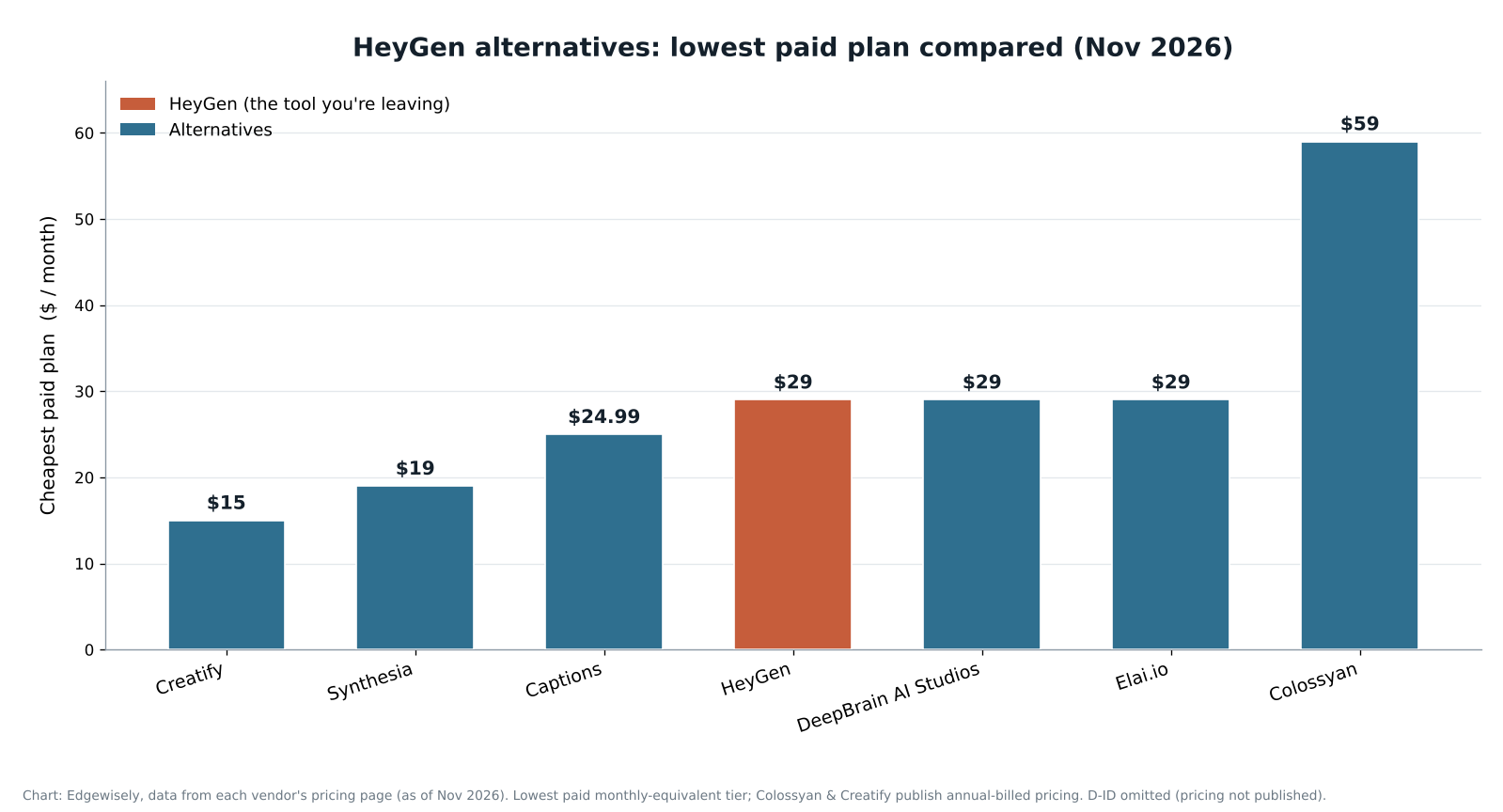
- Key entry prices (as of Nov 2026): Synthesia $19, Creatify $15, Captions $24.99, HeyGen $29, DeepBrain AI Studios $29, Elai $29, Colossyan $59 (lowest paid tier).
What are the best HeyGen alternatives?
HeyGen turns a script into a photoreal presenter speaking to camera. (For full-scene AI video rather than a talking head, see our best Sora alternatives.) Plenty of tools do the same thing, and several do one part of it better or cheaper.
Here are the HeyGen alternatives worth your time, grouped by what they actually win at.
Synthesia is the default pick if you're leaving HeyGen for something comparable. It targets the same corporate-video buyer, advertises 140+ languages and voices, and its pricing page claims it's trusted by "over 90% of Fortune 100 companies." Paid plans start at $19/mo (Starter), per synthesia.io/pricing as of November 2026.
Colossyan aims squarely at learning and development — SCORM export, quizzes, and course workflows that HeyGen treats as an afterthought. Its lowest paid tier runs $59/mo (Professional, billed annually), per colossyan.com/pricing.
D-ID is the developer's talking-head engine. Its Creative Reality API animates a still photo or avatar from audio, and it's built to be called at scale rather than clicked in a dashboard.
DeepBrain AI Studios advertises 2,000+ AI avatars and a cheap Personal plan at $29/mo ($24/mo annual), per aistudios.com/pricing. Elai.io is the small-team option with a public API on every paid plan, from $29/mo. Creatify and Captions chase a different job entirely — short ad and UGC-style avatar videos — and price accordingly.
Deep comparison table (as of November 2026)
| Tool | Best for | Starting price ($/mo)¹ | Languages (advertised) | Avatars (advertised) | Public API? | Free tier? |
|---|---|---|---|---|---|---|
| HeyGen | All-round avatar video | $29 (Creator) | 175+ | 700+ stock | Sold separately | Yes (3 videos/mo, watermark) |
| Synthesia | Enterprise & overall | $19 (Starter) | 140+ | 180+ (Pro) | Higher tiers | Yes (Basic, 10 min/mo) |
| Colossyan | Training / L&D | $59 (Professional) | 120+ | 300+ stock | Enterprise | Starter tier is free |
| D-ID | Developers / API | Not disclosed on page² | Not disclosed | Not disclosed | Yes (API-first) | Trial (watermark) |
| DeepBrain AI Studios | Avatar library size | $29 (Personal) | 70+ (voice) | 2,000+ | Not listed | Yes (3 videos/mo) |
| Elai.io | Small teams + API | $29 (Creator) | 75+ | 80+ | Yes (all paid) | Yes (1 min) |
| Creatify | Ad / UGC avatars | $15 (Standard) | 75+ | 1,500 actors | Separate API plan | Yes (10 credits) |
| Captions | Social / ad creative | $24.99 (Max) | 100+ (captions) | AI Twin | Not listed | Yes (no AI credits) |
¹ Lowest paid plan, monthly-equivalent; some vendors publish only annual billing. ² D-ID's pricing page loads dynamically and did not publish plan figures at fetch time; treat its pricing as "contact/verify in-app." All figures from each vendor's own pricing page, November 2026.
What's the best free HeyGen alternative?
There isn't a great free-forever avatar tool that matches paid quality — but two free tiers are real and usable.
Synthesia Basic gives you $0/mo, 500 credits, about 10 minutes of video a month, 9 avatars, and 140+ languages, per its pricing page. Videos carry a Synthesia watermark and cap at 3 minutes.
HeyGen's own Free plan is $0 with 3 watermarked videos per month, one custom avatar, and "30+ languages," per heygen.com/pricing. DeepBrain AI Studios matches that shape — 3 videos/month, up to 1 minute each, plus 12 one-time credits.
If "free" means no vendor at all, open-source talking-head models like SadTalker exist and cost nothing to run, but you self-host them and the output quality is well below a paid avatar tool. For most people, a watermarked free tier beats a weekend of GPU setup.
The honest read: free tiers are for testing, not production. Every one of them watermarks, and the commercial-use terms tighten the moment you want to publish.
Which HeyGen alternative has the most languages?
On advertised language count, HeyGen itself leads at 175+ languages and dialects — so if multilingual reach is your only reason to switch, you may not need to.
Among the alternatives, Synthesia advertises 140+ languages and voices, Colossyan claims 120+, and Captions advertises captions in 100+ languages. Elai.io and Creatify both cite 75+, and DeepBrain AI Studios lists 70+ voice languages plus 70+ for AI dubbing.
Two cautions. First, "languages supported" is a vendor claim, not a quality benchmark — a language in the dropdown isn't proof the accent, lip-sync, or pronunciation holds up. Second, counts mix text-to-speech languages with dubbing languages, which aren't the same feature. Synthesia, for example, lists 140+ for its avatars but only 70+ for dubbing.
For high-stakes localized video, pick two or three target languages and generate a real test clip before you commit a subscription. And since the voice sells the illusion as much as the face, many teams pair an avatar tool with a dedicated AI voice generator or the best TTS model.
HeyGen vs Synthesia: which wins?
This is the real fork for most buyers, so be specific about what you're optimizing.
Synthesia wins on governance. Its security page states it undergoes periodic SOC 2 Type II, ISO 27001, and ISO 42001 audits, and it leans hard on Fortune 100 adoption. If your video has to clear a security review, Synthesia is the safer procurement story. It's also cheaper to start: $19/mo vs HeyGen's $29/mo.
HeyGen wins on breadth and language count. It advertises 175+ languages, 700+ stock avatars, and a feature set (video agent, translation, interactive avatars) that moves fast. Its credit-based pricing — 600 credits on the $29 Creator plan, 1,500 on the $149 Business plan — buys more raw output if you generate constantly.
The uncomfortable truth: they're converging. Both sell polished studio avatars, both localize, both gate the good stuff behind credits and seats. For a solo creator, the deciding factor is often which free tier you tolerate; for an enterprise, it's which one clears your compliance checklist. If that checklist exists, Synthesia. If it doesn't and you want maximum languages and avatars, HeyGen.
Which HeyGen alternative has a developer API?
If you're building avatar video into a product, the dashboard tools aren't the point — the API is.
D-ID is the most API-native of the group. Its Creative Reality engine is designed to be called programmatically, and its docs note that API minutes draw from the same balance as the web app. It's the one most teams reach for when they need talking-head generation as an endpoint.
Elai.io is the friendliest for small builders: its comparison table marks public API access as included on every paid plan, starting at $29/mo (Creator). Creatify sells dedicated API plans — API Starter at $99/mo (500 credits) and API Pro at $299/mo (2,000 credits) — kept separate from its app credits.
HeyGen and Synthesia both have APIs, but sell them apart from the creator plans. HeyGen's pricing page links to a separate developer/API pricing page rather than bundling API access into Creator or Pro. Budget for that as a second line item.
For low-volume prototyping, Elai's bundled API is the cheapest way in. For production talking-head volume, D-ID is the category's purpose-built answer.
Who should use which?
Match the tool to the job, not the other way around.
- You run L&D or corporate training: Colossyan. SCORM, quizzes, and course structure are first-class, not bolt-ons.
- You need procurement-safe enterprise video: Synthesia. The SOC 2 / ISO 27001 / ISO 42001 audit trail is the product.
- You're a developer embedding avatars: D-ID for volume, Elai.io for a cheap bundled API.
- You make paid social ads or UGC: Creatify or Captions, which are built for short, hooky, actor-style spots — not boardroom explainers.
- You want the biggest avatar library on a budget: DeepBrain AI Studios (2,000+ avatars, $29/mo).
- You just want to test the idea for free: Synthesia Basic or HeyGen Free.
Our take
Here's the thesis most "best HeyGen alternatives" lists won't say out loud: HeyGen and Synthesia are converging on the same product, so the interesting decision was never HeyGen-vs-the-field. It's a three-way split — do you need enterprise governance, developer API volume, or the cheapest path to a talking head — and each pulls you toward a different tool. Pick the axis first; the tool falls out of it.
Start with what the pricing pages hide, because that's where the real cost lives. Almost every vendor in this category has quietly moved to credits, and credits are deliberately hard to translate into minutes. HeyGen's Creator plan lists 600 credits; Synthesia's Starter lists 1,250 credits/month; DeepBrain meters avatar export at roughly 9 credits per minute. None of those are comparable without doing arithmetic the vendor would rather you skip. When you see "credits," mentally convert to minutes of finished video at your actual resolution — and remember 4K export and longer clips burn credits faster. The headline price is the floor, not the bill.
The second hidden cost is commercial use and watermarks. Every free tier here watermarks, and several reserve watermark removal, commercial rights, or voice cloning for higher tiers or paid add-ons. Elai, for instance, sells voice cloning and selfie avatars as separate add-ons ($199–$500) rather than bundling them. If your plan is "make one video free and ship it," read the commercial-use clause before you build a workflow on it.
On the quality-vs-price reality: you are mostly paying for avatar realism and lip-sync, and that's where the money actually goes. The cheap ad-focused tools (Creatify, Captions) look great in a fast-cut 15-second vertical ad and noticeably worse in a static two-minute corporate explainer, because short UGC hides the tells. The premium tools (HeyGen, Synthesia) hold up longer in frame. So the price gap isn't arbitrary — it tracks how long the camera lingers on the face.
Which brings up where avatar video actually breaks, regardless of vendor. The uncanny valley is still real in long-form: 20 seconds is fine, two unbroken minutes of a presenter and viewers start feeling that something's off. Gestures remain the weak point — hands, posture shifts, and genuine emphasis are where synthetic presenters look synthetic. And long-form monologue is the worst case for every tool here; the realism budget is spent in the first half-minute. My blunt advice: script in short beats, cut away to b-roll or slides often, and never ask an avatar to carry five unbroken minutes. That single editing habit does more for perceived quality than switching vendors.
So where does each genuinely fit? Colossyan is the clearest "best for X" in the set — if you're building training, its L&D workflow is a real moat, and nobody else is close on SCORM and quizzing. Synthesia earns its enterprise premium specifically through the SOC 2 / ISO 27001 / ISO 42001 audit trail; that's not marketing, it's the thing that lets your video clear a security review, and it's worth real money to companies that need it. D-ID is the right answer for exactly one buyer — the developer who wants talking-head generation as an endpoint — and the wrong answer for everyone clicking around a dashboard. DeepBrain competes on avatar-library breadth and price, which matters if you want variety cheaply and can live with a thinner language count.
The verdict, stated as opinion: the best HeyGen alternative for most teams is Synthesia — it's cheaper to start, matches the quality, and wins the compliance argument HeyGen can't. The best HeyGen alternative for developers is D-ID. The best for training is Colossyan. Avoid the cheap ad-UGC tools (Creatify, Captions) if your real job is long-form corporate or educational video — they're optimized for a different shape of content, and you'll feel it at the two-minute mark. And if you're only switching for more languages, check HeyGen's own 175+ count first: you might not have a reason to leave at all.
Frequently Asked Questions
What are the best HeyGen alternatives?
The strongest HeyGen alternatives are Synthesia (enterprise-grade, from $19/mo, 140+ languages), Colossyan (training and L&D), and D-ID (an API-first talking-head engine for developers). DeepBrain AI Studios and Elai.io are solid budget picks at $29/mo. Your best choice depends on governance, languages, or API needs.
Is there a free alternative to HeyGen?
Yes. Synthesia's Basic plan is free with about 10 minutes of video monthly, 9 avatars, and 140+ languages. DeepBrain AI Studios offers a free tier with 3 videos per month. HeyGen itself also has a free plan. All free tiers add a watermark and limit commercial use, so treat them as testing tools, not production.
What is the best HeyGen alternative for multiple languages?
Synthesia advertises 140+ languages and voices, the widest count among the main alternatives, followed by Colossyan at 120+. For comparison, HeyGen itself advertises 175+ languages, so if language breadth is your only reason to switch, verify the alternatives beat it. Always test your specific target languages before committing, since counts are vendor claims.
HeyGen vs Synthesia: which is better?
Synthesia is better for enterprises that need governance — it holds SOC 2 Type II, ISO 27001, and ISO 42001 audits and starts cheaper at $19/mo. HeyGen is better for breadth, advertising 175+ languages and 700+ avatars at $29/mo. For regulated or large organizations, choose Synthesia; for maximum languages and avatars, choose HeyGen.
Is there a HeyGen alternative with an API for developers?
Yes. D-ID is the most API-first option, built to generate talking-head video programmatically at scale. Elai.io includes a public API on every paid plan from $29/mo, and Creatify sells dedicated API plans from $99/mo. HeyGen and Synthesia both offer APIs but price them separately from their standard creator plans.
Editor's note — sources: Prices, language counts and avatar figures verified November 2026 on each vendor's own pricing page: HeyGen, Synthesia, Colossyan, DeepBrain AI Studios and Elai.io; Synthesia's audit claims are from its security page. D-ID's pricing page did not render plan figures at access time and is marked "not disclosed." Advertised language counts are vendor marketing claims, not quality benchmarks.