
Top 7 Object Storage Providers (S3 Alternatives) 2026
The best object storage providers and S3 alternatives for 2026, compared on S3 compatibility, egress fees and real pricing: Amazon S3, Cloudflare R2, Backblaze B2, Wasabi, MinIO, Google Cloud Storage and Ceph.

TL;DR
- Object storage keeps data as objects in a flat namespace behind an HTTP API — the model behind Amazon S3 and nearly every cloud backup, data lake, and media store. Most providers now speak the S3 API, so switching is mostly a config change.
- The big 2026 story is egress fees: Cloudflare R2, Backblaze B2, and Wasabi charge little or nothing to pull data out, while AWS and Google Cloud charge roughly $0.09–$0.12/GB after a small free tier.
- Headline storage prices (as of November 2026): R2 $0.015/GB-mo, Backblaze B2 $6.95/TB-mo, Wasabi $7.99/TB-mo, S3 Standard ~$0.023/GB-mo, Google Cloud Storage ~$0.02/GB-mo. Both zero-egress players raised prices in 2026.
- MinIO's open-source edition is effectively dead — its GitHub repo was archived in April 2026 — so self-hosters should look hard at Ceph instead.
Object storage stores data as discrete objects (file plus metadata plus a unique ID) in a flat namespace, accessed over HTTP rather than a file path or block device. It's what sits under cloud data lakes, backups, media libraries, and AI training sets. Amazon S3 defined the category and its API, and the strongest alternatives — Cloudflare R2, Backblaze B2, Wasabi, MinIO, Google Cloud Storage, and Ceph — are judged largely on S3 compatibility, pricing (especially egress), and whether you want a managed service or to self-host. Here are seven object storage providers worth evaluating in 2026, ranked by maturity, ecosystem, and cost model, with real pricing and honest trade-offs.
How we picked these
We ranked on S3-API compatibility (how cleanly existing tooling works), cost model (storage price, and crucially egress and operation fees), maturity and ecosystem ( hyperscaler services, integrations, track record), and deployment fit (managed SaaS versus self-hosted open source). We cite vendor-published pricing with the date observed and attribute durability numbers as the vendors' own claims. Rankings are editorial judgment; we make no claim of sponsorship or paid placement. Prices and features are as of November 2026 and change often — verify on each provider's pricing page before committing.
Quick comparison
| Provider | Best for | Deployment | Pricing model |
|---|---|---|---|
| Amazon S3 | AWS-native, full feature set | Managed (proprietary) | Per-GB + requests + egress |
| Cloudflare R2 | Egress-heavy / edge apps | Managed (proprietary) | Per-GB, zero egress |
| Backblaze B2 | Cost-sensitive backup/archive | Managed (proprietary) | $/TB, 3x free egress |
| Wasabi | Predictable flat-rate hot storage | Managed (proprietary) | Flat $/TB, no egress fee |
| MinIO | On-prem AI (enterprise AIStor) | Self-hosted / commercial | Free tier + quote-only |
| Google Cloud Storage | GCP-native analytics/AI | Managed (proprietary) | Per-GB + requests + egress |
| Ceph | Self-hosted unified storage | Open source (self-hosted) | Free (OSS) |
1. Amazon S3
Amazon S3 is the benchmark against which every other provider is measured — it defined the object storage API that most competitors now implement. AWS designs it for 11 nines of durability (its claim) and backs it with the deepest ecosystem of integrations, storage classes, and AI/analytics features.
Recent additions matter: in December 2025 AWS raised the maximum object size from 5 TB to 50 TB, and at re:Invent 2025 it brought S3 Vectors to general availability for storing embeddings, alongside S3 Tables for analytics. Express One Zone offers single-digit-millisecond latency for hot workloads.
Best for: AWS-native workloads that need the full feature set and ecosystem.
Pros - The de facto standard API with the broadest tooling and service integrations. - Widest range of storage classes (Express One Zone, Intelligent-Tiering, Glacier tiers). - 50 TB objects plus native Vectors and Tables for AI and analytics pipelines.
Cons - Internet egress runs roughly $0.09/GB after the first 100 GB/month free. - Pricing is complex: tiers, request charges, and minimum-duration fees (30/90/180 days for colder classes). - Deep AWS lock-in for the full feature set.
2. Cloudflare R2
Cloudflare R2 is the provider that forced the egress conversation. It's S3-compatible and charges zero egress fees, which flips the economics for any workload that serves a lot of data out — media, AI inference, multi-cloud pipelines. Cloudflare designs it for 11 nines of durability (its claim) with a 99.9% availability SLA.
As of November 2026, R2 Standard is $0.015/GB-month with Class A operations at $4.50/million and Class B at $0.36/million, plus an Infrequent Access tier. A free tier covers 10 GB and a few million operations monthly. R2 reached general availability in September 2022.
Best for: Egress-heavy and edge/Workers workloads.
Pros - Zero egress fees — the headline advantage for data-out-heavy apps. - S3-compatible API with a usable free tier. - Low $0.015/GB storage and tight integration with Cloudflare Workers.
Cons - Narrower storage-class and enterprise feature set than S3. - Region placement is always "auto," giving you little control over data location. - Operation (Class A/B) fees add up at very high request volumes; IA adds a 30-day minimum and retrieval fee.
3. Backblaze B2
Backblaze B2 is the transparent, low-cost option, backed by a publicly traded company (NASDAQ: BLZE) that documents its storage architecture openly. It's S3-compatible and uses Reed-Solomon erasure coding across its storage pods, with 11 nines of durability (its calculated claim).
As of November 2026, B2 is $6.95/TB-month (about $0.00695/GB) after a 16% increase on May 1, 2026. Egress is free up to 3x your average monthly storage, then $0.01/GB, and free to partner clouds like Cloudflare and Fastly. There are no minimum object-size or minimum-retention fees. Its cloud-storage revenue grew 47% year over year in Q3 2026.
Best for: Cost-sensitive backup, archive, media, and AI egress to partner clouds.
Pros - Lower $/TB than the hyperscalers, with no minimum retention or object-size fees. - Free egress up to 3x stored data, and free egress to CDN/compute partners. - Public company with transparent pricing and openly documented architecture.
Cons - Free egress is capped at 3x stored data; beyond that it's $0.01/GB. - Fewer regions and managed services than the hyperscalers. - Storage price rose 16% in May 2026.
4. Wasabi
Wasabi sells simplicity: hot-by-default storage at a flat per-terabyte price with no egress, API-request, or retrieval fees. For teams that got burned by surprise AWS egress bills, the predictability is the selling point. Wasabi claims 11 nines of durability and 16 regions.
As of November 2026, Wasabi pay-as-you-go is $7.99/TB-month (up about 14% effective July 1, 2026). The catch is on the terms, not the rate: there's a 90-day minimum storage duration and a minimum charge equivalent to 1 TB of active storage per account. Reserved-capacity plans (minimum 25 TB) are quote-only. Wasabi raised $70M in early 2026.
Best for: Predictable, flat-rate hot backup and archive without egress surprises.
Pros - No egress, API, or retrieval fees on any plan. - Flat, predictable per-terabyte pricing. - Object Lock (WORM) and tight integrations with Veeam, Commvault, and other backup tools.
Cons - 90-day minimum storage duration — deleting data early still bills for 90 days. - A minimum monthly charge tied to 1 TB of storage, which hurts very small accounts. - At $7.99/TB it's now pricier than Backblaze's $6.95/TB.
5. MinIO
MinIO is the influential, high-performance, S3-compatible object store written in Go — but in 2026 it comes with a serious caveat. After stripping the admin console from the community edition in mid-2025 and halting pre-built binaries, MinIO archived its open-source GitHub repository on April 25, 2026, marking it no longer maintained.
The active product is now AIStor: a free tier exists but is single-node and prohibits redistribution, while multi-node Enterprise and Lite tiers are commercial and quote-only (priced per usable capacity). MinIO still shines technically — erasure coding, bitrot protection, and auto-heal — but new open-source self-hosting is no longer the path it was.
Best for: Enterprises buying AIStor for on-prem AI storage — not new open-source deployments.
Pros - S3-compatible, high-performance object store with erasure coding and bitrot protection. - AIStor targets on-prem AI workloads with multi-node enterprise support. - The AGPLv3 source still exists and can be forked.
Cons - The community edition is archived and no longer maintained — no upstream patches. - Free AIStor is single-node and bars redistribution. - Console features moved behind the paid tier in 2025 without a changelog warning, and binaries stopped shipping.

6. Google Cloud Storage
Google Cloud Storage is the hyperscaler alternative to S3 for teams building on GCP, with strong multi-region options and AI/ML tie-ins. Google designs all classes for at least 11 nines of annual durability (its claim), and offers single-, dual-, and multi-region buckets with turbo replication.
As of November 2026, Standard storage in Iowa is about $0.02/GiB-month. The weak point is egress: internet egress starts at $0.12/GiB (0–10 TiB) — the highest first tier among the managed providers here. Rapid Cache (a managed SSD read cache) and Cloud Storage FUSE target AI/ML pipelines that read the same data repeatedly.
Best for: GCP-native analytics and AI/ML workloads.
Pros - Strong dual- and multi-region bucket options with turbo replication SLAs. - Rapid Cache and FUSE support for AI/ML read patterns. - Designed for 11 nines durability across all storage classes (vendor claim).
Cons - Highest first-tier internet egress of the managed group at $0.12/GiB. - GCP lock-in for the full feature set. - S3 compatibility is via an interoperability layer rather than native.
7. Ceph
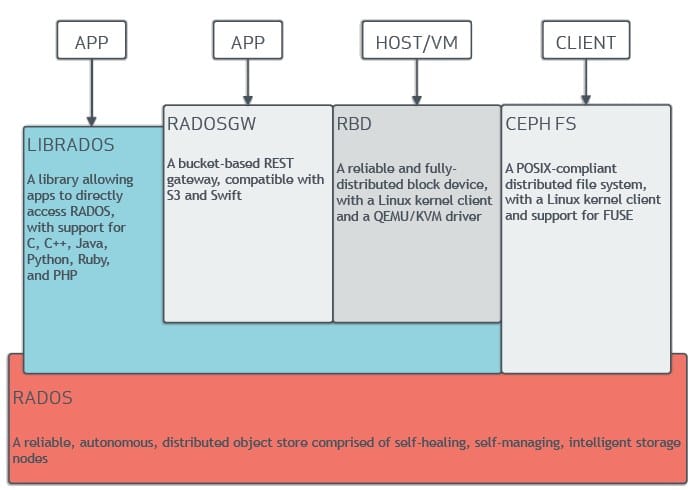
Ceph is the leading open-source answer for teams that want to own their storage. It's a unified system — object, block, and file on one RADOS cluster — and its RADOS Gateway (RGW) implements a large subset of the S3 API. It's licensed mostly under LGPL, so there's no single-vendor license risk.
Ceph releases steadily (the Tentacle v20.x line shipped in 2026), and IBM Storage Ceph 9.0 reached GA in January 2026 for teams wanting commercial support. Governance runs through the Ceph Foundation under the Linux Foundation. The trade-off is operational: Ceph is powerful but demands in-house expertise.
Best for: Self-hosted, large-scale, or private-cloud storage with in-house engineering.
Pros - Open source under LGPL — no single-vendor license risk. - One cluster serves object (S3), block (RBD), and file (CephFS) storage. - Active governance, regular releases, and commercial support via IBM.
Cons - Operationally complex; needs dedicated storage expertise to run well. - S3 compatibility is a "large subset," not full API parity. - No first-party managed service — support comes through IBM/Red Hat.
How to choose
If you're already on AWS or GCP: stay native (S3 or Google Cloud Storage) for the ecosystem and feature depth — unless egress is your dominant cost, in which case look hard at the alternatives below.
If you serve a lot of data out: Cloudflare R2's zero egress or Backblaze B2's 3x free egress will cut bills dramatically versus hyperscaler egress at $0.09–$0.12/GB. R2 suits edge and Workers apps; B2 suits backup and media.
If you want predictable bills: Wasabi's flat per-terabyte, no-egress model is the simplest to forecast — just mind the 90-day minimum retention and 1 TB minimum charge.
If you need to self-host: Ceph is now the safer open-source bet given MinIO's archived community edition. Budget for the operational expertise it requires.
If you're building AI/data pipelines: S3 (Vectors, Tables, 50 TB objects) and GCS (Rapid Cache, FUSE) lead on AI-specific features; pair either with a zero-egress tier for cheap data movement. Object storage is the foundation under your cloud data warehouse and database migration workflows, so weigh how each integrates with the rest of your backend platform.
Frequently Asked Questions
What is object storage?
Object storage manages data as discrete objects — each combining the file, its metadata, and a unique identifier — in a single flat namespace accessed over an HTTP API rather than a file hierarchy or block device. It scales to billions of objects and petabytes cheaply, which makes it the standard foundation for cloud backups, data lakes, media libraries, and AI training data.
How does object storage work?
Instead of a folder tree, object storage puts every object in a flat pool (a "bucket") with a unique key. Applications read and write over HTTP, almost always via the S3 API. Behind the scenes the system spreads data across many disks using replication or erasure coding for durability, and stores rich metadata with each object so it can be indexed and searched at scale.
Is S3 block or object storage?
Amazon S3 is object storage. It stores data as objects in buckets, accessed over an HTTP API by key. AWS's block storage product is a different service, EBS (Elastic Block Store), which presents raw volumes to EC2 instances. S3 is for scalable, durable storage of files and unstructured data; block storage is for low-latency volumes attached to a single server.
What's the cheapest object storage?
Among managed providers in November 2026, Backblaze B2 ($6.95/TB-month) and Cloudflare R2 ($0.015/GB-month, ~$15/TB) are the cheapest for storage, and both keep egress low or free. Wasabi is $7.99/TB flat with no egress fee. Self-hosting Ceph is "free" in licensing but carries real hardware and operational costs. The cheapest overall depends heavily on how much data you move out.
Are object storage providers S3-compatible?
Most are. Cloudflare R2, Backblaze B2, Wasabi, MinIO, and Ceph's RADOS Gateway all implement the S3 API, so existing S3 SDKs and tools usually work with a config change. Compatibility isn't always complete — Ceph supports a "large subset" of the API — so test your specific operations (multipart uploads, lifecycle rules, Object Lock) before migrating.
Editor’s note — sources: Vendor pricing and product pages for Amazon S3, Cloudflare R2, Backblaze B2, Wasabi, MinIO, Google Cloud Storage and Ceph; Backblaze and Wasabi 2026 pricing-change posts; the MinIO GitHub repository (archived April 2026); and IBM Storage Ceph release notes. Prices observed November 2026; durability figures are vendor claims.